InfiniSynapse Vibe Coding Hackathon 2026
Hackathon Prizes: $900, $600, and $300 Cash
Hackathon prizes total $3,000: one award of $900, two of $600, and three of $300. Payout timing and tax handling are not published on the event page yet.
By InfiniSynapse · Last updated October 2, 2026
1st Global Edition
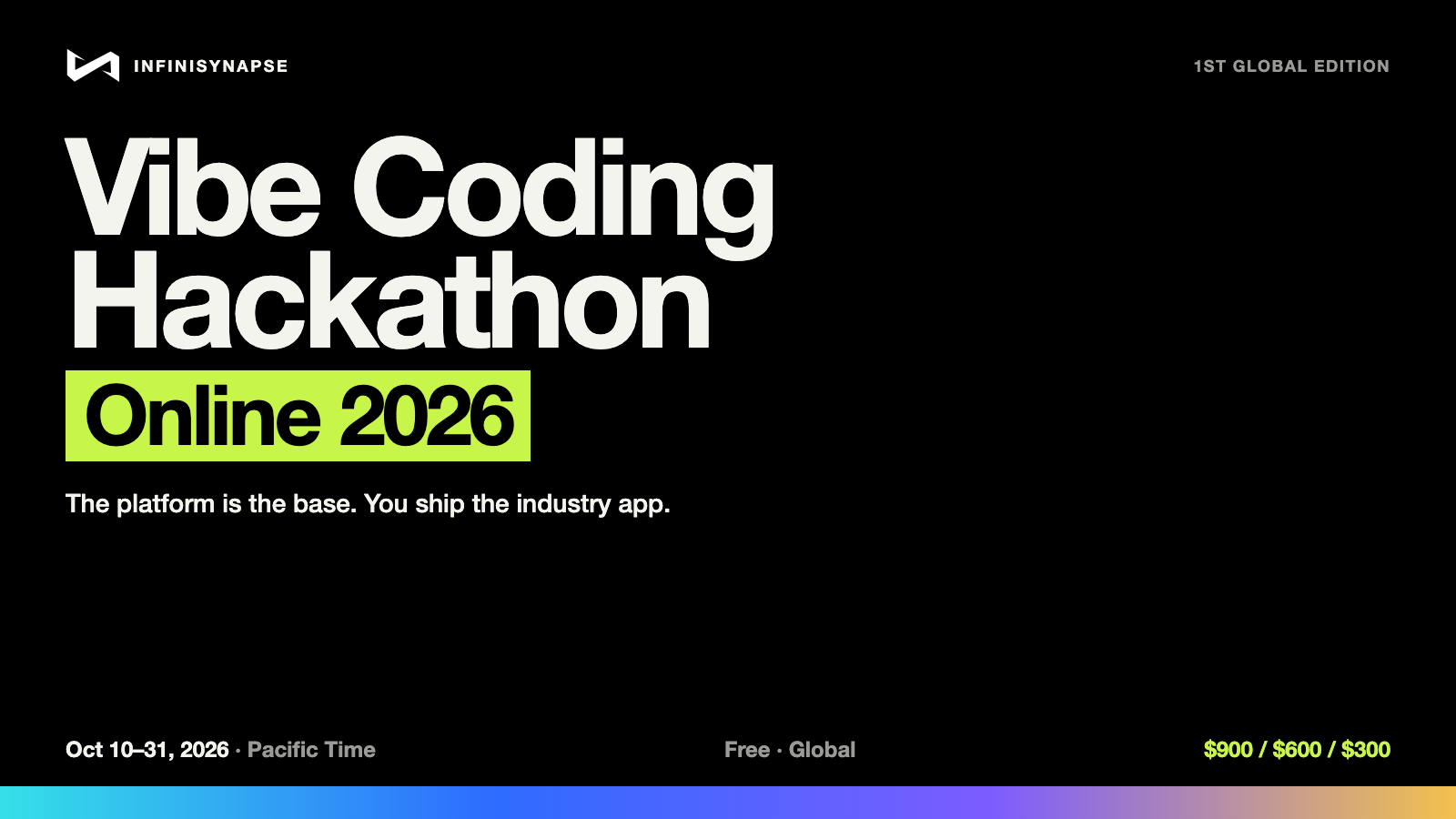
Vibe CodingHackathon
Online 2026
Oct 10–31, 2026 · Pacific Time
Free · Global
$900 / $600 / $300
Prize pool
$3,000
| Place | Award | Seats |
|---|---|---|
| 1st | $900 | 1 |
| 2nd | $600 | 2 |
| 3rd | $300 | 3 |
Repository stars are not part of the score.
TL;DR
Hackathon prizes for the InfiniSynapse Vibe Coding Hackathon 2026 total $3,000. One award is $900, two awards are $600, and three awards are $300. That is six cash seats. The event is online and free. InfiniSynapse hosts it. The build window runs October 10, 2026, 12:00 AM through October 31, 2026, 11:59 PM Pacific Time. In that window Pacific Time is PDT, UTC−7. The open is 07:00 UTC on October 10. The close is 06:59 UTC on November 1.
Hackathon prizes do not change what you ship. A reviewer still needs a working web, mobile, or desktop app. Slide-only pitches, notebooks without an app, fake JSON, and a generic chat box on a spreadsheet are outside the rewarded set. Six tracks are starting points for one registration: Education, Retail & Replenishment, Hit-product Analysis, SMB Operations, Growth for Operators, and Open Industry. Judging is scenario value 40%, technical completeness 35%, and innovation 25%. GitHub stars are not scored. William Zhu, Co-founder of InfiniSynapse, is the confirmed judge. Payout timing and tax handling are not published. The event page has not published age, region, or team-size rules. A submission deadline separate from the build window is not published. Capacity is not published. Register only on Luma. Hackathon prizes stay at those six amounts until the event page says otherwise.
The published cash pool
Hackathon prizes on this page are cash, in the amounts above, for a working app. A prize, in the ordinary sense, is something awarded for a result. The result here is an app an operator can try. The Wikipedia page is a definition, not a payout notice.
One seat at $900
One seat pays $900. It is a single place, not a split you can infer. Hackathon prizes do not publish a rule for dividing that seat across names. Team size is not published on the event page, so do not assume the $900 is per person or per group.
The $900 seat is still the same brief as the smaller seats. Scenario value, completeness, and innovation do not grow because the dollar figure is larger. Hackathon prizes keep one rubric for every seat.
A reviewer looking at that seat still opens one client. They look for a person they can name, fields they can see, and a verb they can imagine doing this week. A larger dollar figure does not replace a missing field. If the screen says "revenue is down" and never shows the period, the source, or the next move, the seat has nothing solid to attach to. Write the period on the screen: this week, this cohort, this promotion.
Two seats at $600 and three at $300
Two seats pay $600 each. Three seats pay $300 each. Together with the $900 seat, that is six awards. Hackathon prizes list no seventh amount and no bonus pool.
How the six seats add up
900 + 600 + 600 + 300 + 300 + 300 = 3,000. Hackathon prizes match that arithmetic on the event page. If a screenshot elsewhere shows a different total, use the page that states $3,000 and these six seats.
| Place | Award | Seats | Subtotal |
|---|---|---|---|
| First | $900 | 1 | $900 |
| Second | $600 | 2 | $1,200 |
| Third | $300 | 3 | $900 |
| Pool | 6 | $3,000 |
What the pool does not buy
The pool does not buy a different artifact. Hackathon prizes still require a working web, mobile, or desktop app. They do not pay for a slide deck, a notebook with no app, fake JSON, or a generic chat window on a spreadsheet. They also do not score GitHub stars.
What the page does not say about money
Read the blanks before you plan a date or a tax line. Hackathon prizes publish amounts. They do not publish a calendar for payment or a tax treatment.
Payout timing is unpublished
Payout timing is not on the event page. Hackathon prizes therefore do not support a sentence like "you will be paid on this date." Wait for official payout terms. A winner date is not published either, and judging dates are not published. Do not fill those blanks from a typical contest calendar.
Tax handling is unpublished
Tax handling is not published. This guide does not give tax advice. Winners should wait for the official payout terms. For general context only, public agency pages exist, and they are not this event's payment notice.
Public agency pages are context only
The IRS pages for small businesses and self-employed people are a public starting point for general tax context in the United States. The USA.gov taxes overview points at official tax information for the public. The Consumer Financial Protection Bureau publishes general consumer information. None of those pages states how these seats are paid, withheld, or reported. Hackathon prizes on this site stop at the six amounts. If you need a filing answer, use the official payout terms when they exist, and a qualified adviser, not this article.
What you still have to ship
Cash follows the app. The event page states the same delivery bar the seats sit on. Hackathon prizes are not a separate contest with a looser artifact.
A working app, not a pitch
Ship one client a reviewer can open. Name the operator, show the fields, and end on a next step. The Vibe Coding Guide is the product guide for the build. Register only at the official Luma listing. This page does not publish a Discord invite. Entry is free. There is no second form. Hackathon prizes are attached to that one registration, not to a second signup.
Web, mobile, or desktop all qualify. One surface is enough. Pick the screen the operator already uses on a Monday. Hackathon prizes do not require three clients.
Forms that sit outside the pool
A deck can explain the person and the question. It cannot replace the app. A notebook can help you explore rows. The rewarded form still needs an application around that work. Static JSON that pretends to be a live path is outside the brief. So is a chat box dropped on a CSV with no named user and no next verb. Hackathon prizes have no published partial award for those forms.
Canned JSON usually fails a simple edit test. Change a lead time or a completion rate and the recommendation should move, or the screen should say why it stayed put. A file that always returns the same three rows is a picture of a workflow. Keep the notebook if you used it to find the pattern. Wrap the pattern so a coordinator who did not write the cells can ask the same question. Put the chart beside the verb, not in a file the reviewer never opens.
Tracks that can win a seat
Any of the six tracks can be the scene for a seat. Tracks are starting points. They are not six pools and not six registrations. Hackathon prizes stay one pool of $3,000.
Six starting points
| Track | Operator | Decision the app should support |
|---|---|---|
| Education | School or training provider | Where to intervene, or which course to change |
| Retail & Replenishment | Store operator | Reorder now, wait, or raise a SKU's priority |
| Hit-product Analysis | Merchandiser | Restock, feature, or watch a product that jumped |
| SMB Operations | Small-business operator | The next operational move the numbers support |
| Growth for Operators | Small team | The channel worth the next week of effort |
| Open Industry | An operator you can name | A next step that person repeats |
Use fields you are allowed to use, or a synthetic set labeled on the screen. The event page has not published a shared dataset. Education can show enrollment, attendance or completion, and assessment results. Retail can show on-hand units, recent sales, and supplier lead time. Hackathon prizes do not add a data-format rule beyond a path a reviewer can try.
An illustrative education direction
This is an illustrative direction, not a customer case study, and it does not promise a product capability beyond the public docs. Question: which courses lose learners before they finish? Input: a roster with attendance and completion, labeled synthetic if you built it. Output: courses ordered by drop-off, plus one suggested follow-up. A reviewer opens that follow-up from the roster. The same shape can sit under any seat amount. Hackathon prizes do not reserve the $900 seat for a particular track.
A store floor can use a parallel direction, also illustrative, not a case study. Question: what is about to stock out this week? Input: units on hand, recent sales, and lead time. Output: a short reorder list with one reason on each line. The reason has to come from those fields.
Hit-product work asks a different question on the same kind of table: why did this item jump, and should you restock, feature, or watch. Show sales over time, the category, and any price or promotion flag you are allowed to use. SMB operations lines up orders, costs, and sales for one period so the next operational move is visible. Growth lines up visits or leads by channel, a conversion event, and repeat activity, then names the channel worth the next week. Open Industry is the same four parts when none of those scenes fit: user, data, analysis, action. None of these sketches is a customer story. They are directions you can demo.
The October window and free entry
The window opens October 10, 2026, at 12:00 AM Pacific Time and closes October 31, 2026, at 11:59 PM Pacific Time. That close is 06:59 UTC on November 1. A submission deadline separate from the window is not published. Hackathon prizes do not add a later money deadline. Capacity is not published, so the six seats are awards, not a cap on how many people may register.
Age, region, and team size are not published on the event page. Until they are, they are not rules you can treat as official. Hackathon prizes do not smuggle those limits in through the seat table.
How the score sits next to the cash
Dollars are the award. Points are the rubric. Keep them apart when you decide what to build. Hackathon prizes do not list a fourth weight called "prize size."
Weights that do not mention dollars
Scenario value is 40%. Technical completeness is 35%. Innovation is 25%. The write-up of those weights is hackathon judging. Tie-break rules are not published. William Zhu, Co-founder of InfiniSynapse, is the confirmed judge. A longer judge list is not published here. Hackathon prizes do not change his confirmation or the three percentages.
The wider rules page for entry, the window, and the blanks is the hackathon competition guide. Read it when you want the frame around the cash. Hackathon prizes on this page stay with the six amounts.
Rehearse in the order of the weights. First, can a stranger name the operator and the week? Second, can they change one input and see the result follow? Third, is there a choice a stock layout would not have made, such as a reason code tied to a figure? If the first answer is no, more chart types will not repair the seat. If the second answer is no, the app is not complete yet. If the third answer is no, you may still have a clear scenario and a working path, and the 25% is the slice left thin. Fix the thin slice on the same screen. Do not open a second document to explain it.
Stars that do not move a seat
GitHub stars are not scored. A popular repository does not move you toward $900, and a quiet one does not push you toward $300 or off the list. Spend the window on the operator, the fields, and a client a reviewer can open. Hackathon prizes ignore star counts.
If two builds are close, you still cannot look up a star tie-break. It is not published. Choose the feature that makes the scenario easier to recognize. Hackathon prizes will not consult a popularity chart.
A quiet repository is not a penalty. Spend that attention on labels a reviewer can read without your narration: the operator, the period, the fields, the result, and one verb. Those five labels are how a seat becomes discussable. A README that repeats them is fine as a note. The labels still have to appear in the client. If you are unsure which verb to show, pick the one the operator would do before Friday, and show the figure that supports it.
Questions about the awards
Is the pool larger than $3,000?
No figure above $3,000 is published. The seats are one at $900, two at $600, and three at $300. Hackathon prizes do not list merchandise, credits, or a second pool on this page.
When is the money paid?
Payout timing is not published. A winner announcement date is not published. Wait for official payout terms. Hackathon prizes do not imply a pay date from the October close.
Does a star count raise a seat?
No. Stars are outside the score. They do not raise a $300 seat to $600 or a $600 seat to $900. Hackathon prizes follow the rubric, not a repository chart.
Are taxes explained on the event page?
Tax handling is not published. This page does not give tax advice. Public agency pages can supply general context. They are not the payout terms. Hackathon prizes should be read as amounts only until those terms exist.
Who may enter?
Age, region, and team size are not published on the event page. Capacity is not published. Entry is free and online. Register only on the Luma listing. Hackathon prizes do not add an eligibility table this page does not have.