InfiniSynapse Vibe Coding Hackathon 2026
Hackathon Ideas You Can Demo for an Operator
Hackathon ideas here start from six published tracks and end in one operator action. Education, retail, hit products, operations, and growth are the starts.
By InfiniSynapse · Last updated October 2, 2026
1st Global Edition
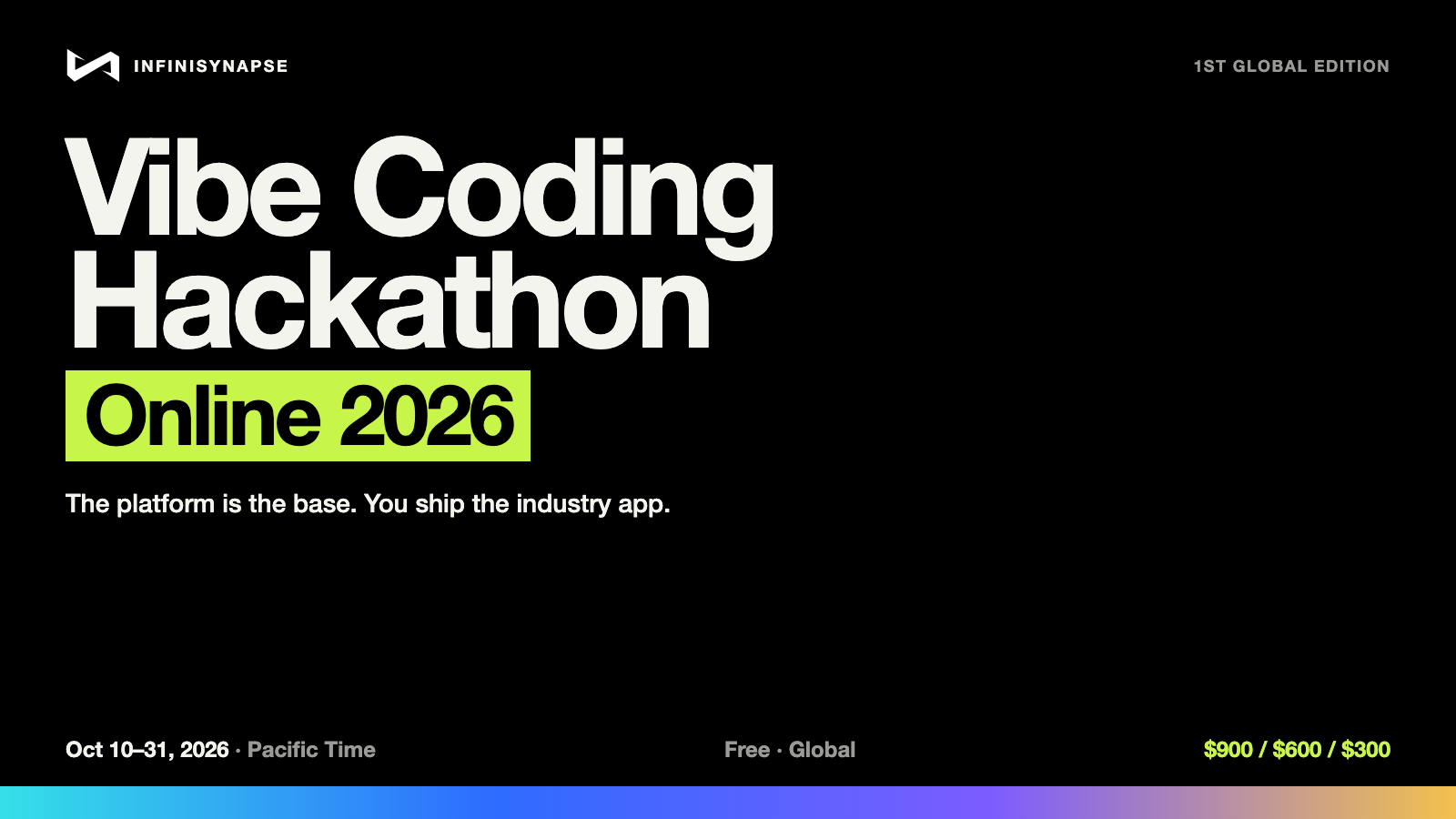
Vibe CodingHackathon
Online 2026
Oct 10–31, 2026 · Pacific Time
Free · Global
$900 / $600 / $300
01
Education
Schools and training providers who cannot see learner engagement, course results, or how seats and tutors are used.
Question Which courses lose learners before they finish?
02
Retail & Replenishment
Store operators deciding when to reorder and which items matter first.
Question What is about to stock out this week?
03
Hit-product Analysis
Merchandisers who need the reason a product is selling, not only a bestseller list.
Question Why did this product jump, and should we reorder it?
04
SMB Operations
Operators of a small business whose sales, costs, and orders live in separate places.
Question Which orders are eating margin?
05
Growth for Operators
A small team that cannot see which channel, conversion step, or retention pattern is worth their time.
Question Which channel should we spend the next week on?
06
Open Industry
Any operator you can name, in a setting the other tracks do not cover.
Question What decision does this operator repeat every week?
TL;DR
Hackathon ideas for the InfiniSynapse Vibe Coding Hackathon 2026 start from six published tracks and end in one action an operator can try. InfiniSynapse hosts the event. It is online and free. The build window is October 10, 2026, 12:00 AM through October 31, 2026, 11:59 PM Pacific Time. During that window Pacific Time is PDT, UTC−7. Hackathon ideas on this page are not slide topics. They are working web, mobile, or desktop apps.
The six starts are Education, Retail & Replenishment, Hit-product Analysis, SMB Operations, Growth for Operators, and Open Industry. They are one registration, not six. The cash pool is $3,000: one prize of $900, two of $600, and three of $300. Judging is scenario value 40%, technical completeness 35%, and innovation 25%. GitHub stars are not scored. William Zhu, Co-founder of InfiniSynapse, is a confirmed judge. The event page has not published age, region, or team-size rules. Register only on Luma. Every hackathon ideas row below is an illustrative direction, not a customer case study.
Start from a track, end on an action
Hackathon ideas that a reviewer can score name a person, a question, the fields, and a verb. A theme with no verb is a poster.
One registration, six scenes
Register once. Then pick a scene. The event page already lists who each track is for, which data it needs, and what the demo must show. Hackathon ideas that try to cover all six tracks in one app usually finish none of them. The form a reviewer can open is described in projects a reviewer can open and try. If the path includes a model, the sibling page is ideas that already assume a model in the path.
The four parts every idea needs
A decision support system is an information system that helps someone choose an action from data. That is the family these builds sit in. Hackathon ideas here do not need a textbook architecture. They need the four parts on one screen.
Operator
Write the job title and the weekly pain. A course coordinator who cannot see which class loses learners. A buyer who cannot see which SKU will stock out. A merchandiser who has a bestseller list and no reason. An owner whose orders, costs, and sales live apart. A small team that cannot tell which channel deserves the next week. Hackathon ideas get sharper when that person is one human, not "users."
Fields and a verb
List the columns the decision actually uses. End on a verb: contact, reorder, feature, watch, review, or assign. If the verb needs a number, show the number beside it. Hackathon ideas that hide the number behind a paragraph are harder to try.
Education and retail
Hackathon ideas in these two tracks are the easiest to demo because the input file is a table a reviewer understands in a minute.
Courses and follow-up
Educational data mining is the public name for analyzing learning data to understand students, courses, and outcomes. You are not writing a research paper. You are shipping an app. Hackathon ideas for Education use enrollment, attendance or completion, the course list, and assessment results you are allowed to use, or a clearly labeled synthetic roster.
Illustrative direction, not a case study: question, which courses lose learners before they finish? Input, a roster with attendance and completion. Output, courses ordered by drop-off, plus a suggested follow-up for the worst ones. The follow-up might be "contact the cohort in week three of course A" with the completion gap printed next to the sentence. Hackathon ideas in this track fail when they stop at a bar chart of averages.
Stock and reorder priority
Inventory is the stock a business holds to meet demand. A replenishment screen turns that stock, recent sales, and supplier lead time into a short list. Hackathon ideas for Retail & Replenishment should answer what is about to stock out this week and suggest an order priority. Reorder, wait, or raise a SKU. One of those three verbs is enough.
An illustrative pair
Illustrative direction, not a case study: on-hand units, unit sales for the last four weeks, and lead time in days. The app ranks SKUs by stockout risk and marks the top five "reorder now." A second illustrative direction on the same file, still not a case study: if lead time is longer than the days of cover, the row moves up even when recent sales are modest. Show both inputs so a buyer can disagree. Hackathon ideas that output only a score, with no unit and no verb, leave the buyer where they started.
Hit products, operations, and growth
Hackathon ideas in the middle tracks explain a change and then pick a move. A ranking alone is not the demo.
Why a product jumped
Hit-product analysis is for a merchandiser who needs the reason a product is selling, not only a bestseller list. Fields: sales over time, category, and a price or promotion flag you are allowed to use. The decision is restock, feature, or watch. Hackathon ideas here should tie the jump to one of those three. Illustrative direction, not a case study: units by week, category, and a promotion flag. Output: the change behind the jump, and a restock or watch recommendation. If the jump lines up with the flag, say so on the row. If it does not, say that too.
Margin and the next operational move
SMB Operations is for an owner whose sales, costs, and orders sit in different places. The SBA business guide is a public primer on planning, launching, and managing a small firm in the United States. It is not a sponsor of this event and it is not a data source you must use. Hackathon ideas for this track still need orders, costs, and sales for the same period, then one operational move those figures support.
Illustrative direction, not a case study: order lines with revenue and cost. Output: the orders to review first, and what to do about them, such as renegotiate, reprice, or stop. Print the margin next to the verb. Hackathon ideas that say "improve operations" without an order id are not done.
One channel for the next week
Growth for Operators is a small team choosing among channels, conversion steps, or retention patterns. Fields: leads or visits by channel, conversion events, and repeat activity. The demo is one recommended focus and the metric behind it. Hackathon ideas for growth should refuse a dashboard of twelve charts. Illustrative direction, not a case study: channel, visits, and conversions. Output: a ranked focus and the conversion gap that justifies it. The verb is where to spend the next week, not a slogan about awareness.
Open industry and the score
Hackathon ideas that do not fit the five rows still have to close the same loop.
When the five rows do not fit
Open Industry is any operator you can name. Define the user, the data, the analysis, and the action. Illustrative direction, not a case study: a clinic office manager repeats a weekly staffing decision from appointment volume and no-show rates. The app lists the sessions to rebalance and the reason. If you cannot name the person and the weekly decision, pick a published track instead. Hackathon ideas in Open Industry are judged on that loop, not on how unusual the industry sounds.
Weights, cash, and stars
Real-world scenario value is 40%. Technical completeness is 35%. Innovation is 25%. A specific operator raises the first weight. A running client with visible fields raises the second. A useful twist on the path raises the third. GitHub stars are not part of the score. The pool is $3,000: one prize of $900, two of $600, and three of $300. Payout timing and tax handling are not published. William Zhu, Co-founder of InfiniSynapse, is a confirmed judge. Judging dates and a winner announcement date are not published. Hackathon ideas are not ranked by stars or by how many tracks you mention.
| Place | Award | Seats |
|---|---|---|
| First | $900 | 1 |
| Second | $600 | 2 |
| Third | $300 | 3 |
Clock, signup, and blanks
Hackathon ideas still have to fit the published window. A clever scene that is not runnable by the close is a note, not an entry.
The October window
Build from October 10, 2026, at 12:00 AM Pacific Time through October 31, 2026, at 11:59 PM Pacific Time. That is 22 calendar days, inclusive. Free tickets on the current Luma listing open on October 10. An earlier open date is not published. A later submission date is not published. There is no submit button until an official entry point is live. Hackathon ideas should be scoped to one path you can cold-open inside those days.
Use the first three days to freeze the operator and the question. Use the next week to lock fields and label the file. Use the rest to put the verb on the screen and rehearse a cold open. A cold open is a reviewer who never heard your explanation. They should see the question, the file label, the fields, and the action. If your local zone is not Pacific, convert the close before you book the last evening. The offset for the whole window is UTC−7. Eastern Daylight Time is three hours ahead. A finish at 11:59 PM Pacific on October 31 is 2:59 AM Eastern on November 1.
Where to register
Register only at the official Luma listing. The Discord join stays on that listing. This page does not publish an invite URL. The Vibe Coding Guide is the product guide. The InfiniSynapse app is the login. Hackathon ideas get built there, with data you may use or with a synthetic set the screen labels as synthetic.
The event page has not published age, region, or team-size rules. Capacity, required materials, repository rules, and demo rules are not published. Do not borrow those limits from another event. Hackathon ideas you can start today need only the track, the four parts, the guide, and the window.
Scope the survivor to a screen you can finish. One upload, one question, one ranked list, one verb. Add a filter only when it changes that verb. Put the file label, real or synthetic, where the reviewer sees it before the rank. Keep the copy in the operator's words: "reorder now," "contact this cohort," "review these orders," "feature this product," or "spend next week here." Cut a second chart if it does not change the verb. Cut a login wall that blocks the reviewer from the sample file. The sample can be tiny: twenty courses, fifty SKUs, or a hundred order lines. A tiny file that supports a real action beats a large file that only draws a chart.
Read the result out loud once. If you hear yourself adding a reason that is not on the screen, type that reason next to the row. If you hear a caveat about the data, type the caveat under the file label. Then do the cold open on a second day, in Pacific Time, without notes. Fix only the step that stopped the stranger. That discipline fits inside the 22-day window. A second track can wait for another event.
Before you pick, write three candidate questions and delete two. The survivor is the one you can demo with a file you can explain in a minute. Education survives when you have a roster shape. Retail survives when you have units, sales, and lead time. Hit-product analysis survives when you have a week column and a promotion flag. Operations survives when revenue and cost share an order line. Growth survives when a channel column sits next to a conversion count. Open Industry survives when you can say the person's name and the weekly decision in one breath. Anything you cannot feed with a small labeled file is a later project, outside this window.
Questions about choosing a scene
Do I have to use all six tracks?
No. Hackathon ideas use the six names as starting points. You register once and demo one loop.
Can the example be a real customer?
The directions on this page are illustrative, not customer case studies. Hackathon ideas should use data you are allowed to use, or a synthetic file you label as synthetic.
Is a chart of bestsellers enough?
A list without a restock, feature, or watch action is short of the brief. Hackathon ideas for hit products tie the jump to one move.
Where do I sign up?
Register only on the Luma listing. Entry is free. Hackathon ideas do not have a second signup form. The Discord join stays on Luma.
Are age and team size published?
The event page has not published age, region, or team-size rules. Hackathon ideas on this page do not add those rules. Payout timing and a separate submission deadline are not published either.