What Analysis of Data Means (With Examples)
By the InfiniSynapse Data Team · Last updated: 2026-07-09 · We build an AI-native data analysis platform and explain analytical concepts to non-technical users daily; this guide answers what analysis of data means directly, with concrete examples.
Table of Contents
- TL;DR
- How We Evaluated This Definition
- The Direct Answer
- How It Works
- Core Elements Compared
- Examples You Can Relate To
- Where It Applies
- Simple vs Advanced
- How AI Performs It
- Getting a Reliable Answer
- Quick Scorecard
- Common Questions Cleared Up
- Frequently Asked Questions
- Conclusion
TL;DR
Direct answer: what analysis of data means is examining a set of data carefully to answer a question and support a decision. You start with a question, gather and clean the relevant data, look for patterns, and interpret what they mean. It turns raw information into an actionable answer.
Who this is for: anyone searching what analysis of data means and wanting a direct, example-driven answer.
What you'll learn: how we evaluated this definition, the direct answer, how it works, core elements compared, relatable examples, and how AI performs it.
This guide sits under the complete data analysis guide. For the broader activity, see analysis of data. For related depth in this pillar, see Data Analysis: What It Is in One Minute.
How We Evaluated This Definition
We framed this answer using criteria that separate genuine understanding from vague definitions: whether the explanation names all three essential elements (question, data, process), whether examples are concrete enough to recognize in daily life, and whether the meaning holds across business, science, and personal contexts without changing its core.
We cross-referenced these criteria with the formal treatment in the Wikipedia overview of data analysis and with how practitioners describe the activity in IBM's augmented analytics overview. What analysis of data means in plain language is organized examination of information to reach a useful conclusion — a meaning that stays constant even as tools evolve from spreadsheets to AI-native agents.
The Stanford HAI AI Index documents how quickly automated examination matured, but the human meaning of what analysis of data means — question, evidence, judgment — has not changed. We favor definitions that a non-technical reader can act on immediately, with examples that show the same three elements every time. Dashboard-centric workflows sit within the broader Wikipedia business intelligence overview, but the investigative meaning described here goes beyond displaying numbers. For warehouse-scale work, align outputs with Databricks documentation on governed data access.
The Direct Answer
If you want to know what analysis of data means in one sentence, here it is: it is the examination of data to find useful information that answers a question. That is the whole idea. When you have a set of facts or numbers and you work through them to reach a conclusion, you are doing what analysis of data means in practice.
Understanding what analysis of data means becomes easier when you see that it always involves three things: a question you want answered, a set of data that might hold the answer, and a process of examining that data to extract it. Remove any of the three and it is no longer analysis. This simple structure is the reliable core of what analysis of data means across every context in which the phrase is used.
How It Works
To grasp what analysis of data means in action, follow the working process. It begins with a clear question, because examining data without a question produces no useful answer. Then you gather the data relevant to that question, and clean it, fixing errors and inconsistencies so the examination rests on trustworthy input.
The heart of the activity is the examination itself: calculating summaries, comparing groups, and searching for patterns that bear on the question. Finally, you interpret the results, deciding what they mean and whether they make sense, and communicate the conclusion. This working process is the concrete reality behind the phrase, and it holds whether the task is a quick spreadsheet calculation or a complex investigation. We detail each stage in the data analysis process.
Core Elements Compared
What analysis of data means becomes clearer when you see how each essential element contributes. The table below maps the three pillars and the outcome they produce together.
| Core element | Role in the meaning | Common failure | Quick fix |
|---|---|---|---|
| Question | Defines what you are trying to learn | Vague or unfalsifiable question | Rewrite as a specific, checkable question |
| Data | Supplies evidence to examine | Wrong source or incomplete coverage | Verify relevance before cleaning |
| Process | Turns raw input into insight | Skipping cleaning or interpretation | Follow gather → clean → examine → interpret |
| Conclusion | Connects insight to action | Burying the takeaway in method | Lead with the answer and its implication |
These four pieces together explain what analysis of data means at a practical level. If you have a question, relevant data, a disciplined process, and a communicated conclusion, you have captured the full meaning regardless of tool or field. Enterprise adoption patterns in Google Cloud's AI overview mirror the shift from pilots to governed analytics.
Examples You Can Relate To
Concrete examples make what analysis of data means immediately clear. Suppose you want to know which of your marketing emails performs best. You gather the open and click rates, clean out test sends, compare the campaigns, and find that emails sent on Tuesday mornings outperform the rest. That is what analysis of data means: a question answered with evidence.
Another example clarifies what analysis of data means in daily life. Imagine reviewing a year of your electricity bills to understand why costs rose. You gather the monthly figures, note which months spiked, compare them against the seasons, and realize summer air conditioning drove the increase. Again, that is what analysis of data means in miniature, question to insight through examination.
Practical example: a small retailer asks which weekday drives the most foot traffic. After cleaning duplicate POS entries, they group transactions by day and find Saturday accounts for 34% of weekly revenue despite being one of seven days. The owner shifts two staff from Monday to Saturday — a decision made the same week because what analysis of data means was demonstrated with a number and a clear implication, the outcome standard that Harvard Business Review's skills-based hiring research associates with teams that treat evidence as an operating habit.
Where It Applies
Understanding what analysis of data means also involves seeing how broadly it applies. In business, it answers questions about customers, sales, and operations. In science, it tests hypotheses against evidence. In personal life, it clarifies decisions about money, health, or time. The same core activity underlies all of them.
This breadth is part of why grasping what analysis of data means is so valuable. Because the activity applies almost anywhere information is used to make a decision, the understanding transfers across contexts. A person who knows what analysis of data means can apply it to a work problem one day and a personal question the next, using the same fundamental process.
Simple vs Advanced
What analysis of data means spans a wide range of sophistication, from simple to advanced. At the simple end, it might be calculating an average or comparing two groups in a spreadsheet, which answers many everyday questions perfectly well. There is no shame in simple analysis; often it is exactly what a question needs.
At the advanced end, the activity can involve statistical modeling, machine learning, and analysis across billions of rows. These powerful methods answer harder questions but are not always necessary. A common mistake is assuming that the work must be complex to be valuable, when in fact matching the sophistication to the question is the real skill. Understanding that what analysis of data means ranges from a quick calculation to an elaborate model frees you to choose the simplest approach that genuinely answers your question.
How AI Performs It
In 2026, what analysis of data means increasingly includes work performed by AI-native agents. Where a person once had to write every query and clean every column, an agent can now take a question in plain language and carry out what analysis of data means autonomously, returning an answer with an inspectable trail of how it got there.
For warehouse-scale or multi-source work, supplement fundamentals with governed AI-assisted analysis. We explain the paradigm in what AI-native data analysis means, and the Stanford HAI AI Index tracks how quickly agent-assisted analysis matured. The core of what analysis of data means stays the same; what changes is how much a machine can now do while humans frame the question and judge the result.
Getting a Reliable Answer
Once you understand the core idea, the natural next concern is reliability: how do you trust the answer you reach? Reliability comes from discipline at each stage rather than from any single trick. It starts with a question precise enough to have a checkable answer, because a vague question invites a vague, unfalsifiable conclusion.
The cleaning stage is where reliability is most often won or lost. Duplicated records, inconsistent categories, and unhandled gaps quietly distort results, so a careful practitioner inspects the data honestly before trusting it. Reliability also depends on checking a result against intuition and against independent cuts of the data. If a finding surprises you, that is a cue to verify rather than to celebrate. Finally, honest interpretation means acknowledging what the data cannot say as readily as what it can.
Quick Scorecard
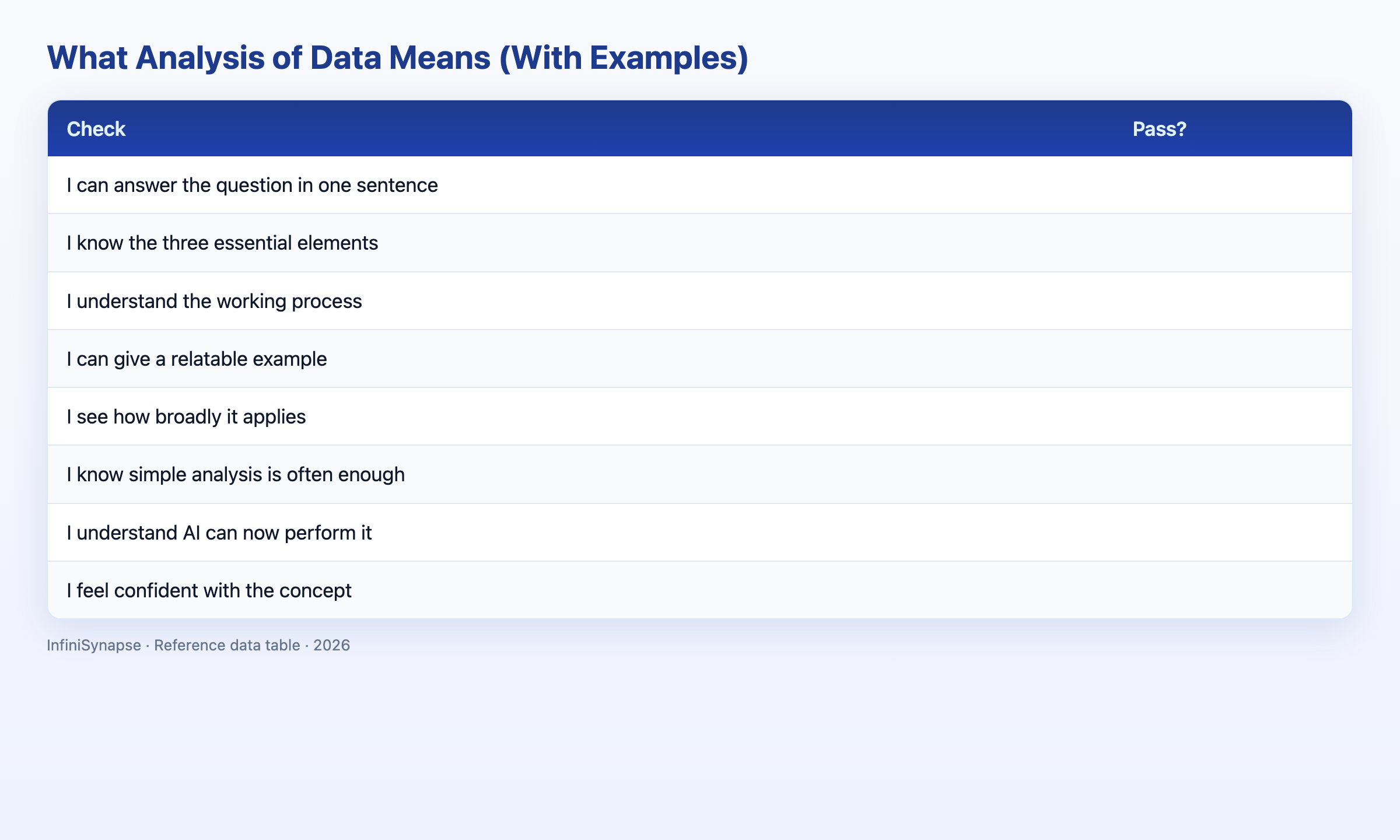
Check your understanding (1 point each):
| Check | Pass? |
|---|---|
| I can answer the question in one sentence | |
| I know the three essential elements | |
| I understand the working process | |
| I can give a relatable example | |
| I see how broadly it applies | |
| I know simple analysis is often enough | |
| I understand AI can now perform it | |
| I feel confident with the concept |
6–8: clear understanding. 3–5: revisit the direct answer. Below 3: reread the examples.
Common Questions Cleared Up
Question 1: Is it the same as statistics? What analysis of data means uses statistics but is broader, including simple examination too.
Question 2: Does it need coding? No; spreadsheets and AI-native tools let you do it without programming.
Question 3: Is complex always better? No; matching sophistication to the question is the real skill.
Question 4: Is it only for businesses? No; it applies in science, personal life, and nearly everywhere.
Frequently Asked Questions
What does the phrase mean in plain terms?
In plain terms, it means examining a set of data carefully to answer a question and support a decision. It always involves three things: a question, relevant data, and a process of examining that data to extract useful information. It turns raw numbers into an actionable answer through a disciplined sequence.
How does the activity work step by step?
It works through a process: define a clear question, gather the relevant data, clean it to ensure it is trustworthy, examine it by calculating summaries and comparing groups to find patterns, then interpret the results and communicate the conclusion. This sequence holds for both quick spreadsheet tasks and complex investigations.
Can you give a relatable example?
To find your best marketing email, you gather open and click rates, remove test sends, compare campaigns, and discover Tuesday-morning emails perform best. That is the activity in miniature — a question answered with evidence through examination, needing no advanced math or coding.
Does it require advanced math?
Not always. The meaning spans from simple calculations like averages and comparisons, which answer many everyday questions, to advanced statistical modeling for harder questions. Matching the sophistication to the question is the real skill, and often a simple examination answers a question better than a complex method.
How do AI tools carry out the work?
AI-native tools take a question in plain language, plan the steps, and carry out the gathering, cleaning, and examination autonomously, returning an answer with an inspectable trail. This automates the mechanical work while humans frame the question and judge the result, keeping the core activity the same but far faster.
Conclusion
What analysis of data means is simply examining data to answer a question and support a decision, through a disciplined process of gathering, cleaning, examining, and interpreting. It applies almost everywhere, ranges from simple to advanced, and in 2026 can be performed largely by AI-native agents while humans supply the questions and judgment.
The most important thing to remember is that the value lies in the answer, not the technique. A simple examination that genuinely resolves your question is worth more than an elaborate method that impresses but decides nothing. Keep the question in front of you, treat the data honestly, and let the evidence lead.
To go deeper and see modern tools in action, read the complete data analysis guide and what AI-native data analysis means, then try the InfiniSynapse web app free on registration, no credit card required.