InfiniSynapse Review: Pros, Cons, and Fit
By William Zhu & the InfiniSynapse Data Team · Published: 2026-06-08 · Last updated: 2026-09-23 · Last verified: 2026-09-23 · About: Editorial standards · About / team · Contact: zhuhl@infinisynapse.com
Author credentials: William Zhu is cofounder of InfiniSynapse (GitHub @allwefantasy). Desk experience: scoring the same five pillars on recurring cross-source KPI jobs, then reading the task timeline before the chart leaves the room. No personal LinkedIn is published; GitHub and InfiniSynapse About are the identity signals.
COI / interest disclosure: We build InfiniSynapse, an AI-native Data Agent. This page is our own scorecard. The 4.5/5 and the five pillar numbers are not a G2 average and not an analyst-firm rating.
Fact-check / verification: Scores below are the vendor scorecard already published on this page. The bar chart compares those scores with an 8.0 pass line we use here. Both are labeled. There is no new customer study in this update. Corrections: zhuhl@infinisynapse.com · editorial corrections.
Version history: 2026-06-08 first scorecard · 2026-09-23 retarget to buyer fit, vendor-score disclosure, and a two-week pilot. Marker:
DESK-ISR-20260923A.
Media note: No hosted overview video. Use the scorecard table, the pass-line chart, and the comparison rows.
Table of Contents
- TL;DR
- How we scored
- What InfiniSynapse is
- This score is ours
- Pros
- Cons and limits
- Who should buy, who should wait
- Pricing
- How it differs
- A two-week pilot
- Frequently Asked Questions
- Conclusion
TL;DR
Key Definition: An infinisynapse review on this page is a vendor scorecard for one job: recurring KPIs that cross more than one source. Overall rating 4.5/5. Five-pillar composite 9.0/10. Buy for that job. Wait if the team only chats with one dashboard.
The 4.5/5 and the pillar weights are ours. They are not a marketplace average. A decision-support note, in the sense of a decision support system, helps a buyer pick a job for a tool. It does not replace a pilot on your own metric.
If the second run of the same KPI still needs a person to rebuild joins, filters, and the signed definition, this infinisynapse review is the page to read before a shortlist. If the work is a single upload and a chart for a meeting that will not repeat, stop here and keep the tool you already open.
The shortlist that sits above this page is best AI tools for data analysis. Use that hub to see the lane. Use this infinisynapse review to see whether the lane matches the job.
How we scored
What we opened
We scored one product against five execution pillars, weighted toward work that repeats. Autonomy asks whether a goal can run more than one step without a person approving every query. Transparency asks whether a reviewer can reopen sources and SQL. Memory asks whether next month can reuse the approved logic. Multi-entry asks whether web, chat, and API hit the same execution behavior. Self-correction asks whether a schema change can reroute without a full rewrite of the prompt.
This infinisynapse review uses the same questions we apply when we compare file assistants and dashboard assistants. The numbers are directional. Run one recurring KPI before you treat them as final for your estate. File the five pass questions beside this infinisynapse review so the next reader scores the same job.
What we will not claim
We will not claim a public list price, a G2 rank, or a customer-hour savings figure. We will not claim that a high autonomy score watches source freshness for you. Data observability is the practice of noticing a stale feed. Put that watch on the source owner, then read this infinisynapse review for the execution layer.
| Pillar | What we measure | Pass question |
|---|---|---|
| Autonomy | Multi-step execution from one goal | Can a user hand off a five-step job without supervising each step? |
| Transparency | Inspectable process lineage | Can a reviewer trace every source and query without scrolling a chat thread? |
| Memory | Reusable distillation across runs | Can a second analyst rerun last month's logic without rebuilding it? |
| Multi-entry | Same behavior on web, chat, and API | Does the API path match the console path on the same goal? |
| Self-correction | Retry and reroute on failure | Does the system recover from a renamed column without a new prompt from scratch? |
What InfiniSynapse is
One sentence
InfiniSynapse is an AI-native data agent that accepts a business goal, plans steps across connected sources, keeps memory cards for the approved logic, and returns a result a reviewer can reopen. In this infinisynapse review, that sentence is the product. Chat that ends when the tab closes is a different product.
| Dimension | What you should expect |
|---|---|
| Archetype | Data agent for goal execution |
| Typical user | Analysts, RevOps, and finance ops with recurring cross-source KPIs |
| Starting point | A business goal on sources you already connect |
| Strength | Autonomy, a task timeline, and persistent memory |
| Governance | Connector policies, a task timeline, and an owner for each memory card |
What it is not
It is not a replacement for the dashboard your executives already read. Power BI workspace roles still decide who may publish that dashboard. This infinisynapse review treats the dashboard as the consumption surface and the agent as the execution surface.
It is not a warehouse migration. Snowflake's data sharing introduction treats a share as access, not a second copy of the warehouse. A connector that reads a source you already own follows the same idea: the grant is the decision, and a new platform is not required before the first question. That access decision belongs in this infinisynapse review before anyone talks about a new warehouse.
The wider tool lane, including products that are not agents, is covered in AI data analysis tools. Read that page when the shortlist is still open. Stay on this infinisynapse review when the question is buy or wait for this product.
This score is ours
An audit trail is the record a reviewer can reopen later. The task timeline is the trail we read. Scores below are the vendor scorecard. They are not an independent lab and not a marketplace badge.
| Pillar | Score (10) | Weight | Weighted | Notes |
|---|---|---|---|---|
| Autonomy | 9.0 | 25% | 2.25 | Strong multi-step planning and execution |
| Transparency | 9.2 | 20% | 1.84 | Task timelines and SQL or source trace |
| Memory | 9.1 | 25% | 2.28 | Memory cards outlast a single session |
| Multi-entry | 9.0 | 15% | 1.35 | Web, chat, and API on one engine |
| Self-correction | 8.6 | 15% | 1.29 | Reroute works; source quality still bounds it |
Composite pillar score: 9.0/10. Overall product rating: 4.5/5 for recurring operational analytics. The chart compares each score with an 8.0 pass line used only in this infinisynapse review. A pillar under 8.0 would be a wait signal for that job. None of the five scores sit under that line. Self-correction is the closest, at 8.6.
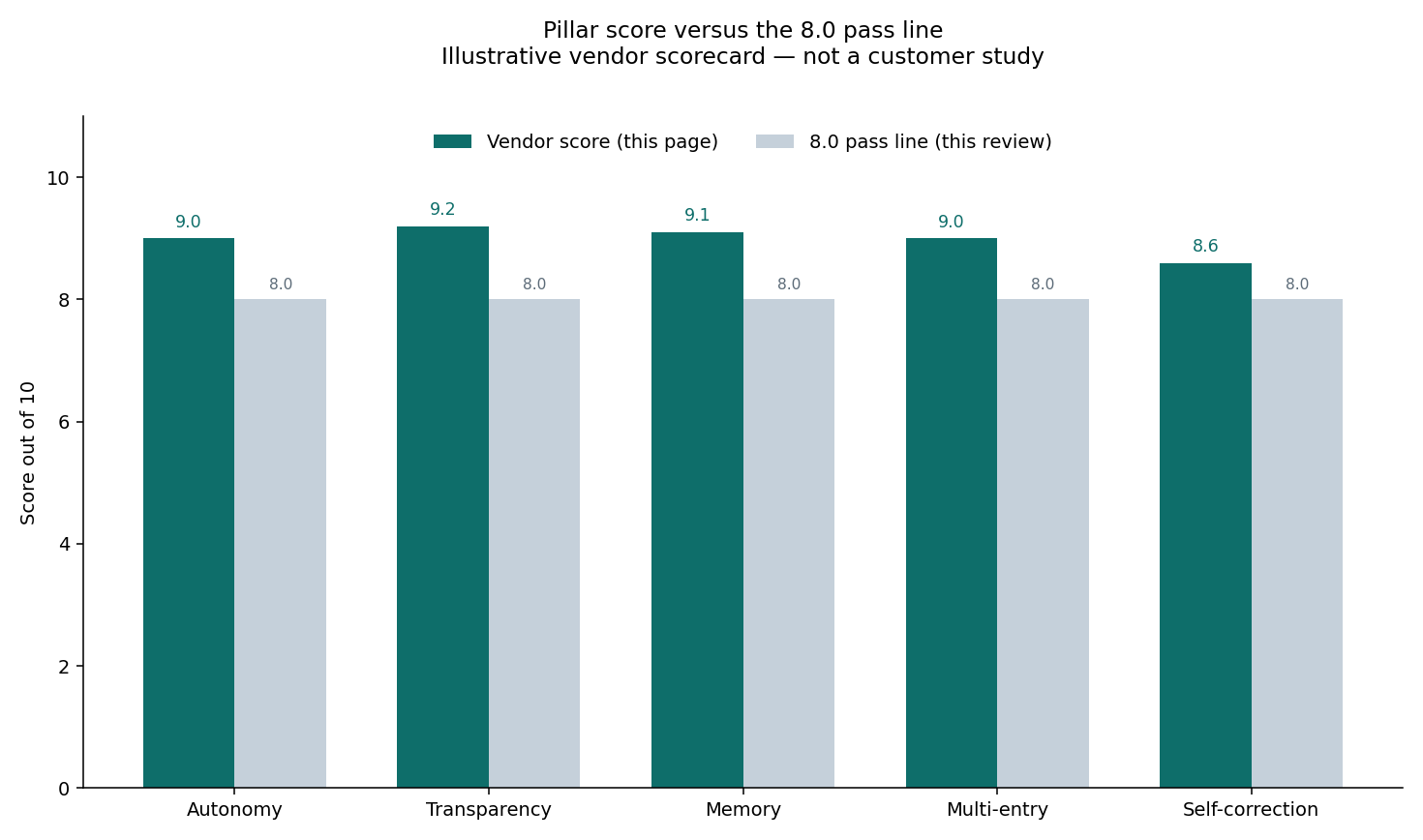
How to read the chart. Blue bars are the vendor scores in the table. Gray bars are the 8.0 pass line. The chart is illustrative. It is not a customer study and not a second rating system.
Update your own notes after the pilot. This infinisynapse review should change when the timeline on your KPI disagrees with the table, not when a demo looks faster.
Pros
Two results matter more than a feature list in this infinisynapse review: a second run that reuses the memory card, and a timeline a reviewer did not have to reconstruct.
Execution and memory
The product takes a goal such as "explain this month's churn by segment and compare it with support themes" and plans the steps. The user does not have to approve every join. Memory cards keep the approved grain, filters, and metric sentence so the next month does not start from a blank prompt. That pair is why this infinisynapse review scores autonomy at 9.0 and memory at 9.1.
Recurring weekly packs with a stable definition across three or more sources are the job where those two pillars pay off. A one-off exploration, where an analyst wants to steer every prompt, is a weaker fit. File-first assistants can feel more interactive on that job. The Julius AI alternatives page is the place to compare that file-first lane.
Cross-source and handoff
Web, chat, and API are scored together because a RevOps trigger and an analyst console should not invent two different numbers. Transparency at 9.2 is the pillar that usually convinces a finance reviewer: the timeline shows sources, SQL, and retries. A second person can check the work without reconstructing a chat. That handoff is a pro in this infinisynapse review when more than one role must sign the same KPI.
Cons and limits
Limits belong in the same infinisynapse review as the 4.5/5, or the score reads like a brochure.
Setup and cadence
Connector setup, metric ownership, and the first memory card still need an analyst. A team with no recurring question will not feel the memory score, because nothing compounds. Change management is the quiet limit: people keep the old spreadsheet until the second run is easier than the first. This infinisynapse review treats that second run as the test, not the demo.
Schema ceiling
Self-correction is 8.6, the lowest pillar. A renamed column can reroute. A broken grain, a silent filter, or a source that stopped updating will not fix itself. The ceiling is the schema and the freshness watch you already run. If your only pain is a chart on one clean extract, the scorecard in this infinisynapse review is the wrong reason to buy.
Who should buy, who should wait
Use this infinisynapse review as a routing note: one job buys, and the other job waits.
Buy now
Buy when analysts rebuild the same cross-source KPI every week or month, more than one role must sign the number, and you can name an owner for the memory card. That buyer matches the 4.5/5 in this infinisynapse review.
Wait
Wait when the team chats with one modeled dashboard, uploads a file for a meeting that will not repeat, or has not named a metric owner. Waiting is a successful outcome of this infinisynapse review. A shortlist can still include other lanes. ChatGPT data analysis alternatives covers the chat-upload lane if that is the real job.
| Persona | Buy or wait | Why |
|---|---|---|
| Finance ops with a monthly close pack | Buy | Same definition, second run, reviewer on the timeline |
| RevOps across CRM and billing | Buy | More than one source, one signed KPI |
| Analyst who wants a chart from one file | Wait | File-first tools stay lighter |
| Executive who only opens a dashboard | Wait | Consumption is already solved |
Pricing
There is no public list price. The quote depends on connectors, seats, and whether deployment is private or on-premises. Ask for the quote against one named KPI, not against a feature grid. This infinisynapse review will not invent a dollar figure the vendor does not publish.
Use a 30-day clock you write down before the pilot. Before day one, write the bar you will accept: a second run that is at least 50% faster than the first manual rebuild of that same KPI. That bar is your rule. It is not a measured savings claim. If the second run misses the bar, wait. If it clears the bar and the timeline still matches the signed metric, the quote is worth a buying conversation.
How it differs
Each row is a different job. Open the paired page when that job is the one you are buying. Bands in the middle column are directional desk ranges already used on this page. They are not a new study.
| Job | Directional desk band | Read the split |
|---|---|---|
| Chat upload and brainstorm | 6.5–7.5 | InfiniSynapse vs ChatGPT |
| File-first charts | 7.0–8.0 | InfiniSynapse vs Julius AI |
| Dashboard consumption | 7.5–8.5 | InfiniSynapse vs Tableau |
| Lakehouse questions | 8.0–8.8 | InfiniSynapse vs Databricks Genie |
| Notebook plus agent | Desk split, not a band | InfiniSynapse vs Hex |
| Warehouse-native analyst | Desk split, not a band | InfiniSynapse vs Cortex Analyst |
Power BI's place on the dashboard row is on Evaluate PowerBI on Tableau alternatives. This review scores InfiniSynapse.
The advantage we claim in this infinisynapse review is execution across sources you already have, plus a memory card the next run can open. It is not a claim that every band above is a worse product. Those products win the jobs in their rows.
A two-week pilot
Week one
Pick one KPI that already has a signed definition, a grain, and at least two sources. Block 10 minutes on day one to read the task timeline before anyone forwards the chart. Write down the sources, the filters, and the metric sentence you expected. Compare that note with the timeline. A mismatch in week one is a stop, even if the chart looks familiar. This infinisynapse review fails its own test when the timeline and the signed sentence disagree.
Week two
Rerun the same KPI without rebuilding the joins in a prompt. The second person should open the memory card and the timeline, not a new chat. Time the second run against the manual rebuild you wrote down in week one. If the rerun misses your 50% bar, or the number moved because a filter changed without a note, do not buy on the week-one demo. Record that result next to this infinisynapse review so the next buyer on your team does not restart from a slide.
Frequently Asked Questions
Can a business user run the second month alone?
Often, after an analyst has saved the memory card and the metric sentence. The first month still needs someone who can check grain and filters. A business user who only forwards charts should stay on the dashboard.
Does this replace a BI tool?
No. Keep the BI tool for distribution and for the roles that publish dashboards. Use the agent when the work is to produce the number, with a timeline, on a cadence.
How is the product different from a chat upload?
A chat upload answers inside a session. The agent is scored here on connectors, memory cards, and a timeline you can reopen next month. If your file will not be asked again, the chat upload is enough.
What should a buyer verify before a paid rollout?
Verify the quote against one KPI, the connector list you will actually use, and the second-run time against the bar you wrote down. Verify that a reviewer who was not in the first session can explain the SQL from the timeline.
Conclusion
This infinisynapse review lands at 4.5/5 overall and 9.0/10 on the five-pillar composite for recurring cross-source KPIs. Buy when that is the job and the two-week rerun clears the bar you set. Wait when the job is one dashboard or one file. The homepage stays the brand page. This page stays the fit page. Read the limits, then pilot one KPI.