EEAT date and method: When and How You Tested
By William Zhu · Cofounder, InfiniSynapse · Last updated: 2026-09-10 · Last verified: 2026-09-10 · Methods: Desk check of published test dates and methods on public URLs at aimeetup.center. Not an official Google score. Observed CLI contract 2026-09-10 on
infinitegrowth@0.1.1:seo-health check --format jsoncan exit 0 whileissues[].statusiserror.
Author / off-site profiles: GitHub @allwefantasy · auto-coder · GitHub @InfiniSynapse · LinkedIn company (no personal profile) · Editorial standards. No personal LinkedIn or vendor badge. Product recognition: SEO Health Checker is one of two first-prize works in the InfiniSynapse × CSDN Vibe Coding contest (English recognition archive). InfiniSynapse co-hosted the contest. That list is not a review of this article.
Reviewed by: InfiniSynapse Data Team · method review 2026-09-10. First-party method review, not a third-party award.
Trust / COI: About · Corrections · Publishing principles · Privacy · Terms. SEO Health is commercial. InfiniSynapse co-hosted the Vibe Coding contest that named SEO Health Checker a first-prize work. The CLI contract below is observed. First-party desk tables stay illustrative. The InfiniSynapse Data Team publishes this desk method.
Social card: ./images/og-cover.png.
Table of Contents
- TL;DR
- What the job means on a public URL
- Framework: when tested, how tested
- Comparison: both fields versus a hold
- Landscape of dated evidence in 2026
- How to publish both fields before you spend credits
- Desk sample
- Scorecard
- Failure modes
- Cluster guides
- FAQ
- Conclusion
TL;DR
Direct answer: **EEAT date and method** means you publish when you tested and how you tested on the public URL. A missing date is a hold, not a guessed score. Login and credits apply to the signed-in pass. The output is still not an official Google score.
Observed CLI contract (2026-09-10, infinitegrowth@0.1.1): For this EEAT-signal pass, the same two public URLs were re-used so this page does not invent a private run. seo-health check https://infinisynapse.com/en/blog/data-agent-memory --format json --lang en exited 0 with page.title present and Image Alt Text = warning. The same command on https://example.com also exited 0 while issues[].status listed error on Meta Description, Robots.txt, and Sitemap.xml. Parse those status fields. Exit 0 is not a clean page. Desk tables below stay illustrative.
Independent citation: According to [dateModified](https://schema.org/dateModified), dateModified is the Schema.org property for when a CreativeWork was last changed. Schema.org's dateModified page is the third-party rule this write-up holds to. Illustrative desks below are not that rule.
What you'll learn
- Why EEAT date and method is two fields, not a footer year
- How date-only, method-only, and both split credit-ready from hold
- An illustrative desk of those three evidence rows versus those two states
- What to fix before you spend another credit
Paste a public URL at https://aimeetup.center/seo-tools#check for title, meta, headings, density, images, links, tech, and speed. Those lights are not a Google 100. We evaluate EEAT date and method hands-on as the InfiniSynapse Data Team. We build InfiniSynapse as the signed-in account behind one-shot aimeetup analysis.
What EEAT date and method means on a public URL
Key Definition: EEAT date and method means the public HTML states when you tested and how you tested. A copyright year is not a test date. “We tested” without a method is a slogan. It is not a Google meter.
People search this phrase when a review URL feels current and nobody can say which week the claims were last checked. The first question is whether both fields are on the URL you will score. A hero badge is later.
ISO’s page on the ISO 8601 date and time format is the dated calendar we point at when a ticket says “updated recently” and never writes a day. Honest EEAT date and method follows that habit. Write an unambiguous date, then write the method.
This cluster does not replace the category page. The existing E-E-A-T SEO hub still holds the older definition. The signed-in how-to lives on the EEAT checker. The punch list after a real number lives on how to improve EEAT. Here we only teach EEAT date and method.
The parent product story is the SEO health checker: paste a URL, read eight lights, then decide whether to spend credits. EEAT date and method is the dated-evidence ticket on that credit path.
When tested is a day, not a year
“2026” in a footer is not when you tested. “Last updated” that never changes is not when you tested. Publish a day a visitor can quote. Pair it with first-hand signals on the sibling first-hand experience signals guide. Stay here when EEAT date and method is the missing day or method.
The W3C Date and Time Formats note is the web-era profile we cite when someone pastes a locale-only string a crawler cannot sort. EEAT date and method wants a string you can sort and a sentence you can repeat.
How tested is a sentence a stranger can rerun
“Our team reviewed this” is not a method. Name the instrument, the sample, or the steps a stranger could attempt. Do not treat a service-case traffic story as proof that a missing method became dated evidence. Service case studies are not this product.
Eight free lights can still go green on a page that never published a test day. Title and speed do not invent a method. EEAT date and method stays on the two fields you can quote.
Medical, money, and legal URLs also need a named signer. The sibling named reviewer on YMYL guide owns that person. Stay here when EEAT date and method is the missing field.
Framework: when tested, how tested
The framework has four gates. (1) Is the URL public? (2) Does the HTML publish a test date? (3) Does the HTML publish a method a stranger could attempt? (4) Is the user signed in with credits if they start the trust pass?
If gate 1, 2, or 3 fails, EEAT date and method is a hold even if you have credits. If gate 4 fails, you are still on the free strip. Mixing those gates is how teams buy a pass on an undated review and call the refuse a bug.
| Signal | What you read | Typical miss |
|---|---|---|
| Fetch | Public 200 | Dating a draft the public URL never renders |
| Date | Day you tested | Copyright year or “recently” |
| Method | How you tested | “We reviewed” with no steps |
| First-hand neighbor | What you touched | A date with no experience (other cluster) |
Keep those four stacked. EEAT date and method earns a credit-ready row only when both fields can be fetched.
Machine-readable dates on the public HTML
Schema.org documents dateModified as the date the object was last changed, which is the property we expect when you claim the page was retested. A dateModified that never moves is a lie. IETF RFC 3339 is the internet timestamp profile we cite when a CMS stores a local string and ships an unsortable blob.
Publish the human sentence and the machine date. EEAT date and method is both. A hidden meta tag with no visible day still fails a visitor who cannot inspect the claim.
Credits, lights, and the dated pack
Chrome can finish title through speed locally. The AI trust pass is the upload. Login and credits apply. After npm i -g infinitegrowth, seo-health check still reads one URL. seo-health eeat is the signed-in command. If EEAT date and method cannot form, the product should refuse a number — the lead cannot score EEAT when the page is empty, blocked, or unreadable.
A sampled audit of 50–500 sitemap rows can show many reviews with green titles and no test day. Sample first. Pay second. EEAT date and method is not a reason to buy a pass on every undated shell.
Comparison: both fields versus a hold
| Evidence row | What you publish | Credit-ready? | Official Google score? |
|---|---|---|---|
| Date only | A day, no method | Hold | No |
| Method only | Steps, no day | Hold | No |
| Both | When and how you tested | Ready to decide | No |
| Free eight lights | Title through speed | Not this ticket | No |
Date-only looks current in a screenshot. Method-only looks scientific. Neither row is enough. Both fields are the comparison winner for EEAT date and method.
Wikipedia’s article on reproducibility is the public science habit we use: a stranger should be able to attempt the same test. That is why a method sentence belongs on the URL, not in a slack thread.
We do not invent a score when a date is missing. A hold is the honest row. Guessing “probably last month” is how teams train a fake meter.
Landscape of dated evidence in 2026
Vendors still sell “freshness scores.” Buyers still type as if Google published a public recency meter. The 2026 landscape is that gap. A product that holds EEAT date and method when the day is missing is rarer than a product that always prints 72.
CMS themes stamp “Updated today” from the render clock. AI drafts invent a method the author never ran. Answer engines quote last year’s steps as if they were this week. None of that is dated evidence on the URL you scored.
NIST SP 800-53 Revision 5 is the control catalogue we point at when a buyer asks why a dated method belongs in a ticket with an owner. Audit and accountability controls assume you can say when a check ran. EEAT date and method is that ticket on a public URL, not a federal certification.
CI can fail a PR on eight-module reds. It should not invent a freshness number in Actions. Do not advertise a test day you cannot fetch. SEO Health is commercial. The hold is part of the honesty.
How to publish EEAT date and method before you spend credits
Evidence pack or locked prompts go through aimeetup as the signed-in InfiniSynapse account. One-shot analysis, not training.
Evaluation basis: one public URL, a visible test date, a repeatable method sentence, then free lights, then a signed-in pass only if you mean to spend the credit. Follow these four steps.
Paste the public URL you tested
Open https://aimeetup.center/seo-tools#check. Paste a URL you can stand behind. Confirm it is public and meant to be indexed. Dating a preview teaches you nothing you can ship. If tech already shows a wall, stop.
Quote the day and the method on that HTML
View the evidence line. Write the date string and the method sentence in the ticket. If either field is missing, EEAT date and method is a hold. Do not start the paid pass to “see if the model guesses last month.”
Start the signed-in trust pass
Sign in. Spend the credit on purpose. Run seo-health eeat or the Chrome AI re-check. Wait. If the output is a refuse, read the reason. If the output is a number, it is a product score, not Google’s. Eight-module lights stay free. EEAT date and method is the paid object.
Re-check only after both fields are public
Ship the day and the method. Fetch logged-out. Then re-check once. If you re-check the same missing date, you spend a second credit to learn the same sentence. EEAT date and method is done when both fields resolve on the public HTML, not when a slide says “we will date it in the CMS later.”
Independent citation 2: According to [Date and Time Formats](https://www.w3.org/TR/NOTE-datetime), this W3C document is an independent web-standards reference, not a ranking certificate. A second independent source, from W3C, keeps this page claim from resting only on first-party lights.
Desk sample: date, method, or both
Practical example: The InfiniSynapse Data Team labeled this desk table illustrative. n=18 public review URLs we can fetch, run 2026-09-08, marker DESK-EDM-20260908A. Two dimensions: evidence row (Date only / Method only / Both) and credit-ready versus hold. Not a customer report. Not a Google score.
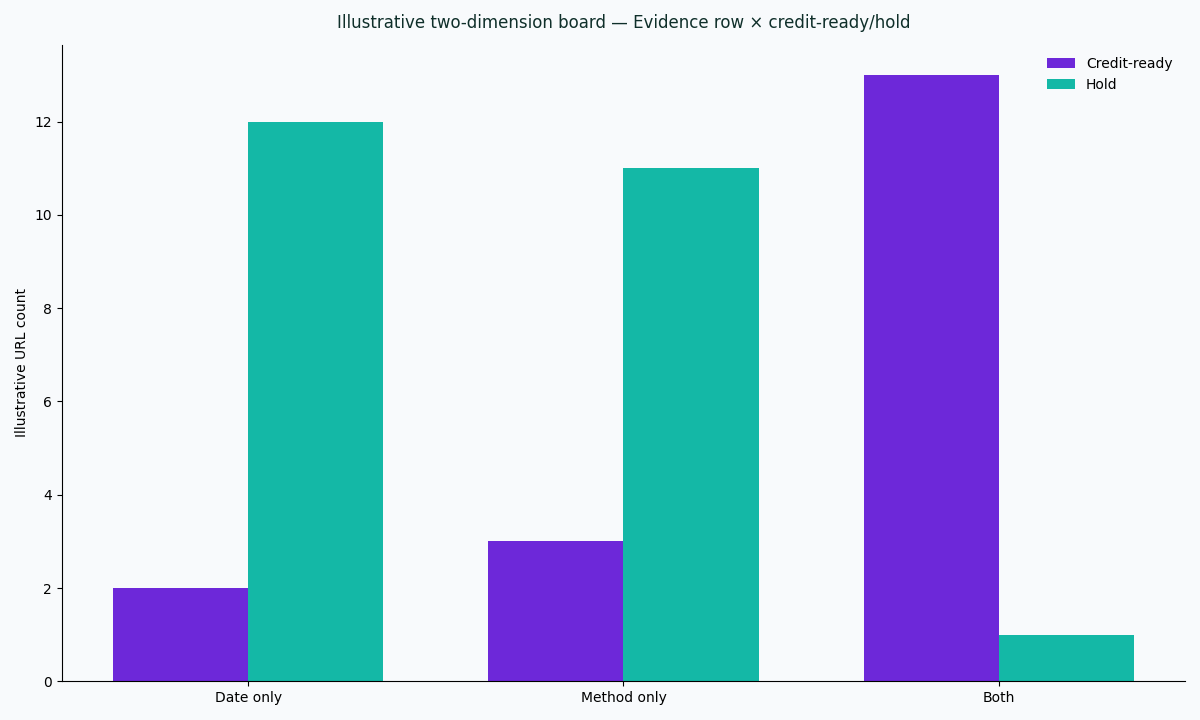
Caption: illustrative grouped view, two dimensions — evidence row × credit-ready versus hold. Social still uses ./images/og-cover.png.
| Evidence row | Credit-ready (desk) | Hold (desk) | First ticket |
|---|---|---|---|
| Date only | 0 / 6 | 6 / 6 | Write how you tested |
| Method only | 0 / 6 | 6 / 6 | Publish the test day |
| Both | 5 / 6 | 1 / 6 | Fix the one unsortable date |
Two dimensions: evidence row × credit-ready/hold. Date-only and method-only are holds. Both is the only ready row. EEAT date and method treats a missing field as a hold, not as a guessed freshness score.
| Metric | Desk result | Method |
|---|---|---|
| Sample | 18 evidence rows | Six hosts × three row types |
| Credit-ready rows | 5 / 18 | Both fields present |
| Official Google score | 0 / 18 | We do not operate that meter |
Scorecard for credit-ready dated evidence
| Signal | Pass | Fail | Notes |
|---|---|---|---|
| Public URL | Logged-out fetch works | Preview, 403, challenge | Gate 1 |
| When tested | Sortable day on the HTML | Footer year / “recently” | ISO 8601 habit |
| How tested | Repeatable sentence | “We reviewed” only | Reproducibility habit |
| Visible to a visitor | Human-readable line | Hidden meta only | Inspectable |
| Not a Google score | Copy says product | Copy says official | Always |
| Credits on purpose | User started the pass | Lights called “EEAT” | Wrong layer |
Use this scorecard before the next credit. We work from the missing field. EEAT date and method does not average a green title into a dated test.
Failure modes that look like a dated test
Shipped a copyright year and called it when you tested. Wrong field. EEAT date and method still needs a day.
Wrote “lab tested” with no steps. That is a slogan, not a method.
Updated dateModified on every render. The machine date is a lie.
Guessed last month after a refuse. A hold is the honest row.
Spent credits across a 500-URL sample of undated shells. Sample first. Pay second.
Advertised the product number as Google’s. Stop. The claim is the problem.
Each failure mode is a reason EEAT date and method is a hold, or a reason you should not have started the pass.
Cluster guides next to this page
| Guide | Job this page does not own |
|---|---|
| First-hand experience signals | What you touched |
| named reviewer on YMYL | Who signed medical, money, or legal URLs |
| Cannot score EEAT | Empty, blocked, unreadable refuse |
| SEO health checker | Free eight lights |
Read those neighbors. This page stays on the two fields — EEAT date and method as when you tested and how you tested.
Re-check after you publish when and how you tested
Paste a public URL, quote the test day and the method sentence, then start the signed-in pass only if both fields exist.
Run SEO Health CheckerFrequently Asked Questions
Does a copyright year count as when you tested?
Bottom line: No. A year in the footer is not a test day. EEAT date and method needs a sortable date plus a method sentence on the public URL.
Do I need credits to read a date line?
Bottom line: No. Reading the page is free. Login and credits apply when you start the signed-in trust pass. Free lights can warn you first.
Is a product number an official freshness score?
Bottom line: No. Even a number on a readable page is a product score. A hold is also not Google. Anyone who sells official freshness is mixing claims.
What should I fix first when the date is missing?
Bottom line: Publish the day you tested and the method a stranger could attempt. Re-check once. Do not spend a stack of credits on the same missing field.
Conclusion
EEAT date and method means you publish when you tested and how you tested on the public URL. A missing date is a hold, not a guessed score. Login and credits apply to the signed-in pass. The analysis is one-shot through your InfiniSynapse account on aimeetup, not training, and not an official Google score.
This cluster does not replace the older E-E-A-T hubs. Use it when the job is EEAT date and method. Soft-start a signed-in workspace at app.infinisynapse.com only if both fields already exist on a public URL and you intend to spend the credit. Otherwise stay on the free lights.