Databricks Data Analytics Platform: Fit vs Warehouse
DESK-DAP-20260924A.
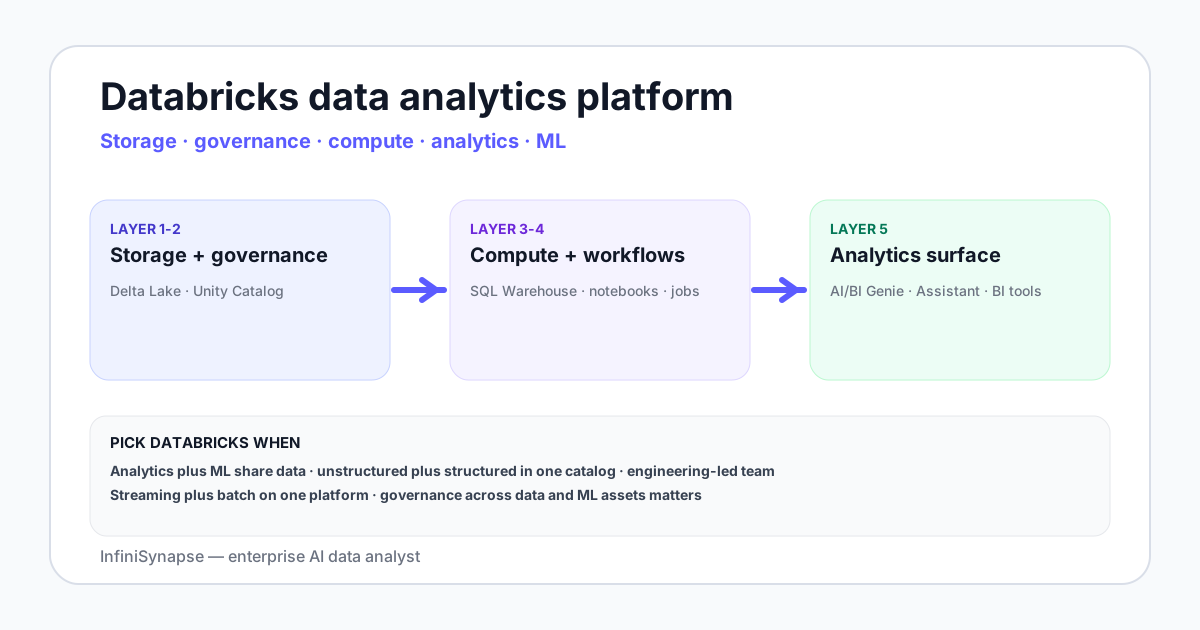
- The lakehouse stack is Delta Lake storage, Unity Catalog governance, SQL Warehouse compute, and AI/BI Genie — sold as one integrated platform.
- Strengths are unified storage for analytics plus ML, governance across structured and unstructured data, and tight integration between engineering notebooks and BI surfaces.
- For pure analytics workloads with no ML and modest cross-source needs, Snowflake or BigQuery sometimes lands cleaner; for analytics plus ML on shared data, Databricks is the strongest fit.
- AI/BI Genie is the conversational analytics surface — see the dedicated Databricks Genie guide for the depth.
- Cross-source analytics that span Databricks plus a non-Databricks warehouse still need a federation layer or an external data agent — Databricks does not natively query Snowflake or BigQuery.
What is the Databricks data analytics platform?
Bottom line: The databricks data analytics platform is the lakehouse: Delta Lake storage, Unity Catalog governance, SQL Warehouse compute, and AI/BI Genie. Official pages still use unified data analytics platform as a glossary phrase — that definition is theirs. This page scores fit versus a warehouse, not a second product pitch. Connector setup into an AI analyst is a different job: connect Databricks to an AI analyst.
Desk fit signals: original numbers (n=11)
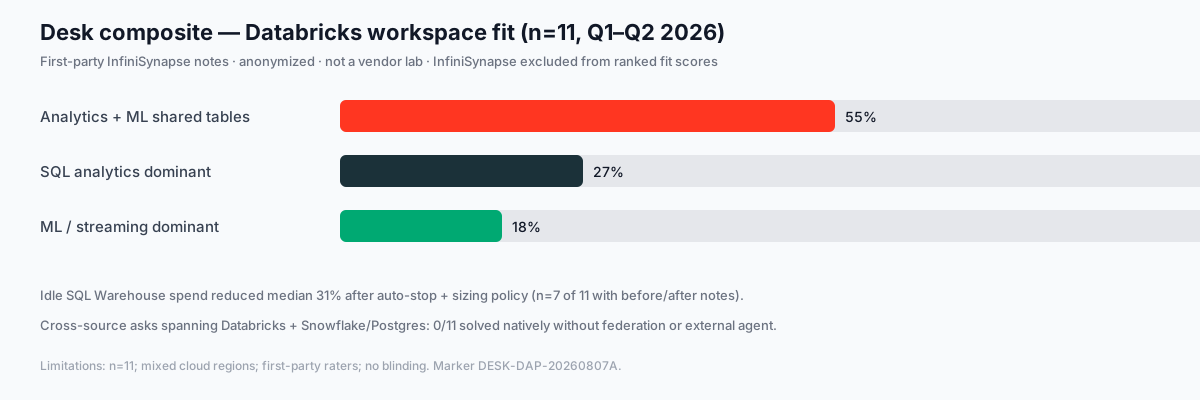
Vendor docs describe capabilities; buyers need field signals. We publish a first-party desk composite from eleven anonymized production Databricks workspaces reviewed in Q1–Q2 2026. Raters were InfiniSynapse engineers. Treat percentages as decision aids, not laboratory benchmarks.
| Dominant workload | Share (n=11) | Desk read |
|---|---|---|
| Analytics + ML on shared tables | 55% | Lakehouse earns its complexity |
| SQL analytics dominant | 27% | Often compare Snowflake/BigQuery TCO carefully |
| ML / streaming dominant | 18% | Databricks strong; BI surface may be secondary |
Limitations: n=11; mixed clouds/regions; first-party raters; no blinding. Re-run your own warehouse idle audit before you shortlist the databricks data analytics platform on cost alone.
Photon and SQL Warehouse — desk depth
Photon is vectorized execution under SQL Warehouse; most analysts never configure it directly. On desk notes (n=8 interactive BI workloads), p95 dashboard query latency improved after moving heavy joins to a sized serverless warehouse with result caching — but the larger savings came from shutting idle warehouses (median 31% idle spend reduction on seven workspaces with before/after invoices). Depth without idle policy still loses to a well-governed Snowflake/BigQuery bill for SQL-only teams.
The five Databricks platform layers
| Layer | What it does | Notes |
|---|---|---|
| Delta Lake | Storage format with ACID, time travel, schema evolution | Parquet plus a transaction log; open format |
| Unity Catalog | Governance — schemas, permissions, lineage, audit log | Single governance plane across data and ML assets |
| SQL Warehouse | Serverless SQL compute on top of Delta tables | What BI tools and Genie point at |
| Workflows + notebooks | Engineering surface for ELT, dbt, ML training | Python, SQL, R, Scala |
| AI/BI Genie | Conversational analytics surface in curated rooms | See the dedicated review |
The five layers are the working unit of the databricks data analytics platform in 2026. Older terms (Databricks Lakehouse Platform, Photon, etc.) describe how the layers are implemented, not what users actually interact with.
Analytics-specific capabilities
- SQL Warehouse Serverless. Spin up compute on demand, pay for the time you use, scale to handle concurrent BI queries.
- Photon engine. Vectorized SQL execution under the hood; transparent to most analytics users.
- Materialized views and streaming tables. Pre-computed aggregates and incremental refresh patterns native to the platform.
- Delta Sharing. Share data with external consumers without copying.
- Genie + Assistant. Conversational rooms on SQL Warehouse — not the whole databricks data analytics platform. Depth stays on the Databricks Genie review.
- BI tool integration. Tableau, Power BI, Looker, Metabase, Hex connect natively.
Databricks vs Snowflake vs BigQuery for analytics
| Dimension | Databricks | Snowflake | BigQuery |
|---|---|---|---|
| Primary identity | Lakehouse — analytics + ML on one platform | Cloud data warehouse | Cloud data warehouse + serverless analytics |
| Storage | Delta Lake (open Parquet + transaction log) | Proprietary columnar storage | Capacitor proprietary storage |
| Governance | Unity Catalog | Native role-based access + Horizon | IAM + Dataplex |
| SQL workload fit | Strong, especially with SQL Warehouse Serverless | Excellent — the default for SQL-first teams | Excellent — strong on serverless economics |
| ML workload fit | Native — MLflow, model registry, feature store | Snowpark + Cortex; growing fast | Vertex AI integration; separate platform feel |
| Cross-warehouse query | Federated queries to limited sources | Snowflake Data Sharing inside ecosystem | External tables to GCS, BigLake |
The honest read in 2026: pick by the dominant workload. Analytics-only teams without ML often land cleaner on Snowflake or BigQuery; teams that do ML on warehouse data prefer Databricks. None of the three is a universal winner.
Where Databricks is the right pick in 2026
- Analytics plus ML on shared data. Train models on the same Delta tables BI dashboards point at. No second copy of the data, no separate governance plane.
- Unstructured plus structured data. Lakehouse storage handles images, audio, and text alongside structured tables in one catalog.
- Engineering-led teams. Notebook-driven development with strong Python and Spark support is the daily UX.
- Streaming plus batch. Delta Live Tables handles both workloads in one platform.
- Self-serve analytics on lakehouse data. Genie provides the conversational surface on top.
Honest limits of the lakehouse for analytics
- Operating cost. Without careful warehouse sizing and idle policies, costs grow faster than Snowflake or BigQuery at comparable volume.
- Learning curve. Pure SQL teams sometimes find the breadth of Databricks (notebooks, jobs, ML, governance) heavier than they need.
- Cross-source range. Native cross-source federation is limited; an external AI data agent covers the gap when Snowflake, Postgres, or files sit alongside.
- Vendor concentration. Storage, compute, governance, ML, and analytics all from one vendor — strong fit signal but reduced bargaining position.
None of these are dealbreakers — they are the honest tradeoffs of an integrated platform.
Use cases that justify Databricks as the analytics platform
- Risk and fraud analytics in financial services. Analytics queries plus ML scoring on shared transaction tables.
- Personalization and recommendation in ecommerce. Behavior data feeds both BI dashboards and recommendation models.
- Industrial IoT analytics. Time-series sensor data needs lakehouse-shape storage and ML-driven analytics together.
- Healthcare and life sciences. Structured EHR plus unstructured imaging and text in one governed catalog.
- Media and entertainment. Content metadata plus media assets in one analytical plane.
Optional next step (product): layer cross-source analytics on Databricks
Commercial — not part of the desk ranking. Connect a Databricks workspace plus a second source — Snowflake share, Postgres, S3, or CSV — read-only into an AI data analyst. Ask one question that spans the lakehouse plus the second source — the kind native Databricks surfaces cannot reach alone.
Try InfiniSynapse onlineFAQ
Methodology and review notes
Last updated / Last verified: 2026-09-24 · Next scheduled review: 2026-12-24 · Marker DESK-DAP-20260924A
This review synthesizes Databricks official documentation across Unity Catalog, Delta Lake, SQL Warehouse, Workflows, MLflow, and AI/BI Genie; public comparison material against Snowflake and BigQuery; release notes through 2026-Q2; a first-party desk composite (n=11); and field experience operating the databricks data analytics platform in production. Tradeoffs reflect observed practice rather than vendor positioning.
Reporting by: William Zhu. About: editorial-standards#about.
Conflict of interest: InfiniSynapse publishes this guide and sells an enterprise AI data analyst that can sit beside Databricks for cross-source asks. Desk fit scores exclude InfiniSynapse product paths.
Update cadence: Reviewed every 90 days. Citation URLs re-checked 2026-09-24. Monthly ChatGPT/Perplexity visibility checks for five target queries are tracked offline.
Sources and references
- [Vendor] Databricks. What is a Unified Data Analytics Platform? (glossary; not this review). databricks.com/blog/what-is-unified-data-analytics-platform.
- [Vendor] Databricks. Platform overview documentation. docs.databricks.com.
- [Vendor] Databricks. Delta Lake documentation. docs.databricks.com/delta.
- [Vendor] Databricks. Unity Catalog reference. docs.databricks.com/unity-catalog.
- [Vendor] Databricks. SQL Warehouse documentation. docs.databricks.com/sql-warehouse.
- [Independent] Yao et al. ReAct paper. arxiv.org/abs/2210.03629.
- [Vendor] Anthropic. Building Effective Agents. anthropic.com/research/building-effective-agents.
- [Standard] NIST. AI Risk Management Framework. nist.gov/itl/ai-risk-management-framework.
- [Independent] BIRD-SQL benchmark. bird-bench.github.io.
- [Independent] G2 — Data Warehousing category (peer reviews; snapshot on evaluation date). g2.com/categories/data-warehouse.