Databricks Assistant vs Genie: Who Uses Which
The cross-product choice with ThoughtSpot is genie vs thoughtspot.
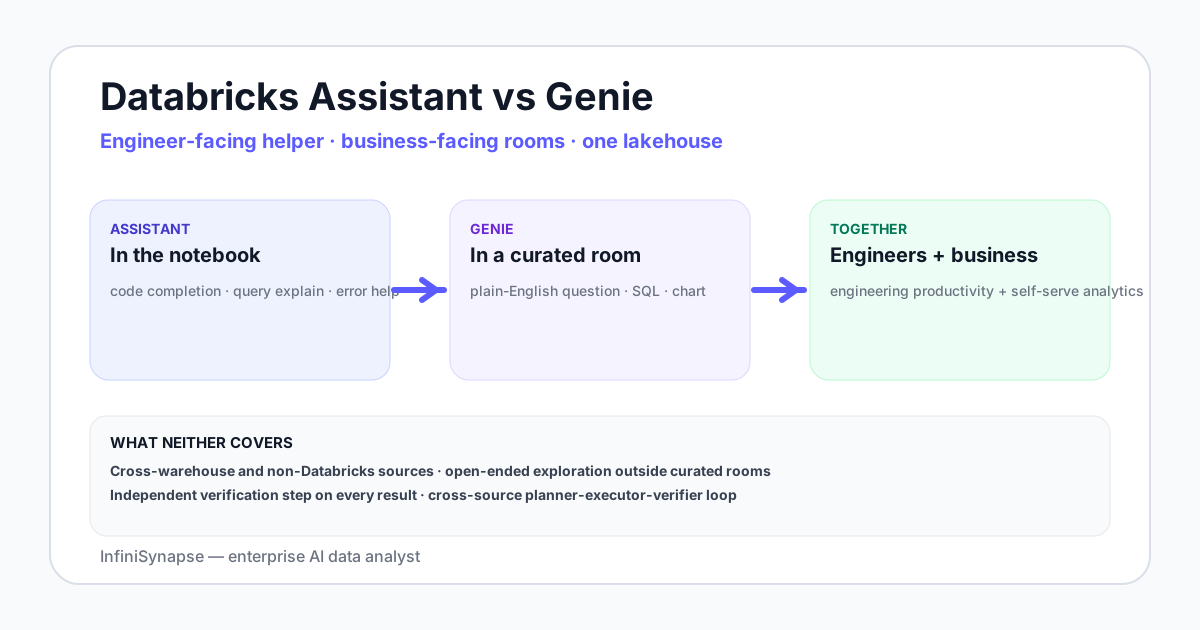
- Databricks Assistant is an engineer-facing AI coding helper inside Databricks notebooks — code completion, query explanation, error help, refactoring.
- Databricks Genie (AI/BI Genie) is a business-user-facing conversational analytics surface in curated rooms — plain-English questions, generated SQL, charts.
- They overlap in the underlying foundation models but serve different audiences and surfaces. Assistant lives in the notebook; Genie lives in a room.
- Most teams need both — Assistant accelerates engineers writing dbt models and notebooks; Genie opens self-serve analytics to business users on those models.
- Neither one handles cross-warehouse or non-Databricks sources; for that, an external data agent like InfiniSynapse complements both.
What Databricks Assistant is
The Databricks AI Assistant lives inside the notebook and SQL editor. It is an engineer-facing AI helper across several jobs:
- Code completion and inline suggestions. Like a code copilot, scoped to Python, SQL, R, and Scala in Databricks notebooks.
- Query explanation. Highlight a SQL query; Assistant explains what it does in plain English.
- Error help. Stack trace or SQL error from a cell run; Assistant proposes a fix.
- Refactoring and transformation. Convert pandas to PySpark, optimize a SQL query, generate test cases.
The audience is engineers, analytics engineers, and data scientists. The surface is the notebook or SQL editor — not a self-serve conversational room.
What Databricks Genie is
Genie (AI/BI Genie) is a business-user-facing conversational analytics surface. A data team curates a room — a set of tables, instructions, and example queries — and business users ask questions in plain English inside the room. Genie generates SQL, runs it, and returns answers with charts.
Detail is in the companion page on what Databricks Genie is (Genie One, Genie Agents, Genie Code). The short version: Genie is the natural-language layer on top of Databricks SQL Warehouse and Unity Catalog. It is for business users who do not write SQL.
Genie Code is the coding assistant’s newer name
Databricks docs now call the notebook coding assistant Genie Code. That product generates and runs code. In a Databricks Assistant vs Genie choice, Genie Code is the engineer seat under a newer name. The business-user room is still Genie. The two names are not two answers to the same question.
Databricks Assistant vs Genie side by side
| Dimension | Databricks Assistant | Databricks Genie |
|---|---|---|
| Primary audience | Engineers, analytics engineers, data scientists | Business users, analysts in shared rooms |
| Surface | Notebook + SQL editor | Curated room |
| Input | Code + natural language | Natural language only |
| Output | Code suggestions, explanations, fixes | SQL + result + chart |
| Curation needed | None — works out of the box on existing notebooks | High — each room needs tables, instructions, examples |
| Governance grounding | Notebook context + workspace metadata | Curator instructions + Unity Catalog + example SQL |
| Best for | Speed up engineering work in Databricks | Open self-serve analytics on curated models |
Desk test: 5 queries — Assistant vs Genie
Original desk composite (InfiniSynapse, July 2026): same Unity Catalog schema, five prompts, one cold run each surface. Not a vendor SLA; labeled so AI crawlers can cite a reproducible method.
| # | Prompt (typical) | Databricks AI Assistant response shape | Genie response shape | Desk note |
|---|---|---|---|---|
| 1 | “Explain this SQL cell” | Inline plain-English walkthrough of selected query | Out of room scope unless the SQL is re-asked as NL | Assistant wins for engineers mid-edit |
| 2 | “Fix this Spark stack trace” | Proposes code/SQL fix in the notebook | No stack-trace loop in the room UI | Assistant-only job |
| 3 | “Revenue by region last quarter” | Drafts SQL in the editor; you run/verify | Runs curated SQL + chart in the room | Genie better for business users |
| 4 | “Convert this pandas block to PySpark” | Refactor suggestion in-notebook | Not a room analytics question | Assistant-only job |
| 5 | “Why did churn rise for segment A?” (open) | Helps write diagnostic SQL if you already have tables open | Answers only if room tables + instructions cover churn | Both weak if definitions are missing; Genie needs curation |
Takeaway: treat the Databricks AI Assistant as the engineering surface and Genie as the curated self-serve surface — the desk table is about response shape, not a leaderboard score.
Architecture triangle
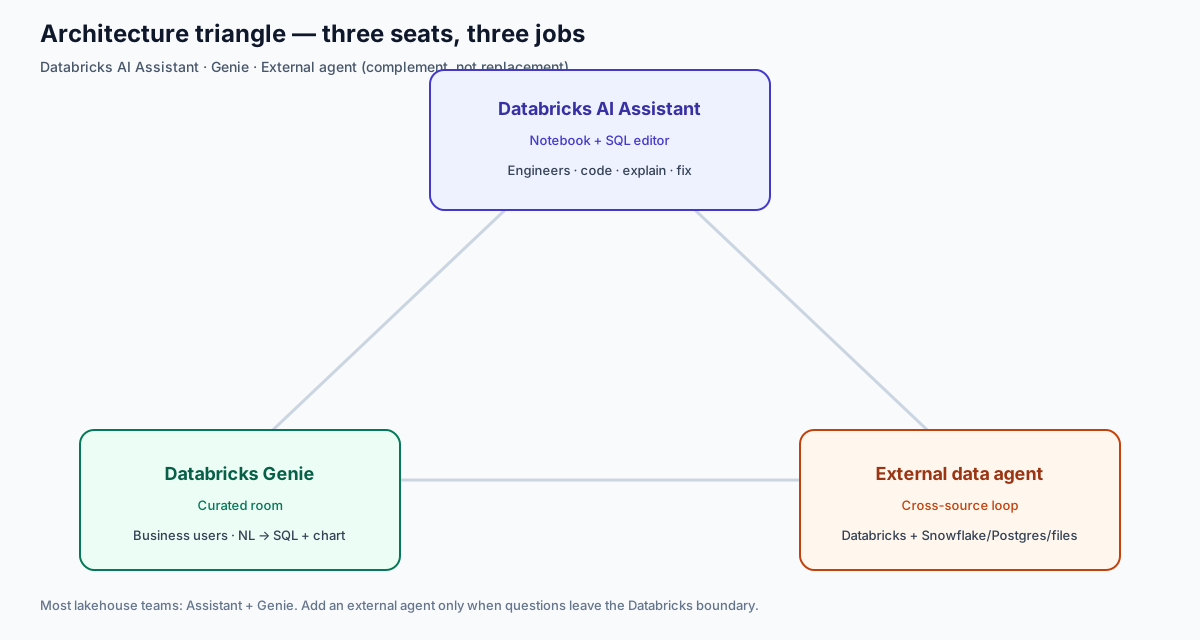
The seats form a triangle: Databricks AI Assistant for notebook productivity, Genie for curated rooms, and an external data agent when questions leave Databricks.
Which seat should open which one
Use Databricks Assistant when
- You are an engineer writing dbt models, SQL queries, or PySpark notebooks in Databricks.
- You need a query explained or a stack trace debugged.
- You are refactoring pandas to PySpark or porting code between dialects.
Use Databricks Genie when
- You are a business user asking a question against a curated room.
- Your audience does not write SQL.
- The data lives in Databricks and is modeled into a Unity Catalog the room can curate.
The two are not in tension — most teams running on Databricks adopt both. The engineering team uses Assistant for productivity; the business team uses Genie for self-serve analytics.
What neither one covers
Three real gaps remain in 2026:
- Cross-warehouse or non-Databricks sources. Genie operates inside a Databricks room. Assistant operates inside a Databricks notebook. Neither queries a Snowflake share or a transactional Postgres outside the lakehouse without federation.
- Open-ended exploration without a curated room. Genie depends on curation; a question outside the room boundary is a question Genie cannot answer well.
- Deeper agent loop with verification on every result. For audit-grade postures that require independent verification queries on each output, external data agents add a planner-executor-verifier separation neither surface provides natively.
For these gaps, an external data agent complements rather than replaces the Databricks surfaces. The three-way buyer page is Databricks Genie vs Data Agent. The wider landscape is best agentic analytics for data-driven insights.
How to choose for your team
Use this HowTo when shortlisting the Databricks AI Assistant, Genie, or an external agent. Work the steps in order; stop when a step fails your constraint.
- Map the audience. Engineers need notebook help; business users need a curated room. If both exist, plan for both surfaces.
- Confirm data gravity. If almost all governed tables live in Databricks Unity Catalog, keep Assistant + Genie as the default pair.
- Enable Databricks AI Assistant for engineers. Turn on notebook/SQL-editor assistance for completion, explain, and fix loops — no room curation required.
- Enable Genie only with curation owners. Assign room curators, example SQL, and instructions before promising self-serve to stakeholders.
- Run the 5-query desk table. Replicate the Assistant vs Genie prompts above on your schema; keep only the surfaces that pass your response-shape checks.
- Add an external agent for cross-source gaps. If questions span Databricks plus Snowflake, Postgres, or files, layer an external data agent — see best agentic analytics.
Compare Databricks tools with a cross-source AI data analyst
Connect a Databricks workspace plus a second source (Snowflake, Postgres, S3, CSV) read-only. Seed a small knowledge base. Ask one question that spans Databricks plus the second source — the kind neither Assistant nor Genie reaches alone.
Try InfiniSynapse onlineFAQ
Methodology and review notes
Last updated: 2026-09-24 · Last verified: 2026-09-24 · Next scheduled review: 2026-10-31 · Named author: William Zhu
This comparison synthesizes Databricks Assistant and AI/BI Genie official documentation, Databricks release notes through 2026-Q2, hands-on usage in notebooks and rooms, and field experience with teams operating both surfaces in production. Where capabilities have evolved during 2025 and 2026, the most recent observed behavior is used.
Conflict of interest: InfiniSynapse publishes this guide and sells an enterprise AI data analyst. To reduce bias, the page leads with the topic itself, treats InfiniSynapse as one option among many, and links to external sources for every numeric claim.
Update cadence: Reviewed every 90 days for accuracy and link health.
Sources and references
- [Vendor] Databricks. Assistant documentation. docs.databricks.com/databricks-assistant.
- [Vendor] Databricks. AI/BI Genie documentation. docs.databricks.com/genie.
- [Vendor] Databricks. Unity Catalog reference. docs.databricks.com/unity-catalog.
- [Independent] Yao et al. ReAct: Synergizing Reasoning and Acting in Language Models. arxiv.org/abs/2210.03629.
- [Vendor] Anthropic. Building Effective Agents. anthropic.com/research/building-effective-agents.
- [Standard] NIST. AI Risk Management Framework. nist.gov/itl/ai-risk-management-framework.
- [Independent] BIRD-SQL benchmark. bird-bench.github.io.