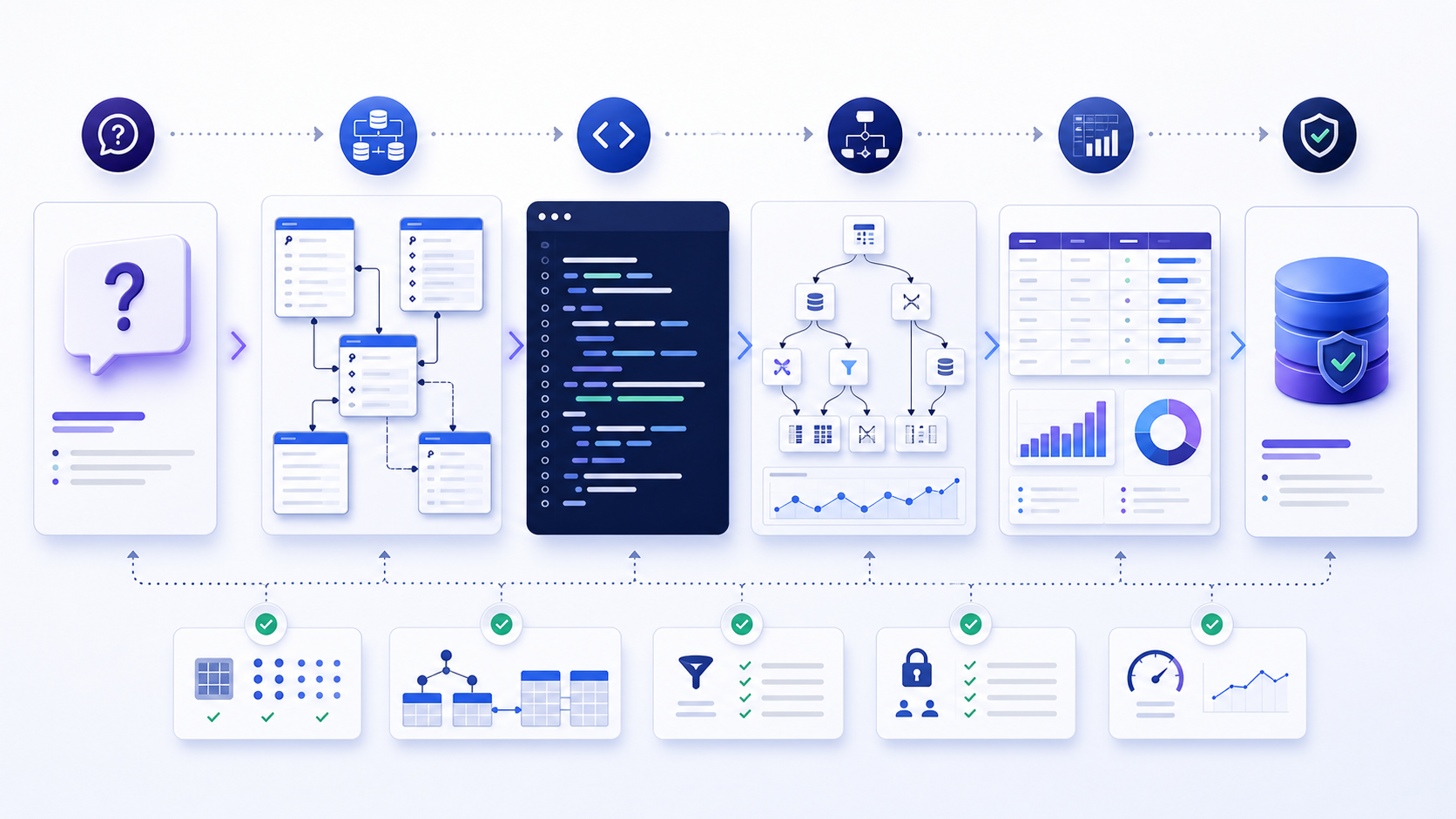
What is a database query?
A database query is a structured request to retrieve, combine, summarize, create, or change data managed by a database. In a relational database, the request is usually expressed in SQL. A complete query decision also includes the intended population, one-row meaning, business definitions, permissions, transaction context, acceptable runtime, and evidence that the result is correct.
For example, “monthly revenue by region” is not yet a query specification. It leaves open which orders count as revenue, which timestamp assigns the month, how refunds and tax behave, which currency is used, and whether regions with zero revenue appear. SQL can be syntactically valid while silently choosing the wrong answer to every one of those questions.
Start with a simple database query example
Suppose a support manager needs the names and email addresses of active customers. The database query can express that request with three basic SQL clauses:
SELECT name, email
FROM customers
WHERE status = 'active';SELECTnames the columns the result should return.FROMidentifies the source table.WHERElimits the result to rows that meet a condition.
A database query is the request for data or an operation; SQL is the language commonly used to express that request in a relational database. The SQL query guide explains SQL syntax and logical clause order in more detail. The client that runs this kind of lookup is covered in database lookup tool development.
Expected result: one row per active customer, with only the approved name and email fields. Before running it against production data, confirm that customers has one row per customer and that the requester is authorized to view email addresses.
How a database query works: the complete lifecycle
A useful mental model has seven stages. The user states a question; the analyst translates it into a result contract; the schema identifies available entities and relationships; SQL encodes the logic; the database parses and optimizes the statement; the engine executes a physical plan under a transaction and permissions; finally, the team validates and interprets the returned rows. A defect in any stage can corrupt the answer even when every later stage behaves exactly as designed.
- Define the decision. Name the user, action, deadline, comparison, and acceptable uncertainty.
- Specify the result. State population, grain, measures, dimensions, time boundaries, and ordering.
- Map the schema. Confirm tables, keys, relationship cardinality, types, constraints, and freshness.
- Write the smallest clear statement. Prefer explicit columns, explicit joins, parameters, and readable stages.
- Inspect how it will run. Review estimated work before execution and actual work in a controlled environment.
- Execute safely. Use least privilege, read-only access where possible, row limits, timeouts, and governed exports.
- Validate before interpretation. Reconcile totals, test edge cases, measure join loss and growth, and record assumptions.
This lifecycle separates three often-confused questions: “Is the SQL valid?”, “Will it run efficiently?”, and “Does it answer the intended business question?” A parser can answer the first, an execution plan helps answer the second, and only a result contract plus evidence can answer the third.
Main types of database queries
People often use “query” as a synonym for SELECT, especially in analytics. Databases accept a broader set of statements. The distinction matters because risk, permissions, transaction handling, review depth, and rollback requirements change by operation.
| Category | Typical statements | Primary concern | Example outcome |
|---|---|---|---|
| Read | SELECT, WITH | Meaning, privacy, workload, consistency | Rows or aggregates |
| Data change | INSERT, UPDATE, DELETE, MERGE | Scope, idempotency, locks, rollback | Persistent row changes |
| Definition | CREATE, ALTER, DROP | Dependencies, migration, availability | Schema changes |
| Access control | GRANT, REVOKE | Least privilege and auditability | Permission changes |
| Transaction control | BEGIN, COMMIT, ROLLBACK | Atomicity, isolation, recovery | A defined unit of work |
Safety boundary: a “read-only” query is not automatically harmless. Large scans can exhaust shared resources; locking clauses can affect concurrent work; exported results can expose sensitive data; and database functions invoked by a query may have side effects. Review privileges, cost, and destination as well as the SQL verb.
Define population, grain, and measures before SQL
The most reliable database queries start with a compact result contract. Suppose a finance lead asks for “net revenue by customer segment for the last complete month.” Before touching the schema, convert that sentence into testable rules.
Posted sales for active legal entities; exclude test accounts and voided documents.
Posting timestamp in the finance timezone; half-open interval from month start to next month start.
Exactly one row per customer segment and reporting currency.
Gross line amount minus recognized discounts and refunds, excluding tax; convert before aggregation.
Show governed segments with zero revenue; place missing segment mappings in an explicit “Unmapped” group.
Segment totals equal the control ledger total; no sale maps to more than one active segment.
This contract makes hidden choices reviewable. It also tells you which tables, timestamps, keys, reference data, and controls are required. If those inputs are unavailable, the correct next step is to surface the gap—not invent a convenient proxy inside the query.
Read a SELECT database query by logical responsibility
A SELECT statement is easier to review when each clause has one clear responsibility. Written order is not the same as logical evaluation order, and the optimizer may execute a physically different plan while preserving SQL semantics. Still, the following structure is a useful review map.
WITH eligible_sales AS (
  SELECT
    s.sale_id,
    s.customer_id,
    s.currency_code,
    s.gross_amount - s.discount_amount - s.refund_amount AS net_amount
  FROM sales s
  WHERE s.posted_at >= :period_start
    AND s.posted_at < :period_end
    AND s.status = 'POSTED'
    AND s.is_test = FALSE
)
SELECT
  COALESCE(seg.segment_name, 'Unmapped') AS segment_name,
  e.currency_code,
  COUNT(*) AS sale_count,
  SUM(e.net_amount) AS net_revenue
FROM eligible_sales e
LEFT JOIN customer_segment seg
  ON seg.customer_id = e.customer_id
 AND seg.valid_from < :period_end
 AND seg.valid_to >= :period_start
GROUP BY
  COALESCE(seg.segment_name, 'Unmapped'),
  e.currency_code
ORDER BY net_revenue DESC, segment_name;| Clause | Responsibility | Review question |
|---|---|---|
WITH | Name an intermediate relation | Does the stage clarify logic, or hide repeated scans and ambiguous grain? |
FROM / JOIN | Choose sources and relationships | Can every join key and expected cardinality be justified? |
WHERE | Define eligible input rows | Are boundaries, statuses, nulls, and time zones explicit? |
GROUP BY | Set aggregate grain | Does one output row now have the promised meaning? |
HAVING | Filter completed groups | Is a group condition being confused with a row condition? |
SELECT | Shape fields and expressions | Are names, units, types, and calculated measures unambiguous? |
ORDER BY / limit | Make presentation deterministic | Are ties resolved, and is the limit applied after the intended ordering? |
The example is intentionally incomplete as a finance solution: it does not yet convert currencies or prove that segment date ranges cannot overlap. Those are specification and data-quality questions, not syntax details. Good query documentation makes such limitations visible beside the SQL.
Inspect schema evidence instead of guessing names
Before writing a database query, inspect the catalog or approved data model. Names such as created_at, amount, and status are not self-defining. A created timestamp may reflect ingestion rather than the business event; an amount may be gross, net, local, or base currency; a status may be mutable and therefore unsuitable for reproducing a historical report.
| Evidence | What it can establish | What it cannot establish alone |
|---|---|---|
| Column type and nullability | Storage domain and whether missing values are allowed | Business unit, completeness, or reason for null |
| Primary and unique keys | Enforced uniqueness at a declared scope | Whether the key represents the desired business entity |
| Foreign keys | An enforced reference between stored keys | Historical timing, optional relationships, or analytical grain |
| Index definitions | Available access paths and ordering | That the optimizer will use the index for current parameters |
| Metric or semantic layer | Approved definitions, filters, and dimensions | That source data meets every assumption today |
| Data profile | Observed nulls, duplicates, ranges, skew, and freshness | Future behavior or business authorization |
Write the output grain as a sentence: “one row per account per UTC calendar day,” not “group by account and date.” Then profile whether every join preserves or deliberately changes that grain. If a dimension key is duplicated, a many-to-one join becomes many-to-many and can multiply money without producing any error.
Write filters with explicit boundaries and null behavior
Filters define who or what is eligible for the answer. The most common defects are hidden boundary choices: inclusive versus exclusive dates, event time versus load time, local time versus UTC, current status versus status at the event, and whether unknown values are excluded or labeled.
SELECT
  order_id,
  customer_id,
  ordered_at,
  total_amount
FROM orders
WHERE ordered_at >= :period_start
  AND ordered_at < :period_end
  AND status = 'COMPLETED';
The half-open interval [start, end) composes cleanly across adjacent periods and retains fractional seconds without inventing a final timestamp such as 23:59:59.999. The application should bind typed parameters, and the team should record the timezone used to construct them. If the column stores UTC instants, convert the business period boundary to UTC before comparison rather than transforming every stored row inside the predicate.
WHERE flag = FALSE excludes null. Use an explicit rule if null means unknown, not false.
NOT IN can behave unexpectedly when the subquery contains null. Prefer a reviewed NOT EXISTS pattern.
Case sensitivity, collation, trimming, and Unicode normalization can change matches across engines and databases.
Wrapping an indexed column in a function may prevent a direct range seek. Compare typed boundaries where possible.
Treat every join as a cardinality claim
A join does more than “add columns.” It asserts that two record sets are related by specific keys at a specific time and scope. It can remove base rows, repeat them, or associate them with the wrong owner. Before joining, profile distinct keys and duplicate frequencies on both sides.
WITH joined AS (
  SELECT
    o.order_id,
    c.customer_id AS matched_customer_id
  FROM orders o
  LEFT JOIN customers c
    ON c.tenant_id = o.tenant_id
   AND c.customer_id = o.customer_id
)
SELECT
  COUNT(*) AS output_rows,
  COUNT(DISTINCT order_id) AS distinct_orders,
  COUNT(*) FILTER (
    WHERE matched_customer_id IS NULL
  ) AS unmatched_orders
FROM joined;
The FILTER syntax is PostgreSQL-style; use your engine's equivalent conditional aggregation where needed. If output_rows exceeds distinct_orders in an expected many-to-one relationship, investigate duplicated customer keys. If unmatched orders exist, decide whether they are invalid data, late dimensions, deleted customers, or legitimate exclusions. Do not hide either problem with DISTINCT.
| Join intent | Preferred pattern | Required proof |
|---|---|---|
| Keep only matching pairs | INNER JOIN | Excluded population and right-key cardinality |
| Preserve every left row | LEFT JOIN | Null meaning and placement of right-side filters |
| Test whether a related row exists | EXISTS | Correlation key and no need for child fields |
| Find missing relationships | NOT EXISTS | Null-safe correlation and intended scope |
| Match effective history | Keys plus time-range predicate | Non-overlapping effective intervals |
For deeper worked patterns, use the SQL query examples guide. It expands individual query shapes; this page keeps the broader database-query lifecycle and review discipline in view.
Aggregate only after proving the input grain
Aggregation compresses detail, so it can also conceal defects. A duplicated join may double revenue and then disappear into a plausible monthly total. A missing dimension may silently remove rows before grouping. A ratio can change depending on whether you average row-level rates or divide aggregated numerators by aggregated denominators.
SELECT
  campaign_id,
  SUM(conversions) AS conversions,
  SUM(eligible_sessions) AS eligible_sessions,
  SUM(conversions) * 1.0
    / NULLIF(SUM(eligible_sessions), 0) AS conversion_rate
FROM campaign_daily
WHERE report_date >= :period_start
  AND report_date < :period_end
GROUP BY campaign_id;
This definition weights days by eligible sessions and returns null when the denominator is zero. That may or may not match the business rule: some reports prefer zero, “not applicable,” or a separate eligibility flag. Decide before formatting. Also confirm whether the numeric type preserves required precision; integer division and floating-point approximation vary by engine and expression types.
- Use
COUNT(*)for rows andCOUNT(column)only when excluding null values is intentional. - Define whether a missing measure is unknown, not applicable, not yet arrived, or genuinely zero.
- Measure both row count and distinct business keys before and after aggregation.
- Reconcile additive measures at the lowest reliable grain before trusting higher summaries.
- Do not use
SUM(DISTINCT amount)to repair duplicated rows; equal legitimate amounts would also collapse.
Make ranking and Top-N database queries deterministic
“Top five products in each category” contains two decisions: how products are scored and how ties are treated. A simple global ORDER BY ... LIMIT 5 cannot answer per-category Top-N. Use a window function, and include a stable tie-breaker if the requirement is exactly five rows.
WITH product_sales AS (
  SELECT
    category_id,
    product_id,
    SUM(net_amount) AS net_sales
  FROM order_lines
  WHERE ordered_at >= :period_start
    AND ordered_at < :period_end
  GROUP BY category_id, product_id
),
ranked AS (
  SELECT
    category_id,
    product_id,
    net_sales,
    ROW_NUMBER() OVER (
      PARTITION BY category_id
      ORDER BY net_sales DESC, product_id
    ) AS position
  FROM product_sales
)
SELECT category_id, product_id, net_sales, position
FROM ranked
WHERE position <= 5
ORDER BY category_id, position;
Use RANK when ties should share a position and can produce more than N rows, or DENSE_RANK when rank numbers should not have gaps. State which behavior is desired. Ordering only by a non-unique score leaves the selected rows unstable across executions, plan changes, or parallel workers.
Separate query structure from untrusted values
SQL injection occurs when untrusted input can change the structure or meaning of a statement. Escaping strings by hand is fragile because syntax, encodings, data types, and driver behavior differ. Use the database driver's prepared-statement or parameter API so values travel separately from SQL structure.
| Input | Safe treatment | Reason |
|---|---|---|
| Dates, IDs, amounts, text values | Typed bind parameters | The driver preserves the value boundary |
| Variable list of values | Array parameter or generated placeholders | Each element remains data, not SQL |
| Table or column identifier | Map an allow-listed token to a known identifier | Most parameter APIs cannot bind syntax identifiers |
| Sort direction | Map a small enum to fixed ASC or DESC | Never paste raw UI text into the clause |
| Filter expression authored by users | Parse a constrained grammar or use a reviewed query builder | Free-form fragments are executable structure |
The OWASP SQL Injection Prevention Cheat Sheet recommends prepared statements and safely constructed stored procedures as primary defenses, with allow-list validation for the limited cases where bind variables cannot represent the input. Least privilege reduces impact but does not replace safe construction.
Do not paste secrets or personal data into an online SQL drafting tool. Use sanitized schema names and synthetic literals. Keep database credentials in an approved secrets manager, and execute production queries only through governed connections.
Use the execution plan as evidence, not decoration
The optimizer chooses physical access paths—scans, index probes, join algorithms, sorts, aggregates, exchanges, and temporary work—based on the SQL, schema, statistics, parameters, and engine configuration. A plan does not prove business correctness, but it can reveal whether the database understood data volume and whether the workload is proportionate to the result.
| Plan signal | Possible explanation | Evidence to gather next |
|---|---|---|
| Actual rows far above estimate | Stale statistics, skew, correlated predicates, duplicated keys | Key frequencies, statistics freshness, join multiplication |
| Large scan for a narrow result | No selective access path, non-sargable predicate, low selectivity | Filter distribution, predicate types, candidate index cost |
| Sort or hash spills to storage | Underestimated rows, wide records, insufficient memory | Actual memory, row width, estimates, safe pre-aggregation |
| Many repeated inner probes | Nested loop with large outer input or weak inner index | Outer cardinality, index coverage, parameter sensitivity |
| Fast in test, slow in production | Different volume, cache, concurrency, parameters, or plan | Representative parameters, actual plan, wait profile, cold-cache test |
In PostgreSQL, EXPLAIN shows the planner's selected plan. EXPLAIN ANALYZE executes the statement and records actual work, so use it carefully—especially for data-changing statements or expensive production queries. Equivalent tools differ across engines. Capture both estimates and actuals with representative parameters instead of tuning from a single unusually small case.
Optimize database queries without changing the answer
Performance work begins after the result contract and validation controls exist. Otherwise, a rewrite may become faster by dropping rows, changing null behavior, moving a filter across an outer join, or altering the calculation grain. Preserve a testable invariant for every optimization.
- Measure a representative baseline. Record parameters, row counts, elapsed time, CPU, reads, waits, plan, concurrency, and cache state.
- Locate the dominant work. Find the operators, inputs, and estimates responsible for most cost or elapsed time.
- Reduce data safely. Apply valid filters, project needed columns, pre-aggregate only at a proven grain, and avoid repeated work.
- Improve access paths selectively. Evaluate indexes against read benefit, write cost, storage, maintenance, and the whole workload.
- Retest semantics and workload. Reconcile exact results, test parameter ranges and skew, then observe concurrency and regressions.
Avoid universal advice such as “indexes always make queries faster” or “CTEs are always materialized.” Behavior depends on engine, version, statistics, data distribution, predicate selectivity, available memory, and concurrent work. A smaller plan cost is also not a cross-query unit of elapsed time; compare measured outcomes under controlled conditions.
For a deeper optimization workflow, see the planned SQL query optimization guide. Keep correctness tests beside the performance change so later reviewers can reproduce both the answer and the improvement.
Know which version of the database your query observes
A query runs within a transaction context even when the client does not display an explicit BEGIN. Isolation level and database implementation determine which committed or concurrent changes are visible. Two statements in one report can therefore observe different data unless the transaction or snapshot policy guarantees a consistent view.
Ask what snapshot the engine provides for one statement and whether database functions or external sources follow it.
Totals and details can disagree when each statement sees a different commit boundary.
Long snapshots can retain storage, delay cleanup, or increase conflict depending on the engine.
Clauses such as FOR UPDATE change concurrency behavior and usually need stronger privileges.
The PostgreSQL transaction tutorial describes a transaction as an all-or-nothing bundle whose intermediate states are not visible to concurrent transactions. Exact isolation behavior differs across systems, so record the engine, version, isolation level, and report timestamp when reproducibility matters.
Validate a database query with independent checks
Validation should be capable of proving the query wrong. Re-running the same logic in a different formatting layer is weak evidence because both versions can share the same assumption. Prefer independent totals, key counts, source-system controls, adversarial fixtures, and explicit invariants.
| Validation layer | Example check | Defect it can expose |
|---|---|---|
| Schema | Referenced objects, types, keys, constraints, and privileges exist | Hallucinated or stale query structure |
| Population | Eligible distinct entity count matches an independent control | Missing or excessive filters |
| Cardinality | Row growth, match rate, and duplicate frequency measured per join | Wrong keys and many-to-many expansion |
| Measures | Detail sums reconcile to trusted ledger or operational total | Duplication, loss, or formula errors |
| Boundaries | Rows exactly before, at, and after time and amount thresholds | Off-by-one and timezone defects |
| Stability | Repeated run under the declared snapshot gives the same ordered result | Non-deterministic ranking or changing source state |
Keep a small golden dataset containing zero matches, one match, multiple matches, null keys, duplicate keys, boundary timestamps, negative amounts, empty groups, tied ranks, and out-of-order arrivals. State the expected row set and measures by hand. A query that passes only a happy-path production sample has not been meaningfully tested.
Port database queries by behavior, not syntax alone
SQL is standardized, but production databases expose different dialects, types, functions, planners, and operational semantics. A statement that parses in two engines may still return different values or scale differently. Record the target engine and version in the query artifact.
| Portability area | Questions to test |
|---|---|
| Identifier rules | Quoting character, case folding, reserved words, qualified names |
| Pagination | LIMIT, TOP, FETCH, offset cost, stable ordering |
| Date and time | Timestamp-with-zone semantics, interval syntax, truncation, daylight saving |
| Numeric behavior | Integer division, decimal precision, overflow, rounding |
| Null ordering | Default position of nulls and support for explicit null ordering |
| String behavior | Concatenation, collation, case sensitivity, pattern syntax |
| Optimizer behavior | CTE treatment, parameter sensitivity, statistics, join strategies |
The PostgreSQL SELECT reference documents that engine's complete syntax and logical processing description. Use the official reference for the exact target database rather than assuming that a generic SQL example is portable. Maintain dialect-specific golden tests around dates, nulls, ranking, text, and numeric edge cases.
Use natural language as a draft, not a result guarantee
Natural-language-to-SQL systems can reduce syntax effort and help users explore unfamiliar schemas. Their hardest problem is not producing fluent SQL; it is grounding ambiguous language in the correct tables, relationships, metric definitions, dialect, permissions, and time context. A plausible query can be structurally valid and semantically wrong. The follow-up that keeps those filters is ai for database exploration.
| Provide to the generator | Why it matters | Review evidence |
|---|---|---|
| Target dialect and version | Controls syntax, types, and supported functions | Parse with the real engine or a dialect-aware validator |
| Approved tables, columns, keys, and relationships | Prevents invented objects and incomplete joins | Catalog lookup and key-cardinality profile |
| Metric definitions and result grain | Resolves business meaning beyond column names | Reconcile against semantic layer or trusted control |
| Population and time boundaries | Prevents silent eligibility and timezone choices | Boundary fixtures and independent entity counts |
| Safety policy | Restricts statement classes, objects, limits, and sensitive fields | Static checks plus read-only least-privilege execution |
A strong prompt is a miniature result contract: “For PostgreSQL, return one row per active account for the last complete UTC month, including accounts with zero completed orders. Show order count and net order value excluding tax. Use bind parameters, do not use SELECT *, and explain assumptions.” Then review every object, join, filter, measure, null rule, and ordering decision.
A query builder can structure those choices, while an AI2SQL alternative evaluation helps teams compare grounding, governance, validation, deployment, and cost rather than judging generated syntax alone.
Diagnose database query failures by layer
“The query is wrong” can describe several unrelated failures. Classify the symptom before changing SQL. Otherwise, a syntax rewrite may distract from permissions, stale replicas, duplicated reference data, transaction visibility, or an overloaded service.
| Symptom | First checks | Avoid |
|---|---|---|
| Parser or syntax error | Dialect, quoted identifiers, commas, aliases, clause order, supported functions | Randomly removing clauses without preserving the intended result |
| Object or permission error | Database, schema search path, object case, role, row policy, environment | Granting broad privileges to make the error disappear |
| Empty or unexpectedly small result | Date timezone, status values, null logic, inner-join loss, replica freshness | Deleting filters until rows appear |
| Too many rows or inflated totals | Join keys, duplicate dimensions, intended grain, one-to-many stages | Adding DISTINCT before finding the cause |
| Slow or timed out | Actual plan, waits, estimates, scans, spills, blocking, parameter skew | Blind hints or indexes without workload evidence |
| Different answer on repeat | Missing deterministic order, changing data, isolation, non-deterministic functions | Assuming row order without ORDER BY |
Reduce the failure to the smallest reproducible query, but keep a copy of the full statement and parameters. Remove one layer at a time, measure what changes, and restore the result contract after diagnosis. A minimal reproducer helps identify the failing operator; it is not automatically the final production design.
Use a repeatable database query review checklist
- Decision: Who uses the answer, for what action, and by when?
- Population: Which entities qualify, and which are intentionally excluded?
- Grain: What does exactly one output row represent?
- Schema: Are every table, column, type, key, relationship, and freshness assumption verified?
- Time: Which event timestamp, timezone, interval boundaries, and historical version apply?
- Joins: Is each key complete, and are match loss and row multiplication measured?
- Measures: Are units, currency, tax, refunds, nulls, zeros, denominators, and rounding defined?
- Determinism: Are ordering, ties, limits, and window frames explicit?
- Security: Are values parameterized, identifiers allow-listed, and credentials least-privileged?
- Privacy: Are sensitive fields necessary, masked, and exported only to approved destinations?
- Performance: Were representative parameters, actual plans, waits, reads, memory, and concurrency tested?
- Validation: Do independent totals, edge cases, and golden fixtures support the result?
- Reproduction: Are engine version, parameters, snapshot, code revision, and verification date recorded?
Turn a sanitized question into a reviewable SQL draft
Open the InfiniSynapse NL2SQL Query Tester with a synthetic business question and approved schema context. Use the generated statement as a draft, then verify objects, joins, filters, grain, dialect, permissions, and expected results against your real environment.
Open NL2SQL Query Tester Use sanitized names and synthetic values. Do not submit credentials, personal data, secrets, or sensitive literals.Database query frequently asked questions
It is a structured request to read, combine, summarize, create, or change data managed by a database. SQL is the most common query language for relational systems.
No. SELECT reads data, while INSERT, UPDATE, DELETE, MERGE, definition statements, and transaction-control statements express other database operations.
Define population and output grain, inspect the schema, state join and metric rules, write the smallest clear query, test edge cases, reconcile independent controls, and inspect representative execution plans.
Use prepared statements or parameterized queries for untrusted values, allow-list identifiers that cannot be bound, apply least privilege, and never concatenate raw input into SQL.
A parser checks syntax, not business meaning. Wrong joins, duplicate dimensions, missing filters, time-boundary errors, null handling, aggregation grain, stale data, and row policies can all produce plausible but incorrect results.
It can accelerate drafting when supplied with approved schema context, metric definitions, dialect, and constraints. Generated SQL still requires review, least-privilege read-only execution, controlled limits, and independent result validation.
Official database query references
- PostgreSQL: SELECT
- PostgreSQL: Table Expressions
- PostgreSQL: Using EXPLAIN
- PostgreSQL: Transactions
- OWASP: SQL Injection Prevention Cheat Sheet
Examples on this page are educational and use PostgreSQL-oriented syntax where noted. Test syntax, semantics, plans, privileges, privacy controls, and operational impact against the actual database engine and governed environment.