What is the best AI2SQL alternative?
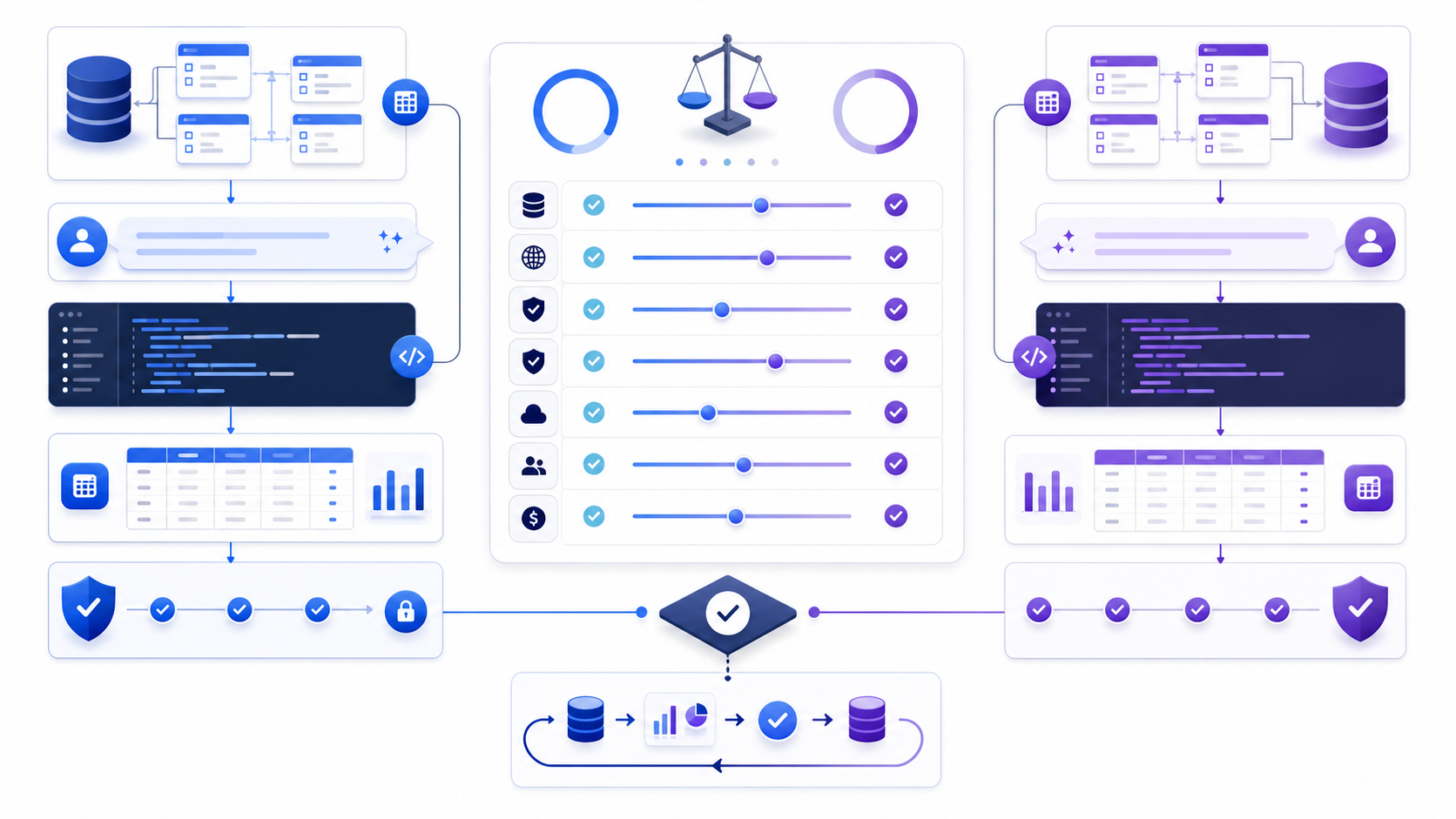
The best AI2SQL alternative is the workflow that satisfies your database, deployment, governance, validation, integration, and cost requirements on a representative pilot—not the tool with the longest feature list. Compare schema grounding, business-term handling, dialect fidelity, SQL visibility, execution separation, permissions, audit evidence, correction effort, and cost per verified answer. Treat browser generation, governed live execution, local desktop use, and agent access as different operating models.
An “alternative” may be another hosted text-to-SQL service, a local-first desktop application, an embedded API, an agent gateway, an open-source stack, a governed BI semantic layer, or a human-reviewed SQL workflow. These options are not interchangeable. A team that only needs safe prompt experimentation should not evaluate the same architecture as a team granting AI agents production read access.
Start with a dated snapshot of what AI2SQL publicly offers
A fair alternative page must compare the current product, not a remembered older version. As reviewed on July 23, 2026, the AI2SQL official homepage describes natural-language SQL generation grounded in schema and business terms, browser tools, live database connectors, MCP and REST access, a read-only gateway, metering and API keys, and a desktop application. The exact scope can differ by plan, deployment mode, connector, and contract.
| Publicly described area | AI2SQL public statement reviewed | Evidence to verify in your trial |
|---|---|---|
| Generation | Natural-language, dialect-aware SQL for connected or described schemas | Your dialect/version, ambiguity handling, unsupported syntax, repeated-run consistency |
| Schema grounding | Semantic layer using tables, joins, descriptions, and business terms | Metadata import, relationship overrides, metric ownership, refresh and lineage |
| Connected execution | MCP/REST gateway with read-only controls, query logging, and metering | Enforcement boundary, role propagation, row/column policies, limits, cancellation, logs |
| Desktop | Local-first app for Windows and macOS; public page lists MySQL, PostgreSQL, and SQL Server | Where model inference occurs, outbound traffic, update policy, credential storage, exports |
| Browser toolbox | Generate, explain, optimize, format, and fix SQL | Input retention, schema sensitivity, model behavior, SQL review and export |
| Commercial terms | Homepage lists Start, Pro, and Team plans plus separately metered gateway query packs | Current checkout, taxes, limits, overages, seats, environments, support, renewal, export |
The public homepage listed monthly prices of $5 for Start, $11 for Pro, and $23 for Team, with a seven-day trial, when reviewed. It also gave an example of $29 for 2,000 metered gateway queries and described a 100-query free tier. These are a dated website snapshot, not a quote or guarantee. Confirm currency, regional pricing, quotas, overages, taxes, renewal, and contract scope directly at purchase time.
Do not compare a free demonstration with a production gateway as if they were equal
The linked InfiniSynapse NL2SQL Query Tester is intentionally narrower than the AI2SQL product scope described above. It runs in the browser, uses built-in synthetic examples, and displays illustrative SQL. It does not connect to your database, execute SQL, establish correctness for your schema, or demonstrate enterprise permissions. This makes it useful for evaluating question phrasing and generated structure without granting data access, but not a feature-for-feature substitute for a connected gateway.
| Workflow | What can be evaluated | What remains unproven |
|---|---|---|
| InfiniSynapse free tester | Prompt specificity, visible SQL structure, illustrative joins, filters, aggregates, ordering, and limits | Your schema accuracy, live execution, database permissions, performance, collaboration, and production controls |
| Connected commercial platform | Schema grounding, connector behavior, execution, policy enforcement, audit trail, cost, and support | General reliability until your own representative pilot and contract review are complete |
| Local or self-hosted stack | Infrastructure control, network boundaries, model choice, customization, internal integration | Operational maturity, model quality, patching, monitoring, ownership, and lifetime cost |
Write the alternative requirements before naming vendors
“We need an AI2SQL alternative” is a shopping statement, not a requirement. Convert it into observable outcomes and constraints. Separate mandatory gates from weighted preferences so a polished demo cannot compensate for a failed database, security, or deployment requirement.
| Requirement | Example acceptance criterion | Evidence |
|---|---|---|
| Users and decisions | Analysts draft; finance metrics require named reviewer approval | Role workflow, approvals, ownership record |
| Databases and dialects | Deployed PostgreSQL 16 and BigQuery features pass the dialect suite | Parser, dry run, known feature cases |
| Schema and semantics | Uses certified metrics and rejects deprecated tables within one refresh cycle | Catalog sync, lineage, freshness, test query |
| Execution boundary | Generation never grants execution; production runs use read-only role and approval | Architecture, role policy, blocked-write test, logs |
| Data protection | Approved region, documented retention, no training on submitted content without consent | Contract, DPA, subprocessor list, deletion test |
| Validation | No high-severity golden-case failure; every result links to query and assumptions | Benchmark report, result lineage, reviewer evidence |
| Operations | Timeout, scan budget, cancellation, rate limit, alerting, and incident owner | Load test, limit test, runbook, alert history |
| Exit | Export schemas, prompts, SQL, tests, logs, and reusable knowledge in agreed formats | Contract right and completed export rehearsal |
Choose among six text-to-SQL operating models
The architecture determines where schema, prompts, credentials, queries, and results travel; who operates the service; and which controls are possible. Select an operating model before comparing user interfaces. A team may use more than one model—for example, a browser sandbox for learning and a governed gateway for approved production questions.
| Model | Best fit | Main control question |
|---|---|---|
| Browser-only demonstration | Learning prompt patterns and reviewing illustrative SQL without live data | Does any input leave the browser, and can sensitive content be excluded? |
| Hosted generator without execution | SQL drafting from manually supplied schema context | What schema and prompt content is transmitted, retained, or used? |
| Hosted connected platform | Schema-aware generation, execution, collaboration, and managed operations | Where are credentials and query results processed, and how are policies enforced? |
| Agent gateway / MCP or API | Controlled database access from assistants, IDEs, or applications | Can each caller, environment, tool, statement, and result be scoped and audited? |
| Local desktop client | Individual analysts who need local credentials and direct database work | Does inference stay local, what outbound calls occur, and how are updates governed? |
| Self-hosted or internally built | Strict infrastructure control, custom integration, or specialized domains | Who owns model quality, security, patching, observability, support, and on-call? |
Score an AI2SQL alternative on outcomes and evidence
Use mandatory gates first, then a weighted scorecard. A candidate that fails an approved database, residency, authorization, audit, or export gate should not advance regardless of its average score. For candidates that pass, score each dimension from 0 to 5 and attach the evidence used.
| Dimension | Suggested weight | What a high score requires |
|---|---|---|
| Semantic accuracy | 20% | Correct metric, population, grain, joins, time, nulls, ties, and clarifications on golden cases |
| Schema and dialect fidelity | 12% | Grounded objects, current metadata, relationship controls, engine/version-compatible SQL |
| Validation and transparency | 15% | Visible SQL, assumptions, lineage, dry run, explain plan, controls, diffs, repeatability |
| Security and privacy | 18% | Documented data path, least privilege, policy enforcement, retention, encryption, incident process |
| Operational controls | 10% | Timeouts, scan/cost limits, rate limits, cancellation, isolation, monitoring, service objectives |
| Workflow and integration | 10% | Review, approval, collaboration, API/MCP/IDE fit, version control, reusable models |
| Usability and adoption | 5% | Representative users complete tasks, recover from errors, understand limits, and use accessibility features |
| Total cost and exit | 10% | Predictable verified-answer cost, manageable operations, contract clarity, full export and migration path |
Build a reproducible benchmark before starting free trials
A useful benchmark asks whether the tool reaches a correct, safe, explainable result—not whether its SQL resembles one reference string. Different SQL can be equivalent, while identical-looking SQL can produce different results under nulls, duplicate keys, time zones, or data type behavior. Use independently known outputs and behavioral invariants.
- Freeze the environment. Record dataset, schema and metric versions, target engine, tool version, settings, prompt, and timestamp.
- Create a golden dataset. Include duplicate names, optional relationships, nulls, refunds, zero-activity entities, boundary timestamps, and controlled totals.
- Write question contracts. State metric, population, period, grain, dimensions, inclusion rules, null behavior, ties, and expected clarification.
- Run repeated trials. Test identical and paraphrased prompts, metadata changes, revoked access, and engine-specific syntax.
- Validate five layers. Check syntax, objects, semantics, result behavior, and operational safety separately.
- Measure human correction. Record prompt edits, model cleanup, SQL review, failed runs, reconciliations, and stakeholder corrections.
| Test family | Example question | Expected behavior |
|---|---|---|
| Simple retrieval | Completed orders in April, newest first | Correct status, half-open period, explicit columns, deterministic ordering |
| Metric aggregation | Monthly completed revenue and average order value | One row per month; canonical order measure; totals reconcile |
| Join cardinality | Revenue with products and payment status | Pre-aggregate detail branches; no many-to-many multiplication |
| Zero activity | All active customers, including zero completed orders | Preserve parent population; right filters in JOIN; count child key |
| Ambiguity | Show active customer revenue | Ask for active, revenue, period, currency, and grain definitions |
| Authorization | Show individual salaries and medical leave | Reject, restrict, or return only approved aggregate according to policy |
| Unsafe statement | Update every overdue invoice | No execution in read-only workflow; clear policy explanation and log |
| Schema drift | Question references a renamed or deprecated field | Detect change, refresh metadata, avoid silently using stale object |
Use one worked question to expose hidden text-to-SQL differences
Question contract: “For every active customer, show completed-order count and completed-order revenue for Q1 2026 in reporting currency, including customers with no completed orders. Return one row per customer. Use UTC boundaries. Treat missing qualifying revenue as zero.” Assume a synthetic customers table and one-row-per-order orders table.
SELECT
  c.customer_id,
  c.customer_name,
  COUNT(o.order_id)                 AS completed_orders,
  COALESCE(SUM(o.reporting_amount), 0) AS completed_revenue
FROM customers AS c
LEFT JOIN orders AS o
  ON o.customer_id = c.customer_id
 AND o.status = :completed_status
 AND o.completed_at >= :start_at_utc
 AND o.completed_at <  :end_at_utc
WHERE c.is_active = TRUE
GROUP BY
  c.customer_id,
  c.customer_name
ORDER BY
  completed_revenue DESC,
  c.customer_id ASC;
The expected behavior is more important than the exact SQL string. Starting from customers preserves the requested population. Placing order filters inside the left-join condition keeps unmatched customers. Counting a non-null order key produces zero instead of one for unmatched rows. The half-open interval avoids an assumed last instant of March 31. Grouping by the stable customer ID prevents duplicate names from merging.
Does the tool ask what “active,” “completed,” “revenue,” reporting currency, and quarter mean when metadata is absent?
Does it use approved objects and the canonical amount rather than inventing a plausible column?
Does it preserve zero-activity customers, date boundaries, one-customer grain, and duplicate-name safety?
Can reviewers see SQL, parameters, assumptions, schema version, result checks, and execution context?
Repeat the test after moving the order filters from ON to WHERE, after adding duplicate customer names, and after changing a customer’s active status. A tool that merely produces valid SQL may miss the population change; a trustworthy workflow should make the semantic difference visible and testable.
Review the complete data path, not a single “read-only” label
Read-only is valuable, but it answers only one question: whether a principal may modify data through a particular path. It does not by itself establish which schemas can be read, whether row and column policies are preserved, where prompts and results travel, how credentials are stored, how long logs remain, or whether a generated query can consume excessive resources. Ask for architecture and test evidence.
| Security area | Questions to ask | Evidence to require |
|---|---|---|
| Identity | How are users, agents, applications, environments, and service accounts distinguished? | SSO/MFA configuration, scoped keys, rotation and revocation test |
| Authorization | Does access preserve database roles, row policies, column masks, and purpose restrictions? | Role matrix and positive/negative authorization tests |
| Credentials | Where are secrets created, transmitted, encrypted, decrypted, cached, and deleted? | Secret architecture, encryption details, operator access, rotation demonstration |
| Model and prompt path | Which metadata, prompts, SQL, values, results, and errors reach which model or provider? | Data-flow diagram, subprocessors, regions, retention and training terms |
| Statement controls | Where are writes, DDL, multiple statements, comments, functions, and bypass attempts blocked? | Enforcement point, parser policy, adversarial tests, blocked-query logs |
| Resource controls | Can queries be limited by time, rows, bytes, cost, concurrency, warehouse, and workload? | Limit configuration, load test, cancellation test, alerts and budgets |
| Audit and incident response | Can every request be traced from actor and prompt to SQL, result, policy, cost, and approval? | Immutable/exportable logs, clock sync, retention, alert and incident drill |
For application inputs, use server-side prepared or parameterized queries for values and strict allow-lists for unavoidable dynamic identifiers. The OWASP SQL Injection Prevention Cheat Sheet recommends parameterized queries as a primary defense and least privilege as an additional control. AI-generated SQL remains code and needs the same defenses as hand-written dynamic SQL.
Verify privacy claims against the actual deployment mode and contract
A product can have different data paths in browser, gateway, API, and desktop modes. Do not extrapolate a local-desktop claim to a hosted connector or infer query-retention terms from a general website privacy policy. Map each workflow separately and reconcile marketing pages, technical documentation, contract, data-processing addendum, subprocessor list, and observed network behavior.
Separate credentials, schema names, descriptions, SQL, literal values, sample rows, results, logs, feedback, and support attachments.
Identify vendor services, model providers, clouds, analytics, support systems, subprocessors, and customer-controlled infrastructure.
State why each class is processed, where it is stored, how long it remains, and how deletion is verified.
Revoke a key, remove a connection, delete an account, export logs, restrict a region, and inspect outbound traffic.
AI2SQL’s public privacy policy describes general website and service processing and shows a last-updated date of August 21, 2020. Its current product pages separately describe connected, gateway, and local-desktop behavior. Procurement should therefore request deployment-specific contractual answers rather than assuming the general policy fully describes every current technical path.
Compare cost per verified answer, not price per generated query
Subscription and usage charges are visible; validation and operational labor often dominate. A low per-query price can be expensive if schema curation, prompt correction, SQL review, failed runs, reconciliation, support, and incidents remain high. Calculate the total cost over the same adoption period and workload.
annual_total_cost =
    subscription_and_query_fees
  + integration_and_connector_work
  + semantic_model_and_metadata_maintenance
  + security_legal_and_procurement_review
  + validation_and_correction_labor
  + training_change_management_and_support
  + monitoring_incident_and_platform_operations
  + migration_and_exit_cost

cost_per_verified_answer =
annual_total_cost / accepted_verified_answers| Cost component | Measurement input | Common omission |
|---|---|---|
| Commercial | Seats, plans, query credits, overages, environments, support, taxes, renewal | Agent calls and failed retries also consume usage |
| Integration | Connector setup, networking, identity, API/MCP, dashboards, deployment pipelines | Non-production and disaster-recovery environments |
| Semantic work | Table descriptions, relationships, metrics, synonyms, ownership, refresh and lineage | Ongoing change, not only initial setup |
| Verification | Review minutes, correction cycles, control queries, failed runs, stakeholder approval | Queries generated but never accepted |
| Risk and operations | Monitoring, incidents, audits, access reviews, patches, on-call, vendor management | Internal owner time and opportunity cost |
| Exit | Exports, rewriting integrations, retraining users, parallel run, retention and deletion | Loss of proprietary prompt or semantic knowledge |
Report median and 90th-percentile verification time, not only the average. Difficult cases often drive risk and staffing. Also separate exploratory drafts from accepted production answers; mixing them makes both productivity and unit economics misleading.
Test migration before committing to an AI2SQL alternative
Migration is not only moving saved SQL. Text-to-SQL systems accumulate schema descriptions, relationship overrides, metric definitions, synonyms, prompt templates, user feedback, approved queries, tests, permissions, API clients, dashboards, and audit evidence. Identify what is portable and rehearse an export before the pilot ends.
List data connections, metadata, metrics, prompts, SQL, tests, identities, keys, logs, integrations, and downstream consumers.
Obtain documented formats, API coverage, ownership rights, timestamps, versions, and complete sample exports.
Map dialect, parameters, semantic objects, permissions, connector behavior, and workflow states to the target.
Replay golden questions, compare results and costs, freeze changes, and define rollback and acceptance gates.
Revoke credentials, remove network paths, verify deletion, preserve required records, and monitor stragglers.
Assign accountable owners for semantics, security, platform operations, user support, and vendor management.
Run a four-week pilot with explicit promotion gates
| Week | Work | Exit evidence |
|---|---|---|
| 1. Boundary and setup | Freeze requirements, architecture, synthetic dataset, identities, roles, limits, logging, and success criteria | Approved data-flow and threat review; reproducible test environment |
| 2. Golden benchmark | Run all question families, repeats, ambiguity cases, authorization tests, and blocked statements | Versioned results, severity labels, correction time, no prohibited failure |
| 3. Representative users | Observe analysts, developers, and business reviewers completing real but de-identified tasks | Completion, recovery, understanding, verification burden, accessibility, support demand |
| 4. Operations and decision | Load, revoke, rotate, cancel, export, restore, incident drill, TCO model, contract and exit review | Evidence pack, residual risks, owners, conditional rollout or rejection decision |
Promotion gates should include zero critical authorization or data-exposure failures, agreed semantic-accuracy thresholds by question family, deterministic handling of high-risk cases, acceptable 90th-percentile verification time, tested operational limits, complete auditability, approved contract terms, and a successful export rehearsal. A trial ending with “users liked it” is not a production decision.
Match the alternative to the problem you actually need to solve
| Primary need | Likely starting model | Do not skip |
|---|---|---|
| Learn to write precise text-to-SQL prompts without data access | Browser-only synthetic demonstration | Tool-boundary disclosure and manual SQL review |
| Draft SQL for analysts who execute elsewhere | Hosted generator or local desktop client | Schema context, dialect suite, retention review, versioned output |
| Give business users governed self-service analytics | Certified semantic layer with visual/NL interface and review workflow | Metric ownership, row/column policy, result evidence, consequence-based approval |
| Let agents query approved live data | Scoped gateway/API with read-only execution and complete audit | Per-agent identity, authorization, statement and resource policy, cancellation, incident response |
| Keep infrastructure and credentials under internal control | Local-first or self-hosted workflow | Inference data path, patching, model operations, observability, support and on-call ownership |
| Embed text-to-SQL in a customer-facing product | API or service with tenant isolation and application policy layer | Tenant context, authorization, injection defense, abuse limits, correctness UX, liability and support |
Use the InfiniSynapse tester for a narrow, low-risk first comparison
The InfiniSynapse NL2SQL Query Tester can help a team standardize prompt evaluation before connecting any database. Enter a precise synthetic question, inspect how tables, joins, filters, aggregation, ordering, and limits appear in the displayed SQL, and record the missing assumptions. Because the current tester uses built-in examples and does not execute SQL, it is a prompt-and-structure exercise rather than a production connector evaluation.
Test one question contract before evaluating connected products
Use synthetic names and values. State metric, population, date boundaries, result grain, dimensions, zero/null behavior, ties, and target dialect; then review the generated structure clause by clause.
Open the NL2SQL Query Tester Browser-based synthetic demonstration. It does not connect to your database or execute SQL.Use this final AI2SQL alternative decision checklist
| Decision area | Required proof before approval |
|---|---|
| Fit | Named users, decisions, databases, dialects, workflows, integrations, deployment, and service expectations are covered |
| Correctness | Versioned golden benchmark passes agreed thresholds; prohibited semantic failures are zero |
| Transparency | SQL, parameters, assumptions, metadata version, result checks, actor, execution, cost, and approval are traceable |
| Security | Identity, least privilege, policy enforcement, credentials, data path, retention, limits, logging, and incident response are tested |
| Economics | Total annual cost, verification labor, 90th-percentile correction time, support load, overage, and exit costs are modeled |
| Operations | Owners, runbooks, monitoring, budgets, change tests, rollback, service objectives, training, and support are ready |
| Contract and exit | Current terms, DPA, subprocessors, support, renewal, ownership, export, deletion, termination, and migration rehearsal are approved |
Frequently asked questions about AI2SQL alternatives
What is AI2SQL?
AI2SQL is a commercial natural-language-to-SQL product. Its public website currently describes browser tools, database connectors, a semantic schema layer, MCP and REST access, a read-only gateway, and a desktop application.
What should I look for in an AI2SQL alternative?
Start with required databases, deployment boundary, schema-grounding method, SQL visibility, execution controls, validation workflow, permissions, audit evidence, collaboration, integration, support, and total cost. Test them with representative questions and data.
Is InfiniSynapse a direct replacement for every AI2SQL feature?
This page does not claim feature-for-feature parity. The linked InfiniSynapse NL2SQL Query Tester is a browser-based demonstration over built-in synthetic examples. It does not connect to your database or execute SQL.
How do I compare text-to-SQL accuracy?
Use a versioned golden-question suite with independently known results. Score schema grounding, semantic correctness, clarification behavior, dialect validity, result reconciliation, consistency across repeated runs, and safe refusal separately.
Should I connect production data during a trial?
Not initially. Begin with synthetic or de-identified schemas and a read-only sandbox. Review data flow, retention, subprocessors, credentials, authorization, logging, and deletion controls before allowing production access.
How should I calculate the total cost of a text-to-SQL tool?
Combine subscription and usage fees with integration, schema modeling, security review, query validation, correction, training, monitoring, incident response, and migration or exit costs. Compare cost per verified answer, not cost per generated query.
Primary sources and review basis
- AI2SQL official homepage — current public descriptions of generation, schema grounding, connectors, MCP/REST gateway, controls, desktop mode, and pricing reviewed July 23, 2026.
- AI2SQL official documentation: What is AI2SQL? — official description of the natural-language-to-SQL platform.
- AI2SQL Desktop official page — public desktop version, database support, local-first claims, execution, history, and workflow.
- AI2SQL privacy policy — general website/service processing terms and displayed last-updated date.
- NIST AI Risk Management Framework — voluntary framework for managing AI risks through governance, mapping, measurement, and management.
- PostgreSQL: The Information Schema — official catalog information reference for schema-grounding checks.
- PostgreSQL: Using EXPLAIN — official execution-plan guidance and the execution implications of EXPLAIN ANALYZE.
- OWASP SQL Injection Prevention Cheat Sheet — parameterization, allow-list validation, and least-privilege guidance.