Data Science for Product Managers in 2026: A Working Guide
- PMs do not need to be data scientists — but the best ones are fluent in five skills: funnel analysis, cohort retention, A/B test reading, opportunity sizing, and ad-hoc data querying.
- Funnel analysis is the daily skill — measuring step-to-step conversion, segmenting by user properties, and spotting which step degraded.
- Cohort retention is the weekly skill — reading curves to evaluate channel quality, feature impact, and product-market fit signal.
- A/B test reading is the most error-prone skill — peeking before significance, reading the wrong metric, ignoring SRM (sample ratio mismatch) are the common failure modes.
- In 2026 PMs increasingly use AI data agents to ask warehouse questions without filing analyst tickets — write SQL when the question is yours to defend, ask the agent when the question is exploratory.
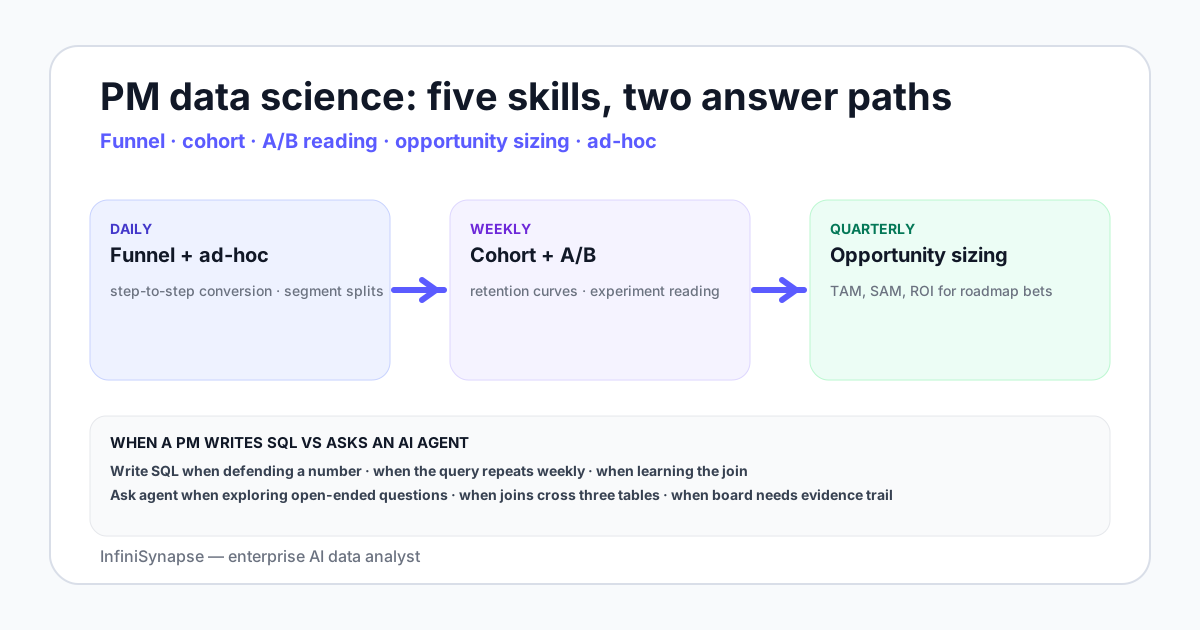
The five PM data science skills, ranked by use frequency
| Skill | Frequency | What it covers |
|---|---|---|
| Funnel analysis | Daily | Step-to-step conversion, segmentation, drop-off diagnosis |
| Cohort retention | Weekly | Curves by signup or feature cohort, lifetime trends |
| A/B test reading | Weekly–monthly | Significance, power, SRM, metric choice, peeking |
| Ad-hoc data querying | Weekly | SQL or AI-agent-driven exploration of warehouse data |
| Opportunity sizing | Quarterly | Market sizing, TAM/SAM, ROI estimation for a roadmap bet |
The frequency ranking is what to invest in first — funnel and cohort beat A/B test reading on the volume curve, but A/B test reading is the most expensive to do badly.
Funnel analysis the PM way — what to ask, what to ignore
Funnel analysis answers "where do people drop off". For PMs, three questions matter:
- Which step has the biggest absolute drop? The bottleneck is usually the step that loses the most users in absolute count — not the step with the lowest percentage conversion.
- Does the funnel shape change by segment? Mobile vs desktop, country, channel, time of day. A flat overall funnel often hides a fixable segment-specific drop.
- Did the drop change over time? Compare last week to the same week four weeks ago. A new drop is more actionable than a permanent one.
What to ignore: vanity conversion rate published by competitors. Funnels are defined differently across products; cross-product comparison is mostly noise. The most useful comparison is your funnel against your funnel last quarter.
A later desk pass on a product-analytics-plus-billing stack showed the same failure in grain, not just step order. The first activation read looked like a lift until trial users were double-counted across devices. The agent flagged the mismatch; the PM locked one user-grain definition, stored it, and the next four weekly reviews did not reopen the argument. Treat that note as an illustrative desk composite, not a launch SLA.
Cohort retention reading — three traps
A cohort retention curve plots the share of a signup cohort still active at week N. Three reading traps to avoid:
- The curve flattens — declare PMF too early. Curves flatten because the worst users have churned. Look at absolute counts, not just percentages.
- Compare cohorts at different ages. A 2-month-old cohort is not comparable to a 12-month-old cohort. Align week-N for week-N.
- Conflate signup cohort with feature cohort. "Users who first used feature X" is a feature cohort. "Users who signed up in March" is a signup cohort. They answer different questions.
The PM job is reading the curves, not generating them. The data team produces the curves; the PM defends the interpretation in the roadmap conversation.
A/B test reading without misreading — the four common failures
| Failure mode | What happens | Fix |
|---|---|---|
| Peeking before significance | Stopping at the first "p < 0.05" inflates false positives | Pre-register sample size; use sequential testing if you must peek |
| Sample Ratio Mismatch (SRM) | Treatment/control split deviates from 50/50; randomization is broken | Always check the assignment split before reading the metric |
| Wrong primary metric | "It moved a downstream metric" tempts after-the-fact metric switching | Pre-commit the primary metric; secondary metrics are diagnostic only |
| Novelty effect | Treatment lift in week 1 reverses by week 4 as users adjust | Run long enough to cover the adjustment period |
The PM does not run the math — the data team does. The PM owns the test design and the post-test decision. The literature to start with is Ron Kohavi's experimentation platform research; the failure modes above are documented there in painful detail.
When a PM should write SQL vs ask an AI agent
| Scenario | Write SQL | Ask the AI agent |
|---|---|---|
| You are defending a number to the team | Yes — own the query | — |
| You are exploring an open-ended question | — | Yes — agent drafts, you read |
| The question crosses 3+ tables | — | Yes — agent handles the joins |
| You will repeat this query weekly | Yes — turn it into a saved dashboard | — |
| You need an evidence trail for the board | — | Yes — agent returns plan + SQL + verification |
| You are learning what a join looks like | Yes — typing it is the lesson | — |
The rule of thumb: SQL is the PM skill that survives the AI shift, but the daily volume of ad-hoc questions a PM produces is exactly what an AI data analyst handles fastest. PMs that pair the two ship more.
In an April 2026 desk pass with two growth PMs, the artifact that survived review was a decision memo — hypothesis, data pulled, sanity checks, recommendation, and explicit risks — not a Slack screenshot. Use SQL when you will defend the number in that memo; use the agent when you are still finding which join or segment belongs in it. Treat the memo pattern as a desk composite, not a customer result.
The tools a PM actually needs
- Product analytics (one). Amplitude, Mixpanel, PostHog, or Heap. The default surface for funnel and cohort questions.
- Warehouse access. Read-only credentials to Snowflake, BigQuery, Redshift, or Postgres. Not optional — the warehouse is the source of truth for the questions product analytics cannot answer.
- A BI tool. Looker, Metabase, Tableau, Power BI, or Hex. Where saved analyses live.
- An A/B testing platform. Statsig, Optimizely, GrowthBook, or LaunchDarkly. The default surface for experimentation.
- An AI data agent. The ad-hoc question pile a PM produces is exactly what an AI data agent handles — connect read-only and ask in plain English.
- A spreadsheet. For opportunity sizing, ROI estimates, and one-off chart polish for a deck.
Ask a PM-shaped question across your product warehouse
Connect Snowflake, BigQuery, Postgres, or the warehouse where your product events land. Seed a small business glossary of event names and metric definitions. Then ask one open-ended product question and review the plan, SQL, and verification step.
Try InfiniSynapse onlineFAQ
Methodology and review notes
Last updated: 2026-09-17 · Next scheduled review: 2026-12-17
This skills guide synthesizes product analytics vendor documentation from Amplitude and Mixpanel, A/B testing research from Ron Kohavi and the Microsoft Experimentation Platform team, public product management benchmark studies, the BLS data scientists occupational outlook, and field experience with PMs and data teams across SaaS and consumer products. The five-skill ranking and SQL-vs-agent rubric reflect observed practice across PM organizations.
Conflict of interest: InfiniSynapse publishes this guide and sells an enterprise AI data analyst. To reduce bias, the page leads with the topic itself, treats InfiniSynapse as one option among many, and links to external sources for every numeric claim.
Update cadence: Reviewed every 90 days for accuracy and link health.
Sources and references
- [Vendor] Amplitude. Product analytics documentation. help.amplitude.com.
- [Vendor] Mixpanel. Product analytics reference. help.mixpanel.com.
- [Independent] Kohavi et al. Experimentation Platform research. exp-platform.com.
- [Standard] US Bureau of Labor Statistics. Data Scientists occupational outlook. bls.gov/ooh/math/data-scientists.
- [Vendor] Statsig. Experimentation platform documentation. docs.statsig.com.
- [Independent] Yao et al. ReAct: Synergizing Reasoning and Acting in Language Models. arxiv.org/abs/2210.03629.
- [Vendor] Anthropic. Building Effective Agents. anthropic.com/research/building-effective-agents.
- [Standard] NIST. AI Risk Management Framework. nist.gov/itl/ai-risk-management-framework.
- [Independent] BIRD-SQL benchmark. bird-bench.github.io.