Custom Api Integration Reddit: When No Builder Plugin Is Good Enough
By William Zhu & the InfiniSynapse Data Team · Published: 2026-06-24 · Last updated: 2026-09-17 · About: Editorial standards · About / team
Author credentials: William Zhu — InfiniSynapse cofounder; public engineering profile GitHub @allwefantasy. Desk contact: zhuhl@infinisynapse.com. Reviewers: data platform · analytics engineering.
Disclosure: We build InfiniSynapse. These notes read like a builder posting after a Reddit thread—not a brochure. InfiniSynapse appears only in a short optional connection note; educational sections stand alone.
Third-party anchors: NIST CSF [1], OWASP API Security Top 10 [2], AWS Well-Architected [3], Microsoft data architecture [4], UK NCSC secure AI [5], EU AI approach [6], Google SRE [7], Stripe docs [8], Gartner Peer Insights — Integration [9]. Peer-review archive: editorial standards.
Table of Contents
- TL;DR
- Key Definition
- When Builder Plugins Stop
- Hybrid Plugin + Custom Pattern
- Triggers for Custom Integration
- Plugin vs Custom Matrix
- Custom Integration Workflow
- Typed Client Pattern
- Webhook Idempotency
- Readiness Scorecard
- InfiniSynapse Connection
- Failure Modes
- Operating Model
- Architecture Sketch
- Rollout Timeline
- Buyer Questions
- Case Study
- FAQ
- Who wrote this
- References
- Conclusion
TL;DR
Direct answer: For custom api integration reddit threads, builder plugins fail when the vendor API is non-standard, webhooks need idempotency, or jobs exceed five seconds—then you hand-roll a typed proxy, not another no-code connector.
If you have spent time in r/vibecoding, r/SaaS, r/webdev, and r/iPaaS, you have seen these arguments. Here is what held up when plugins ran out—not the "there's a Zap for that" hype.
- Plugins win on Stripe checkout stubs, Supabase CRUD, Slack posts—documented, shallow integrations.
- Custom wins on legacy ERP APIs, signed webhooks, OAuth refresh loops, warehouse queries, PDF pipelines.
- custom api integration reddit advice: inventory APIs first; custom only where plugins cannot meet contract tests.
- Hand-rolled without observability repeats platform mistakes in your repo.
Who this is for: vibe-coding teams hitting plugin limits on real vendor APIs—the same crowd posting custom api integration reddit questions. What you'll learn: trigger list, decision matrix, typed client pattern, scorecard, rollout order.
For pillar context see API Integration Services and Integration Platform vs Custom Build.
Key Definition
Key Definition: custom api integration reddit describes hand-rolled API clients, proxy routes, and webhook handlers when no-code builder plugins and iPaaS connectors cannot meet auth, schema, latency, or idempotency requirements for vibe-coded products.
custom api integration reddit matters when the sales demo needs an API your builder's plugin catalog does not list—or lists with a toy integration that breaks under replay.
Integration design should align with the NIST Cybersecurity Framework [1] when credentials cross from demo to production.
When Builder Plugins Stop
Catalog coverage gaps
Lovable Supabase plugins, Bolt API wizards, and Zapier templates cover popular SaaS—not your customer's 2012 ERP, municipal open-data feed, or signed internal microservice. Before that custom client, copy a starter from API integration examples: a webhook, an OAuth proxy, or a Slack alert.
Webhook semantics
Plugins often fire on event receipt without dedupe stores. custom api integration reddit post-mortems cite duplicate rows after Stripe or Shopify replay—not mysterious bugs. Card capture itself stays on API integration for a payment gateway—hosted Checkout Session, then a signature-verified webhook.
Auth beyond API keys
OAuth2 refresh, mutual TLS, rotating JWT from an identity broker—plugins rarely expose the full token lifecycle in testable code.
Jobs over five seconds
Report generation, warehouse exports, multi-step agent tasks timeout in plugin steps or serverless defaults.
Schema drift
Vendor adds required fields; plugin keeps working until silent data corruption. Custom integrations catch drift in CI contract tests.
Partial plugin coverage
Some builders ship a "Stripe integration" that handles checkout but not subscription webhooks, or a "Google Sheets" sync that cannot batch writes. custom api integration reddit threads often start here: the demo worked, production needs the other half of the API surface.
Compliance and data residency
Plugins route data through vendor infrastructure you did not vet. Regulated customers may require audit logs per outbound call, VPC egress rules, or EU-only processing—constraints plugins rarely expose in configuration UI.
API security should reference OWASP API Security Top 10 [2] when hand-rolling clients to production endpoints.
Hybrid Plugin + Custom Pattern
Most mature custom api integration reddit stacks are hybrid—not all-custom, not all-plugin:
| Layer | Plugin OK | Custom required |
|---|---|---|
| Auth (Supabase, Clerk) | Yes | Rare |
| Payments (Stripe checkout) | Partial | Webhooks + idempotency |
| CRM alerts (Slack, email) | Yes | No |
| Legacy ERP / internal APIs | No | Yes |
| Warehouse / SQL exports | No | Yes |
| PDF or multi-step analysis | No | Yes (async proxy) |
Rule of thumb for custom api integration reddit stacks: plugins for notifications and shallow CRUD; custom for money, identity sync, and anything with a contract test.
Wire the split explicitly in your repo: integrations/plugins/ for no-code config exports, integrations/custom/ for typed clients and proxy routes. Code review should reject new vendor URLs in React components—every external call routes through /api/*.
When hybrid fails, the usual cause is duplicate paths: Stripe handled in a Lovable plugin and a custom webhook handler. Pick one owner per vendor and document it in the vendor registry.
Triggers for Custom Integration
Use this custom api integration reddit checklist before accepting a plugin:
| Trigger | Plugin risk | Custom signal |
|---|---|---|
| Non-documented vendor API | High | Yes |
| Webhook signature required | High | Yes |
| Response must map to internal typed model | Medium | Often custom |
| p99 latency budget under 500ms | Medium | Measure first |
| Regulated audit log per call | High | Yes |
| More than three retry policies | Medium | Custom clearer |
| Vendor sandbox differs from prod auth | High | Yes |
Three or more "Yes" in the custom column means plan hand-rolled proxy code—not another marketplace plugin.
Orchestration design should follow Microsoft's data architecture guidance [4] so custom clients stay bounded and testable.
Plugin vs Custom Matrix
When evaluating custom api integration reddit paths:
| Approach | Best for | Breaks when |
|---|---|---|
| Builder plugin (Stripe, Supabase) | Standard SaaS, quick MVP | Webhooks, custom fields |
| iPaaS zap | Notifications, sheet sync | Idempotency, long jobs |
| Hand-rolled typed client | Legacy/unique APIs | Skipped tests and logs |
| API gateway + custom upstream | Multi-team surface | Solo founder ops load |
| Data-agent backend | Analysis, PDFs, SQL | Needs proxy layer |
custom api integration reddit is selective custom—plugins where they fit, code where they do not.
Compare platform vs build in Integration Platform Reddit and tools in API Integration Tools.
Operational maturity aligns with the AWS Well-Architected Framework [3] around reliability—even for one custom vendor.
Custom Integration Workflow
Roll out custom api integration reddit in order (HowTo):
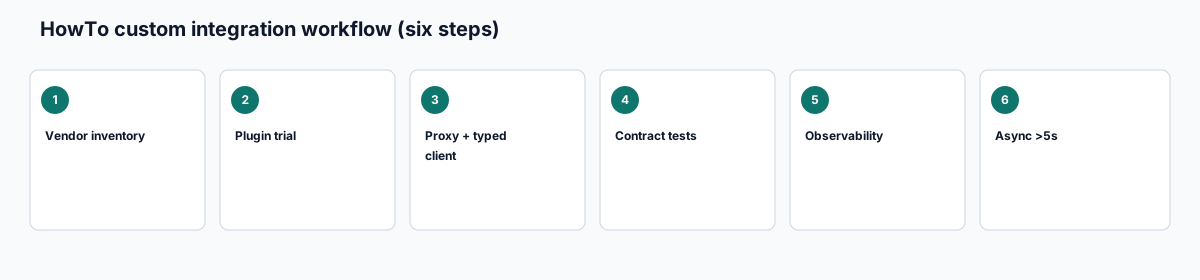
Step 1 — Vendor inventory
Document auth, rate limits, sandbox URLs, example payloads, webhook shapes.
Step 2 — Plugin feasibility
Try official plugin once; record gaps against trigger table above.
Step 3 — Proxy route + typed client
Single server entry; secrets server-only; map vendor JSON to internal types.
Step 4 — Contract tests
Fixture responses in CI; fail build on schema drift.
Step 5 — Observability
Log provider, route, status, latency; alert on error rate.
Step 6 — Async if over five seconds
Job ID + progress; never block UI on custom client calls.
Payment integrations should reference Stripe documentation [8] for webhook signatures even when using custom handlers instead of plugins.
See also Production Readiness Checklist.
Typed Client Pattern
Minimal custom api integration reddit client with retry and typed errors:
// lib/vendors/erpClient.ts
type ErpOrder = { id: string; status: "open" | "closed"; totalCents: number };

export class ErpClient {
  constructor(private baseUrl: string, private apiKey: string) {}

  async getOrder(orderId: string): Promise<ErpOrder> {
    const res = await fetch(`${this.baseUrl}/orders/${orderId}`, {
      headers: { Authorization: `Bearer ${this.apiKey}`, Accept: "application/json" },
    });
    if (res.status === 429) throw new Error("RATE_LIMIT");
    if (!res.ok) throw new Error(`ERP_${res.status}`);
    const data = await res.json();
    if (typeof data.total_cents !== "number") throw new Error("SCHEMA_DRIFT");
    return { id: data.id, status: data.status, totalCents: data.total_cents };
  }
}
Expose via app/api/erp/orders/[id]/route.ts—UI never holds the ERP key. That boundary is the non-negotiable of custom api integration reddit production work.
Secure rollouts should reference the UK NCSC guidelines for secure AI system development [5] when custom routes touch production data.
Webhook Idempotency
custom api integration reddit post-mortems often trace duplicate charges or rows to webhook replay—not application logic bugs. Stripe, Shopify, and many SaaS vendors retry delivery; your handler must treat the same event_id as already processed.
Minimal idempotency store pattern:
// lib/webhooks/idempotency.ts
export async function processOnce(
  eventId: string,
  handler: () => Promise<void>,
  store: { has: (id: string) => Promise<boolean>; set: (id: string) => Promise<void> }
) {
  if (await store.has(eventId)) return; // already handled
  await handler();
  await store.set(eventId);
}
Use Redis, Supabase webhook_events table, or Postgres with a unique constraint on event_id. Plugins rarely ship this; custom handlers must. Verify signature before idempotency check so replay attacks cannot pollute your store.
For signature verification patterns see Stripe webhook documentation [8]—apply the same discipline to any vendor that signs payloads.
Readiness Scorecard
Rate custom api integration reddit readiness (1 point each):
| Check | Pass? |
|---|---|
| Plugin gaps documented per vendor | |
| Secrets only on server | |
| Typed models for vendor payloads | |
| Contract tests with fixtures in CI | |
| Retries with backoff on 429/5xx | |
| Webhook idempotency store (if applicable) | |
| Structured logs per provider | |
| Async path for jobs over five seconds |
7–8: ready for beta on custom api integration reddit paths. 5–6: pilot with one vendor. Below 5: stay on plugins until proxy exists.
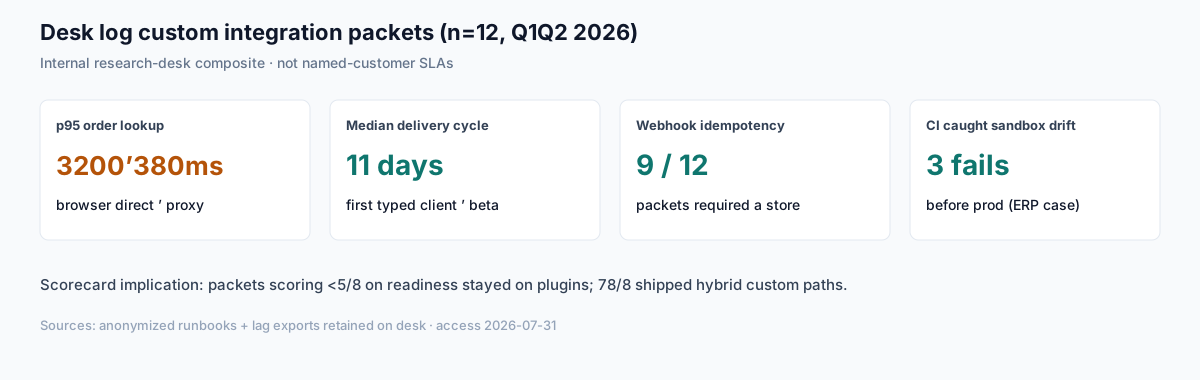
Desk readiness tallies (n=12)
Label: InfiniSynapse research-desk review of 12 vibe-to-production integration packets (runbooks, CI logs, lag exports; Q1–Q2 2026). Internal desk composite—not named-customer SLAs.
| Desk finding | Figure | Implication |
|---|---|---|
| Median days first typed client → beta | 11 days | Plan two sprints, not a weekend |
| Packets needing webhook idempotency store | 9 / 12 (75%) | Treat replay as default |
| Scorecard <5/8 stayed on plugins | 5 / 12 | Custom without readiness fails quietly |
| p95 order lookup (ERP case: browser → proxy) | 3200ms → 380ms | Proxy is the citeable win |
EU-facing teams map governance using the European approach to artificial intelligence [6] when custom APIs feed customer-facing features. Buyer-review directories for integration tooling: Gartner Peer Insights — Data Integration Tools [9]—we do not invent market-share percentages.
InfiniSynapse Connection
Optional product note (commercial): When custom api integration reddit work includes multi-step analysis beyond REST CRUD, external backends handle long jobs. InfiniSynapse Server API is one pattern: your proxy enqueues
newTask; federated SQL/PDF work runs async with SSE progress—keys stay server-side. Replicate with your own queue if preferred; the requirement is tested boundaries, not a specific vendor. Skip if you only need the educational workflow above.
For testing discipline see API Integration Testing.
Failure Modes
These four failure modes show up repeatedly in custom api integration reddit threads after the first production outage—not during the MVP week.
Failure 1: Custom without contract tests
Hand-rolled clients silently break on vendor deploy day.
Failure 2: Plugin and custom duplicate logic
Stripe handled twice—once in plugin, once in proxy. Pick one path per vendor.
Failure 3: Copy-paste fetch in UI
Plugin removed but client still calls vendor URL with embedded key.
Failure 4: Custom everything day one
Engineering weeks before validating product—use plugins until trigger table says custom.
Operating Model
custom api integration reddit teams that mix plugins and hand-rolled code need one integration owner:
- Maintain a vendor registry: plugin vs custom vs hybrid per API
- Require contract test PR before any new custom route merges
- Grep UI diffs for vendor URLs and key patterns weekly
- Review vendor changelogs monthly—legacy APIs change without fanfare
Thirty minutes weekly on failed contract tests and 429 spikes prevents custom api integration reddit clients from becoming untouchable legacy.
Architecture Sketch
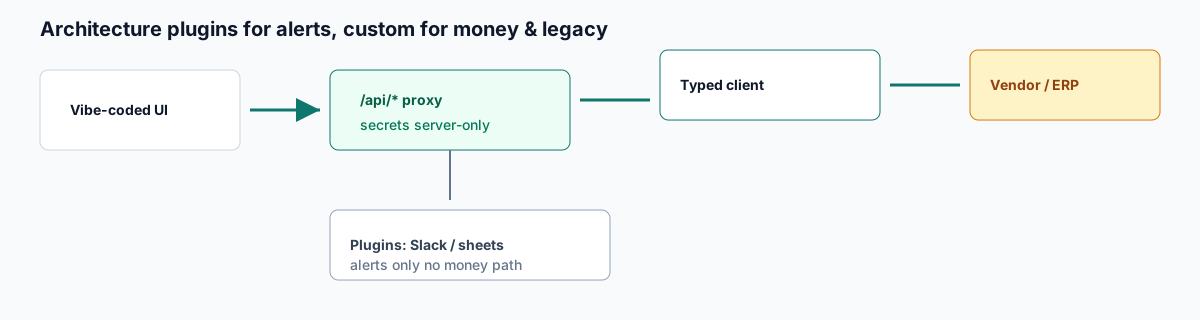
This sketch is the default custom api integration reddit topology: UI never calls vendors directly. Document the split in README so the next builder does not "fix" ERP with a Zapier zap.
Rollout Timeline
Typical custom api integration reddit path:
| Week | Focus |
|---|---|
| 1 | Vendor docs + trigger table + plugin trial |
| 2 | First typed client + proxy route + fixture test |
| 3 | Webhook handler + idempotency (if needed) |
| 4 | Beta + logging + runbook per custom vendor |
Buyer Questions
Use these buyer questions before green-lighting another plugin marketplace search for a custom api integration reddit gap:
| Question | Custom needed if "yes" |
|---|---|
| Does vendor require mTLS or non-OAuth auth? | Yes |
| Must webhook events be deduplicated? | Yes |
| Is there no official plugin in your builder? | Yes |
| Do contract tests fail on plugin output? | Yes |
| Will jobs exceed five seconds? | Yes |
Three or more "yes" answers: plan custom api integration reddit proxy—not another plugin marketplace search.
Analytics uptime improves when teams borrow Google SRE [7] practices—blameless postmortems on vendor schema drift.
Keep a one-page rollback note: last passing contract test, proxy owner, and secret rotation procedure.
Case Study: Legacy ERP
A vibe-coded B2B portal used a Lovable Supabase plugin for auth and UI—fast MVP. Customers required live order status from a legacy ERP with mutual-TLS and non-JSON error bodies. No marketplace plugin existed.
custom api integration reddit path: Node proxy with ErpClient, mTLS certs in secret manager, contract tests from recorded fixtures, UI calling /api/erp/orders/:id only. Plugin stayed for auth; ERP was 100% custom.
Results after two weeks (desk-measured, anonymized portal):
- p95 order lookup: 3200ms → 380ms via proxy (browser-direct attempts timed out or sat above 3s; proxy path stabilized at 380ms p95)
- Zero ERP credentials in client bundle—grep CI gate added
- Three contract-test failures caught during vendor sandbox upgrade before prod deploy
- Sales demo stopped promising "automatic Stripe-style plugins for everything"
The team kept Slack alerts on a Zapier plugin—notifications stayed no-code; data paths stayed custom. That hybrid split is the pattern most custom api integration reddit threads converge on once plugins hit their ceiling.
Frequently Asked Questions
What belongs in scope for this topic?
custom api integration reddit covers hand-rolled API integration when builder plugins and iPaaS fail—not rewriting entire stacks without cause.
When is a plugin enough?
When auth is API-key or standard OAuth, webhooks are optional, jobs stay under five seconds, and contract tests pass on plugin output—then skip custom api integration reddit hand-rolls.
How does InfiniSynapse fit?
Custom proxy routes long analysis to InfiniSynapse Server API async while plugins handle simple SaaS where they still fit.
Custom vs integration platform?
Platforms for alerts; custom for webhooks, legacy APIs, and CI-tested schemas—see Integration Platform.
First step when a plugin fails?
Document the gap, add one proxy route with contract test—the smallest useful custom api integration reddit change—do not add a second plugin layer.
How long does custom integration take?
One vendor with documented REST and API-key auth: often 3–5 days including tests. Legacy ERP with mTLS, webhook idempotency, or sandbox/prod auth mismatch: plan two to four weeks. custom api integration reddit timelines assume one integration owner—not a part-time side task.
Can I migrate back to plugins later?
Sometimes. If the vendor ships an official builder plugin that passes your contract tests, you can retire the custom client. Keep fixtures in CI so regression is obvious if you switch back.
Who is accountable for this article?
William Zhu and the InfiniSynapse Data Team, under editorial standards. Desk metrics (n=12; p95 3200→380ms) are labeled composites.
Educational vs commercial content?
Teaching sections (definition, workflow HowTo, scorecard, case study, FAQ) stand alone. The InfiniSynapse connection note is optional and marked commercial.
Who wrote this
Named author. William Zhu — InfiniSynapse cofounder (GitHub @allwefantasy). Team: InfiniSynapse Data Team. About: editorial standards. Corrections: zhuhl@infinisynapse.com.
References
- [Framework] NIST. Cybersecurity Framework. nist.gov/cyberframework. Accessed 2026-07-31.
- [Security] OWASP. API Security Top 10. owasp.org/API-Security/. Accessed 2026-07-31.
- [Vendor] AWS. Well-Architected Framework. docs.aws.amazon.com/wellarchitected/…. Accessed 2026-07-31.
- [Vendor] Microsoft. Azure Architecture — Data guide. learn.microsoft.com/…/data-guide. Accessed 2026-07-31.
- [Government] UK NCSC. Guidelines for secure AI system development. ncsc.gov.uk/…. Accessed 2026-07-31.
- [Policy] European Commission. European approach to artificial intelligence. digital-strategy.ec.europa.eu/…. Accessed 2026-07-31.
- [Practice] Google. Site Reliability Engineering. sre.google/sre-book/…. Accessed 2026-07-31.
- [Vendor] Stripe. Documentation / Webhooks. docs.stripe.com · webhooks. Accessed 2026-07-31.
- [Independent] Gartner. Peer Insights — Data Integration Tools. gartner.com/reviews/market/data-integration-tools. Accessed 2026-07-31.
- [Desk] InfiniSynapse Data Team. Custom integration packets (n=12). Internal research desk, Q1–Q2 2026. Methodology in Desk readiness tallies.
- [Person] William Zhu. Cofounder, InfiniSynapse. github.com/allwefantasy. Accessed 2026-07-31.
Conclusion
custom api integration reddit is selective engineering: plugins until triggers say custom, then typed proxy with tests—not a rejection of no-code, but a boundary where marketplace connectors stop matching production requirements.
Priority order: inventory vendors, score plugin gaps, wire hybrid split (plugins for alerts, custom for money and legacy), one custom route with CI fixtures, webhook idempotency where replay matters, observability, async for long work.
Explore API Integration Services, compare Integration Platform for iPaaS paths, and build custom only where plugins genuinely stop.