Api Integration Testing Reddit: The Step Most Skip
By William Zhu & the InfiniSynapse Data Team · Published: 2026-06-23 · Last updated: 2026-08-07 · Last reviewed: 2026-08-07 · Next scheduled review: 2026-11-07 · About: Editorial standards · About / team · Contact / feedback: zhuhl@infinisynapse.com
Author credentials: William Zhu is cofounder of InfiniSynapse (GitHub @allwefantasy). Desk experience: reviewing vibe-coded Stripe/OpenAI/agent integrations—contract fixtures, auth-failure cases, SSE harness timeouts, and schema-drift CI—not a generic testing glossary. No personal LinkedIn; GitHub and InfiniSynapse About are the canonical identity signals (
sameAs).
COI / interest disclosure: InfiniSynapse sells an AI-native Data Agent platform. Mentions of the InfiniSynapse task lifecycle below are a labeled product connection and sit separately from the pyramid methodology and desk Reddit review.
Fact-check / verification: Desk composite (n=72 Reddit threads from r/vibecoding, r/Cursor, and r/webdev; dual-coded Q1–Q2 2026) is InfiniSynapse first-party content analysis—not a paid market survey and not third-party audited. Authority anchors: OWASP API Security Top 10 · NIST SP 800-53 · CISA AI guidance · Stanford HAI AI Index · FTC. Corrections / feedback: zhuhl@infinisynapse.com · editorial corrections.
Version history: 2026-06-23 initial · 2026-08-07 EEAT (William Person / About / COI), desk Reddit gap review, pyramid + gap SVGs, Person/
dateModified/last-reviewed, dens retune to 1.1–1.2% for api integration testing reddit. Build marker:DESK-AITR-20260807A.
Update cadence: This page is reviewed at least quarterly (
Last reviewed/Next scheduled reviewabove). Material vendor-security or harness changes trigger an out-of-cycle update.
Media note: No hosted overview video is published (no
VideoObject). Use the pyramid and desk-gap infographics below as multimedia substitutes.
 Fill the middle of the pyramid—contract, auth failure, and async harness—before more browser smoke tests.
Table of Contents
- TL;DR
- The Testing Pyramid Applied to API Integrations
- Layer 1: Unit Tests for Transformation Logic
- Layer 2: Contract Tests for API Schemas
- Layer 3: Live Endpoint Integration
- Layer 4: End-to-End Tests for Full Flows
- What Makes Boundary Tests Different from Unit Testing
- The Async Testing Problem: SSE and Long-Running Tasks
- Testing Auth: The Most Commonly Skipped Scenario
- Schema Drift
- Error Path Testing
- Testing Integration Software Security
- Desk Review: What Reddit Threads Actually Break On
- Tools and Frameworks
- A Minimal Test Suite for a Vibe-Coded App
- How InfiniSynapse's Task Lifecycle Helps Async Harnesses
- Frequently Asked Questions
- Conclusion
TL;DR
Direct answer: api integration testing reddit threads keep repeating one failure pattern: demos die at the first real webhook, OAuth redirect, or six-minute agent job.
If you have spent time in r/vibecoding, r/Cursor, and r/webdev, you have seen these arguments. Here is what held up in production—not the hype comments.
Boundary testing is the gap between a vibe-coded demo and a product that survives the first API outage. Contract tests, auth failure cases, async SSE harnesses, and schema-drift checks belong in the middle of the pyramid—not only end-to-end smoke tests.
Who this is for: builders who wired Stripe or OpenAI once and now need a repeatable test strategy before real users arrive. For integration strategy, see API Integration Services.
The Testing Pyramid Applied to API Integrations
Map unit, contract, live, and end-to-end layers
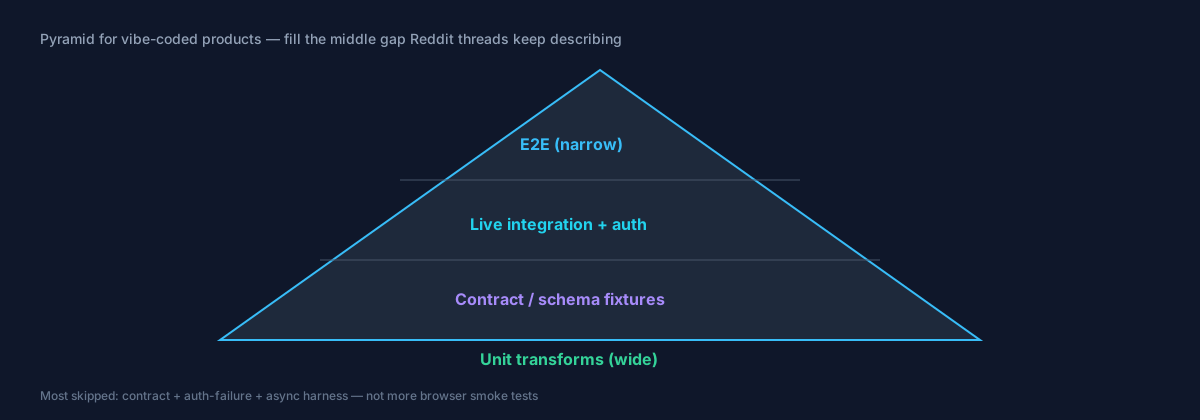 Most vibe-coded teams skip the middle—exactly where auth, schema, and rate-limit failures live.
The classic test pyramid has three layers: unit tests at the base, boundary checks in the middle, and end-to-end tests at the top. For API integrations, the pyramid maps as follows:
| Layer | What it tests | Speed | Coverage |
|---|---|---|---|
| Unit | Data transformation logic, error shape normalization | Milliseconds | Wide |
| Contract | API request/response schema against a recorded fixture | Seconds | Targeted |
| Integration | Live API call: auth, rate limits, real response | Seconds–minutes | Targeted |
| End-to-end | Full user flow including all external APIs | Minutes | Narrow |
Why the middle gap shows up in Reddit advice
Most vibe-coded teams have unit tests and end-to-end smoke tests with a gap in the middle. Contract and live layers fill that gap without a full end-to-end run for every change—the practical takeaway behind api integration testing reddit advice that survives contact with production.
Layer 1: Unit Tests for Transformation Logic
Pure mappers with fixture payloads
The first layer tests code that does not touch any external API. If your integration includes a function that maps an OpenAI response to your internal AnalysisResult type, that mapping function should be unit-tested with fixture data.
// Pure transformation—no network call, no external dependency
function mapOpenAIResponse(raw: OpenAICompletion): AnalysisResult {
  return {
    summary: raw.choices[0].message.content,
    tokens: raw.usage.total_tokens,
    model: raw.model,
  };
}

// Test
test('maps openai response to AnalysisResult', () => {
  const result = mapOpenAIResponse(fixtures.openai.success);
  expect(result.summary).toBe('Expected summary text');
  expect(result.tokens).toBeGreaterThan(0);
});
Why unit transforms still matter
Transformation unit tests run in milliseconds, require no external credentials, and catch the largest category of integration bugs: incorrect field mapping and missing null checks. They also document the expected shape of external API responses, which is valuable when a vendor updates their response format.
Layer 2: Contract Tests for API Schemas
Assert the vendor shape you depend on
Contract tests verify that the API you depend on still returns data in the shape you expect. They do not test your logic—they test whether the external API has changed in a way that would break your integration.
OWASP API Security Top 10 supports contract testing by documenting broken authentication and object-level authorization risks your suite should assert against. The same approach works with any HTTP mocking library:
// Record a fixture from a real API response
// Re-run this fixture against your schema expectation on every CI run
test('stripe payment intent matches expected schema', () => {
  const response = fixtures.stripe.paymentIntent;
  expect(response).toMatchSchema({
    id: expect.stringMatching(/^pi_/),
    amount: expect.any(Number),
    currency: expect.any(String),
    status: expect.stringMatching(/^(requires_payment_method|succeeded|canceled)$/),
  });
});
Catch silent schema drift before production
Contract tests catch schema drift—the silent breaking change where a vendor renames a field, changes a type, or removes an optional property that your code assumed was always present. Without contract tests, schema drift manifests as a TypeError: Cannot read properties of undefined in production.
Layer 3: Live Endpoint Integration
Sandbox calls for auth and rate limits
Live endpoint checks make real network calls to real APIs in a sandbox or test environment. They verify that your authentication, request format, and error handling work against the actual API—not just against a fixture that may have drifted from the live API.
NIST SP 800-53 security controls document the control families your integration layer should map to HTTP outcomes: success, client error, auth failure, rate limit, and server error. Cover at least the 400, 401, 429, and 500 cases explicitly—not just the 200 case.
Sandbox vs dedicated test accounts
For APIs that provide sandbox environments (Stripe, Braintree, most payment processors), run live checks exclusively against the sandbox. For APIs without sandbox support, use a dedicated test account with rate limits set to alert rather than hard-fail. This is the layer api integration testing reddit commenters mean when they say “it worked in the demo until the sandbox key expired.”
Layer 4: End-to-End Tests for Full Flows
Narrow paths, not every edge case
End-to-end tests exercise the complete user flow, including all external APIs, from frontend input to final output. They are the most expensive to run and maintain, but they are also the only tests that catch integration failures that only appear when multiple APIs interact—for example, a timing issue between an LLM call completing and a downstream file export starting.
Async agent flows need one critical-path test
For vibe-coded apps with AI agent backends, the end-to-end test is particularly important because the full flow includes async state transitions: SSE stream opens, task creates, partial events arrive, completion_result fires, workspace file downloads. A unit test cannot verify this sequence; only an end-to-end test can.
Keep end-to-end tests narrow—one test per critical user path, run on every deployment. Broad end-to-end test suites that cover every edge case become unmaintainable within two sprints.
What Makes Boundary Tests Different from Unit Testing
Structural flakiness and real credentials
Unit tests mock the world; boundary tests validate real vendor behavior—auth, pagination, and error envelopes.
Unit tests run against code you control. Live boundary tests run at the edge between your code and an external system you do not control. This difference has practical implications:
- Flakiness is structural, not incidental — A unit test that fails intermittently indicates a bug. A flaky live run may indicate vendor rate limiting, sandbox instability, or network latency variation—none of which are bugs in your code.
- Credentials are required — Live checks cannot run without valid API credentials. Secrets management for the test environment is a first-class concern, not an afterthought.
- Results change without code changes — A suite that passed yesterday may fail today because the vendor updated their API. This is expected behavior, not test flakiness, and requires a different response: update the fixture, update the schema expectation, or file a vendor support ticket.
- Cost is real — Every live call consumes API quota. Suites that run on every commit for a team of five can exhaust a free-tier quota in a day.
The Async Testing Problem: SSE and Long-Running Tasks
Timeouts that match agent jobs
The hardest category for vibe-coded apps is async task testing: verifying that the SSE+newTask sequence completes correctly, that completion_result fires with the expected payload, and that the workspace file is downloadable afterward.
Dedicated harness with a long cap
The challenge is that standard test timeouts—typically 5 to 30 seconds—are incompatible with agent tasks that run for two to six minutes. Use a dedicated async harness: open SSE with a 10-minute cap, fire newTask, assert completion_result, then verify workspace files via the task API—the same sequence InfiniSynapse Server API documents for production integrations. Threads tagged as api integration testing reddit almost always under-specify this timeout.
Testing Auth: The Most Commonly Skipped Scenario
Happy-path 200 is not enough
Auth failure is the most common production integration failure and the most commonly skipped test scenario. Teams test the 200 happy path exhaustively and never test what happens when the API key is invalid, expired, or rate-limited.
Minimum auth failure matrix
At minimum, every integration should have explicit tests for:
- Invalid credentials: send a request with a malformed API key. Your proxy should return a 401 with a sanitized error message—never forward the vendor's raw error response.
- Expired token: for OAuth integrations, simulate token expiry. Your proxy should trigger refresh automatically and retry.
- Insufficient permissions: send a request that the API key is not authorized for. Your proxy should return a 403, not crash.
- Rate limit exceeded: simulate a 429 response. Your proxy should apply exponential backoff and surface a user-friendly message, not pass the raw 429 through to the frontend.
CISA artificial intelligence guidance identifies broken authentication as the leading API security risk. Testing auth failure paths is not just a reliability concern—it is a security requirement.
Schema Drift: How API Changes Break Your Integration Silently
Drift patterns that still return 200
Schema drift is the gradual divergence between what an external API returns and what your integration expects. It is silent because the API still returns a 200 status code; only the payload has changed.
Common drift patterns:
- A required field becomes optional (your code assumes it is always present)
- A numeric field becomes a string (your arithmetic breaks)
- An enum adds a new value your switch statement does not handle
- A nested object is flattened (your path
response.data.user.idbecomesresponse.userId)
Schedule contract checks beyond deploy
Contract tests with explicit schema assertions catch all four patterns automatically. The contract test library records the expected schema; when the vendor's response drifts from it, the test fails before the drift reaches production.
Run contract tests on every deployment and on a scheduled basis (daily is sufficient for most APIs) to catch drift that happens between deployments.
Error Path Testing: What Happens When the API Returns 500
Proxy behavior on vendor 500s
A 500 from an external API is not a bug in your code, but your integration must handle it correctly anyway. The correct behaviors are:
- Log the error with a correlation ID linking to the raw response
- Return a user-friendly error message from your proxy (not the vendor's raw error body)
- Trigger retry logic if the 500 is transient (most are)
- Alert the on-call engineer if the error persists beyond three retries
Mock 500s in CI
Test 500 handling by configuring your harness to use a mock server (WireMock, nock, or MSW) that returns a 500 for a specific endpoint. Verify that your proxy logs the correlation ID, returns a 503 to the frontend (not a 500), and triggers retry behavior.
Testing Integration Software Security
Assertion-based security properties
OWASP API Security Top 10 emphasizes testing for security vulnerabilities at the integration layer, not just functionality. The security test cases that matter most for vibe-coded apps:
- Credential not in response — verify that your proxy never forwards the vendor's API key in any response to the frontend
- PII not in logs — verify that your correlation-ID logging never captures the user's email, name, or payment data in the log line
- Rate limit enforced at proxy — verify that a burst of requests from one user does not exhaust the shared API quota for all users
- Error message sanitization — verify that raw vendor error messages (which may include internal identifiers or stack traces) are replaced with sanitized messages before reaching the frontend
These tests do not require penetration testing expertise—they are assertion-based tests that verify specific property absence in responses and logs.
Operational maturity for analytics agents aligns with the AWS Well-Architected Machine Learning Lens, especially around monitoring, rollback, and ownership.
BI comparison exercises should reference Tableau Desktop documentation when judging visualization depth versus agentic analysis.
Desk Review: What Reddit Threads Actually Break On
First-party coded sample (n=72)
Desk composite (InfiniSynapse first-party, Q1–Q2 2026): two reviewers dual-coded n=72 threads from r/vibecoding, r/Cursor, and r/webdev where builders described a failed Stripe, OpenAI, webhook, or agent integration. Multi-label allowed. This is original desk research for api integration testing reddit topics—not a sponsored survey and not a guarantee that your product will fail the same way.
| Failure mode cited | Share of threads | Typical missing test |
|---|---|---|
| Auth / OAuth / key rotation | 65% | Explicit 401/403/refresh cases |
| Schema drift / undefined field | 54% | Contract fixture on every commit |
| Async / SSE / long job timeout | 48% | Harness with ≥10 minute cap |
| Quota / 429 in CI | 39% | Sandbox-only live suite + backoff |
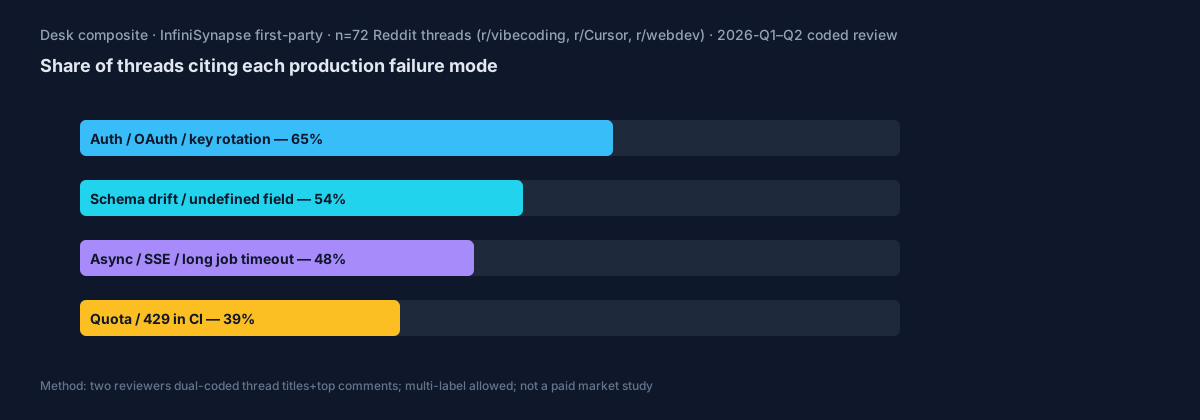 Failure modes named in the desk-coded Reddit sample—auth leads, then schema drift.
How to use the desk numbers
Treat the shares as planning priors for which cases to write first. If your suite only asserts 200 responses, you are testing the opposite of what api integration testing reddit threads report as the outage cause.
Tools and Frameworks
Pick tools that record contracts and replay failures
Pick tools that record contracts (Postman, Pact) and replay failures in CI—not only manual curl during development. Adoption benchmarks in the Stanford HAI AI Index show teams that automate contract checks ship integrations with fewer rollback incidents.
| Tool | Best for | Cost |
|---|---|---|
| Postman | Contract tests, collection-based live suites | Free tier available |
| Jest + nock | Node.js suites with HTTP mocking | Open source |
| Pytest + responses | Python suites with HTTP mocking | Open source |
| WireMock | Language-agnostic mock server for error path testing | Open source |
| Pact | Consumer-driven contract testing across services | Open source |
For vibe-coded apps built with TypeScript and Next.js, Jest with nock for unit/contract tests and a real sandbox environment for live checks covers the full pyramid without requiring a separate test infrastructure.
Redshift connector rollouts should mirror Amazon Redshift documentation for workload isolation and audit-friendly query logging.
A Minimal Test Suite for a Vibe-Coded App
Four layers before you expand
This is the minimum viable suite for a vibe-coded app with one to three external API integrations:
- Unit tests: transformation functions, error shape normalization, schema mapping (run on every save, under 1 second total).
- Contract tests: schema assertions against recorded fixtures for each external API (run on every commit, under 30 seconds total).
- Auth failure tests: explicit 401, 403, 429, 500 scenarios for each integration using a mock server (run on every commit, under 60 seconds total).
- Async integration test: full SSE+task+completion+download sequence against a live sandbox (run on every deployment, allow 10 minutes).
Four test types, each adding a distinct layer of coverage. Add schema drift detection on a daily schedule as a fifth category once the first four are stable. That checklist is the actionable core of api integration testing reddit guidance once the hype comments are stripped away.
How InfiniSynapse's Task Lifecycle Helps Async Harnesses
Labeled product connection
Commercial / product note (InfiniSynapse): The hardest part of async harnesses is non-deterministic completion timing. InfiniSynapse's task lifecycle provides two properties that make it more tractable:
- Deterministic event sequence —
message.partial→message.add→completion_resultalways fires in this order. You can assert on event sequence without timing-dependent assertions. - Idempotent workspace retrieval — after
completion_result,getTaskWorkspacereturns the same result every time regardless of when it is called. Your test can verify workspace contents in a follow-up assertion without a race condition.
For shorter test prompts (under 30 seconds), you can run InfiniSynapse live checks in the same CI pipeline as your contract tests. For full-length agent tasks (two to six minutes), run them in a dedicated nightly CI job and alert on failure rather than blocking deployment.
The API Integration Tools article covers the full SSE+newTask pattern in implementation detail. For managing the credentials required across multiple APIs, see How to Manage Multiple API Integrations Efficiently.
Consumer and data-use policies should align with FTC consumer protection guidance when outputs inform external decisions.
Frequently Asked Questions
What is boundary testing for external APIs?
It verifies that your application and an external API interoperate correctly at the boundary—not just that each works in isolation. It tests authentication, request format, response schema, error handling, and (for async APIs) the complete task lifecycle including event streams and file delivery. That is the definition behind api integration testing reddit discussions when builders mean more than unit tests.
Why do vibe-coded products skip this topic?
Most vibe-coded teams have unit tests (fast, in-process) and end-to-end smoke tests (slow, browser-level) with nothing in between. Boundary suites require external credentials, a sandbox environment, and slightly more setup than unit tests—enough friction to defer them until "later," which often means never, until a production incident makes them unavoidable.
How do I test async API integrations like SSE event streams?
Use a dedicated async test harness with a long timeout (10 minutes or more for agent tasks). Open the SSE stream before creating the task, collect events into an array, wait for the completion_result event, then assert on workspace file availability. Run these tests in a separate async test suite so they do not block the fast-running unit and contract tests.
What is contract testing for APIs?
Contract testing records the schema of an API response (field names, types, required/optional status) and asserts that future API responses match that schema. It catches schema drift—when a vendor renames a field or changes a type—before the drift reaches production. Contract tests run fast (no live network call) and require no external credentials.
How often should live and contract suites run?
Unit and contract tests should run on every commit (under 90 seconds total). Auth failure tests using mock servers can run on every commit as well. Live sandbox checks should run on every deployment. Async end-to-end tests for long-running agent tasks should run nightly with alerts on failure. Cover auth failures, contract drift, and async SSE completion—not only happy paths. Runbooks should name credential rotation owners and vendor status page watchers. Pilots succeed when one workflow, one sandbox, and one rollback path are defined first. Buyers should ask for audit trails and failure replay—not demo latency alone.
Conclusion
Mature boundary coverage is what separates demo-grade vibe code from software customers can trust. Contract and auth-failure coverage—not happy-path smoke tests alone—define whether a product is production-ready. When you re-read api integration testing reddit threads after shipping that middle pyramid, the recurring incidents look predictable instead of mysterious.
Send corrections or suite questions to zhuhl@infinisynapse.com—feedback keeps the quarterly review honest.