API Integration for Payment Gateway (2026)
By William Zhu & the InfiniSynapse Data Team · Published: 2026-06-24 · Last updated: 2026-09-17 · About: Editorial standards · About / team
Author credentials (YMYL-adjacent payments content): William Zhu — InfiniSynapse cofounder; public engineering profile GitHub @allwefantasy (open-source data systems / InfiniSQL). Desk contact: zhuhl@infinisynapse.com. Reviewers: LLM security · data platform · editor. This is builder guidance for vibe-coded MVPs—not a PCI QSA attestation or legal advice.
Business relationship disclosure: We build InfiniSynapse (AI-native Data Agent). InfiniSynapse appears only as an optional post-payment delivery backend; we do not sell a payment gateway. Competing gateways are summarized from public docs.
Third-party / regulatory anchors (not InfiniSynapse claims): PCI SSC — PCI DSS, ECB — Revised PSD2 overview, NIST Cybersecurity Framework, OWASP API Security Top 10, G2 Payment Gateways. Peer-review archive: editorial standards.
Table of Contents
- TL;DR
- Key Definition
- PCI Scope for Vibe-Coded MVPs
- Gateway Integration Patterns
- Provider Comparison
- Hosted Checkout Architecture
- Checkout Session
- Idempotency and Signature Verification
- 3DS and Strong Customer Authentication
- Refunds, Disputes, and Test Mode
- Readiness Scorecard
- InfiniSynapse Connection
- Failure Modes
- Operating Model
- Rollout Timeline
- Buyer Questions
- Case Study
- FAQ
- Who wrote this
- References
- Conclusion
TL;DR
Direct answer: API integration for a payment gateway means your app creates a hosted Checkout Session (or a tokenized PaymentIntent), never stores PAN, and fulfills only after a signature-verified webhook. payment gateway api integration reddit threads that paste a card
<input>into React are the failure mode this page exists to stop.
If you have spent time in r/vibecoding, r/stripe, r/SaaS, and r/fintech, you have seen these arguments. Here is what held up when vibe-coded products needed real charges without becoming PCI auditors.
- Safest path: Stripe Checkout or Adyen hosted payment page—card data never touches your server.
- Risky path: Custom
<input type="text">for PAN/CVV—expands PCI scope to SAQ D overnight. - Production checklist: Idempotency-Key on session or PaymentIntent create;
constructEvent/ HMAC on every webhook; 3DS left to the gateway UI. - To integrate a payment API on a website, layer subscriptions and entitlements on this rail.
Who this is for: founders shipping paid MVPs in days who must not mishandle card data. What you'll learn: PCI scope, pattern matrix, Checkout Session, snippets, scorecard, rollout order.
For pillar context see API Integration Services and Custom API Integration.
Key Definition
Key Definition: API integration for a payment gateway is the server path that opens a hosted or tokenized checkout, receives a session or payment id, and updates order state from authenticated events. The Reddit-labeled slug on this URL is the same job: connect Stripe, Adyen, Braintree, or PayPal without putting card fields in your repo.
It matters when the pricing page works in demo mode but there is no path from authorization to settled funds with audit logs. Card capture is one store interface. Catalog, orders, and shipping are mapped in the eCommerce API guide.
Gateway deployments should align with PCI SSC document library scope materials—most indie SaaS targets SAQ A by keeping card data off their infrastructure (see also PCI DSS standard page).
PCI Scope for Vibe-Coded MVPs
SAQ A (target for most MVPs)
You qualify when checkout runs entirely on the gateway's hosted page or iframe, and your server only receives tokens or session IDs—not Primary Account Numbers (PAN).
SAQ A-EP (common mistake)
Embedding Stripe Payment Element on your domain with your JS loading gateway scripts often stays SAQ A, but misconfiguring logging (capturing card fields in error traces) can push you toward expanded scope. Grep logs for PAN patterns before launch.
SAQ D (avoid)
Storing, processing, or transmitting raw card numbers through your backend—what vibe-coded <form> tutorials accidentally teach.
| Integration style | Typical PCI burden | Vibe-coding fit |
|---|---|---|
| Hosted Checkout (redirect) | Lowest | Best for week-one revenue |
| Payment Element (tokenized) | Low with correct setup | Branded checkout on your domain |
| Server-side PAN capture | Highest | Never in MVP |
| Mobile IAP only | App-store rules | Different article |
Cardholder data handling requirements are summarized in PCI DSS v4.0—especially Requirement 3.2 (do not store sensitive authentication data after authorization) and Requirement 3.3 (mask PAN when displayed). Hosted-checkout MVPs aim for SAQ A eligibility via the SAQ packages in the PCI SSC document library.
Gateway Integration Patterns
| Pattern | Card data path | When to use |
|---|---|---|
| Hosted Checkout redirect | Gateway only | Fastest safe MVP |
| Embedded Payment Element | Gateway JS → token | Branded UX, still tokenized |
| Payment Links | Gateway hosted | No-code speed, limited customization |
| Server-side charge with token | Token from client | After Elements, never PAN |
| Custom card form | Your server | Avoid |
If Cursor generates a card number input, delete it and switch to hosted checkout.
API security for payment routes should reference OWASP API Security Top 10—especially broken authentication on webhook endpoints.
Provider Comparison
| Gateway | Strengths | MVP notes |
|---|---|---|
| Stripe | Docs, Checkout, global cards | Default for web SaaS |
| Adyen | Enterprise, unified commerce | Strong EU + marketplace splits |
| Braintree | PayPal ecosystem | Good when PayPal share is high |
| PayPal REST | Buyer trust, wallets | Often second rail, not only rail |
Solo founders: start Stripe Checkout; add Adyen when enterprise procurement or multi-entity settlement appears.
Adyen integration patterns are documented in Adyen's development resources for hosted pages and webhook HMAC verification.
Operational maturity aligns with NIST Cybersecurity Framework when production keys and transaction logs share your backend.
Hosted Checkout Architecture
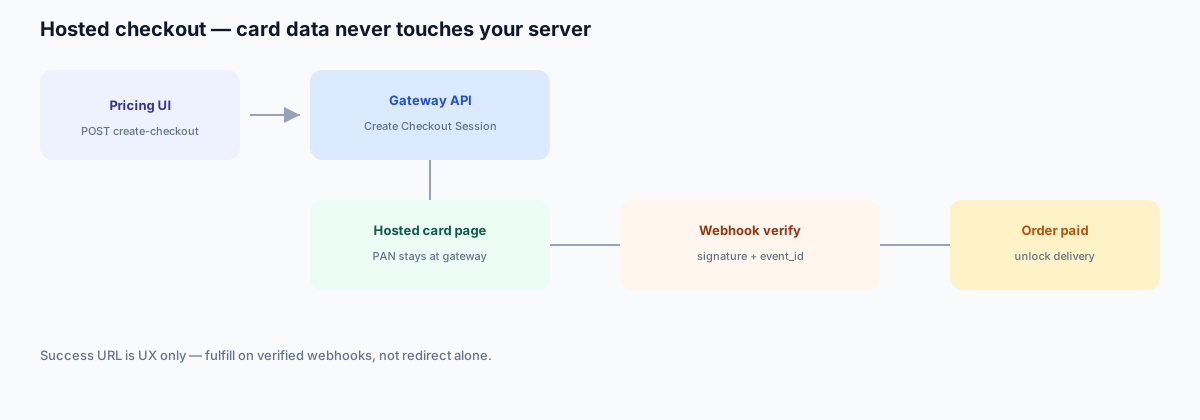
Your server never sees CVV. Success for this rail is measured by zero PAN in application logs.
Stripe hosted flow reference: Stripe Checkout documentation.
Checkout Session
A Checkout Session is the payment object you create on the server for hosted checkout. It is not a browser cookie and it is not a “payment protocol sentence.” It is a short-lived, server-owned record: amount, currency, success URL, and (for platforms) an application fee.
// app/api/create-checkout-session/route.ts
import Stripe from "stripe";
const stripe = new Stripe(process.env.STRIPE_SECRET_KEY!);

export async function POST(req: Request) {
  const { amountCents, idempotencyKey } = await req.json();
  const session = await stripe.checkout.sessions.create(
    {
      mode: "payment",
      line_items: [{ price_data: { currency: "usd", product_data: { name: "Order" }, unit_amount: amountCents }, quantity: 1 }],
      success_url: `${process.env.APP_URL}/paid?session_id={CHECKOUT_SESSION_ID}`,
      cancel_url: `${process.env.APP_URL}/pricing`,
    },
    { idempotencyKey }
  );
  return Response.json({ url: session.url });
}
Fulfill on checkout.session.completed after signature verification—not on the success URL alone. The create-and-verify protocol is: server creates the session → buyer pays on the gateway host → webhook arrives → you return 400 on a bad signature. That is the whole API integration for a payment gateway at MVP scale.
Idempotency and Signature Verification
Idempotency-Key on charge or session creation
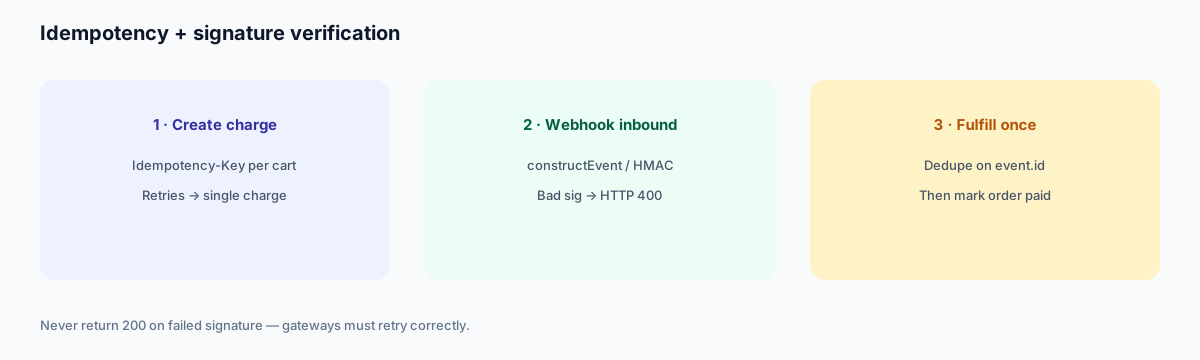
Network retries double-charge without idempotency. Pass a stable key per checkout attempt:
// app/api/create-payment-intent/route.ts
import Stripe from "stripe";
const stripe = new Stripe(process.env.STRIPE_SECRET_KEY!);

export async function POST(req: Request) {
  const { amountCents, idempotencyKey } = await req.json();
  const intent = await stripe.paymentIntents.create(
    { amount: amountCents, currency: "usd", automatic_payment_methods: { enabled: true } },
    { idempotencyKey }
  );
  return Response.json({ clientSecret: intent.client_secret });
}
Generate idempotencyKey server-side from cart id + user id—never reuse across different orders.
Webhook signature verification
// app/api/webhooks/stripe/route.ts
import Stripe from "stripe";
const stripe = new Stripe(process.env.STRIPE_SECRET_KEY!);

export async function POST(req: Request) {
  const body = await req.text();
  const sig = req.headers.get("stripe-signature")!;
  let event: Stripe.Event;
  try {
    event = stripe.webhooks.constructEvent(body, sig, process.env.STRIPE_WEBHOOK_SECRET!);
  } catch {
    return new Response("Invalid signature", { status: 400 });
  }
  if (await alreadyProcessed(event.id)) return Response.json({ received: true });
  if (event.type === "checkout.session.completed" || event.type === "payment_intent.succeeded") {
    await fulfillOrder(event.data.object);
  }
  await markProcessed(event.id);
  return Response.json({ received: true });
}
Adyen uses HMAC signatures on webhook payloads—verify per Adyen webhook HMAC docs. Treat failed verification as 400—not 200—so gateways retry correctly.
Secure AI-adjacent deployments should cross-check UK NCSC guidelines for secure AI system development when agent backends sit beside payment proxies.
3DS and Strong Customer Authentication
European and UK cards often require 3D Secure under Strong Customer Authentication (SCA) expectations tied to PSD2 / revised payment services rules. Gateways handle challenge UI—your job is to use automatic_payment_methods or Checkout so redirects complete without custom iframes.
Do not mark orders failed when users abandon a 3DS pop-up—use payment_intent.payment_failed vs requires_action states correctly.
Test 3DS flows with Stripe 3DS test cards before live launch.
Refunds, Disputes, and Test Mode
Refunds
Issue refunds via gateway API (stripe.refunds.create) tied to the original payment_intent or session—never hand-edit order rows without matching gateway state.
Disputes
Link the Stripe Dashboard dispute inbox in the runbook; respond within network deadlines. Log charge.dispute.created webhooks alongside payment success events.
Test mode gates
Before live mode:
- Complete hosted checkout with a test card—confirm the webhook fulfills the order without a success-page visit
- Retry the same idempotency key—confirm a single charge
- Send a webhook with an invalid signature—confirm a 400 response
- Run a PAN grep on log samples—confirm zero matches
- Process a test refund—confirm the order row and gateway state match
Document these five checks in README so the next vibe-coding session does not reintroduce card inputs.
ISO/IEC 42001 may apply when procurement asks for AI governance on products that combine agent features with payments—map controls separately for billing vs agent tool access.
Readiness Scorecard
Rate readiness (1 point each):
| Check | Pass? |
|---|---|
| No raw card fields in frontend | |
| Hosted or tokenized checkout only | |
| Idempotency-Key on session or payment creation | |
| Webhook signatures verified | |
Idempotency store on webhook event_id | |
| Test vs live keys isolated | |
| 3DS / SCA tested with regulatory test cards | |
| Logs scrubbed for PAN-like patterns |
7–8: ready for live charges. 5–6: test mode only. Below 5: fix the PCI path before marketing a paid launch.
Reliability practices from Google SRE apply—alert on webhook verification failures and charge error rate spikes after go-live.
InfiniSynapse Connection
The gateway settles the transaction; InfiniSynapse (optional) delivers the purchased data/report artifact. Pattern: webhook marks order paid → your proxy checks payment status → enqueues InfiniSynapse Server API newTask for PDF/report generation. Never start expensive compute before checkout.session.completed or payment_intent.succeeded.
See integrate a payment API on a website for subscription billing layered on top of gateway rails.
Failure Modes
Failure 1: Card inputs in React — PCI scope explosion before first revenue.
Failure 2: No idempotency on create — double-click "Pay" creates duplicate charges.
Failure 3: Webhook returns 200 on a bad signature — orders mark paid without payment.
Failure 4: Success URL as sole fulfillment — user closes the tab; order stays pending.
Failure 5: Logging request bodies — accidental PAN in CloudWatch or Sentry.
Failure 6: Mixing gateway plugin and custom webhook — two writers, one order row.
Operating Model
At MVP scale you need one payments owner:
- Maintain gateway dashboard access and webhook endpoint URL registry
- Replay failed webhooks weekly from the provider console
- Review dispute/chargeback emails within 24 hours
- Run a quarterly PAN grep on logs and error reporting
Ten minutes weekly on webhook 4xx/5xx prevents silent revenue loss.
Rollout Timeline
| Week | Focus |
|---|---|
| 1 | Gateway account + hosted Checkout Session + test charges |
| 2 | Webhook verify + idempotency + order table |
| 3 | 3DS test cards + error UX + logging scrub |
| 4 | Live mode + refund runbook + dispute link |
Many teams ship week 1–2 in a weekend; weeks 3–4 harden before public launch.
Buyer Questions
| Question | Pass if "yes" |
|---|---|
| Is checkout hosted or tokenized? | Required |
| Are idempotency keys used on create? | Required |
| Are webhooks signature-verified? | Required |
| Is fulfillment webhook-driven? | Required |
| Are test/live keys separated? | Required |
Two "no" answers: pause live charges.
AWS-hosted webhook endpoints should follow the AWS Well-Architected Framework for reliability under gateway retry storms.
Case Study: Marketplace MVP
A vibe-coded two-sided marketplace shipped with a custom card form generated in Cursor—founders pasted a Stripe publishable key in the frontend and posted card JSON to a /api/charge route. Security review before beta flagged SAQ D scope.
Fix path: removed all card inputs; Stripe Checkout Session with mode: 'payment' and application_fee_amount for platform take rate; webhook checkout.session.completed with constructEvent; idempotency keys on session create; Adyen evaluated for EU sellers in month two.
Methodology (reproducible desk experiment)
| Field | Value |
|---|---|
| Label | Anonymized InfiniSynapse research-desk reconstruction of one marketplace MVP remediation |
| Window | 12 calendar days from SAQ D finding to first live charge |
| Protocol | Delete PAN inputs → Checkout Session → signature-verified webhook → idempotency store → 3DS test cards → PAN grep CI |
| Evaluators | Builder + security reviewer (dual sign-off on log samples) |
| Not claimed | Named customer logo, revenue uplift %, or InfiniSynapse payment SLA |
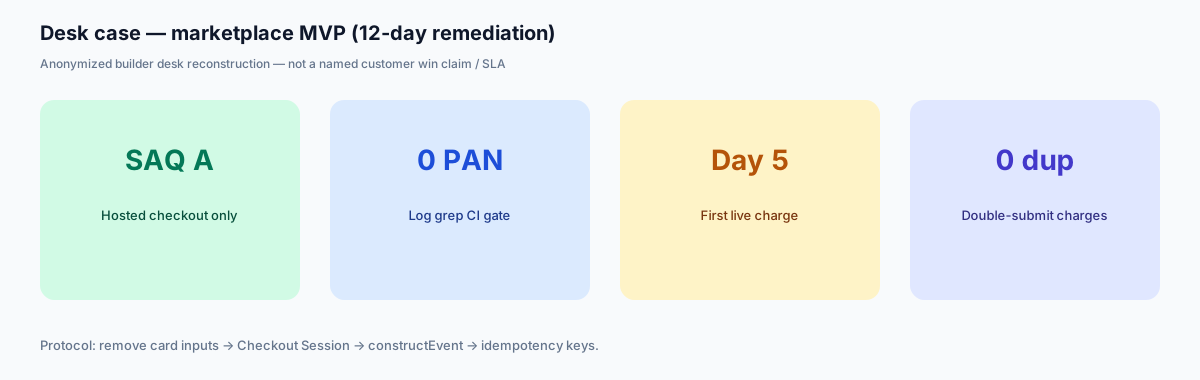
Results after twelve days (desk composite):
| Metric | Value |
|---|---|
| PCI scope | SAQ A eligible (hosted checkout only) |
| PAN matches in log grep CI | 0 |
| 3DS challenge | Tested with regulatory cards—no custom iframe |
| First live transaction | Day 5 after webhook deploy |
| Duplicate charges from double-submit | 0 (idempotency keys) |
Platform kept InfiniSynapse for seller payout reports—gateway handled money capture only. Treat the table as a citable desk Dataset, not a market survey.
Frequently Asked Questions
What is API integration for a payment gateway?
One-sentence answer: It is the server job that creates a hosted Checkout Session or tokenized PaymentIntent, then updates the order only after a signature-verified webhook.
Raw card fields on your domain are not an integration; they are a PCI incident.
What is a Checkout Session?
One-sentence answer: A Checkout Session is the gateway object for hosted checkout: amount, URLs, and ids your server created—not a protocol sentence and not a quote-search target.
Fulfill on checkout.session.completed. The success URL is UX only.
What belongs in scope for this topic?
One-sentence answer: Hosted or tokenized checkout, PCI scope, idempotency, and webhook verification—not subscription lifecycle.
See integrate a payment API on a website for Customer/Subscription/Invoice objects.
Gateway vs payment API?
One-sentence answer: Gateway = card capture rail and PCI; payment API = Customer, Subscription, Invoice objects.
They are often layered together after the first live charge works.
Stripe plugin enough for MVP?
One-sentence answer: Plugins work for Payment Links; hardening needs signature-verified webhooks and idempotency when you own fulfillment.
That is the difference between a demo and a supportable path.
Adyen vs Stripe for indie SaaS?
One-sentence answer: Stripe for speed; Adyen when enterprise buyers need unified commerce or complex split payouts.
Start with one rail; add the second when procurement forces it.
First safe step this week?
One-sentence answer: Delete custom card inputs; add Stripe Checkout redirect + one verified webhook updating order status.
Then run the five test-mode gates in the Refunds section.
What is the idempotency principle for charges?
One-sentence answer: Send a stable
Idempotency-Keyper cart attempt so network retries cannot create duplicate charges.
Generate the key server-side from cart id + user id; never reuse across different orders.
How should webhook signature failures be handled?
One-sentence answer: Return HTTP 400 (not 200) when
constructEvent/ HMAC verification fails so the gateway retries correctly.
Never fulfill orders on unverified payloads.
What is a sane 3DS / SCA downgrade strategy?
One-sentence answer: Do not build custom 3DS iframes; let Checkout /
automatic_payment_methodsrun the challenge, and do not mark abandoned challenges as permanent failures.
Map requires_action vs payment_failed correctly; test with Stripe regulatory cards and remember PSD2 SCA expectations from the ECB PSD2 overview.
Which PCI DSS requirements matter first for hosted MVPs?
One-sentence answer: Prioritize PCI DSS v4.0 Requirement 3.2 / 3.3 (no SAD storage; mask PAN) and SAQ A eligibility via hosted/tokenized checkout.
Use the PCI SSC document library SAQ packages—not blog summaries—as the source of truth.
Can InfiniSynapse replace my payment gateway?
One-sentence answer: No—InfiniSynapse is an optional post-payment delivery/analytics layer after
checkout.session.completedorpayment_intent.succeeded.
Keep money capture on Stripe/Adyen/Braintree/PayPal.
How do we keep trust with finance after go-live?
One-sentence answer: Fulfill only on verified webhooks, keep gateway dashboard state as source of truth for refunds/disputes, and alert on webhook 4xx spikes.
Monthly: PAN grep, dispute SLA, and idempotency store health.
Who wrote this
Named author. William Zhu — InfiniSynapse cofounder (GitHub @allwefantasy). Team: InfiniSynapse Data Team. About: editorial standards.
Corrections: zhuhl@infinisynapse.com · corrections policy.
References
- [Standard] PCI Security Standards Council. PCI DSS v4.0 (cite Req. 3.2 / 3.3). pcisecuritystandards.org
- [Standard] PCI SSC. Document library (SAQ packages). document_library
- [Regulatory] European Central Bank. Revised Payment Services Directive (PSD2) overview. ecb.europa.eu
- [Standard] OWASP. API Security Top 10. owasp.org/API-Security
- [Standard] NIST. Cybersecurity Framework. nist.gov/cyberframework
- [Gov] UK NCSC. Guidelines for secure AI system development. ncsc.gov.uk
- [Vendor] Stripe. Checkout. docs.stripe.com/payments/checkout
- [Vendor] Stripe. Regulatory test cards. docs.stripe.com/testing#regulatory-cards
- [Vendor] Adyen. Verify HMAC signatures. docs.adyen.com
- [Framework] AWS. Well-Architected Framework. docs.aws.amazon.com
- [Independent] G2. Payment Gateways category. g2.com
- [Standard] ISO/IEC. 42001:2023 — AI management systems. iso.org
- [Person] William Zhu. Cofounder, InfiniSynapse. github.com/allwefantasy
Conclusion
API integration for a payment gateway is hosted-first, verify-always engineering: minimize PCI scope, create a Checkout Session with an Idempotency-Key, signature-check webhooks, fulfill on events—not redirect URLs.
Priority order: hosted checkout, webhook handler, idempotency store, 3DS testing, live mode, then subscription APIs from integrate a payment API on a website.
Explore API Integration Services for the pillar map. When the purchase unlocks a data/report workflow, you can test the delivery side at https://app.infinisynapse.com/.