AI-Powered Semantic Layers for Enterprise Data Strategy
By William Zhu & the InfiniSynapse Data Team · Published: 2026-06-09 · Last updated: 2026-09-17 · Last verified: 2026-09-17 · About: Editorial standards · About / team
Author credentials: William Zhu is cofounder of InfiniSynapse (independent public engineering profile: GitHub @allwefantasy; no personal LinkedIn). Hands-on desk work on this page is a May 2026 CTO workshop: twelve recurring executive questions mapped to copilot, governed-layer, and agent lanes, then re-checked at ninety days for metric reopen. GitHub and InfiniSynapse About are the canonical identity signals.
COI / interest disclosure: InfiniSynapse sells an AI-native Data Agent. Product notes appear only in the labeled InfiniSynapse Connection section. The three-lane memo, tenth-run test, and workshop counts stand independently of any trial.
Fact-check / verification: Lane counts (3 / 5 / 4) and 90-day reopen bars are independence-labeled desk composites from that workshop—not a paid survey and not a named-customer case. Independent anchors: Stanford HAI AI Index · NIST AI Risk Management Framework · Microsoft data architecture guidance · OWASP Top 10 for LLM Applications · Snowflake Cortex Analyst · Google SRE book · Wikipedia data warehouse overview · CISA AI guidance. Corrections: zhuhl@infinisynapse.com · editorial corrections.
Version history: 2026-06-09 factory use-case stencil · 2026-09-17 EEAT rewrite (William Zhu / COI), keep the May workshop, replace generic 30-day filler with a semantic-layer CTO memo. Marker:
DESK-CTO-SL-20260917A.
Media note: No hosted overview video (no
VideoObject). Use the lane-split chart and the three-lane table as multimedia substitutes.
 A CTO memo locks the metric contract before the model. The warehouse stays where it is.
Table of Contents
- TL;DR
- What this phrase means for a CTO
- Three lanes of an enterprise data strategy
- Layer vs warehouse views vs agent memory
- KPI scorecard
- HowTo: a 30-day first pack
- Desk workshop: twelve questions
- Governance that survives a board pack
- Frequently Asked Questions
- Conclusion
- InfiniSynapse Connection
TL;DR
ai-powered semantic layers for enterprise data strategy are a governed metric contract that large-language-model agents and analysts must compile against before they touch warehouse tables. Buy the layer only after you can name the join, the grain, the owner, and the reviewer. A model brand is not a strategy.
Who this is for: CTOs, CDOs, and enterprise architects who already have a warehouse and are being asked to “add AI” without a second dictionary per team.
What you'll learn:
- A citable definition that separates ai-powered semantic layers for enterprise data strategy from LookML folders and chat demos
- Three lanes—copilot, governed layer, agentic execution—and when a question graduates
- A tenth-run test under schema drift
- The May 2026 twelve-question workshop (kept and charted)
Scope note: This is a CTO memo. The catalog definition of a semantic layer stays on that hub. Role tooling lives on AI tools for data analysts.
What this phrase means for a CTO
Key definition
Key Definition: ai-powered semantic layers for enterprise data strategy means one versioned map from business words (revenue, active customer, churn) to physical tables, plus an agent or NL2SQL compiler that must use that map. The layer is the product. The model is a runtime.
Foundational warehouse ideas—grain, dimensions, conformed metrics—still apply; Wikipedia's data warehouse overview is the refresher we hand reviewers before they sign a compile. Adoption curves in the Stanford HAI AI Index show enterprise AI spend rising while evaluation rigor lags. That gap is why a CTO funds a contract, not another chat seat.
What a semantic layer is not
It is not a dashboard folder. It is not a prompt library. It is not “we documented metrics in Confluence.” Those artifacts help people; they do not stop two SQL dialects from shipping two board numbers. If a new analyst can change ARR grain without a review ticket, you do not yet have ai-powered semantic layers for enterprise data strategy—you have a wiki.
A first-principles primer remains What is a semantic layer?. This page answers the portfolio question for ai-powered semantic layers for enterprise data strategy: which questions may skip the layer, which must compile through it, and which stay human.
Three lanes of an enterprise data strategy
CTOs buying ai-powered semantic layers for enterprise data strategy face a portfolio problem: every team wants speed, but only one architecture can win. Write a decision memo with three lanes and explicit graduation rules.
Copilot assist
One instruction at a time. Schema pasted or a single warehouse. Fine for exploration, vendor bake-offs, and questions that will not recur. No memory card. No board number. ai-powered semantic layers for enterprise data strategy do not start here. Multi-source connector design should still follow Microsoft's data architecture guidance so a copilot pilot does not quietly become a second warehouse.
Governed semantic layer
Shared metric contracts, compile targets, and owners. Dashboards, APIs, and agents read the same definition. This is the default lane for ai-powered semantic layers for enterprise data strategy whenever a number can reopen a quarter-end debate. Warehouse-native options such as Snowflake Cortex Analyst change NL2SQL grounding; they do not replace an executive owner.
Agentic execution
One goal, multi-step plan, inspectable SQL, memory for the next cycle. Use this lane only after the metric already compiles in lane two. Otherwise the agent will memorize a wrong join. That is the most expensive failure mode we see when teams skip ai-powered semantic layers for enterprise data strategy. Platform context for that runtime is What is a Data Agent? and the category split in AI for data analysis.
ai-powered semantic layers for enterprise data strategy fail when leadership funds lane three first. Graduate a question only after two clean reruns and a named reviewer.
Layer vs warehouse views vs agent memory
Pattern scorecard
| Pattern | What it locks | Breaks when | CTO use |
|---|---|---|---|
| Warehouse semantic views | SQL compile in one engine | You leave that vendor or need cross-source grain | Fast start inside one cloud |
| dbt / metrics layer | Versioned metrics in git | Teams bypass it in a BI tool | Engineering-owned contracts |
| BI semantic model | Explores and dashboards | Agents query tables directly | Display, not execution |
| Agent memory cards | Last approved run | The card is a chat transcript, not a contract | Recurring packs after the layer exists |
ai-powered semantic layers for enterprise data strategy sit above the first three rows. Memory is how the layer compounds; it is not a substitute for the layer. Snowflake Cortex Analyst documentation is the right read when the first compile target is a Snowflake semantic view. Cross-source packs still need an explicit contract the agent cannot silently rewrite.
Engineers who own the compile path should keep AI for data engineers open beside this memo. Finance packs that consume the same contracts belong on AI data analysis for finance teams—not a second dictionary.
KPI scorecard
Keep the same five rows the June page already used. They are the operating scorecard for ai-powered semantic layers for enterprise data strategy, not vanity model scores.
| KPI | Current baseline | 90-day target | Owner |
|---|---|---|---|
| Enterprise metric consistency | 61% | > 93% | Chief data architect |
| Data-to-decision cycle | 21 days | < 7 days | Strategy office |
| Governance exception rate | 19% | < 5% | Security + compliance |
| Platform utilization ROI | Unclear | Quantified quarterly | CTO staff |
| Cross-BU data reuse | Low | High | Platform PM |
Metric consistency means: the same named metric returns the same SQL fingerprint across two business units. If reopen rate on definitions climbs while cycle time falls, pause new connectors. The bottleneck is the contract, not the model. When ai-powered semantic layers for enterprise data strategy have owners on these five rows, the program is an operating system.
HowTo: a 30-day first pack
Do not “connect everything.” The 30-day pack for ai-powered semantic layers for enterprise data strategy is one recurring executive question, ten metrics, one reviewer.
Week 1–2: baseline and contract
Pick a question the exec staff already asks every week. Write the metric list, grain, and forbidden joins on one page. Name the source systems and the people who may change a definition. That page is the first artifact of ai-powered semantic layers for enterprise data strategy. Production access reviews should follow the NIST AI Risk Management Framework when those queries touch live schemas.
Week 3–4: tenth-run and board format
Run the same question ten times while you rename one column and add one null-heavy week. If run ten disagrees with run one on grain, the layer is decorative. Publish one board-shaped memo with SQL links. LLM-backed compiles should account for prompt-injection and data-exfiltration in the OWASP Top 10 for LLM Applications, especially when connectors expose production schemas.
A tenth-run pass is the buy signal for ai-powered semantic layers for enterprise data strategy. A kickoff demo is not.
Desk workshop: twelve questions
Twelve-question map
In a May 2026 executive workshop we mapped twelve recurring executive questions to data sources and risk tiers. We evaluate that split as vendor desk evidence, not a market survey. Three were safe for full automation with review; five required semantic-layer enforcement; four stayed human-led because regulatory interpretation was intrinsic. That split prevented an expensive “connect everything” mandate. The same twelve are the only first-party counts on this page.
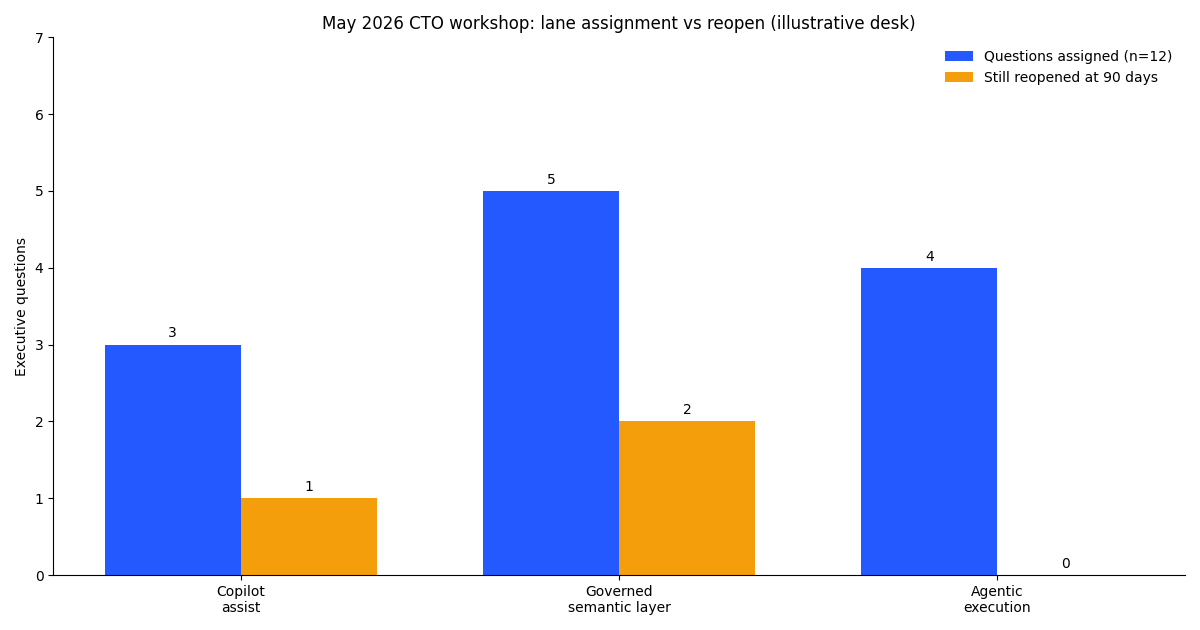
| Lane | Questions assigned | Still reopened at 90 days |
|---|---|---|
| Copilot assist | 3 | 1 |
| Governed semantic layer | 5 | 2 |
| Agentic execution | 4 | 0 |
Vendor selection for ai-powered semantic layers for enterprise data strategy should include that tenth-run test under schema drift, not a kickoff demo. Memory, connector permissions, and export logs matter more than model branding. CISA AI guidance is a practical vocabulary for those tiers when the security team joins the memo.
Reopen rate as the architecture signal
We also recommend quarterly architecture reviews that measure reopen rates on metric definitions. High reopen rates mean the layer is decorative. Low reopen on the agent lane in the chart is not magic—it is because those four questions only entered lane three after the contract existed. That is how ai-powered semantic layers for enterprise data strategy should graduate work.
Analytics uptime improves when teams borrow Google SRE practices—error budgets and blameless postmortems—for failed query chains, not only for app pages.
Governance that survives a board pack
Source controls
Role-aware access for every connected system. Read-only for agents unless a human approves a write. ai-powered semantic layers for enterprise data strategy assume least privilege, not a shared service account. CISA AI guidance and the NIST AI Risk Management Framework are the two documents we put in the appendix of the decision memo—not a vendor one-pager.
Metric contracts
Stable names, grain, and owners. A change is a ticket, not a Slack edit. ai-powered semantic layers for enterprise data strategy without this rule will recreate the Confluence problem inside the agent. Review gates sit in front of any number that can leave the building.
NL2SQL accuracy on clean leaderboards is a weak proxy. The BIRD benchmark adds dirty-schema realism that Spider-only scores under-weight. Use it as a sanity check, then re-measure on your own compile.
Frequently Asked Questions
What are ai-powered semantic layers for enterprise data strategy?
One-sentence: They are a versioned metric contract that AI and analysts must compile against so board numbers stay stable.
Expansion: Without the contract, each team (and each agent run) invents SQL. That is the failure mode this memo is written to stop.
How is this different from a warehouse semantic view?
A warehouse view locks compile in one engine. ai-powered semantic layers for enterprise data strategy also cover ownership, graduation between lanes, and agents that span more than one source. Start with the view if you are already in Snowflake; do not stop there if finance and ops share the same named metric.
Who should own the first thirty days?
A named architect plus one executive reviewer. Platform engineering builds the compile. The CTO does not need to write YAML. They do need to refuse a “connect everything” mandate before ten metrics are stable.
Can we skip the layer and put a chat bot on the warehouse?
You can for exploration. You cannot for recurring board numbers. That is copilot-lane work, not ai-powered semantic layers for enterprise data strategy. Promote the question only after two clean reruns through the contract.
How do we know the buy was worth it?
Watch the five KPI rows and the reopen bar on the workshop chart. If cycle time drops and reopen climbs, you bought a faster wrong number. ai-powered semantic layers for enterprise data strategy pay off when both move the right way together.
Conclusion
ai-powered semantic layers for enterprise data strategy are a portfolio decision: three lanes, one contract, a tenth-run test. Keep the May workshop split—three automated, five layer-enforced, four human—until your own twelve questions say otherwise.
Do not fund an agent platform to hide a missing dictionary. Write the contract, run the tenth pass, then graduate. That is the operating rhythm that keeps ai-powered semantic layers for enterprise data strategy from becoming another slide in last year’s AI offsite.
InfiniSynapse Connection
Commercial — skip if you only need the memo. InfiniSynapse can compile a named metric, run the SQL, and store a memory card for the next cycle. Try it on one recurring executive question in the InfiniSynapse web app. The workshop counts and scorecard above do not require a trial.