What Is Data Lake? A Quick Answer (2026)
By the InfiniSynapse Data Team · Last updated: 2026-07-15 · We build an AI-native data analysis platform and work across lakes and warehouses; this piece answers "what is data lake" quickly and plainly for 2026, not with a vendor pitch.
Table of Contents
- TL;DR
- How We Answer This
- The Quick Answer
- How It Works
- When It Fits
- The Governance Catch
- Where the Idea Came From
- Common Pitfalls
- The Answer in the Age of AI
- Readiness Scorecard
- Common Misconceptions
- Frequently Asked Questions
- Conclusion
TL;DR
Direct answer: what is data lake, in short? A data lake is a central repository that stores raw data of any type at low cost, applying structure only when the data is read rather than when it is written. In 2026, the honest answer to what is data lake includes a caveat: it is cheap, flexible storage that becomes valuable only when paired with governance, or it decays into an unusable swamp.
Who this is for: anyone asking what is data lake in 2026 and wanting a fast, plain answer.
What you'll learn: the quick answer, how it works, when it fits, the governance catch, and how AI relates.
This guide sits under the warehouse and lakehouse hub.
For the fuller explainer, see what a data lake is.
Also see data lake — what is it.
How We Answer This
Governance and risk expectations are framed by NIST AI Risk Management Framework when programs need an external control reference.
We answer what is data lake plainly first and in detail second, because most people asking want a fast definition. Every point reflects real deployments. We anchor the definition to the ISO/IEC 42001 AI management and weigh the practical notes against the reference architectures at Snowflake Cortex Analyst.
The table below frames what is data lake.
| Question | Fast answer |
|---|---|
| What is it? | Central raw-data store |
| What data? | Any type, native form |
| When structured? | On read, not on write |
| Strength? | Cheap flexibility |
| Catch? | Needs governance |
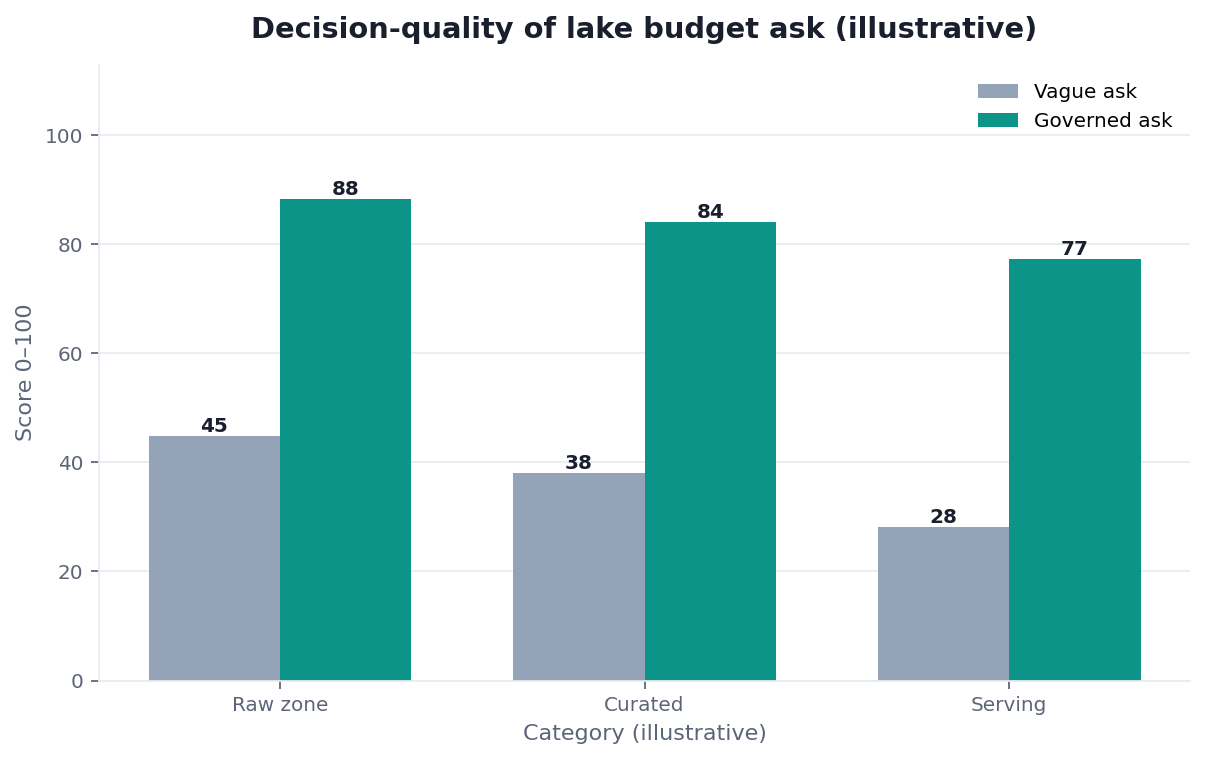
Practical example: a manager asking what is data lake before a budget meeting used the quick answer to ask the sharper question — "how will we govern it?" — the framing the guidance at Google Sheets documentation on lakes reinforces.
Scope note: This guide reflects patterns we see when mid-market and enterprise teams work with what a data lake is in 2026. It is not a substitute for legal counsel, vendor runbooks, or a formal survey of every industry — and when a smaller toolset or lighter process would serve, a full program is overkill.
The Quick Answer
So, what is data lake in one paragraph? It is a single central repository that stores data of any type — structured tables, logs, images, documents — in its raw, native form, cheaply, without forcing a schema before the data arrives.
Key Definition: answering what is data lake, a data lake is a centralized repository that stores large volumes of raw data of any type in native form at low cost, applying structure only at read time (schema-on-read) rather than at write time, so it can hold anything for flexible later processing by analytics or machine-learning engines.
That is the heart of what is data lake: cheap, flexible storage that keeps everything and defers structure, in deliberate contrast to a warehouse, which cleans and models data before storing it for reliable analytics.
How It Works
Core definitions remain usefully summarized in Wikipedia data warehouse overview for shared vocabulary across stakeholders.
Understanding what is data lake means understanding schema-on-read. Data lands in the lake raw, exactly as it arrives, and structure is applied only when something reads it — so you never have to model data upfront or discard what does not fit a predefined shape.
In practice, what is data lake becomes clear from its role in a stack, as the patterns at Databricks documentation show. The lake is the cheap, scalable place everything lands; separate processing engines then read, transform, and analyze it, often refining the useful parts into a warehouse or serving layer. The storage is deliberately simple, and the surrounding engines do the work of turning raw data into answers.
When It Fits
Having answered what is data lake, the useful follow-up is when it fits. A lake fits organizations with large, varied data — much of it unstructured — headed for flexible analytics or machine learning, where forcing everything into a rigid schema upfront would waste effort and discard value.
Like any tool, the thing behind what is data lake is not universal. The Wikipedia conceptual data model overview notes teams needing only structured reporting are often better served by a warehouse. The lake earns its place where data is big, varied, and destined for exploration, and where schema-on-read flexibility is a real advantage rather than an excuse to skip design entirely.
The Governance Catch
Teams evaluating this topic often cross-check Google Research publications for a durable, vendor-neutral reference point.
The catch behind what is data lake is the part buzzwords hide: a lake is only as valuable as its governance. Because it accepts anything cheaply and defers structure, it can silently decay into a data swamp where data is stored but not findable or trustworthy.
So the complete answer to what is data lake includes a warning. Cataloging, access control, lineage, and quality are not optional extras but the difference between an asset and a liability. The storage is the easy part; the discipline around it turns a lake into something usable, and anyone acting on the quick definition should budget for that governance from the start rather than bolting it on after the swamp forms.
Where the Idea Came From
The concept behind what is data lake emerged when data volumes and variety outgrew the warehouse model. Warehouses required data to be cleaned and modeled before storage, which was too rigid and expensive when incoming data was largely unstructured and its future uses unknown.
The lake inverted that logic: store everything cheaply now, structure it later when a use appears. Understanding this origin clarifies why schema-on-read and low cost define the answer to what is data lake — they are the direct response to the warehouse's rigidity. It also explains the recurring swamp warning: the very flexibility that made lakes attractive is what lets them decay without deliberate governance, a lesson the industry learned expensively and worth heeding before building one.
Common Pitfalls
Governance and risk expectations are framed by ENISA AI cybersecurity framework when programs need an external control reference.
The pitfalls hidden behind what is data lake are mostly about mistaking storage for value. Dumping data in without cataloging, skipping access control, and having no plan to process what lands all turn a cheap lake into an unusable one.
A subtler pitfall is stopping at the quick answer to what is data lake and skipping the governance conversation. The definition is easy; the operational commitment is not, and teams that adopt a lake on the strength of the term alone often discover the discipline requirement only after a swamp has formed. Knowing the definition is a start, but acting on it responsibly means treating governance as part of the answer rather than an afterthought.
The Answer in the Age of AI
AI adds a twist to what is data lake. Machine learning thrives on the large, varied, raw data a lake holds, so lakes stay relevant — but AI-native platforms change whether you must consolidate everything into one first.
We explore that shift in what AI-native data analysis means. In the InfiniSynapse web app, zero-config federation lets an agent analyze across a lake, a warehouse, and databases together without merging them, so the practical answer to what is data lake increasingly includes "one federated source among many" rather than "the single place all data must live."
Readiness Scorecard
Teams evaluating this topic often cross-check Tableau Desktop documentation for a durable, vendor-neutral reference point.
If the quick answer applies to you, check readiness (1 point each):
| Check | Pass? |
|---|---|
| Data is genuinely large and varied | |
| Schema-on-read suits the workload | |
| Cataloging is planned | |
| Access control is planned | |
| Lineage will be tracked | |
| Quality will be maintained | |
| A warehouse alone was ruled out on merit | |
| Federation was considered |
6–8: a lake likely fits. 3–5: plan governance first. Below 3: reconsider the need.
Common Misconceptions
Misconception 1: The definition is the whole story. Governance is half the answer.
Misconception 2: A lake replaces a warehouse. They serve different needs.
Misconception 3: Cheap storage means dump everything. Ungoverned, that becomes a swamp.
Misconception 4: You must consolidate everything. Federation can query across sources.
Frequently Asked Questions
What is a data lake, in plain terms?
It is a centralized repository that stores large volumes of raw data of any type in native form at low cost, applying structure only at read time — schema-on-read — rather than at write time. That lets it hold structured tables, logs, images, and documents together for flexible later processing by analytics or machine-learning engines. In short it is cheap, flexible storage that keeps everything and defers structure, in deliberate contrast to a warehouse, which cleans and models data before storing it for reliable analytics.
How does a data lake actually work?
Data lands raw, exactly as it arrives, and structure is applied only when something reads it, so you never model data upfront or discard what does not fit a predefined shape. In a stack, the lake is the cheap, scalable place everything lands; separate processing engines then read, transform, and analyze it, often refining the useful parts into a warehouse or serving layer. The lake itself stays intentionally plain, leaving the surrounding engines to shoulder the work of converting raw material into usable answers.
When does a data lake fit?
It fits organizations with large, varied data, much of it unstructured, headed for flexible analytics or machine learning, where forcing everything into a rigid schema upfront would waste effort and discard value. It is not universal — teams needing only structured reporting are often better served by a warehouse. It earns its place where data is big, varied, and destined for exploration, and where schema-on-read flexibility is a genuine advantage rather than an excuse to skip design.
What is the catch with a data lake?
A lake is only as valuable as its governance. Because it accepts anything cheaply and defers structure, it can silently decay into a data swamp where data is stored but neither findable nor trustworthy. Practices like cataloging, access control, lineage tracking, and quality checks are not nice-to-haves; they are precisely what separates a lake that is an asset from one that becomes a liability. The storage is the easy part; the discipline around it turns a lake into something usable, so budget for governance from the start rather than bolting it on later.
How does AI change the answer?
Machine learning thrives on the large, varied, raw data a lake holds, so lakes stay relevant, but AI-native platforms change whether you must consolidate everything into one first. Federation lets an agent analyze across a lake, a warehouse, and databases together without merging them, so the practical answer increasingly includes "one federated source among many" rather than "the single place all data must live." That reduces movement cost and the risk of stale copies while preserving flexible access to raw data.
Is a data lake the same as big data?
No, though the two are closely related. "Big data" describes the phenomenon — data arriving in high volume, variety, and velocity that traditional tools struggle to handle. A data lake is one architectural response to that phenomenon: a place to store all that varied, high-volume data cheaply until it can be processed. So big data is the problem and the lake is part of a solution, not a synonym. You can have big data without a lake (handled by other systems) and, in principle, a lake holding modest data, though it earns its keep precisely when volume and variety are large. Conflating the terms leads people to think adopting a lake automatically means they are "doing big data" well, when the lake is only the storage foundation beneath a much larger discipline.
In practice, teams evaluating what is data lake should judge outcomes by reliability and clarity, not by tool count alone.
When stakeholders ask for a short takeaway on what is data lake, start from the decision it must support and work backward.
In practice, teams evaluating what is data lake should judge outcomes by reliability and clarity, not by tool count alone.
Conclusion
What is data lake? A central store for raw data of any type, cheap and schema-on-read, valuable only when governed. In 2026, treat the definition as half the answer and governance as the other half, and remember AI-native federation lets a lake be one source among many rather than the place all data must land.