What Is Data Governance? A Plain-Language 2026 Guide
By the InfiniSynapse Data Team · Last updated: 2026-07-15 · We build an AI-native data analysis platform and help teams make governance real; this guide answers the question in plain language, grounded in what works in 2026.
Table of Contents
- TL;DR
- How We Approached This
- What It Means
- Why It Matters
- The Core Pieces
- How to Start
- What It Is Not
- Governance in the Age of AI
- Readiness Scorecard
- Common Misconceptions
- Frequently Asked Questions
- Conclusion
TL;DR
Direct answer: what is data governance? It is the system of ownership, rules, and controls that decides who can do what with which data, and how its quality and compliance are maintained. In 2026, understanding what is data governance matters because AI agents reading your data are only as trustworthy as the definitions and access rules governing it.
Who this is for: anyone asking what is data governance before starting a program, joining a data team, or buying tooling in 2026.
What you'll learn: a plain-language definition, why it matters, its core pieces, how to start, and how governance underpins trustworthy AI.
This guide sits under the data governance frameworks hub.
For the full discipline, see data governance.
Also see data governance definition.
How We Approached This
Teams evaluating this topic often cross-check Redis documentation for a durable, vendor-neutral reference point.
We answer what is data governance from program work rather than a glossary. Every explanation below reflects what we see when organizations try to make governance real rather than theoretical. We anchor the definition to the Apache Airflow documentation, and we align expectations with the OECD AI policy observatory, which treats data provenance and access as core risk factors for any AI system.
The table below maps the pieces behind what is data governance. Use it as a quick reference.
| Piece | Question it answers |
|---|---|
| Ownership | Who is accountable for this data? |
| Access | Who may use it, and how? |
| Quality | Is it accurate and fresh? |
| Policy | What rules apply? |
| Lineage | Where did it come from? |
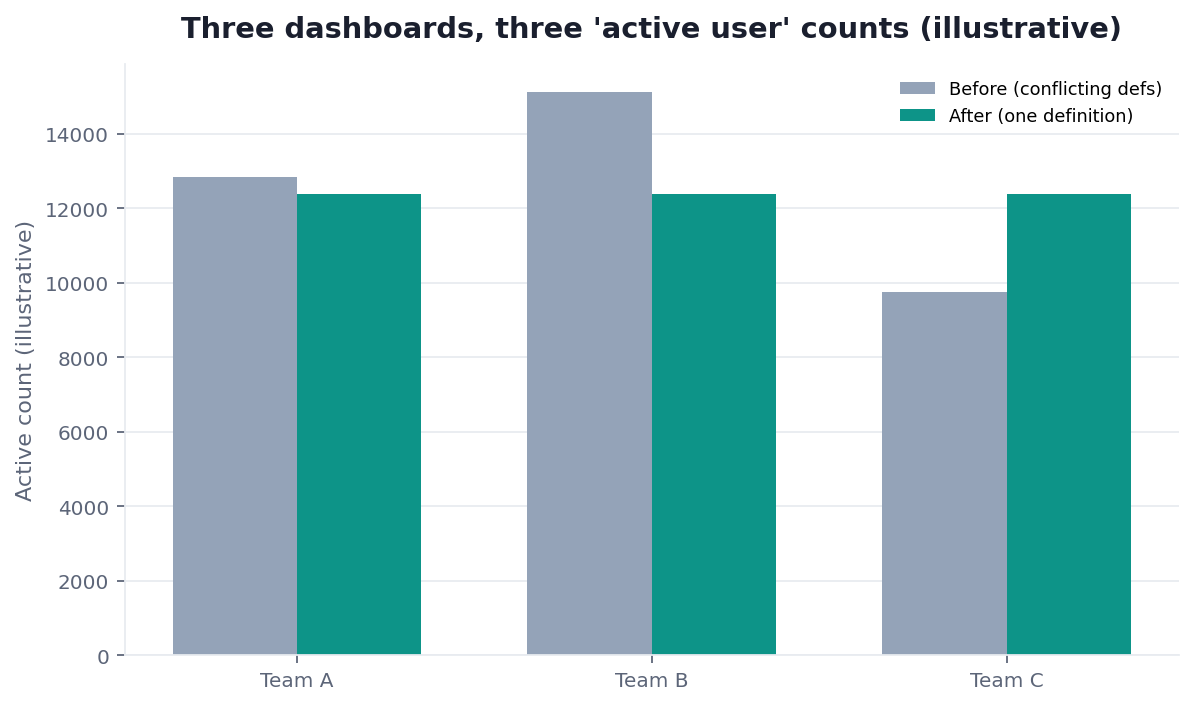
Practical example: a startup asking what is data governance for the first time discovered three teams defined "active user" differently, so three dashboards disagreed. Assigning one owner and one definition — a governance act — reconciled them. Grounding that decision in enterprise patterns from EU AI Act overview kept it pragmatic. The answer to the question is rarely abstract; it shows up as who owns which definition.
Scope note: This guide reflects patterns we see when mid-market and enterprise teams work with what is data governance in 2026. It is not a substitute for legal counsel, vendor runbooks, or a formal survey of every industry — and when a smaller toolset or lighter process would serve, a full program is overkill.
What It Means
Architecture choices are often checked against Databricks Genie architecture post so boundaries, ownership, and scale patterns stay explicit.
The clearest answer to what is data governance is about accountability: making explicit who owns each dataset, who may use it, what rules apply, and how quality is measured.
Key Definition: data governance is the system of decision rights, policies, roles, and controls that governs how data is defined, accessed, protected, and maintained across its lifecycle, so that data is trustworthy and used responsibly.
Understanding what is data governance means seeing that it is enforceable, not aspirational. A policy binder nobody follows is not governance; a set of rules wired into systems, with named owners and measurable quality, is. That difference between documentation and control is the heart of the answer, and it is what separates programs that work from those that gather dust.
Why It Matters
Governance and risk expectations are framed by ISO/IEC 27001 when programs need an external control reference.
People ask what is data governance usually because something went wrong — conflicting numbers, a compliance scare, or an AI project that produced nonsense. Governance is the answer to all three because it removes the ambiguity that causes them.
Without governance, the same word means different things to different teams, data of unknown quality drives decisions, and no one is accountable when it breaks. The reason what is data governance matters more each year is that AI amplifies these problems: an agent reading ambiguous data returns confidently wrong answers, and the guidance from the W3C WCAG accessibility standard increasingly treats data governance as a prerequisite for responsible AI.
The Core Pieces
Teams evaluating this topic often cross-check Anthropic research for a durable, vendor-neutral reference point.
Answering what is data governance completely means naming its reinforcing pieces.
Ownership and access
Every important dataset needs a named owner accountable for its definition, quality, and access, and access controls decide who can use it and how. Without ownership, the answer to what is data governance has no teeth: rules exist but nobody maintains them. Ownership is the piece to establish first.
Quality and policy
Quality measures whether data is trustworthy, and policy codifies the rules — retention, privacy, classification. A complete answer to what is data governance wires these together so a policy change propagates to real controls, an approach reinforced by risk guidance in MongoDB documentation. When quality and policy are disconnected, governance becomes theater.
How to Start
Implementation details are commonly grounded in Python documentation when teams translate concepts into production practice.
The practical answer to what is data governance is: start small. Pick your highest-value or highest-risk data, assign an owner, agree on one definition, and add a couple of quality checks. Prove value there, then expand.
This incremental path is how governance becomes durable rather than a doomed boil-the-ocean project. A program that reconciles one disputed definition in a month earns the credibility to spread, while one that tries to govern everything at once stalls. Understanding what is data governance as a habit you build, not a system you install, is the mindset that makes it stick.
A useful first move is simply to write down the three definitions your teams argue about most and get them agreed in one room. This sounds trivial, but it is often the single highest-leverage governance act a young organization can take, because those three definitions quietly distort dozens of reports. Once they are settled and owned, you have a concrete example of what governance does, and the abstract question of what is data governance becomes a lived experience rather than a slide. From there, adding an owner, a source of truth, and a quality check to the same domain is a natural next step rather than an imposed process.
The Cost of Not Having It
It is worth being concrete about the cost of skipping governance, because that cost is what usually turns the question what is data governance from academic into urgent. The first cost is wasted analyst time: without agreed definitions, every analysis begins with an argument about what the numbers mean, and that argument repeats endlessly because nothing is written down. The second is bad decisions made on data nobody validated, which compound as they flow into forecasts and commitments. The third, and most corrosive, is lost trust: once leaders catch conflicting numbers, they discount all dashboards and revert to intuition, which defeats the purpose of collecting data at all.
These costs are usually invisible on a balance sheet, which is why ungoverned organizations tolerate them for years. But they are real, and quantifying them — even roughly — is how governance advocates make the case for investment. When a team estimates the hours lost to reconciliation and the decisions revisited because of data errors, the answer to what is data governance stops being a definition and becomes a business case. The strongest programs we see were funded precisely because someone translated the vague discomfort of untrustworthy data into concrete numbers that leadership could not ignore.
Governance in the Age of AI
The 2026 reason what is data governance is asked so often is AI. When an autonomous agent reads your data and answers questions, every governance weakness becomes a wrong answer delivered with confidence. Ungoverned definitions produce inconsistent AI output; unclear access lets agents reach data they should not.
An AI-native platform helps by binding governed definitions and access rules to the data an agent queries, an approach we describe in what AI-native data analysis means. In the InfiniSynapse web app, governance travels with the data, so the answer to what is data governance directly shapes whether your AI answers can be trusted.
Readiness Scorecard
Test your grasp of what is data governance in practice (1 point each):
| Check | Pass? |
|---|---|
| Key datasets have named owners | |
| Definitions are agreed and written | |
| Access reflects current policy | |
| Quality is measured | |
| Lineage is traceable | |
| There is a sponsor | |
| You started with one domain | |
| It is ready for AI use |
6–8: strong grasp. 3–5: assign owners and definitions. Below 3: start with one domain.
What It Is Not
Part of answering what is data governance is saying what it is not. It is not data management (the broad practice of handling data), not a single tool, and not a one-time project. It is the decision layer that sits on top: who is accountable and what rules apply. Confusing governance with management or tooling is the most common source of stalled programs, because it leads teams to buy a platform expecting it to supply the decisions that only people can make. It is also not a compliance box to tick once and forget; it is a living practice that changes as your data, teams, and regulations do.
Common Misconceptions
Misconception 1: It is about restriction. What is data governance really about is safe use; restriction is a side effect.
Misconception 2: It is a tool. Tools enforce decisions humans must make first.
Misconception 3: It slows teams down. Good governance speeds work by removing ambiguity.
Misconception 4: It is a project. It is a standing capability that evolves.
Frequently Asked Questions
What is data governance in simple terms?
What is data governance, plainly? Think of it as the rulebook and org chart for your data: it names who is responsible for each dataset, states who is allowed to use it and for what, and defines how you keep it accurate and compliant. It converts data from something everyone touches but no one owns into a managed asset with clear accountability, so the business can actually trust the numbers it runs on.
Why does data governance matter?
Because without it the same word means different things to different teams, data of unknown quality drives decisions, and nobody is accountable when it breaks. AI makes this worse by amplifying ambiguity into confidently wrong answers. Governance removes the ambiguity that causes conflicting numbers, compliance scares, and unreliable AI output.
What are the core pieces?
The core pieces are ownership, access, quality, policy, and lineage. Ownership assigns accountability, access controls who can use data, quality measures whether it is trustworthy, policy codifies the rules, and lineage traces where data came from. These pieces reinforce one another, and a gap in any weakens the whole.
How do you start with data governance?
Begin with a single domain that hurts the most today. Give its most important dataset one accountable owner, settle the one definition that teams keep arguing about, and put two lightweight quality checks in place. Show that this removed a real pain — reconciled a report, unblocked an approval — and use that proof to justify the next domain. Governance built one domain at a time, as a habit rather than a big-bang install, is what proves durable.
Is data governance the same as data management?
No. Data management is the broad practice of handling data — storage, integration, operations. Governance is the decision layer on top: who is accountable and what rules apply. Management executes; governance decides and oversees. Confusing the two is a common reason programs stall, because tooling gets bought before decisions get made.
Conclusion
So, what is data governance? It is enforceable accountability for data — owners, definitions, access, quality, and lineage wired into systems rather than written in a binder. In 2026 it is the foundation of trustworthy AI. Start with one domain, prove value, and build the habit. Do not wait for a crisis or an audit to force the question; the organizations that grasp what governance is early pay a small, steady cost to stay trustworthy, while those that ignore it pay a large, sudden one when a bad number or a compliance failure finally makes the gap impossible to overlook.
To see how governed definitions travel with data into automated analysis, read what AI-native data analysis means and try the InfiniSynapse web app free on registration.