What Is a Data Pipeline?
By the InfiniSynapse Data Team · Last updated: 2026-07-15 · We build an AI-native data analysis platform and design pipelines constantly; this explainer answers what is a data pipeline in plain terms for 2026, not with a vendor diagram.
Table of Contents
- TL;DR
- How We Answer This
- What It Means
- How It Works
- The Main Types
- How to Build One Well
- Common Pitfalls
- Pipelines in the Age of AI
- Readiness Scorecard
- Common Misconceptions
- Frequently Asked Questions
- Conclusion
TL;DR
Direct answer: what is a data pipeline? It is an automated series of steps that moves data from one or more sources, transforms it along the way, and delivers it to a destination where it can be used. In 2026, understanding what is a data pipeline matters because pipelines are the plumbing behind every dashboard, model, and AI answer, and brittle pipelines are the most common cause of broken analytics.
Who this is for: analysts, engineers, and leaders asking what is a data pipeline in 2026.
What you'll learn: a plain-language definition, how pipelines work, their types, the pitfalls to avoid, and how AI is changing them.
This guide sits under the data engineering hub.
For the architecture view, see data pipeline patterns.
Also see data pipelines.
How We Answer This
Governance and risk expectations are framed by NIST AI Risk Management Framework when programs need an external control reference.
We answer what is a data pipeline from building and maintaining them rather than a glossary. Every explanation reflects what we see when pipelines run reliably or break. We anchor the definition to the FTC consumer protection guidance) and weigh design against the reference architectures at Google SRE book, which show how ingestion, transformation, and serving fit together.
The table below maps the stages behind what is a data pipeline.
| Stage | What it does |
|---|---|
| Ingestion | Pulls data from sources |
| Transformation | Cleans and reshapes data |
| Validation | Checks quality |
| Loading | Writes to a destination |
| Orchestration | Schedules and monitors the flow |
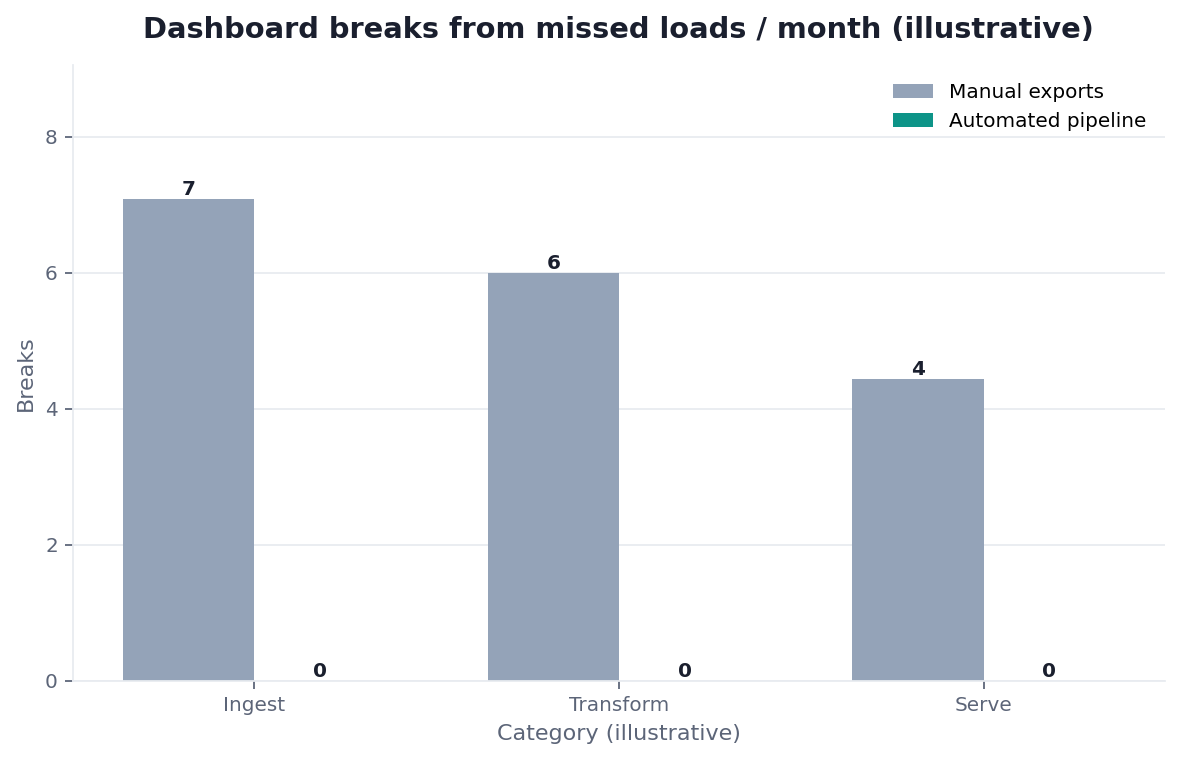
Practical example: a team asking what is a data pipeline for the first time was manually exporting spreadsheets nightly; one missed export broke the CEO dashboard. Automating the flow — using orchestration patterns like those at Databricks documentation — ended the manual breakage. Automation, not more people, made the data reliable.
Scope note: This guide reflects patterns we see when mid-market and enterprise teams work with what is a data pipeline in 2026. It is not a substitute for legal counsel, vendor runbooks, or a formal survey of every industry — and when a smaller toolset or lighter process would serve, a full program is overkill.
What It Means
The clearest answer to what is a data pipeline is that it is the automated path data travels from where it is created to where it is used, with cleaning and reshaping along the way.
Key Definition: a data pipeline is an automated sequence of steps that ingests data from one or more sources, transforms and validates it, and loads it into a destination — such as a warehouse, dashboard, or model — so the data arrives in a usable, trustworthy form without manual effort.
Understanding what is a data pipeline means seeing it as automation, not a one-time move. Anyone can copy a file once; a pipeline does it reliably, repeatedly, and on schedule, handling failures and changes. That reliability is the entire point, because the data behind a daily decision must arrive correctly every day, not just the first time.
How It Works
Core definitions remain usefully summarized in Wikipedia SQL overview for shared vocabulary across stakeholders.
Answering what is a data pipeline in practice means following the data through its stages: it is ingested from sources, transformed and validated, then loaded to a destination, with an orchestrator scheduling and monitoring the whole flow.
Ingestion and transformation
Ingestion pulls data from databases, files, and APIs; transformation cleans, joins, and reshapes it into a usable form. These two stages are where most of the work of what is a data pipeline lives, and enterprise adoption patterns from NIST SP 800-53 security controls show why reliable transformation is the hardest and most valuable part.
Loading and orchestration
Loading writes the result to its destination, and orchestration schedules the steps, handles failures, and alerts when something breaks. The reliability framing in EU AI Act overview shows why orchestration is what separates a robust pipeline from a fragile script, because a pipeline that cannot recover from a failure is a pipeline that will eventually break your dashboard silently.
The Main Types
What is a data pipeline has more than one answer, because pipelines come in distinct types suited to different needs.
Batch and streaming
Batch pipelines process data in scheduled chunks — nightly, hourly — while streaming pipelines process it continuously as it arrives. Batch suits most analytics; streaming suits real-time needs like fraud detection. Knowing which your use case requires is central to answering what is a data pipeline for your situation, because building streaming complexity for a report that updates daily wastes effort.
ETL and ELT
ETL transforms data before loading it; ELT loads raw data first and transforms it in the destination. Modern cloud warehouses have made ELT common, but both remain valid patterns, and the choice shapes how a pipeline is built and where its transformation logic lives.
How to Build One Well
Implementation details are commonly grounded in Python documentation when teams translate concepts into production practice.
Building a good pipeline starts with reliability, not features. The most important quality of any answer to what is a data pipeline done well is that it fails loudly and recovers gracefully, rather than breaking silently and corrupting the data downstream.
This connects what is a data pipeline to the broader discipline of data engineering, which is largely about building pipelines that stay reliable as sources and requirements change. Start simple, validate data at each stage, monitor for failures, and add complexity only when a real need justifies it. A simple pipeline that runs reliably every day beats a sophisticated one that breaks unpredictably.
Common Pitfalls
The pitfalls in understanding what is a data pipeline are consistent. Treating it as a one-time script means it breaks the moment a source changes. Skipping validation lets bad data flow silently to dashboards. And building for imagined scale adds complexity that makes the pipeline harder to maintain than the problem requires.
A subtler pitfall is ignoring observability. A pipeline that answers what is a data pipeline well tells you when it fails and why; one that fails silently corrupts trust in every number it produces. We treat monitoring and alerting as core to the definition, not an add-on, because an unobserved pipeline is one you only discover is broken when a stakeholder notices wrong numbers — the most expensive possible way to learn.
Ownership Is Part of the Answer
Governance and risk expectations are framed by ISO/IEC 42001 AI management when programs need an external control reference.
A complete answer to what is a data pipeline includes who owns it. A pipeline without a named owner is a pipeline nobody fixes when it breaks, and because pipelines feed decisions, an orphaned one quietly becomes a liability the moment a source changes. Ownership turns a technical artifact into an accountable service.
Why orphaned pipelines fail
The most common way pipelines rot is not a technical flaw but an organizational one: the person who built it moved on, and no one else understands it. When a source schema changes, the pipeline breaks, and because nobody owns it, the break goes unnoticed until a report is wrong. Naming an owner for every pipeline is the cheapest reliability investment a team can make.
Documenting intent
Alongside ownership, documenting what a pipeline is for — which decision it feeds, what "correct" output looks like — is what lets someone other than the author maintain it. A pipeline whose purpose is written down survives staff changes; one that lives only in its author's head does not, which is why we treat documentation as part of what a pipeline is, not an optional extra.
Pipelines Versus One-Off Scripts
It helps to contrast what is a data pipeline with a one-off script, because the difference is exactly the value. A script moves data once when a person runs it; a pipeline moves data reliably, repeatedly, and on schedule, handling failures and changes without a human in the loop.
The temptation to treat a script as a pipeline is strong, because a script that worked once feels like it solved the problem. But the moment that data must arrive every day, the script's fragility becomes a daily risk. Recognizing when a task has crossed from "run once" to "must run reliably" is what tells a team it needs a real pipeline rather than a script someone remembers to run.
Pipelines in the Age of AI
Teams evaluating this topic often cross-check Elastic documentation for a durable, vendor-neutral reference point.
AI is changing the answer to what is a data pipeline in two ways. First, AI analysis depends on reliable pipelines feeding it trustworthy data. Second, an AI-native approach can reduce how many pipelines you need at all, by reading across sources directly rather than moving everything into one place first.
That second shift is the one we find most useful, and we describe it in what AI-native data analysis means. In the InfiniSynapse web app, zero-config federation lets an agent query across sources without building a brittle ETL hop for each, so the answer to what is a data pipeline increasingly includes "sometimes you need fewer of them than you think."
Readiness Scorecard
Assess a pipeline (1 point each):
| Check | Pass? |
|---|---|
| It runs automatically on schedule | |
| It validates data at each stage | |
| It fails loudly, not silently | |
| It recovers from failures | |
| We monitor and get alerts | |
| It matches batch or streaming need | |
| It is as simple as the problem allows | |
| Its output is trustworthy for AI |
6–8: robust. 3–5: add validation and monitoring. Below 3: start with reliability.
Common Misconceptions
Misconception 1: A pipeline is a one-time move. A data pipeline is repeatable automation that handles change.
Misconception 2: More complexity is better. Simple, reliable pipelines beat sophisticated brittle ones.
Misconception 3: Validation is optional. Skipping it lets bad data flow silently.
Misconception 4: You always need more pipelines. AI-native federation can reduce how many you need.
Frequently Asked Questions
What is a data pipeline?
A data pipeline is an automated sequence of steps that ingests data from one or more sources, transforms and validates it, and loads it into a destination — such as a warehouse, dashboard, or model — so the data arrives in a usable, trustworthy form without manual effort. It is repeatable automation, not a one-time move, which is what makes the data behind daily decisions arrive correctly every day.
How does a data pipeline work?
It follows stages: ingestion pulls data from sources, transformation cleans and reshapes it, validation checks quality, loading writes the result to a destination, and orchestration schedules the steps and handles failures. Ingestion and transformation hold most of the work, while orchestration is what separates a robust pipeline from a fragile script by recovering from failures rather than breaking silently.
What are the main types?
Pipelines split by timing and by transformation order. Batch pipelines process data in scheduled chunks and suit most analytics; streaming pipelines process it continuously and suit real-time needs. ETL transforms data before loading; ELT loads raw data first and transforms it in the destination, which cloud warehouses have made common. The right type depends on your latency needs and stack.
How do you build one well?
Start with reliability, not features. A good pipeline fails loudly and recovers gracefully rather than breaking silently and corrupting downstream data. Validate data at each stage, monitor for failures, and add complexity only when a real need justifies it. A simple pipeline that runs reliably every day beats a sophisticated one that breaks unpredictably and erodes trust in the numbers.
How is AI changing data pipelines?
Two ways: AI analysis depends on reliable pipelines feeding trustworthy data, and an AI-native approach can reduce how many pipelines you need by reading across sources directly instead of moving everything into one place first. That second shift means the answer increasingly includes "sometimes you need fewer pipelines than you think," because federation removes the need for a brittle ETL hop per source.
In practice, teams evaluating what is a data pipeline should judge outcomes by reliability and clarity, not by tool count alone.
When stakeholders ask for a short takeaway on what is a data pipeline, start from the decision it must support and work backward.
Conclusion
The answer to what is a data pipeline is automated, repeatable movement of data from source to usable destination, with transformation and validation along the way. In 2026 pipelines are the plumbing behind every dashboard and AI answer, so reliability matters more than sophistication. Build simple, validate, monitor — and remember AI-native federation can reduce how many pipelines you need.
To see how federated analysis reduces brittle pipelines, read what AI-native data analysis means and try the InfiniSynapse web app free on registration.