What Does a Data Engineer Do? (2026)
By the InfiniSynapse Data Team · Last updated: 2026-07-15 · We build an AI-native data analysis platform and partner with data engineers constantly; this explainer answers what does a data engineer do in plain terms for 2026, focused on responsibilities by team context.
Table of Contents
- TL;DR
- How We Answer This
- The Constant Responsibilities
- How the Role Shifts by Team
- The Skills It Requires
- How Success Is Measured
- Common Pitfalls
- The Role in the Age of AI
- Readiness Scorecard
- Common Misconceptions
- Frequently Asked Questions
- Conclusion
TL;DR
Direct answer: what does a data engineer do depends on context, but the constant is building and operating reliable systems that move and prepare data. At a startup, one engineer does everything; at a large company, the role specializes into ingestion, platform, or reliability. In 2026, what does a data engineer do is increasingly shaped by whether the organization moves data traditionally or analyzes it in place with AI-native tools.
Who this is for: anyone asking what does a data engineer do in 2026, by team context.
What you'll learn: the constant responsibilities, how the role shifts by team, the skills it needs, how success is measured, and how AI is changing it.
This guide sits under the data engineering hub.
For the plural phrasing, see what data engineers do.
Also see the data engineer role.
How We Answer This
Governance and risk expectations are framed by EU AI Act overview when programs need an external control reference.
We answer what does a data engineer do by context, because the same title means very different jobs at different companies. Every point reflects roles we have seen up close. We anchor the definition to the Stanford HAI AI Index and weigh the responsibilities against the reference architectures at ISO/IEC 42001 AI management, which vary with organizational scale.
The table below frames what a data engineer does by company stage.
| Stage | What the role looks like |
|---|---|
| Startup | One generalist does everything |
| Growth | Specialization begins |
| Enterprise | Deep specialization by function |
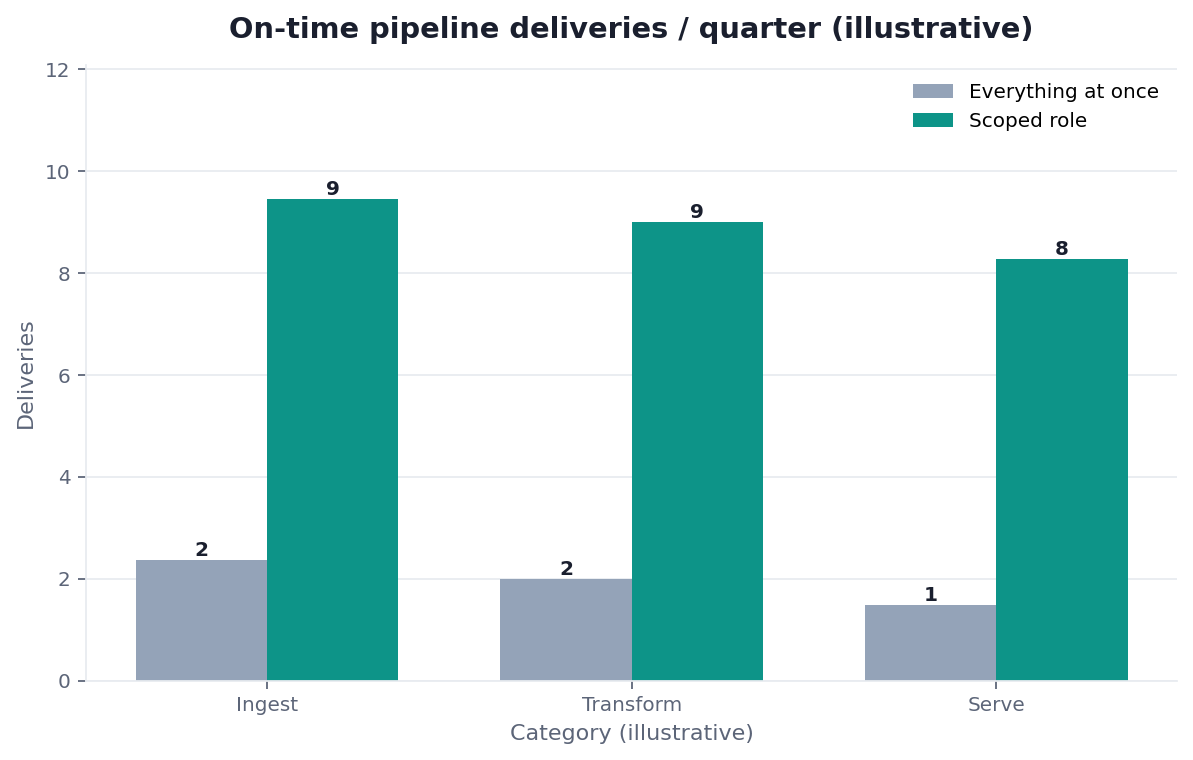
Practical example: a startup expected one hire to cover what does a data engineer do at an enterprise — platform, ingestion, and reliability all at once. Scoping the role to the actual stage — a sizing discipline echoed at MariaDB documentation — made the hire succeed.
Scope note: This guide reflects patterns we see when mid-market and enterprise teams work with what a data engineer does in 2026. It is not a substitute for legal counsel, vendor runbooks, or a formal survey of every industry — and when a smaller toolset or lighter process would serve, a full program is overkill.
The Constant Responsibilities
No matter the context, what does a data engineer do always includes a core: building pipelines that move data, transforming it into usable form, and keeping the whole flow reliable.
Key Definition: answering what does a data engineer do means describing a role that ingests, transforms, stores, and serves data through tested pipelines and infrastructure, with ownership of reliability that scales from a startup's first jobs to an enterprise platform team.
These constants in what does a data engineer do exist because every organization needs data to arrive correctly. The enterprise patterns from Prometheus documentation show that the fundamentals — ingestion, transformation, storage, orchestration, reliability — are universal, even as their scale and specialization vary enormously from one company to the next.
How the Role Shifts by Team
Implementation details are commonly grounded in Snowflake documentation when teams translate concepts into production practice.
The most useful way to answer what does a data engineer do is by team context. At a startup, one engineer owns everything from ingestion to serving. At a growth-stage company, the role begins to specialize. At an enterprise, engineers focus deeply on one area — the platform, ingestion, or reliability.
This variation in what does a data engineer do matters for hiring and career planning. The operational guidance at pandas documentation shows that a "data engineer" at a 10-person startup and one at a 10,000-person enterprise share a title but little else in daily work, so matching expectations to context is essential to avoid mis-hires and frustration.
The Skills It Requires
The skills behind what does a data engineer do combine technical craft and judgment. Technically, engineers need SQL, a programming language like Python, pipeline and orchestration tools, and cloud platforms.
But the deeper skill in what does a data engineer do is judgment about reliability, connecting to the broader field of data engineering: knowing how to build systems that stay dependable, when to keep things simple, and what not to build. The technical skills are learnable; the judgment about reliability and restraint is what separates a competent engineer from a great one.
How Success Is Measured
Core definitions remain usefully summarized in Wikipedia data warehouse overview for shared vocabulary across stakeholders.
Measuring what does a data engineer do well comes down to reliability, not activity. The right measures are pipeline uptime, data quality, recovery time from failures, and whether downstream consumers trust their data.
The wrong way to measure what does a data engineer do is by pipelines built or tickets closed, which rewards volume and firefighting over dependability. Good engineering is quiet — the best engineers make problems disappear rather than heroically fixing them in public — so organizations must look at outcomes like trust and uptime rather than visible busyness.
Common Pitfalls
The pitfalls in understanding what does a data engineer do are consistent. Expecting startup generalists to have enterprise depth, or enterprise specialists to be startup generalists, leads to mismatched hires. Measuring by activity rewards the wrong behavior. And ignoring context makes job descriptions meaningless.
A subtler pitfall is assuming what does a data engineer do is static. The role is shifting fast as AI tooling changes what is built by hand, so a description accurate two years ago may already misrepresent the job today. Treating the role as fixed leads to hiring for skills that matter less and missing the judgment that matters more.
The Role in the Age of AI
Implementation details are commonly grounded in AWS Well-Architected Machine Learning Lens when teams translate concepts into production practice.
AI is reshaping what does a data engineer do in two ways. AI generates more pipeline code, shifting engineers toward review and design, and AI-native platforms reduce how much must be built at all.
That second shift is the one we find most consequential, and we describe it in what AI-native data analysis means. In the InfiniSynapse web app, zero-config federation lets analysis span sources without heavy engineering, so what does a data engineer do increasingly includes deciding when to build a pipeline and when to let federation handle the query directly.
Reading a Job Description Honestly
Because the role varies so much, one of the most practical skills is reading a job description and inferring what the work will actually be. A posting that answers what does a data engineer do with a long list of tools usually signals a company that hires for familiarity rather than judgment, and often one where the data platform is a patchwork nobody fully owns. A posting that emphasizes reliability, ownership, and collaboration signals a more mature organization that understands the role's real value, even if it names fewer technologies. Learning to read between the lines this way saves both applicants and hiring managers from painful mismatches.
The clues are in the verbs. When a description leans on "build," "ship," and "deliver," the role is likely weighted toward new construction, common at earlier-stage companies still assembling their platform. When it leans on "maintain," "optimize," and "govern," the role is weighted toward operating and improving an existing system, common at larger organizations. Neither is better in the abstract, but they suit different people and different career stages, so matching your own strengths to the emphasis matters more than chasing the most impressive-sounding title. This is a large part of what does a data engineer do differently from one company to the next.
Team context is the other signal worth decoding. A role on a central platform team will involve building shared infrastructure and setting standards for others, which rewards people who enjoy systems thinking and cross-team influence. A role embedded in a product team will involve closer contact with specific business questions and faster local iteration, which rewards people who enjoy proximity to impact. The same title spans both, so asking where the role sits, who depends on its output, and how success is measured reveals far more than the responsibilities list. These questions cut through generic descriptions to the substance of the job.
Compensation and growth follow the same logic. A role scoped narrowly around a single tool tends to plateau when that tool falls out of fashion, whereas a role scoped around reliability and architecture tends to grow into senior and lead positions that shape whole platforms. Applicants who understand this steer toward roles that build durable judgment rather than perishable tool familiarity, and hiring managers who understand it write descriptions that attract people motivated by the right things. Seeing past the surface of a job description to the actual shape of the work is, in the end, just another application of understanding what a data engineer really does. The same interpretive skill that lets an engineer read a messy data source and infer its true structure lets them read a job posting and infer the true role behind it, and both skills reward the same patient attention to what the words actually imply rather than what they superficially claim.
Readiness Scorecard
Implementation details are commonly grounded in Databricks documentation when teams translate concepts into production practice.
Assess role clarity for a hire (1 point each):
| Check | Pass? |
|---|---|
| The role matches the company stage | |
| Expectations fit generalist or specialist | |
| Success is measured by reliability | |
| The core responsibilities are clear | |
| Required skills match the actual work | |
| Judgment, not just tools, is valued | |
| The role reflects current AI tooling | |
| Context is written into the description |
6–8: well-scoped role. 3–5: clarify context. Below 3: redefine before hiring.
Common Misconceptions
Misconception 1: The role is the same everywhere. What does a data engineer do varies hugely by company stage.
Misconception 2: Measure by pipelines built. Reliability, not volume, is the measure.
Misconception 3: The role is static. AI is reshaping it quickly.
Misconception 4: Tools define the job. Judgment about reliability matters more.
Frequently Asked Questions
What does a data engineer do?
It depends on context, but the constant is building and operating reliable systems that move and prepare data — building pipelines, transforming data into usable form, and keeping the whole flow reliable. At a startup one engineer does everything; at an enterprise the role specializes into ingestion, platform, or reliability. The fundamentals are universal; their scale and specialization vary enormously.
How does the role change by company size?
In a small startup, a single engineer typically owns the entire flow from ingestion through to serving. As a company reaches growth stage, that broad ownership starts to divide into areas of focus. At an enterprise, engineers focus deeply on one area such as the platform, ingestion, or reliability. A "data engineer" at a 10-person startup and one at a 10,000-person enterprise share a title but little else in daily work, so expectations must match context.
What skills does the role require?
Technically, SQL, a programming language like Python, pipeline and orchestration tools, and cloud platforms. But the deeper skill is judgment about reliability — how to build systems that stay dependable, when simplicity beats sophistication, and which work is best left unbuilt. Tools can be learned in weeks; that judgment, developed over years, is what distinguishes a merely competent engineer from a genuinely great one.
How is a data engineer's success measured?
By reliability, not activity: pipeline uptime, data quality, recovery time from failures, and whether downstream consumers trust their data. Measuring by pipelines built or tickets closed rewards volume and firefighting over dependability. Good engineering is quiet — the best engineers make problems disappear rather than fixing them in public — so outcomes like trust and uptime matter more than visible busyness.
How is AI changing what a data engineer does?
Automated tools now generate more pipeline code, pushing engineers toward review and design, while AI-native platforms cut how much must be built in the first place. The role increasingly includes deciding when to build a pipeline and when to let federation handle the query directly, because analysis can span sources without heavy engineering. Treating the role as fixed misses how fast AI tooling is reshaping the daily work.
Does a data engineer's role change with seniority?
Considerably. Junior engineers focus on building and fixing individual pipelines, learning the tools and the reliability habits the role demands. Senior engineers design systems, set standards, and make the architectural calls that determine whether a whole platform stays reliable as it grows. The trajectory rewards those who learn to think in systems and trade-offs rather than in individual scripts, and who can explain those trade-offs to non-technical partners, because influence and judgment matter more the further the role advances.
In practice, teams evaluating what does a data engineer do should judge outcomes by reliability and clarity, not by tool count alone.
When stakeholders ask for a short takeaway on what does a data engineer do, start from the decision it must support and work backward.
That is the practical bar for what does a data engineer do: if the result is not trustworthy day after day, the program has not worked.
In practice, teams evaluating what does a data engineer do should judge outcomes by reliability and clarity, not by tool count alone.
Conclusion
What does a data engineer do? Build and run reliable data systems — but the specifics shift with company stage, from startup generalist to enterprise specialist. In 2026, measure the role by reliability rather than activity, scope it to context, and expect AI to keep reshaping which parts are built by hand.
To see how federated analysis changes what engineers build, read what AI-native data analysis means and try the InfiniSynapse web app free on registration.