Snowflake Data Warehouse: A Practical Guide (2026)
By the InfiniSynapse Data Team · Last updated: 2026-07-15 · We build an AI-native data analysis platform and work across cloud warehouses; this guide reflects how a snowflake data warehouse actually behaves in 2026, not a marketing datasheet.
Table of Contents
- TL;DR
- How We Approach It
- What It Is
- What Makes It Distinctive
- When It Fits
- Managing Cost
- Where It Came From
- Common Pitfalls
- Snowflake in the Age of AI
- Readiness Scorecard
- Common Misconceptions
- Frequently Asked Questions
- Conclusion
TL;DR
Direct answer: a snowflake data warehouse is a cloud data platform whose defining feature is fully separated storage and compute, letting multiple independent compute clusters query the same data and scale elastically. In 2026, a snowflake data warehouse is prized for that elasticity and its low operational burden, but its consumption-based pricing rewards disciplined use and punishes careless queries, so cost governance matters as much as the technology.
Who this is for: architects and engineers evaluating a snowflake data warehouse in 2026.
What you'll learn: how it works, what makes it distinctive, when it fits, how to manage cost, and how AI relates.
This guide sits under the warehouse and lakehouse hub.
For the general model, see cloud data warehouse.
Also see what a data warehouse is.
How We Approach It
Teams evaluating this topic often cross-check Google Sheets documentation for a durable, vendor-neutral reference point.
We approach a snowflake data warehouse by its architecture and its economics, because both shape how it should be used. Every point reflects real deployments. We anchor concepts to the EU AI Act overview and weigh patterns against the reference architectures at Shopify ecommerce analytics, which cover comparable cloud warehouse designs.
The table below frames the snowflake data warehouse.
| Aspect | Snowflake data warehouse |
|---|---|
| Architecture | Separated storage and compute |
| Scaling | Independent, elastic clusters |
| Pricing | Consumption-based |
| Strength | Elasticity, low ops |
| Watch-out | Cost of careless use |
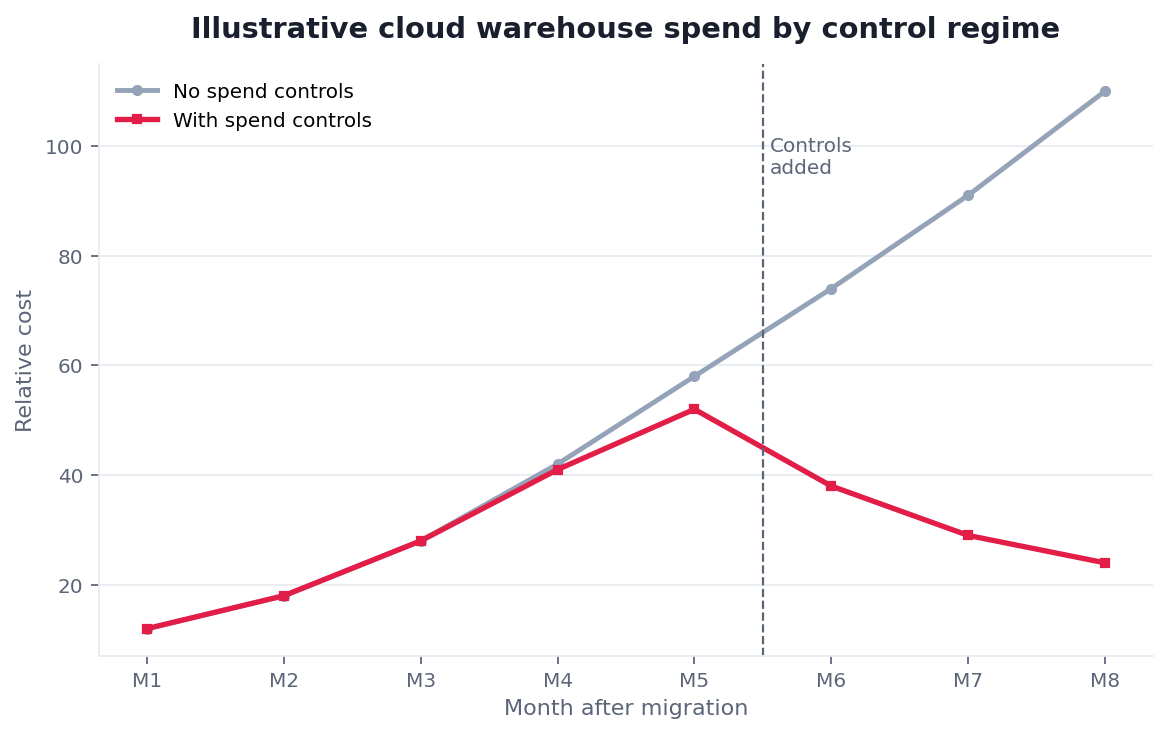
Practical example: a team's snowflake data warehouse bill spiked because clusters ran idle and queries scanned everything. Sizing warehouses and adding auto-suspend — the cost discipline echoed at Supabase documentation for comparable platforms — cut spend sharply with no loss of performance.
What It Is
At its core, a snowflake data warehouse is a cloud-native analytical database that stores data centrally and lets separate compute clusters process it, so storage and compute scale independently.
Key Definition: a snowflake data warehouse is a cloud data platform that fully separates storage from compute, keeping data in central cloud storage while independent, elastically scalable compute clusters ("virtual warehouses") query it, so different workloads can run concurrently without contending for the same resources.
The idea that defines a snowflake data warehouse is the separation of storage and compute taken to its logical end. Because compute clusters are independent, one team's heavy query cannot slow another's, and capacity can scale up for a spike and down again, which is the elasticity the cloud made possible.
What Makes It Distinctive
Implementation details are commonly grounded in Google Cloud architecture framework when teams translate concepts into production practice.
What distinguishes a snowflake data warehouse is that separation, plus near-zero infrastructure management. Teams do not tune hardware or manage clusters manually; they spin virtual warehouses up and down as needed.
The distinctive value of a snowflake data warehouse is concurrency without contention. The patterns at Apache Kafka documentation for comparable platforms show why this matters: multiple teams and workloads can hit the same data simultaneously on their own compute, so a demanding data-science job and a routine dashboard refresh do not fight for resources. This isolation, combined with elasticity, is what made the model influential across the whole cloud warehouse category.
When It Fits
A snowflake data warehouse fits organizations wanting a low-operational-burden cloud warehouse with elastic scaling and strong concurrency, especially where many teams share data but have varied, spiky workloads.
Like any tool, a snowflake data warehouse is not universal. The Wikipedia SQL overview reminds us that the right choice depends on workload and existing stack; teams deeply invested in another cloud's native warehouse, or with simple and predictable needs, may find less advantage. The strongest case is diverse, concurrent workloads on shared data where elasticity and isolation pay off, which is precisely the scenario the architecture was built for.
Managing Cost
Teams evaluating this topic often cross-check BIRD NL2SQL benchmark for a durable, vendor-neutral reference point.
The Google Vertex AI documentation adds dirty-schema realism that Spider-only leaderboards under-weight in production.
The economics of a snowflake data warehouse demand active management, because consumption-based pricing means you pay for compute time. An idle-but-running cluster or a query that scans everything both cost money that discipline would save.
Managing a snowflake data warehouse well means sizing compute to the workload, enabling auto-suspend so clusters stop when idle, and writing queries that prune data rather than scanning it. These practices connect to the broader discipline covered across the warehouse and lakehouse hub. The elasticity that makes the platform powerful also makes waste easy, so cost governance — monitoring spend, setting limits, educating users — is not optional but central to running it sensibly.
Where It Came From
The separated-storage-and-compute model rose to prominence because the previous generation of warehouses coupled the two, forcing painful trade-offs. When storage and compute grew together, scaling for a heavy workload meant over-provisioning expensive capacity that sat idle the rest of the time, and concurrent workloads fought over the same fixed resources.
Decoupling them solved both problems at once, and the idea proved so compelling that it reshaped expectations across the entire cloud warehouse category. Understanding this origin clarifies why elasticity and concurrency are the headline benefits: they are the direct payoff of the architectural decision to separate the two layers. It also explains the cost model — because you rent compute by the second rather than owning a fixed cluster, the pricing follows usage, which is a feature when managed and a trap when ignored.
Common Pitfalls
Implementation details are commonly grounded in Snowflake documentation when teams translate concepts into production practice.
The pitfalls of a snowflake data warehouse center on cost and complacency. Leaving clusters running idle wastes money; oversizing compute for routine work wastes more; and writing queries that scan full tables instead of pruning drives spend up invisibly.
A subtler pitfall is treating a snowflake data warehouse as infinitely elastic and therefore free of design discipline. Because scaling is easy, teams sometimes stop caring about modeling and query efficiency, letting the platform's flexibility paper over sloppy work — until the bill arrives. Elasticity is a tool for handling genuine variability, not a substitute for good data modeling and query hygiene, and the teams that respect that distinction get the benefits without the runaway costs.
Another trap is organizational rather than technical: giving every team unrestricted power to spin up compute with no guardrails. The convenience that lets an analyst provision capacity in seconds also lets dozens of them do so simultaneously, each unaware of the others' spend, and the aggregate bill can surprise finance even when no single query looks unreasonable. Mature deployments pair the platform's self-service ease with lightweight controls — default warehouse sizes, per-team budgets, and visibility into who is spending what — so that the elasticity stays a benefit rather than becoming an untracked liability. None of this is exotic; it is simply the recognition that a resource billed by the second needs the same accountability any variable operating cost deserves in a well-run organization.
Snowflake in the Age of AI
AI intersects a snowflake data warehouse in two ways. AI analysis depends on trusted warehouse data, and AI-native platforms change how much must be consolidated into any one warehouse.
That second shift is worth weighing, and we describe it in what AI-native data analysis means. In the InfiniSynapse web app, zero-config federation lets an agent analyze across sources — including a Snowflake instance and other databases together — without forcing everything into one platform, so a snowflake data warehouse can be one federated source among many rather than the sole destination for all data.
Readiness Scorecard
Assess your Snowflake usage (1 point each):
| Check | Pass? |
|---|---|
| Compute is sized to the workload | |
| Auto-suspend is enabled | |
| Queries prune rather than scan | |
| Spend is monitored | |
| Concurrency needs justify the model | |
| Data is still modeled well | |
| Usage limits are set | |
| Federation was considered before consolidating |
6–8: disciplined usage that keeps the platform economical. 3–5: tighten cost controls before spend grows. Below 3: govern spend now, before the next bill arrives.
Common Misconceptions
Misconception 1: It is just a database in the cloud. Its separation of storage and compute is the point.
Misconception 2: Elasticity means you can ignore modeling. Good design still matters.
Misconception 3: Consumption pricing is always cheaper. Only with cost discipline.
Misconception 4: Everything must live in one platform. Federation can query across many.
Frequently Asked Questions
What is a Snowflake data warehouse?
It is a cloud data platform that fully separates storage from compute, keeping data in central cloud storage while independent, elastically scalable compute clusters — often called virtual warehouses — query it. Because those clusters are independent, different workloads run concurrently without contending for the same resources, and capacity scales up for a spike and down again. That separation of storage and compute, taken to its logical end, is the platform's defining idea.
What makes it distinctive?
The full separation of storage and compute, combined with near-zero infrastructure management, gives concurrency without contention: multiple teams and workloads can hit the same data simultaneously on their own compute, so a demanding data-science job and a routine dashboard refresh never fight for resources. Teams spin compute up and down as needed rather than tuning hardware, and this isolation plus elasticity is what made the model influential across the whole cloud warehouse category.
When does it fit best?
It fits organizations wanting a low-operational-burden cloud warehouse with elastic scaling and strong concurrency, especially where many teams share data but have varied, spiky workloads. It is not universal — teams deeply invested in another cloud's native warehouse, or with simple, predictable needs, may find less advantage. The strongest case is diverse, concurrent workloads on shared data, which is exactly the scenario the separated architecture was built to serve.
How do you manage its cost?
Because pricing is consumption-based, size compute to the workload, enable auto-suspend so clusters stop when idle, and write queries that prune data rather than scanning full tables. The elasticity that makes the platform powerful also makes waste easy, so monitoring spend, setting limits, and educating users are central rather than optional. Treating elasticity as a reason to skip modeling and query hygiene is the fastest route to a surprising bill.
How does AI relate to a Snowflake data warehouse?
AI analysis depends on trusted warehouse data, so the platform stays relevant, but AI-native platforms change how much must be consolidated into any one warehouse. Federation lets an agent analyze across sources — including a Snowflake instance alongside other databases — without forcing everything into one platform, so it can be one federated source among many rather than the sole destination for all data, which reduces costly movement and duplication.
Is it the same as any other cloud warehouse?
Not quite. All cloud warehouses share managed infrastructure and elastic compute, but this platform's defining trait is how fully it separates storage from compute and how independently its compute clusters scale, which gives especially strong concurrency isolation. Rival platforms achieve overlapping goals through different architectures, and each cloud's native warehouse integrates most tightly with its own ecosystem. The practical takeaway is that the choice should turn on your existing stack, workload shape, and cost tolerance rather than on brand — the separated model is a strength, not a universal winner.
A useful checkpoint for snowflake data warehouse is whether owners, metrics, and escalation paths are written down — not just discussed.
Conclusion
A snowflake data warehouse separates storage from compute for elastic, low-ops, high-concurrency analytics — powerful when its consumption-based cost is actively governed and its data still modeled well. In 2026, size compute deliberately, enable auto-suspend, keep query hygiene, and remember AI-native federation lets it be one source among many rather than the sole place all data must land.
To see how federated analysis spans Snowflake and other sources together, read what AI-native data analysis means and try the InfiniSynapse web app free on registration.