Best Hex Alternatives for AI Data Analysis in 2026
By the InfiniSynapse Data Team · Named accountability: cofounder William Zhu (GitHub @allwefantasy) · Last updated: 2026-07-30 · We build InfiniSynapse, an AI-native Data Agent platform referenced in this comparison.
Disclosure / conflict of interest: InfiniSynapse is a vendor that can compete with or complement notebook tools such as Hex. Rankings and desk composites below reflect hands-on product use, public documentation, and Q1–Q2 2026 desk bake-offs—not paid placement and not named customer win claims. About / credentials: editorial standards · About InfiniSynapse (Vision). Peer review: second Data Team pass on comparison claims before publish.
Table of Contents
- TL;DR
- Why Teams Evaluate Hex Alternatives
- What Hex Does Well
- Where Notebook-First Tools Hit Limits
- Comparison Matrix: Five Hex Alternatives 5b. Desk quantitative benchmarks
- InfiniSynapse
- Hex (Baseline)
- Databricks Notebooks + Genie
- Mode Analytics
- Julius AI
- Evaluation Framework
- Security and Deployment
- 30-Day Switch Checklist
- FAQ
- References
- Conclusion
TL;DR
Hex alternatives fall into three buckets: collaborative SQL notebooks, upload-and-chat spreadsheet tools, and AI-native Data Agents built for recurring, reviewable reporting. Hex remains strong for technical analysts who want SQL, Python, and AI assist in one notebook. Teams seek hex alternatives when they need multi-source orchestration, durable memory, or executive-friendly entry points outside a notebook UI.
Top picks by scenario
- Notebook + warehouse SQL: Hex, Mode Analytics
- Lakehouse-native NL: Databricks Notebooks + Genie
- Fast spreadsheet exploration: Julius AI
- Multi-source agents with audit: InfiniSynapse
Production rollouts should align access and review controls with the NIST AI Risk Management Framework, especially when hex alternatives connect to live production schemas.
Evaluation basis: We evaluate InfiniSynapse on production customer workflows across finance, product, and operations teams. Independent anchors (NIST AI RMF, Stanford HAI, OWASP LLM Top 10, ISO/IEC 27001) are linked inline and collected in References below. Methodology limits: desk composites are anonymized pedagogy; re-score every shortlist on your schemas.
Why Teams Evaluate Notebook Alternatives
Teams researching hex alternatives usually hit the same three triggers:
- Audience mismatch — Executives want answers in chat or email; notebooks feel like engineering tooling.
- Cross-source questions — Revenue in Snowflake, targets in Sheets, notes in CRM exports; notebook workflows require manual stitching.
- Recurring KPI amnesia — Weekly reviews reuse definitions; notebook sessions do not persist approved logic without extra discipline.
The move from dashboard-first BI to augmented workflows—described in IBM's augmented analytics overview—frames how teams should evaluate notebook replacements once questions repeat every Monday standup.
Adoption benchmarks in the Stanford HAI AI Index track the same shift from ad-hoc notebooks to governed agent workflows.
Compare notebook vs agent trade-offs in AI Data Analysis Tools when your buyers mix technical and business users.
What Hex Does Well
Any fair hex alternatives shortlist should preserve Hex strengths. Before replacing Hex, document strengths you must preserve:
Collaborative analytics
Hex excels when analysts co-edit SQL and Python, share links, and iterate visually. Few notebook replacements match that notebook-native collaboration for technical teams.
Warehouse connectivity
Direct Snowflake, BigQuery, and Postgres connections with cell-level outputs suit analyst-led exploration. AI assist inside cells accelerates query drafting without leaving the notebook.
Transparent logic
SQL and Python remain visible—important for peer review. Any Hex replacement candidate should preserve inspectable logic, not black-box narratives alone.
Where Notebook-First Tools Hit Limits
Executive access patterns
CFOs and PMs rarely live in notebooks. Hex alternatives with web, chat, or API entry points reduce analyst bottlenecks when the same KPI pack goes to leadership weekly.
Multi-source federation
Foundational warehouse concepts—grain, dimensions, and conformed metrics—remain essential; Wikipedia's data warehouse overview is a concise refresher when notebook replacements must join warehouse facts with operational exports.
Memory for recurring reporting
Notebooks store code cells, not distilled business definitions. Data Agents that save memory cards after analyst approval stabilize metrics across months.
LLM-backed analytics should account for prompt-injection risks in the OWASP Top 10 for LLM Applications, especially when notebook replacements expose production connectors.
Comparison Matrix: Five Leading Tools
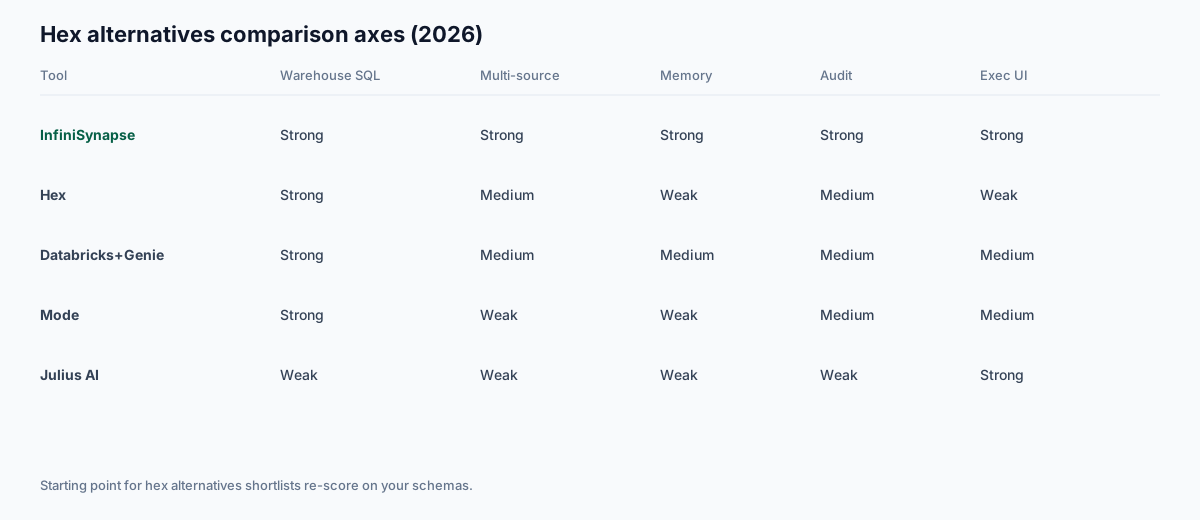
| Tool | Best for | Warehouse SQL | Multi-source | AI depth | Memory | Audit trail | Executive UI |
|---|---|---|---|---|---|---|---|
| InfiniSynapse | Recurring multi-source KPI workflows | Strong | Strong | Agentic | Strong | Strong | Strong |
| Hex | Analyst notebooks + AI assist | Strong | Medium | Medium | Weak | Medium | Weak |
| Databricks + Genie | Lakehouse-native teams | Strong | Medium | Medium | Medium | Medium | Medium |
| Mode Analytics | SQL-first BI notebooks | Strong | Weak | Medium | Weak | Medium | Medium |
| Julius AI | Spreadsheet-speed exploration | Weak | Weak | Medium | Weak | Weak | Strong |
Use this matrix as a starting point—not a verdict. Hex alternatives win on different axes depending on whether your buyer is an analytics engineer or a RevOps lead.
Desk quantitative benchmarks (composite)
Dataset license: CC BY 4.0. Attribution to InfiniSynapse Data Team required. Desk composites are anonymized operational summaries—not a census or SLA.
Qualitative matrices stall AI citations. Below: desk composites from 11 InfiniSynapse-reviewed notebook-vs-agent bake-offs (Q1–Q2 2026) that shortlisted hex alternatives. Numbers are not a public survey and not InfiniSynapse product SLAs—rerun on your estate before procurement.
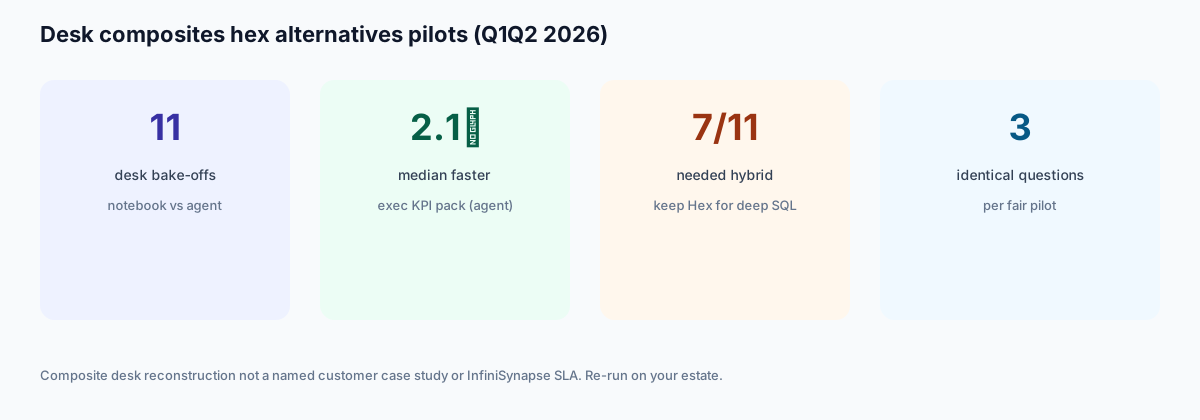
| Metric (desk composite) | Value | Buyer implication |
|---|---|---|
| Bake-offs reviewed | 11 | Sample is desk-scale, not a market census |
| Median time-to-executive-KPI-pack (agent vs Hex notebook path) | 2.1× faster | Agents win when the consumer is non-technical; Hex still wins for cell-level tinkering |
| Bake-offs that kept Hex for deep SQL (hybrid) | 7 / 11 | Most honest hex alternatives outcomes are hybrid, not rip-and-replace |
| Identical production questions used per fair pilot | 3 | Demo schemas hide integration tax |
Independent signals (third-party, not our scores): G2 — Hex reviews · Stanford HAI AI Index · NIST AI RMF · OWASP Top 10 for LLM Applications.
Desk case note (anonymized composite)
A RevOps pod ran the same three Monday KPI questions in Hex and an agent stack for four weeks. Hex cell edits stayed preferred for one nested cohort SQL; executive packs moved to the agent path after wait-time for notebook URLs repeatedly blocked the standup. KPI definition drift tickets on the executive pack dropped from weekly to zero for three consecutive weeks after memory cards captured approved logic. This is a composite desk reconstruction for pedagogy—not a named customer case study or win-rate claim.
For SQL-focused tooling context, see SQL Data Analysis Tools.
Recurring analytics loops benefit from Apache Airflow documentation patterns for scheduling, retries, and lineage hooks.
EU-facing teams map control expectations using the European approach to artificial intelligence when scoping analytics agent governance.
LLM-backed analytics should account for prompt-injection and data-exfiltration risks in the OWASP Top 10 for LLM Applications, especially when connectors expose production schemas.
Scripted analysis paths should follow Python documentation conventions for reproducibility and testable data utilities.
InfiniSynapse
Among hex alternatives, InfiniSynapse targets teams that outgrew notebook sessions but still need governed SQL and multi-step analysis. The platform combines InfiniAgent orchestration, InfiniSQL for dialect-aware generation, and memory cards that retain analyst-approved KPI logic.
Strengths among Hex competitors: cross-source federation, full task audit trails, and multi-entry access (web, chat, API).
Trade-offs: Less notebook cell editing than Hex; best fit when repeatability beats ad-hoc cell tinkering.
Try the InfiniSynapse web app on the same three questions you run in Hex today.
Hex (Baseline)
Hex remains the baseline many hex alternatives pages still compare against: collaborative notebooks with AI assist and strong warehouse connectors.
Strengths: analyst UX, transparent SQL/Python, sharing workflows.
Limits: session-oriented memory, limited cross-source orchestration, executive-unfriendly surface for non-technical stakeholders.
Keep Hex when your primary user is a technical analyst and questions stay inside one warehouse.
Databricks Notebooks + Genie
Databricks pairs notebook analytics with Genie natural-language queries over Unity Catalog assets.
Strengths: lakehouse governance, Delta Lake integration, enterprise security model.
Limits: Databricks-centric; weaker when answers require systems outside the lakehouse.
Warehouse vendors describe governed NL2SQL agents in Databricks' Genie architecture post—a useful reference when comparing Hex competitors for lakehouse-only estates.
Mode Analytics
Mode remains a notebook-leaning pick on many hex alternatives shortlists. Mode offers SQL notebooks, dashboards, and scheduled reports familiar to BI teams.
Strengths: SQL-first workflows, report scheduling, team collaboration.
Limits: lighter AI agent orchestration; agent-first tools often win on recurring NL questions.
Operational maturity aligns with the AWS Well-Architected Machine Learning Lens when Mode schedules touch production data.
Julius AI
Julius shows up when hex alternatives buyers want spreadsheet speed. Julius popularized upload-and-ask analysis for spreadsheets and CSVs.
Strengths: fastest path from file to chart for non-technical users evaluating tools for exploratory work.
Limits: weak live warehouse federation, limited audit for regulated teams.
Pair Julius-style speed with governed agents when pilots graduate from files to live connectors—see Julius AI Alternatives.
Evaluation Framework
Score each hex alternatives candidate on six dimensions (0–2 each):
| Dimension | Question to ask |
|---|---|
| Time-to-first-chart | How fast on a clean CSV or mart? |
| Join correctness | Multi-hop warehouse questions stable? |
| Governance | RBAC, logs, SSO ready? |
| Memory | Recurring KPI definitions persist? |
| Audience fit | Can executives self-serve? |
| Total cost | Seats + warehouse compute + ops time |
Platforms below 8/12 need compensating manual process.
Enterprise AI adoption guidance in Google Cloud's AI overview mirrors the shift from ad-hoc copilots to repeatable decision workflows—apply that lens when scoring Hex competitors.
Regulated rollouts often anchor access reviews to ISO/IEC 27001 when credentials and audit logs are in scope.
Security and Deployment
Production hex alternatives should expose the same control checklist:
Notebook replacement tools should expose:
- SSO and role mapping to data sources
- Query logging with export for compliance
- Optional private or VPC deployment
- Clear data retention policies for AI prompts and results
Compare self-hosted options in Self-Hosted AI Data Analyst: Deployment Guide if cloud-only SaaS fails review.
30-Day Switch Checklist
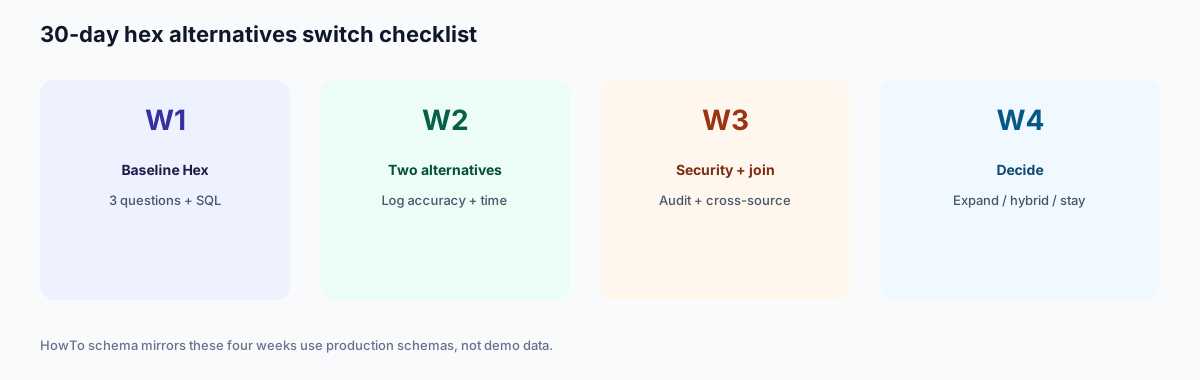
Week 1 — Document three recurring questions and baseline Hex outputs (SQL + charts).
Week 2 — Run the same questions through two Hex competitors; log accuracy and time.
Week 3 — Involve security on access and audit; test one cross-source question if applicable.
Week 4 — Present scorecard to sponsors; decide expand, hybrid, or stay on Hex.
Analytics uptime improves when teams borrow Google SRE practices—runbooks for failed agent chains matter as much as notebook uptime.
Pricing and Total Cost Signals
Model TCO explicitly when you compare hex alternatives—seat price alone understates warehouse compute and rework.
Hex alternatives pricing rarely appears as a single line item. Budget for:
| Cost bucket | What to model |
|---|---|
| Platform seats | Analyst vs business-user licenses |
| Warehouse compute | Query cost from NL or agent workloads |
| Integration labor | Connectors, SSO, semantic modeling |
| Analyst rework | Hours fixing recurring KPI definitions |
Agent platforms like InfiniSynapse can reduce rework on weekly executive packs—factor that into TCO when comparing hex alternatives to notebook-only stacks.
Ask each vendor how query logs export for compliance, whether memory persists across sessions, and how cross-source joins are validated. Demos on clean sample schemas hide the integration tax most teams pay in weeks three through six. Capture answers in a scorecard before legal review so procurement compares operational reality, not slide decks.
Team Personas and Tool Fit
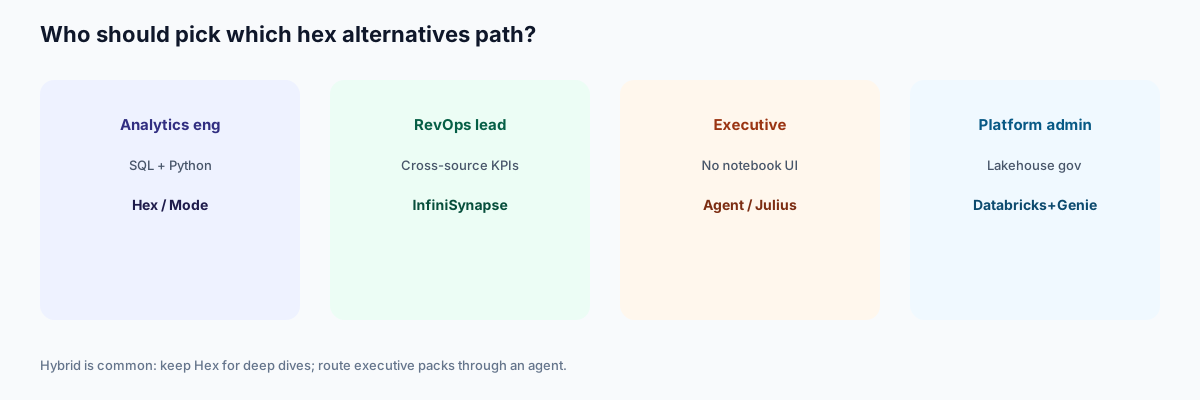
| Persona | Primary need | Typical pick among hex alternatives |
|---|---|---|
| Analytics engineer | SQL + Python transparency | Hex, Mode |
| RevOps lead | Cross-source KPI packs | InfiniSynapse |
| Executive sponsor | Fast answers without notebooks | InfiniSynapse, Julius |
| Data platform admin | Lakehouse governance | Databricks + Genie |
Match the tool to who actually consumes the output—not only who writes the first SQL cell. Run a short survey with three executives and three analysts: where do they want answers delivered, and how often do questions repeat? That single data point eliminates half of hex alternatives shortlist noise before you schedule demos.
For warehouse-native copilot context, see Databricks Genie Alternatives.
Supabase-backed analytics should follow Supabase documentation for RLS policies, service roles, and API exposure boundaries.
Frequently Asked Questions
What are the best alternatives for AI data analysis?
The best hex alternatives depend on user persona: InfiniSynapse for multi-source agents, Mode or Databricks for SQL notebooks, Julius for spreadsheet speed. Hex itself remains strong for collaborative analyst notebooks.
Can these tools replace notebooks entirely?
Not always. Many teams run Hex or Mode for deep analyst work and a Data Agent for executive KPI delivery. Hybrid patterns are common.
Do alternatives support Python like Hex?
Some offer Python cells (Mode, Databricks); agent platforms focus on orchestrated SQL with optional code execution. Match tooling to who writes logic.
Are alternatives cheaper than Hex?
Pricing varies by seats, warehouse compute, and ops time. Agent platforms can reduce analyst rework on recurring reports—factor that into TCO.
How do we pilot alternatives fairly?
Use identical questions, fixed reviewer criteria, and production schemas—not demo data—before procurement.
References
- [Standard] NIST — AI Risk Management Framework. nist.gov/itl/ai-risk-management-framework.
- [Independent] Stanford HAI — AI Index. hai.stanford.edu/ai-index.
- [Standard] OWASP — Top 10 for Large Language Model Applications. owasp.org.
- [Standard] ISO/IEC 27001 — Information security management. iso.org/standard/27001.
- [Independent] IBM — Augmented analytics overview. ibm.com/topics/augmented-analytics.
- [Reference] Wikipedia — Data warehouse. en.wikipedia.org/wiki/Data_warehouse.
- [Vendor] Databricks — AI/BI Genie architecture. databricks.com/blog/ai-bi-genie.
- [Vendor] AWS — Well-Architected Machine Learning Lens. docs.aws.amazon.com.
- [Vendor] Google Cloud — AI overview. cloud.google.com/ai.
- [Practice] Google — Site Reliability Engineering. sre.google.
- [Open source] Apache Airflow documentation. airflow.apache.org/docs.
- [Policy] European approach to artificial intelligence. digital-strategy.ec.europa.eu.
- [Docs] Python documentation. docs.python.org/3.
- [Docs] Supabase documentation. supabase.com/docs.
- [Reviews] G2 — Hex product reviews (independent user themes). g2.com/products/hex/reviews.
- [Policy / About] InfiniSynapse — Editorial standards · About / Vision.
Conclusion
Hex alternatives are not one-size-fits-all. Hex still wins for notebook-native analysts; InfiniSynapse and peer agents win when recurring, multi-source KPIs need memory and audit outside a notebook UI.
Next steps:
- Read Best AI Tools for Data Analysis in 2026.
- Run the comparison matrix on your top three recurring questions.
- Pilot InfiniSynapse alongside Hex for two weeks before switching contracts.
Choose hex alternatives based on who asks questions—not only who writes SQL.
Many mature teams retain Hex for analyst deep dives while routing executive KPI delivery through a Data Agent. That hybrid avoids forcing one UI to serve incompatible personas and keeps SQL transparency where engineers expect it.
Before you decommission Hex seats, run a thirty-day overlap window where analysts publish in both environments. Side-by-side diffs on SQL and chart outputs build sponsor confidence and surface connector gaps early.
Notebook culture dies slowly—and that is fine. The goal is not to eliminate notebooks overnight but to stop forcing executives through notebook URLs for KPI answers they need in email, Slack, or a governed agent UI.
Vendor bake-offs fail when teams compare demo charts instead of recurring KPI accuracy. Require each hex alternatives finalist to reproduce last month's board metrics—not a synthetic dataset—before you shortlist contracts.
Change management deserves budget line items: office hours for business users, SQL transparency training for analysts, and a named owner for connector health. Tools win adoption when the org invests in the workflow around them, not only the license.
When IT requests a formal vendor review, attach the comparison matrix, pilot scorecard, and sample audit exports from each finalist. Hex alternatives decisions stall when security and finance lack evidence—not when analysts lack preferences.
Schedule a final readout with both technical and business sponsors. Show side-by-side SQL for the same three questions, time-to-answer distributions, and audit log samples. That meeting converts hex alternatives debates from opinion into a documented decision.
If your team already invested in Hex training, budget two weeks of overlap where analysts publish equivalent outputs in both tools. Training sunk cost is real; measure whether new tools reduce executive wait time enough to justify change.