Data Quality Software: A 2026 Market Guide
By the InfiniSynapse Data Team · Last updated: 2026-07-15 · We build an AI-native data analysis platform and evaluate quality products regularly; this market guide reflects how we read the data quality software landscape in 2026, not a sponsored ranking.
Table of Contents
- TL;DR
- How We Evaluated
- What It Is
- The Market Categories
- What to Look For
- Pricing and Deployment
- Common Mistakes
- Software in the Age of AI
- Selection Scorecard
- Common Misconceptions
- Frequently Asked Questions
- Conclusion
TL;DR
Direct answer: data quality software is the category of products that profile, validate, monitor, and help remediate data quality — from open-source libraries to enterprise observability platforms. In 2026, the best data quality software runs checks continuously inside your pipelines and routes clear alerts to owners, because quality audited occasionally fails silently.
Who this is for: analysts, engineers, and data leaders evaluating data quality software in 2026.
What you'll learn: what the software does, the market categories, what to look for, pricing and deployment, and how it supports trustworthy AI.
This guide sits under the data governance frameworks hub.
For the tools view, see data quality tools.
For more, see data quality.
How We Evaluated
Implementation details are commonly grounded in Google BigQuery documentation when teams translate concepts into production practice.
We read the data quality software market the way a buyer must: by fit and adoption, not feature count. Every observation reflects what we see when teams deploy — or abandon — quality products in 2026. We anchor category definitions to the Kubernetes documentation and weigh expectations against the Google Cloud architecture framework, which treats measurable quality as foundational for AI.
The table below maps the categories of data quality software.
| Category | Core function |
|---|---|
| Profiling | Discover data characteristics |
| Validation | Check against rules |
| Monitoring | Track quality over time |
| Observability | Detect anomalies and drift |
| Remediation | Fix or route issues |
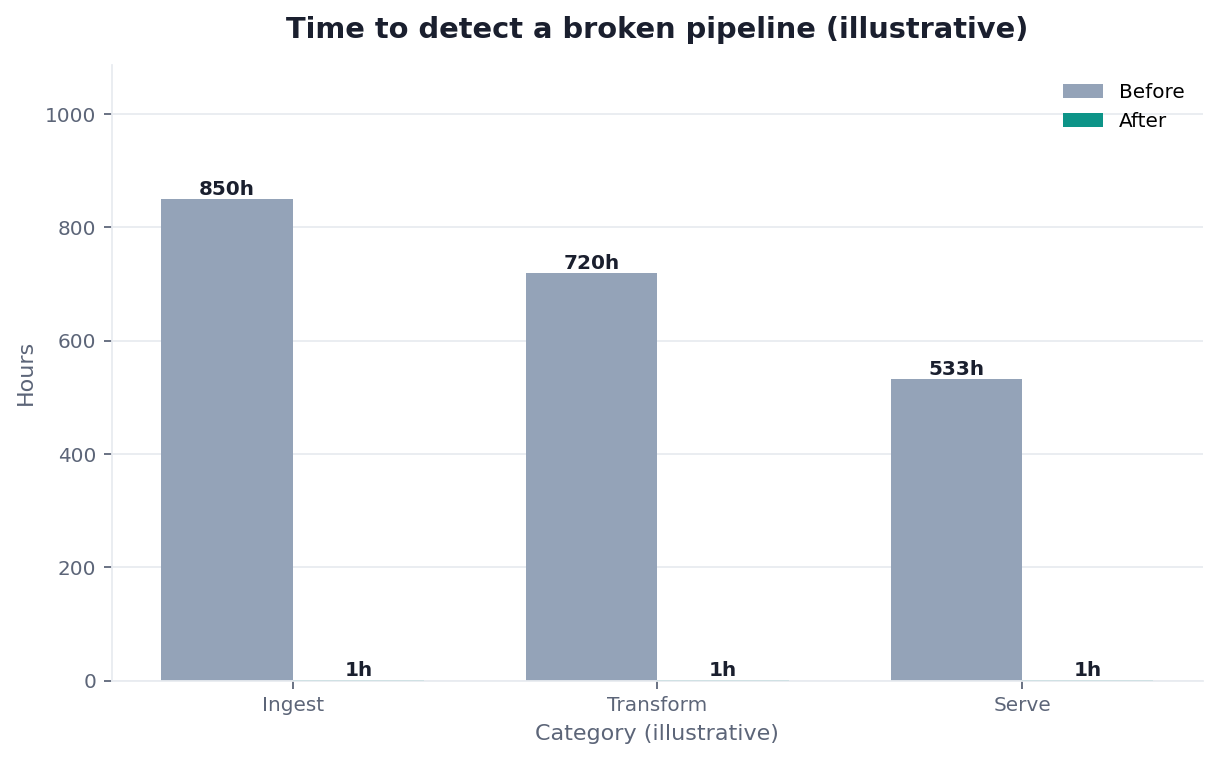
Practical example: a team ran no data quality software and found a broken pipeline only at month-end. After adding in-pipeline validation — the expectations documented at Apache Airflow documentation — the same break surfaced within an hour. Continuous checking, not periodic audits, is the value this software buys.
Scope note: This guide reflects patterns we see when mid-market and enterprise teams work with data quality software in 2026. It is not a substitute for legal counsel, vendor runbooks, or a formal survey of every industry — and when a smaller toolset or lighter process would serve, a full program is overkill.
What It Is
Teams evaluating this topic often cross-check RFC 4180 CSV format for a durable, vendor-neutral reference point.
At its core, data quality software turns quality dimensions into automated checks that run on a schedule or inside pipelines. It enforces and monitors quality at scale but does not decide what "good" means — that definition is yours.
Key Definition: data quality software is the category of products that profile data, validate it against defined rules, monitor its quality over time, detect anomalies, and help remediate issues, so that quality problems are caught before they reach decisions.
The distinction that matters is that data quality software measures and alerts; it does not define quality. A team with clear rules and owners gets leverage; a team without them gets alerts nobody acts on. The definitional work — what to check and who fixes failures — comes first, always, and no amount of sophisticated tooling can substitute for the human judgment that decides what "good enough" means for each dataset.
The Market Categories
Teams evaluating this topic often cross-check Prometheus documentation for a durable, vendor-neutral reference point.
The data quality software market splits into embedded libraries, monitoring platforms, and observability suites.
Libraries and validation
Open-source libraries and validation frameworks let engineers express quality checks in code and run them inside pipelines. This category of data quality software excels at fitting existing engineering workflows, and the architecture patterns at BIRD NL2SQL benchmark show how validation embedded in pipelines catches problems before they propagate.
Monitoring and observability
Monitoring platforms track quality metrics over time, and observability suites detect anomalies and drift automatically, often with minimal configuration. This category of data quality software suits teams that want continuous coverage without hand-writing every rule, catching regressions that point-in-time validation misses. The trade-off is that automatic detection can surface noise alongside signal, so these products earn their keep only when their alerting is tuned well enough that owners trust it rather than learning to ignore it.
What to Look For
Governance and risk expectations are framed by NIST Cybersecurity Framework when programs need an external control reference.
The features that matter in data quality software are the ones that drive daily use: how easily an analyst expresses a rule, how well it runs inside your pipelines, and how actionable its alerts are.
Beyond features, evaluate how the data quality software fits your broader data quality practice rather than creating a parallel one. A product that routes failures to accountable owners gets acted on; one that dumps alerts into a channel nobody watches does not. Weigh usability and alert quality as heavily as raw capability, because software whose alerts are ignored delivers no quality at all. It also helps if the software lets you express rules against recognized definitions — grounding validation in an information-security baseline such as Google Research publications keeps your checks defensible and consistent with the rest of your controls rather than ad hoc.
How It Fits a Quality Program
Core definitions remain usefully summarized in Wikipedia data warehouse overview for shared vocabulary across stakeholders.
Data quality software is one part of a quality program, not the whole of it. It sits downstream of the definitions that say what "good" means and the owners who fix failures, and upstream of the decisions that depend on trustworthy data. Placed correctly, it closes the loop between detecting a problem and acting on it.
The teams that get the most from data quality software wire it into the pipeline so checks run automatically and bad data is flagged or blocked before it propagates. This is the difference between quality as a gate and quality as an afterthought. Software that runs as a separate, occasional audit — disconnected from where data actually flows — catches problems late, after decisions have already relied on the bad data. Software embedded in the flow catches them early, when they are cheap to fix. When you evaluate data quality software, favor the option that integrates into your orchestration over the one with the longer feature list but no pipeline presence, because the placement of the checks matters more than their sophistication.
Pricing and Deployment
Pricing for data quality software ranges from free open-source to usage-based and enterprise licenses, and the sticker price rarely reflects total cost. Integration, configuration, and the human time to tune checks and triage alerts often exceed the license fee.
Deployment matters too: some data quality software is SaaS-only, while teams with strict data-residency needs may require private deployment. Model three-year total cost of ownership and confirm deployment fit before shortlisting, because a cheap-to-license product that is expensive to integrate and noisy to operate can cost more than a pricier one that runs cleanly inside your stack.
Common Mistakes
The mistakes we see in choosing data quality software are consistent. Buying before defining rules produces alerts nobody understands. Choosing on feature count rather than integration produces software that never runs in pipelines. Alerting on everything trains people to ignore alerts. And treating the software as the program produces motion without progress.
A subtler mistake is neglecting alert tuning. Data quality software that fires on every fluctuation drowns owners in noise, while one tuned too loosely misses real problems. Getting thresholds right is iterative work, and the best products keep incident history so you can calibrate against reality rather than guesswork.
One more mistake deserves attention: buying data quality software and then applying it only to the data that is already good. It is tempting to instrument the clean, well-understood datasets because they are easy, but the value of quality software comes from watching the data you are least sure about — the messy integrations, the third-party feeds, the tables that feed critical reports through fragile logic. Pointing the software at your riskiest data first feels uncomfortable because it surfaces problems, but surfacing those problems is exactly the point. Teams that instrument only their safe data get a reassuring dashboard and none of the protection, while teams that instrument their risky data catch the failures that would otherwise reach a decision. The discomfort of early alerts is the price of the protection, and it is a price worth paying, because the alternative is discovering the same problems later through a wrong number that has already done its damage.
Software in the Age of AI
AI sharply raises the value of data quality software. When an autonomous agent reads your data to answer questions, undetected quality problems become confidently wrong conclusions. Continuous quality checking becomes a guardrail that keeps automated analysis trustworthy.
An AI-native platform closes the gap by binding governed definitions and quality expectations to the data an agent queries, an approach we describe in what AI-native data analysis means. In the InfiniSynapse web app, quality context travels with the data, so the checks your data quality software runs directly improve the reliability of AI answers rather than sitting in a separate dashboard.
Selection Scorecard
Score each product (1 point each):
| Check | Pass? |
|---|---|
| An analyst can add a rule easily | |
| It runs inside our pipelines | |
| It profiles data automatically | |
| It monitors quality over time | |
| Alerts route to an owner | |
| It detects anomalies / drift | |
| Pricing and deployment fit us | |
| It supports AI/agent trust in data |
6–8: strong fit. 3–5: pilot in one pipeline. Below 3: define rules and owners first.
Common Misconceptions
Misconception 1: Software defines quality. Data quality software measures it; you define it.
Misconception 2: More alerts are better. Alert fatigue is worse than no alerts.
Misconception 3: License price is the cost. Integration and tuning usually cost more.
Misconception 4: A periodic audit is enough. Continuous, in-pipeline checks catch far more.
Frequently Asked Questions
What is data quality software?
Data quality software is the category of products that profile data, validate it against defined rules, monitor its quality over time, detect anomalies, and help remediate issues, so problems are caught before they reach decisions. It enforces and monitors quality at scale but does not define it — the rules about what "good" means, and who fixes failures, come first.
What are the main categories?
The market splits into embedded libraries and validation frameworks (checks expressed in code and run in pipelines), monitoring platforms (tracking quality metrics over time), and observability suites (detecting anomalies and drift automatically). Libraries fit engineering workflows, while monitoring and observability give continuous coverage without hand-writing every rule.
What should you look for?
Look for what drives daily use: how easily an analyst expresses a rule, how well it runs inside your pipelines, and how actionable its alerts are. Ensure it fits your broader quality practice rather than creating a parallel one, and weigh usability and alert quality as heavily as raw capability — software whose alerts are ignored delivers no quality.
How is it priced and deployed?
Pricing ranges from free open-source to usage-based and enterprise licenses, but integration, configuration, and the time to tune checks and triage alerts often exceed the license fee. Some products are SaaS-only while others support private deployment for data-residency needs. Model three-year total cost of ownership and confirm deployment fit before shortlisting.
How does it support AI?
When an agent reads your data to answer questions, undetected quality problems become confidently wrong conclusions. Continuous quality checking becomes a guardrail that keeps automated analysis trustworthy, and an AI-native platform that carries quality context with the data ensures the checks directly improve the reliability of agent answers rather than sitting in a separate dashboard.
Conclusion
Data quality software profiles, validates, monitors, and helps remediate your data, but it only enforces a definition of quality that you yourself must set. Choose for pipeline integration and actionable alerts, model total cost of ownership, and remember that AI agents increasingly depend on the continuous checks this software runs.
Point it at your riskiest data first, wire the checks into your pipelines, and tune thresholds patiently until a firing alert reliably means something genuinely worth acting on. To see how quality context travels with data into automated analysis, read what AI-native data analysis means and try the InfiniSynapse web app free on registration, no credit card required.