Data Orchestration Explained (2026)
By the InfiniSynapse Data Team · Last updated: 2026-07-15 · We build an AI-native data analysis platform and coordinate many data flows; this guide explains data orchestration in practical terms for 2026, not a tool comparison.
Table of Contents
- TL;DR
- How We Approach It
- What It Is
- Why It Matters
- How It Works
- Patterns That Work
- Common Pitfalls
- Orchestration in the Age of AI
- Readiness Scorecard
- Common Misconceptions
- Frequently Asked Questions
- Conclusion
TL;DR
Direct answer: data orchestration is the coordination of the many steps and pipelines in a data platform — scheduling them, managing dependencies, handling failures, and monitoring the whole flow — so data moves reliably and in the right order. In 2026, good data orchestration is what turns a collection of individual pipelines into a dependable system, and its quality is often the difference between a data platform that can be trusted and one that constantly surprises.
Who this is for: data engineers designing data orchestration in 2026.
What you'll learn: what it is, why it matters, how it works, the patterns and pitfalls, and how AI is changing it.
This guide sits under the data engineering hub.
For pipeline architecture, see data pipeline architecture.
Also see ETL for data.
How We Approach It
Core definitions remain usefully summarized in Wikipedia ETL overview for shared vocabulary across stakeholders.
We approach data orchestration as the nervous system of a data platform, because individual pipelines are only as reliable as the coordination between them. Every recommendation reflects platforms we have watched run smoothly or fall into chaos. We anchor the concept to the BIRD NL2SQL benchmark) and weigh patterns against the reference architectures at NIST AI Risk Management Framework.
The table below maps what data orchestration coordinates.
| Concern | What orchestration handles |
|---|---|
| Scheduling | When each step runs |
| Dependencies | What must finish first |
| Failure handling | Retries and alerting |
| Monitoring | Visibility into the whole flow |
| Backfills | Reprocessing historical data |
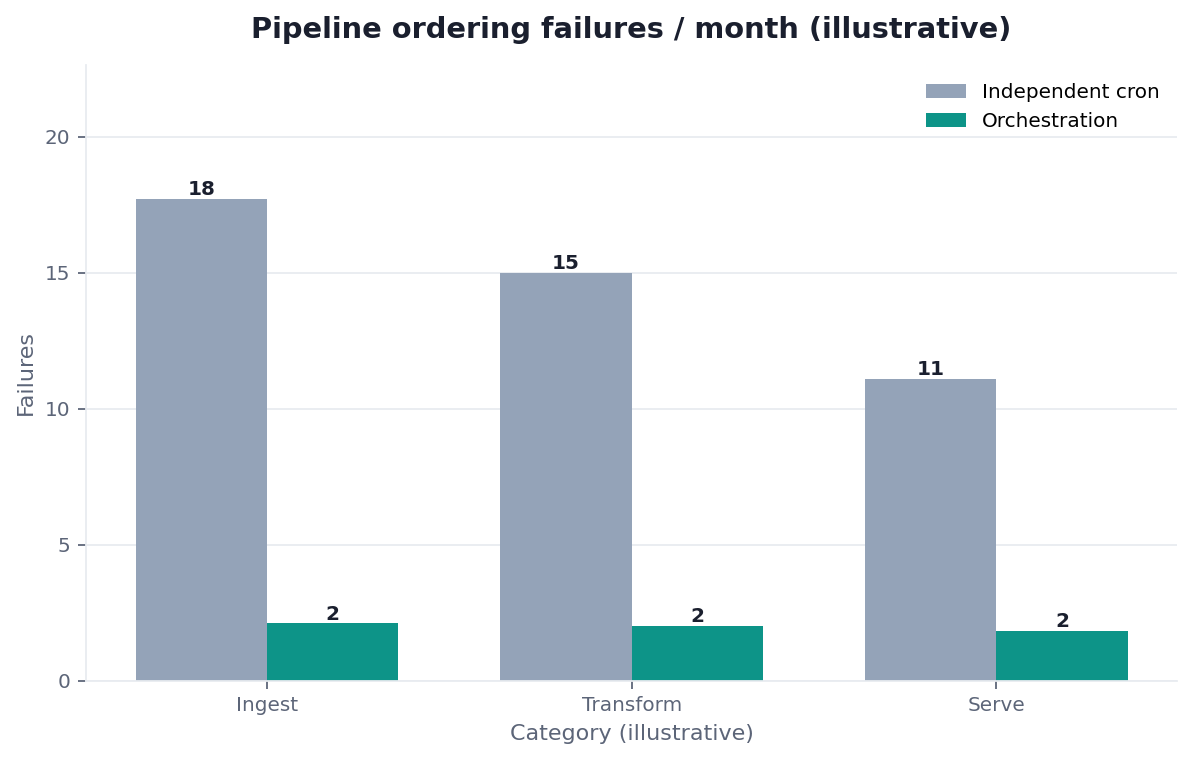
Practical example: a team ran pipelines on independent cron jobs and suffered constant ordering failures. Adopting real data orchestration with explicit dependencies — a pattern the guidance at ISO/IEC 27001 supports — ended the breakage overnight.
Scope note: This guide reflects patterns we see when mid-market and enterprise teams work with data orchestration in 2026. It is not a substitute for legal counsel, vendor runbooks, or a formal survey of every industry — and when a smaller toolset or lighter process would serve, a full program is overkill.
What It Is
At its core, data orchestration is the coordination layer that decides when each step in a data platform runs, ensures steps run in the correct order, handles failures, and provides visibility into the whole flow.
Key Definition: data orchestration is the coordination of the tasks, pipelines, and dependencies in a data platform — scheduling execution, enforcing correct ordering, managing retries and failures, and monitoring the whole flow — so that data is produced reliably, in the right sequence, and on time.
The distinction that matters with data orchestration is between scheduling and coordination. A simple scheduler runs things at set times; orchestration understands dependencies, so a step waits for its inputs and the system recovers gracefully when something fails.
Why It Matters
Teams evaluating this topic often cross-check ClickHouse documentation for a durable, vendor-neutral reference point.
The reason data orchestration matters is that a data platform is not one pipeline but many, with complex dependencies. Without coordination, steps run in the wrong order, failures cascade silently, and no one has a clear view of what ran and what broke.
The reliability framing in Databricks documentation shows why data orchestration is foundational: it turns a set of independent jobs into a coherent system where dependencies are respected and failures are visible and recoverable. Without it, the platform's reliability degrades as it grows, until firefighting consumes the team.
How It Works
Understanding how data orchestration works starts with the dependency graph. Orchestration tools represent the platform's steps and their dependencies as a graph, then execute steps in the correct order, waiting for inputs and handling failures.
The distributed patterns at Anthropic research show why the graph model is powerful: data orchestration can run independent steps in parallel, retry failed ones, skip or alert on broken dependencies, and backfill historical data — all driven by the declared graph rather than brittle manual scheduling. The reference guidance at Google Research publications reinforces that this declarative, dependency-aware approach is what makes large platforms manageable.
Patterns That Work
Core definitions remain usefully summarized in Wikipedia statistics overview for shared vocabulary across stakeholders.
The patterns that make data orchestration effective center on explicit dependencies and idempotency. Declare what each step depends on rather than relying on timing, and make steps re-runnable so retries and backfills are safe.
This connects data orchestration to the broader discipline of data engineering: the same reliability principles apply. Good orchestration also means loud alerting — failures should be impossible to miss — and clear observability, so anyone can see what ran, what is running, and what failed. The best orchestrated platforms make their own state obvious, which is what lets a small team run a large number of pipelines confidently.
Common Pitfalls
The pitfalls of data orchestration are consistent. Relying on timing instead of explicit dependencies causes ordering failures. Non-idempotent steps make retries and backfills dangerous. And poor observability means failures hide until numbers are wrong.
A subtler pitfall is over-orchestrating. Not every platform needs a heavyweight orchestration system; sometimes data orchestration for a handful of simple pipelines adds complexity the problem does not warrant. We favor matching the orchestration to the platform's real complexity, because an elaborate orchestration layer for three pipelines is its own maintenance burden that outweighs the benefit.
Orchestration in the Age of AI
Implementation details are commonly grounded in Microsoft data architecture guidance when teams translate concepts into production practice.
AI is changing data orchestration in two ways. AI helps author and monitor orchestration, and AI-native platforms reduce how many pipelines need orchestrating at all.
That second shift is the one we find most useful, and we describe it in what AI-native data analysis means. In the InfiniSynapse web app, zero-config federation lets an agent analyze across sources without orchestrating a chain of pipelines first, so the simplest data orchestration is often the coordination you never had to build because the data was analyzed in place.
Scheduling Versus True Coordination
The single most useful distinction in this topic is between scheduling and true coordination, because conflating them is the root of most reliability problems. A scheduler simply runs a task at a set time — nine o'clock, every hour, once a day. Real data orchestration, by contrast, runs a task when its inputs are ready, regardless of the clock. The difference sounds subtle but it is enormous in practice: a schedule assumes the world runs on time, while coordination adapts to a world where upstream jobs slip, sources arrive late, and failures happen. Systems built on schedules alone are brittle precisely because reality rarely keeps to a timetable.
Consider the classic failure it prevents. A transformation scheduled to run at ten o'clock assumes its source finished loading by then, but one morning the load runs late, the transformation fires on stale or partial data, and a dashboard quietly shows wrong numbers. No error is raised because nothing technically failed; the timing assumption simply broke. Real data orchestration eliminates this class of bug by making the transformation wait for the load to actually complete, so it runs on correct data or not at all. That guarantee — right order, right inputs, every time — is the core value the discipline provides.
The dependency graph is what makes the guarantee possible. By declaring that the transformation depends on the load, and the load depends on the extraction, you describe the true shape of the work rather than a fragile sequence of clock times. The orchestrator then honors that shape: it runs independent branches in parallel for speed, waits where a dependency demands it, and knows exactly what to re-run when something fails partway through. This declarative approach scales gracefully as the platform grows, whereas a tangle of hand-tuned schedules becomes exponentially harder to reason about with every job added.
The practical lesson is to reach for coordination the moment dependencies exist between tasks, which is almost immediately in any real platform. A single isolated job can live on a schedule, but as soon as one task's output feeds another, timing-based scheduling starts accumulating hidden risk. Adopting proper data orchestration early — while the platform is small enough that the migration is easy — spares a team the painful, error-prone transition later, when dozens of interdependent jobs are all balanced precariously on assumptions about the clock. Coordinating by dependency rather than by time is the habit that keeps a growing platform trustworthy. It is also the habit that lets a small team operate a surprisingly large platform, because a system that understands its own dependencies largely runs itself, surfacing problems precisely where they occur and leaving the humans free to build rather than to babysit. That leverage — more reliable operation from fewer people — is ultimately why the discipline earns its place at the center of any serious data platform, and why teams that invest in it early tend to outgrow those that keep patching schedules by hand.
Readiness Scorecard
Assess your orchestration (1 point each):
| Check | Pass? |
|---|---|
| Dependencies are explicit, not timing-based | |
| Steps are idempotent | |
| Failures retry and alert loudly | |
| The whole flow is observable | |
| Independent steps run in parallel | |
| Backfills are safe and supported | |
| Orchestration matches real complexity | |
| Federation was considered to reduce pipelines |
6–8: well-orchestrated. 3–5: add explicit dependencies and alerting. Below 3: rethink coordination.
Common Misconceptions
Misconception 1: Orchestration is just scheduling. Data orchestration understands dependencies, not just times.
Misconception 2: Every platform needs a big tool. Match orchestration to real complexity.
Misconception 3: Timing is good enough. Explicit dependencies prevent ordering failures.
Misconception 4: Silent success is fine. Orchestration must make failures visible.
Frequently Asked Questions
What is data orchestration?
Data orchestration is the coordination of the tasks, pipelines, and dependencies in a data platform — scheduling execution, enforcing correct ordering, managing retries and failures, and monitoring the whole flow — so data is produced reliably, in the right sequence, and on time. The key distinction is between scheduling, which just runs things at set times, and orchestration, which understands dependencies so steps wait for their inputs.
Why does data orchestration matter?
Because a data platform is not one pipeline but many, with complex dependencies. Lacking coordination, steps fire out of sequence, failures spread unnoticed, and nobody can see clearly what actually ran and what quietly broke. Orchestration turns a set of independent jobs into a coherent system where dependencies are respected and failures are visible and recoverable, which is what keeps reliability from degrading as the platform grows.
How does it work?
These tools model the platform's steps and their dependencies as a graph, then run each step in the correct order, pausing for inputs and catching failures as they go. The graph model lets orchestration run independent steps in parallel, retry failed ones, skip or alert on broken dependencies, and backfill historical data — all driven by the declared graph rather than brittle manual scheduling, which is what makes large platforms manageable.
What patterns work best?
Explicit dependencies and idempotency: declare what each step depends on rather than relying on timing, and make steps re-runnable so retries and backfills are safe. Good orchestration also means loud alerting so failures are impossible to miss, and clear observability so anyone can see what ran, is running, and failed. The best orchestrated platforms make their own state obvious.
How is AI changing orchestration?
Automated tools now help author and watch over orchestration, while AI-native platforms cut how many pipelines need orchestrating in the first place. The simplest orchestration is often the coordination you never had to build, because federation lets an agent analyze across sources without orchestrating a chain of pipelines first. As with pipelines themselves, the biggest lever is often reducing how much coordination is needed rather than coordinating more.
When should a team adopt an orchestration tool?
As soon as dependencies exist between tasks, which is almost immediately in any real platform. A single isolated job can live on a simple schedule, but the moment one task's output feeds another, timing-based scheduling starts accumulating hidden risk. Adopting proper orchestration early — while the platform is small enough that the migration is easy — spares a team the painful transition later, when dozens of interdependent jobs are all balanced precariously on assumptions about the clock rather than on declared dependencies.
Conclusion
Data orchestration is the coordination layer that turns many pipelines into a dependable system — scheduling, enforcing dependencies, handling failures, and providing visibility. In 2026, favor explicit dependencies, idempotency, loud alerting, and observability, match the tooling to real complexity, and remember AI-native federation can reduce how much you need to orchestrate at all.
To see how federated analysis reduces the pipelines you orchestrate, read what AI-native data analysis means and try the InfiniSynapse web app free on registration.