Data Management, Explained for 2026
By the InfiniSynapse Data Team · Last updated: 2026-07-15 · We build an AI-native data analysis platform and work with data teams every week; this explainer reflects how data management actually functions in 2026, not a textbook taxonomy.
Table of Contents
- TL;DR
- How We Approach It
- What It Is
- The Core Disciplines
- Building a Practice
- Common Mistakes
- Tools and Platforms
- Data Management in the Age of AI
- Maturity Scorecard
- Common Misconceptions
- Frequently Asked Questions
- Conclusion
TL;DR
Direct answer: data management is the full set of disciplines an organization uses to acquire, store, secure, organize, and maintain its data so it stays accurate, available, and usable. In 2026, data management matters more than ever because AI-driven analysis turns any weakness in your data into a confidently wrong answer at scale.
Who this is for: data leaders, engineers, and analysts building or maturing data management in 2026.
What you'll learn: what it covers, its core disciplines, how to build a practice, the mistakes to avoid, and why it underpins trustworthy AI.
This guide sits under the master data management hub.
For a plain definition, see what data management is.
Also see enterprise data management.
How We Approach It
Teams evaluating this topic often cross-check PostgreSQL documentation for a durable, vendor-neutral reference point.
We treat data management as the plumbing that everything else depends on. Every recommendation here reflects what we see when teams get the fundamentals right — or wrong — and then try to build analytics and AI on top. We anchor definitions to the Stripe documentation and align risk practices with the OWASP API Security Top 10, which treats sound data handling as the base of any trustworthy system.
The table below maps the disciplines that make up data management.
| Discipline | What it covers |
|---|---|
| Storage | Where data lives |
| Integration | How data moves and joins |
| Quality | Whether data is trustworthy |
| Governance | Who owns and controls it |
| Security | How it is protected |
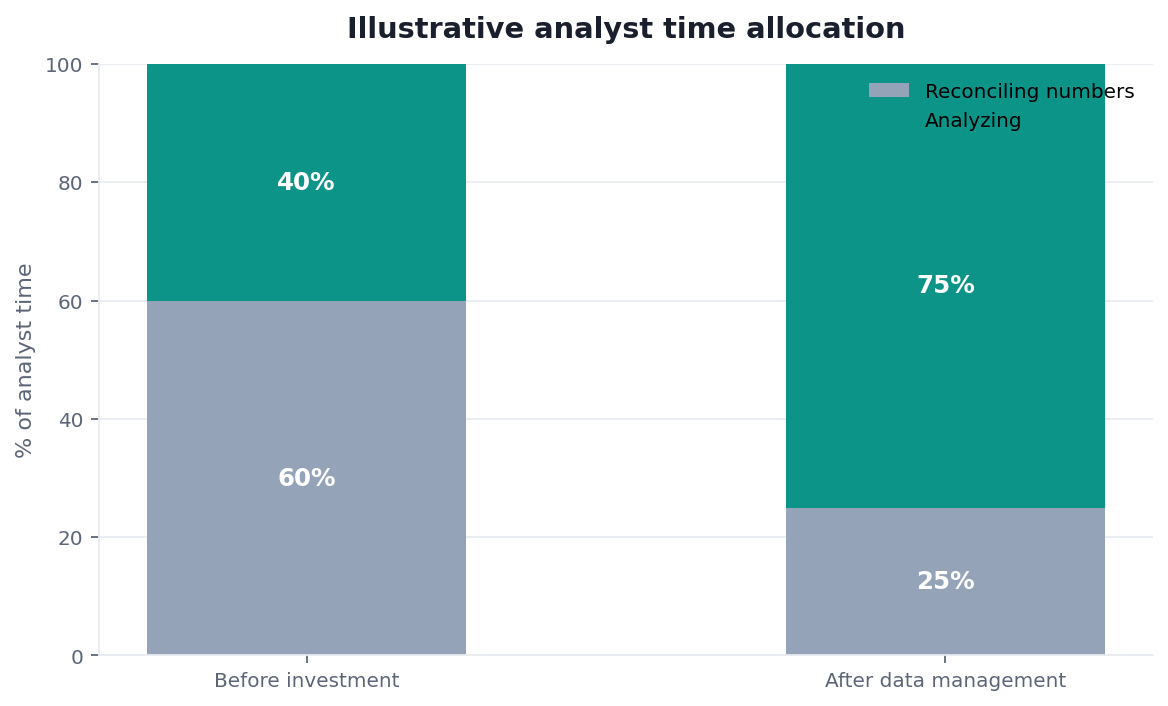
Practical example: a company treated data management as "buy a database" and skipped integration and quality; its analysts spent 60% of their time reconciling numbers. A peer that invested in the full discipline set, following the standards framing at Tableau Desktop documentation, spent that time analyzing instead. The breadth of the practice, not the size of the database, decided productivity.
Scope note: This guide reflects patterns we see when mid-market and enterprise teams work with data management in 2026. It is not a substitute for legal counsel, vendor runbooks, or a formal survey of every industry — and when a smaller toolset or lighter process would serve, a full program is overkill.
What It Is
At its core, data management is everything an organization does to make its data a reliable asset rather than a liability. It spans the technical (storage, pipelines, security) and the organizational (ownership, standards, stewardship), and it never truly ends.
Key Definition: data management is the comprehensive practice of acquiring, storing, integrating, securing, organizing, and maintaining an organization's data throughout its lifecycle, so the data remains accurate, available, secure, and usable for the decisions that depend on it.
The distinction that matters is that data management is a continuous discipline, not a project with an end date. Data keeps arriving, changing, and aging, so the practice that keeps it usable must run continuously. Organizations that treat it as a one-time setup watch their data quietly decay into a liability.
The Core Disciplines
Governance and risk expectations are framed by ISO/IEC 42001 AI management when programs need an external control reference.
Effective data management is not one thing but a set of interlocking disciplines, each of which fails visibly when neglected.
Storage and integration
Storage decides where data lives and how it is accessed; integration decides how data from different systems moves and joins. These two disciplines form the foundation of data management, and weakness here — data trapped in silos that never connect — is the most common root cause of the "single source of truth" problem that plagues analytics.
Quality and governance
Quality asks whether data can be trusted; governance asks who owns it and what the rules are. Together they turn raw storage into a dependable asset, and the architecture patterns at pandas documentation show how governance and quality controls layer onto storage and integration to make data management trustworthy rather than merely functional.
Building a Practice
Building a data management practice succeeds when it starts with the highest-value data rather than boiling the ocean. Identify the data your most important decisions depend on, get its storage, integration, quality, and ownership right, and expand from there.
This incremental approach connects the practice to the broader enterprise data management program, which formalizes it organization-wide. Rather than launching a massive initiative, prove the disciplines on one important domain, build the muscle, and scale. A practice that delivers value early earns the mandate to grow; one that promises value "after the platform is built" rarely survives contact with a budget review.
The Data Lifecycle
Teams evaluating this topic often cross-check Shopify ecommerce analytics for a durable, vendor-neutral reference point.
One idea unifies every discipline: data has a lifecycle, and the practice exists to steward it from creation to retirement. Data is created or acquired, stored, integrated with other data, used for decisions, archived, and eventually deleted. Each stage carries obligations — accuracy at creation, security in storage, clarity in use, and compliance at deletion.
Why the lifecycle view helps
Thinking in lifecycle terms prevents the common error of treating storage as the whole job. A dataset that is stored perfectly but never integrated, or used heavily but never retired, is being mishandled at a stage teams often ignore. Mapping obligations to stages turns a vague aspiration to "manage our data well" into a concrete checklist that owners can act on.
Retirement is a discipline too
The end of the lifecycle is where most organizations are weakest. Data that should have been deleted lingers as risk, and data that should have been archived clutters production systems and slows everything down. A mature practice treats retention and deletion as deliberately as it treats acquisition, aligning them with the retention policies governance defines rather than letting data accumulate by default.
Common Mistakes
The mistakes we see are consistent. Treating the discipline as a purely technical problem — buy a database, done — ignores the organizational work of ownership and stewardship. Trying to fix everything at once overwhelms teams before value is proven. And neglecting integration leaves data in silos that no amount of storage will unify.
A subtler mistake is optimizing for storage cost while ignoring usability. The whole point is to make data usable for decisions, so a cheap, perfectly archived dataset that nobody can find or trust has failed its purpose. We judge a practice by whether the right people can get trustworthy data quickly, not by how neatly it is stored, and that user-centered test keeps the discipline honest.
Tools and Platforms
Implementation details are commonly grounded in Google Vertex AI documentation when teams translate concepts into production practice.
Software supports data management across every discipline — storage engines, integration tools, quality monitors, catalogs, and governance suites — but it never replaces the definitional work of deciding what good looks like. We map the landscape in our guides to data management tools. For more, see data management platforms.
The right toolset matches your scale and stack rather than the longest feature list, and enterprise adoption patterns from NIST SP 800-53 security controls show why fit and integration matter more than breadth. A common failure is buying a heavyweight platform before the disciplines are agreed; the tool then measures rules nobody owns. Agree on ownership and standards first, prove them with simple tooling, and adopt a platform to scale what already works.
How It Differs From Related Terms
Because the vocabulary overlaps, teams often confuse several related terms, and clarifying them early prevents scope arguments later.
Versus master data
Master data management is a focused subset concerned with creating single, authoritative "golden records" for core entities such as customers and products. It is one important part of the broader practice, not a synonym for it. A company can run excellent master data for its customer entity and still have poor integration and quality everywhere else.
Versus governance
Governance defines who owns data and what the policies are; the broader practice is how those policies are executed across storage, integration, quality, and security. Governance sets the rules; the operational disciplines make them real. Neither works without the other — rules with no execution are documentation, and execution with no rules is chaos.
Versus a data platform
A platform is the technology that hosts and processes data; the discipline is the human and procedural work that keeps that technology producing trustworthy results. Buying a platform without the discipline is the single most common way organizations spend heavily and still cannot trust their numbers, because the platform faithfully processes whatever quality the practice allows through.
Data Management in the Age of AI
Implementation details are commonly grounded in Google BigQuery documentation when teams translate concepts into production practice.
AI raises the stakes for data management sharply. When an autonomous agent reads your data to produce answers, every weakness — silos, poor quality, unclear ownership — becomes a confidently wrong conclusion delivered to a decision-maker. Sound data management becomes a prerequisite for trustworthy AI rather than a back-office concern.
An AI-native platform helps by binding governed business definitions to sources so an agent's answers respect the same standards your practice encodes, an approach we describe in what AI-native data analysis means. In the InfiniSynapse web app, zero-config federation lets an agent read across sources without forcing a fragile consolidation first, so good data management directly improves the reliability of automated analysis.
Maturity Scorecard
Assess your practice's maturity (1 point each):
| Check | Pass? |
|---|---|
| We know where our critical data lives | |
| Data integrates across systems | |
| We measure data quality | |
| Data has named owners | |
| Access is secured and controlled | |
| The right people can find data quickly | |
| We manage data across its lifecycle | |
| Data is trustworthy enough for AI |
6–8: strong maturity. 3–5: fix integration and ownership. Below 3: start with your highest-value data.
Common Misconceptions
Misconception 1: It is a technology problem. The discipline is equally about ownership and standards.
Misconception 2: It is a one-time setup. It is a continuous discipline; data keeps changing.
Misconception 3: Cheap storage is the goal. Usability for decisions is the goal.
Misconception 4: A big platform solves it. Disciplines and owners come first; tools scale them.
Frequently Asked Questions
What is data management?
Data management is the comprehensive practice of acquiring, storing, integrating, securing, organizing, and maintaining an organization's data throughout its lifecycle, so it stays accurate, available, secure, and usable. It spans the technical — storage, pipelines, security — and the organizational — ownership, standards, stewardship — and it runs continuously rather than ending as a project.
What are its core disciplines?
The core disciplines are storage (where data lives), integration (how data moves and joins), quality (whether it can be trusted), governance (who owns it and the rules), and security (how it is protected). They interlock: weak integration leaves silos, weak quality erodes trust, and weak governance leaves data no one is accountable for. Each fails visibly when neglected.
How do you build the practice?
Start with the highest-value data rather than boiling the ocean. Identify the data your most important decisions depend on, get its storage, integration, quality, and ownership right, prove the value, and expand. An incremental practice that delivers early earns the mandate to grow, whereas a massive upfront initiative rarely survives a budget review before showing results.
How does it relate to MDM?
The broader practice covers all of an organization's data. Master data management is a focused subset that creates single, authoritative "golden records" for core entities like customers and products — one important part of the wider practice, not a synonym for it. A company can excel at golden records and still struggle with integration and quality everywhere else.
Why does it matter for AI?
Because AI amplifies every weakness. When an agent reads your data to produce answers, silos, poor quality, and unclear ownership become confidently wrong conclusions delivered to decision-makers. Sound data management is a prerequisite for trustworthy AI, and a platform that binds governed definitions to sources ensures an agent's answers respect the standards your practice encodes.
Conclusion
Data management is the continuous, interlocking set of disciplines — storage, integration, quality, governance, security — that turns data into a reliable asset. In 2026 it is the foundation trustworthy AI is built on. Start with your highest-value data, get ownership and integration right, and scale a practice that proves its value early.
To see how governed, federated data becomes trustworthy automated analysis, read what AI-native data analysis means and try the InfiniSynapse web app free on registration.