What Is a Data Lakehouse? (2026)
By the InfiniSynapse Data Team · Last updated: 2026-07-15 · We build an AI-native data analysis platform and work across lakes, warehouses, and lakehouses; this explainer covers what a data lakehouse is in 2026, in plain terms rather than a vendor pitch.
Table of Contents
- TL;DR
- How We Approach It
- What It Is
- How It Merges Two Models
- When It Fits
- The Trade-Offs
- Where It Came From
- Common Pitfalls
- The Lakehouse in the Age of AI
- Readiness Scorecard
- Common Misconceptions
- Frequently Asked Questions
- Conclusion
TL;DR
Direct answer: a data lakehouse is an architecture that adds warehouse-style structure, transactions, and governance on top of low-cost data-lake storage, aiming to serve both flexible data science and reliable analytics from one platform. In 2026, the data lakehouse is popular because it promises to end the lake-versus-warehouse split, but it delivers only when the added structure — table formats, governance, quality — is actually enforced rather than assumed.
Who this is for: architects and leaders weighing a data lakehouse in 2026.
What you'll learn: what it is, how it merges two models, when it fits, its trade-offs, and how AI relates.
This guide sits under the warehouse and lakehouse hub.
For the two models it merges, see what a data lake is.
Also see data lake vs data warehouse.
How We Approach It
Governance and risk expectations are framed by NIST Cybersecurity Framework when programs need an external control reference.
We explain a data lakehouse as the reconciliation of two older models, because that framing shows what it adds and what it inherits. Every point reflects real deployments. We anchor concepts to the OpenTelemetry documentation and weigh patterns against the reference architectures at Wikipedia statistics overview.
The table below frames the data lakehouse.
| Aspect | Data lakehouse |
|---|---|
| Storage | Low-cost, lake-style |
| Structure | Warehouse-style tables, transactions |
| Goal | One platform for science and analytics |
| Strength | Flexibility plus reliability |
| Watch-out | Structure must be enforced |
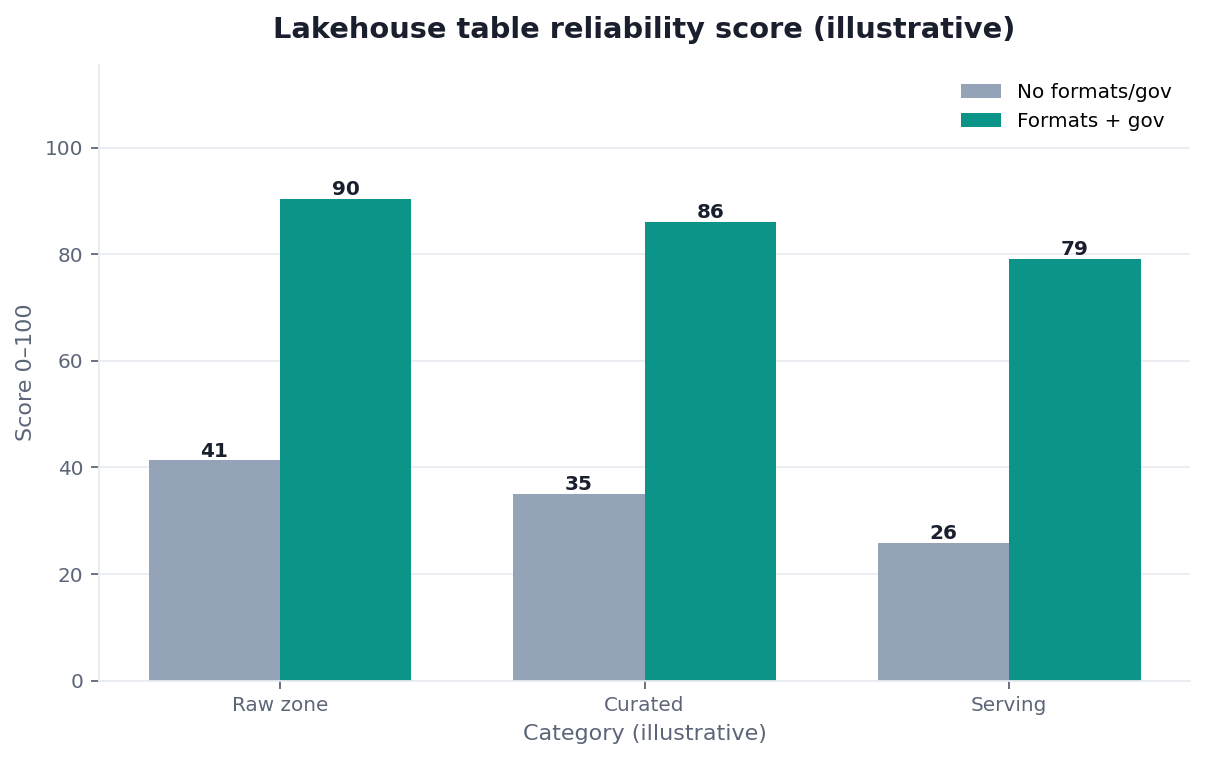
Practical example: a team built a data lakehouse expecting warehouse reliability but skipped table formats and governance, so it behaved like a swamp — the failure mode the guidance at MongoDB documentation on lakehouse design warns against.
Scope note: This guide reflects patterns we see when mid-market and enterprise teams work with data lakehouse in 2026. It is not a substitute for legal counsel, vendor runbooks, or a formal survey of every industry — and when a smaller toolset or lighter process would serve, a full program is overkill.
What It Is
At its core, a data lakehouse is an architecture that layers the structure, transactions, and governance of a warehouse directly onto the cheap, open storage of a data lake, so one platform can serve both raw exploration and reliable reporting.
Key Definition: a data lakehouse is a data architecture that adds warehouse-style capabilities — structured tables, ACID transactions, schema enforcement, and governance — on top of the low-cost, open-format storage of a data lake, aiming to support both flexible data-science workloads and reliable business analytics from a single platform without maintaining separate systems.
The essence of a data lakehouse is having it both ways: the lake's cheap, flexible storage for any data, plus the warehouse's reliability and structure for trustworthy analysis. It emerged to end the awkward situation where organizations ran a lake and a warehouse side by side, copying data between them.
How It Merges Two Models
Implementation details are commonly grounded in Kubernetes documentation when teams translate concepts into production practice.
A data lakehouse merges the two by keeping lake storage underneath and adding a metadata and transaction layer — open table formats — on top. That layer brings schema, ACID transactions, and governance to files that were previously just objects in storage.
The value of a data lakehouse is that this merger removes the need to maintain and synchronize two systems, as the patterns at Google Vertex AI documentation for comparable architectures show. Data scientists get flexible access to raw data; analysts get reliable, governed tables — from the same store. When it works, it eliminates the copying and drift that plagued the two-system world and gives everyone a single source.
When It Fits
A data lakehouse fits organizations that genuinely need both flexible data-science access and reliable analytics on large, varied data, and that are willing to invest in the table formats and governance the model requires to work.
Like any architecture, a data lakehouse is not universal. The OWASP Top 10 for LLM Applications reminds us that simpler needs may be met by a warehouse alone or a well-governed lake. The lakehouse earns its place where the two workloads truly coexist at scale and the cost of running separate systems — in money and in data drift — has become real. Where needs are simpler, its added complexity may not pay off.
The Trade-Offs
Implementation details are commonly grounded in Python documentation when teams translate concepts into production practice.
The trade-off of a data lakehouse is that its promise depends entirely on enforcement. The structure and reliability are not automatic properties of the storage; they come from the table formats and governance layered on top, and they hold only if those are actually applied.
Weighing a data lakehouse honestly means accepting that it is younger and more complex than a mature warehouse, part of the broader landscape covered across the warehouse and lakehouse hub. Tooling is evolving, and getting reliability right requires discipline that a purpose-built warehouse enforces more automatically. The model can absolutely deliver both flexibility and trust, but it asks the team to build and maintain the guarantees rather than inheriting them.
Where It Came From
The data lakehouse arose to resolve a genuine pain: organizations were running data lakes and data warehouses side by side, each strong where the other was weak. The lake held everything cheaply and flexibly but lacked reliability; the warehouse gave trustworthy analytics but was rigid and expensive. Keeping both meant copying data between them, which introduced cost, latency, and drift.
Open table formats made it possible to add transactions and structure to lake storage, and that technical advance is what turned the two-system compromise into a single-platform possibility. Understanding this origin clarifies why the model is defined by what it adds on top of the lake rather than by new storage: the storage was always cheap and flexible, and the missing piece was reliability. It also explains the central caveat — because reliability is added rather than inherent, it exists only to the degree the team enforces it.
Common Pitfalls
Teams evaluating this topic often cross-check RFC 4180 CSV format for a durable, vendor-neutral reference point.
The pitfalls of a data lakehouse center on assuming its benefits are automatic. Skipping table formats and governance leaves you with a data lake wearing a new name, offering none of the promised reliability.
A subtler pitfall is adopting a data lakehouse for its buzz rather than a real need. Organizations without genuinely coexisting science and analytics workloads may take on the model's complexity for benefits they will not use, when a warehouse or well-governed lake would serve them more simply. The lakehouse is a strong answer to a specific problem; applied where that problem does not exist, it adds cost and immaturity without payoff.
There is also a governance pitfall specific to the model's dual audience. Because the same platform serves data scientists exploring raw data and analysts consuming curated tables, it is easy to blur the boundary between the two — letting exploratory, unvetted datasets bleed into the layer that reporting depends on, or conversely locking everything down so tightly that the flexibility the scientists needed disappears. A well-run lakehouse maintains clear zones: a raw area where experimentation is free, and a curated area where the transactions, quality checks, and access controls are strictly enforced. Losing that separation is how a promising lakehouse quietly reverts to either an ungoverned swamp or an inflexible warehouse, forfeiting the very balance that justified the architecture.
The Lakehouse in the Age of AI
AI intersects a data lakehouse naturally, since the model was partly designed to serve the flexible data access that machine learning needs alongside reliable analytics. Trusted, governed data feeds better AI.
But architecture is not the only path to unified access, and we explore this in what AI-native data analysis means. In the InfiniSynapse web app, zero-config federation lets an agent analyze across a lake, a warehouse, and databases together without first merging them into a single lakehouse — an alternative route to the unified access a data lakehouse promises, for teams not ready to rebuild their storage.
Readiness Scorecard
Architecture choices are often checked against IBM augmented analytics overview so boundaries, ownership, and scale patterns stay explicit.
Assess your lakehouse readiness (1 point each):
| Check | Pass? |
|---|---|
| Both workloads genuinely coexist | |
| Open table formats are used | |
| Governance is enforced | |
| Schema and transactions are applied | |
| Team can maintain the guarantees | |
| Cost of two systems was real | |
| A simpler option was ruled out on merit | |
| Federation was considered as an alternative |
6–8: lakehouse-ready. 3–5: shore up structure. Below 3: reconsider fit.
Common Misconceptions
Misconception 1: A lakehouse is reliable by default. Reliability comes from enforced structure.
Misconception 2: It is just a renamed data lake. The added table and governance layer is the point.
Misconception 3: Everyone needs one. Only where both workloads truly coexist.
Misconception 4: Unified access requires rebuilding storage. Federation offers another route.
Frequently Asked Questions
What is a data lakehouse?
It is a data architecture that adds warehouse-style capabilities — structured tables, ACID transactions, schema enforcement, and governance — on top of the low-cost, open-format storage of a data lake. The goal is to support both flexible data-science workloads and reliable business analytics from a single platform, without running and synchronizing separate systems. In essence it tries to have it both ways: the lake's cheap flexibility plus the warehouse's reliability, from one store.
How does it merge a lake and a warehouse?
It keeps lake storage underneath and adds a metadata and transaction layer — open table formats — on top, bringing schema, ACID transactions, and governance to files that were previously just objects in storage. That merger removes the need to maintain and synchronize two systems: data scientists get flexible access to raw data while analysts get reliable, governed tables, all from the same store, eliminating the copying and drift that plagued the two-system world.
When does it fit best?
It fits organizations that genuinely need both flexible data-science access and reliable analytics on large, varied data, and that will invest in the table formats and governance the model requires. It is not universal — simpler needs may be met by a warehouse alone or a well-governed lake. It earns its place where the two workloads truly coexist at scale and the cost of running separate systems, in money and in data drift, has become real.
What are its main trade-offs?
Its promise depends entirely on enforcement: the structure and reliability are not automatic properties of the storage but come from the table formats and governance layered on top, and they hold only if those are actually applied. The model is also younger and more complex than a mature warehouse, with evolving tooling, so getting reliability right takes discipline a purpose-built warehouse enforces more automatically. It delivers, but asks the team to build the guarantees.
How does AI relate to a data lakehouse?
The model was partly designed to serve the flexible data access machine learning needs alongside reliable analytics, so trusted, governed data feeds better AI. But architecture is not the only route to unified access: federation lets an agent analyze across a lake, a warehouse, and databases together without first merging them into a single lakehouse. That is an alternative path to the unified access the model promises, useful for teams that need it now but are not ready to rebuild their storage layer.
How is it different from a data warehouse?
A warehouse is built structure-first: data is cleaned, modeled, and loaded into a purpose-built system optimized for reliable, governed analytics, and that reliability is largely inherent to how it works. A lakehouse instead starts from cheap, flexible lake storage and adds warehouse-style guarantees on top, so it can also hold raw data for science while serving analytics. The warehouse gives reliability more automatically but with less flexibility and higher cost; the lakehouse offers both flexibility and reliability, but the reliability is only as strong as the structure the team enforces.
Conclusion
A data lakehouse layers warehouse structure, transactions, and governance onto cheap lake storage to serve science and analytics from one platform — but only delivers when that structure is genuinely enforced. In 2026, adopt it where both workloads truly coexist and you can maintain the guarantees, and remember AI-native federation offers another route to unified access without rebuilding storage.
To see federated analysis across a lake and warehouse together, read what AI-native data analysis means and try the InfiniSynapse web app free on registration.