Data Governance: The Complete 2026 Guide
By the InfiniSynapse Data Team · Last updated: 2026-07-15 · We build an AI-native data analysis platform and work with governance teams weekly; this guide reflects what makes data governance stick in 2026, not a compliance checklist nobody follows.
Table of Contents
- TL;DR
- How We Approached This
- What It Is
- The Core Pillars
- Building a Program That Sticks
- Common Failure Modes
- Tooling and Automation
- Governance in the Age of AI
- Maturity Scorecard
- Common Misconceptions
- Frequently Asked Questions
- Conclusion
TL;DR
Direct answer: data governance is the system of policies, roles, and controls that determines who can do what with which data, and how quality and compliance are maintained. In 2026, data governance is no longer a back-office function — it is the foundation that decides whether your AI agents produce trustworthy answers or confident nonsense.
Who this is for: data leaders, stewards, and engineers building or maturing data governance in 2026.
What you'll learn: what it is, the pillars that define it, how to build a program that actually sticks, the failure modes to avoid, and why it underpins trustworthy AI.
This guide sits under the data governance frameworks hub.
For a plain-language starting point, see what data governance is.
Also see data governance definition.
How We Approached This
Teams evaluating this topic often cross-check Tableau Desktop documentation for a durable, vendor-neutral reference point.
We built this guide from real program work rather than a framework diagram. Every recommendation reflects what we see when organizations try to make data governance operational rather than aspirational. We anchor definitions to the OECD AI policy observatory, and we align control expectations with the Google Cloud architecture framework, which treats data provenance and access as core risk factors for any AI system.
The table below maps the pillars of data governance. Use it as a quick reference; the sections below go deeper on each.
| Pillar | Question it answers |
|---|---|
| Ownership | Who is accountable for this data? |
| Access | Who is allowed to use it, and how? |
| Quality | Is it accurate, complete, and fresh? |
| Policy | What rules apply to it? |
| Lineage | Where did it come from? |
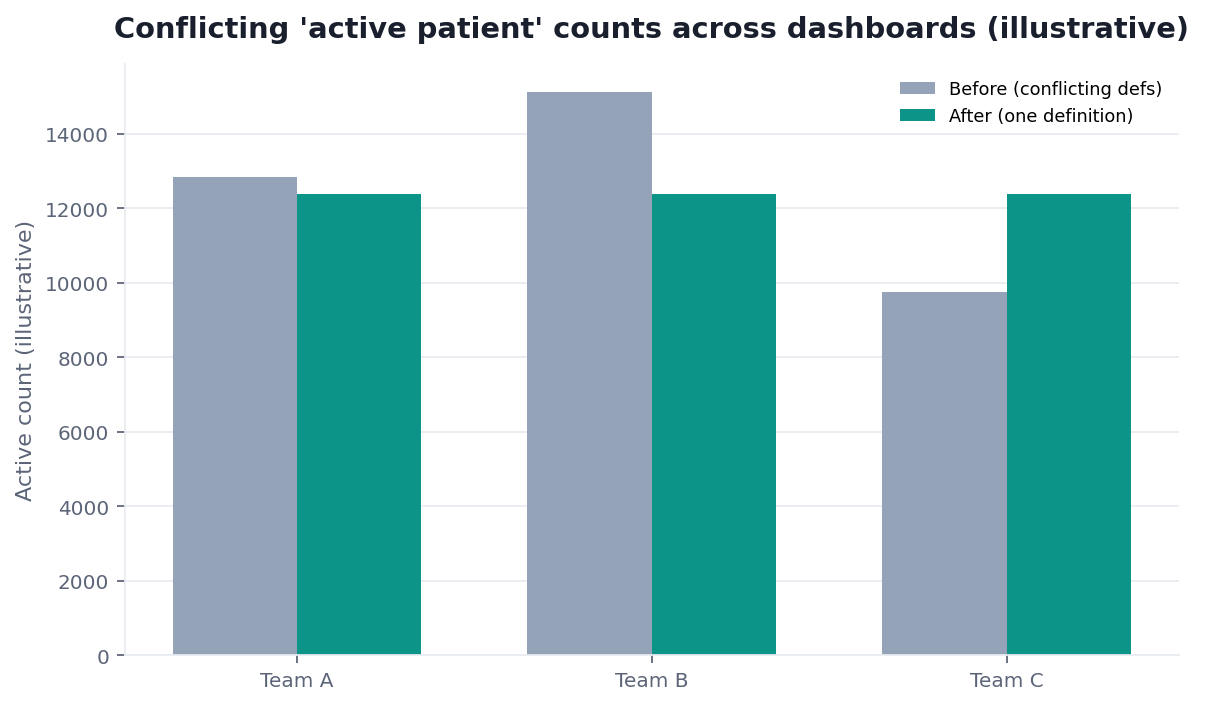
Practical example: a healthcare analytics team with no data governance had three definitions of "active patient," so three dashboards disagreed and executives stopped trusting all of them. After assigning owners, agreeing one definition, and wiring access controls aligned with MariaDB documentation, the dashboards reconciled and trust returned. That shift — from ambiguity to accountable definitions — is what data governance delivers in practice.
Scope note: This guide reflects patterns we see when mid-market and enterprise teams work with data governance in 2026. It is not a substitute for legal counsel, vendor runbooks, or a formal survey of every industry — and when a smaller toolset or lighter process would serve, a full program is overkill.
What It Is
Teams evaluating this topic often cross-check OWASP API Security Top 10 for a durable, vendor-neutral reference point.
At its core, data governance is about accountability: making explicit who owns each dataset, who may use it, what rules apply, and how quality is measured. It turns data from an ungoverned free-for-all into a managed asset with clear responsibilities.
Key Definition: data governance is the system of decision rights, policies, roles, and controls that governs how data is defined, accessed, protected, and maintained across its lifecycle, so that data is trustworthy and used responsibly.
The distinction that matters is between governance as documentation and governance as control. A policy binder nobody enforces is not data governance; a set of rules wired into systems, with named owners and measurable quality, is. That difference — enforceable versus aspirational — is what separates programs that work from those that gather dust, and it is the theme running through everything below.
The Core Pillars
Implementation details are commonly grounded in Snowflake documentation when teams translate concepts into production practice.
Effective data governance rests on a few pillars that reinforce one another. Weakness in any one undermines the rest.
Ownership and accountability
Every important dataset needs a named owner accountable for its definition, quality, and access. Without ownership, data governance has no teeth: rules exist but no one maintains them. Ownership is the pillar we recommend establishing first, because it makes every other decision assignable to a person rather than a committee.
Access and policy
Access controls decide who can use data and how, while policy codifies the rules — retention, privacy, classification. Strong data governance wires these together so that a policy change propagates to actual permissions, aligning with the enterprise adoption patterns described in ISO/IEC 27001. When access and policy drift apart, governance becomes theater.
Building a Program That Sticks
Governance and risk expectations are framed by NIST AI Risk Management Framework when programs need an external control reference.
The hardest part of data governance is not designing it but making it durable. Programs fail when they start too big, so we recommend starting with the data that matters most and expanding.
Pick your highest-value or highest-risk domain, assign owners, agree on definitions, wire access controls, and add a few quality checks. Prove value there, then reuse the template. This incremental approach connects directly to your broader data governance framework, which provides the structure that individual domains plug into. A program that delivers a visible win in one domain earns the credibility to expand; one that tries to boil the ocean stalls.
The organizational lesson we return to constantly is that data governance is a people problem wearing a technical costume. Tools help, but the durable programs are the ones where owners feel genuine accountability and where governance decisions are visible, recorded, and revisited rather than made once and forgotten.
A Pragmatic 30-Day Rollout
Core definitions remain usefully summarized in Wikipedia SQL overview for shared vocabulary across stakeholders.
Teams often ask what the first month should look like. Our answer is deliberately modest. In week one, pick a single high-value domain and interview the people who already act as its de facto owners; you are documenting reality, not inventing it. In week two, write down the three or four definitions that cause the most disagreement and get them agreed in a single working session. In week three, wire access controls to match the policy you just wrote and add two or three quality checks on the fields that matter most. In week four, review what broke, record the decisions, and pick the next domain.
This 30-day cadence works because it produces a visible win before enthusiasm fades. Rather than a year-long program that delivers nothing until it delivers everything, you show a reconciled definition and a working control inside a month. That early proof is what earns the mandate to expand, and it turns governance from an abstract initiative into a concrete habit the organization can see paying off.
Common Failure Modes
The failures we see most are organizational. A program with no executive sponsor loses to competing priorities. A program run entirely by a central team, with no domain owners, cannot scale. And a program that produces policies but no enforcement becomes documentation theater — the most common failure of all.
A subtler failure is treating data governance as a one-time project with an end date. Data, systems, and regulations change continuously, so governance is a standing capability, not a deliverable. Programs that disband their governance team after "completing" the work watch their gains erode within a year.
There is also a measurement failure worth naming. Many programs cannot say whether they are working because they track activity — meetings held, policies written — instead of outcomes. The outcomes that matter are concrete: fewer conflicting definitions, faster access approvals, fewer quality incidents reaching dashboards, and shorter time to answer an audit question. Choosing two or three of these as headline metrics keeps a program honest and gives sponsors a reason to keep funding it. Without outcome metrics, governance becomes a cost center that is easy to cut the moment budgets tighten, which is exactly when the discipline matters most.
Tooling and Automation
Software supports data governance but does not create it. Catalogs, lineage tools, and access platforms automate the mechanics, but they cannot decide who should own a dataset or what "active customer" means. Those decisions are human, and no tool substitutes for them.
The right approach is to make decisions first and automate them second. Once owners and definitions exist, tooling enforces them at scale — propagating access rules, tracking lineage, and monitoring quality. Buying a platform before doing the definitional work produces expensive software that governs nothing, a pattern strong data governance programs deliberately avoid.
When you do evaluate tools, judge them by how well they fit the decisions you have already made rather than by feature count. A catalog that makes it effortless to attach an owner and a definition to a dataset, and to see who is using it, delivers more real governance than a sprawling suite nobody adopts. Fit and adoption beat breadth every time.
Governance in the Age of AI
The 2026 shift that raises the stakes is AI-driven analysis. When an autonomous agent reads your data and answers questions, every governance weakness becomes a wrong answer delivered with confidence. Ungoverned definitions produce inconsistent AI output; unclear access lets agents reach data they should not. This makes data governance a prerequisite for trustworthy AI rather than an optional refinement, a point echoed by international policy work at the Wikipedia data warehouse overview.
An AI-native platform helps by binding governed definitions and access rules to the data an agent queries, an approach we describe in what AI-native data analysis means. In the InfiniSynapse web app, governance travels with the data rather than living in a separate binder, so data governance directly improves the reliability of automated analysis instead of being bypassed by it.
Maturity Scorecard
Assess your data governance maturity (1 point each):
| Check | Pass? |
|---|---|
| Key datasets have named owners | |
| Definitions are agreed and documented | |
| Access controls reflect current policy | |
| Quality is measured, not assumed | |
| Lineage is traceable | |
| There is executive sponsorship | |
| Domain owners share the load | |
| Governance is ready for AI use |
6–8: strong maturity. 3–5: expand ownership and enforcement. Below 3: start with one domain.
Common Misconceptions
Misconception 1: It is about restriction. Data governance enables safe use; restriction is a side effect, not the goal.
Misconception 2: It is a one-time project. It is a standing capability that evolves with data and regulation.
Misconception 3: Tools deliver it. Tools automate decisions humans must make first.
Misconception 4: It slows teams down. Good governance speeds work by removing ambiguity and rework.
Frequently Asked Questions
What is data governance?
Data governance is the system of decision rights, policies, roles, and controls that determines how data is defined, accessed, protected, and maintained across its lifecycle. It makes explicit who owns each dataset, who may use it, what rules apply, and how quality is measured — turning data from an ungoverned free-for-all into a managed, trustworthy asset.
What are the core pillars?
The core pillars are ownership, access, quality, policy, and lineage. Ownership assigns accountability, access controls who can use data, quality measures whether it is trustworthy, policy codifies the rules, and lineage traces where data came from. These pillars reinforce one another, and weakness in any one undermines the rest.
How do you build a governance program that sticks?
Start small and expand. Choose one high-value or high-risk domain, name its owners, settle its most contested definitions, connect access controls to policy, and add a handful of quality checks before moving on. Demonstrate a visible win in that domain, then reuse the approach elsewhere. Durable programs have executive sponsorship, share the load with domain owners, track outcome metrics, and treat governance as a standing capability rather than a one-time project.
Why does it matter for AI?
Because AI amplifies weaknesses. When an agent reads your data and answers questions, ungoverned definitions produce inconsistent output and unclear access lets agents reach data they should not. Governance ensures agents work from agreed definitions and permitted data, making it a prerequisite for trustworthy automated analysis rather than an optional refinement.
Is it the same as data management?
No. Data management is the broad practice of handling data throughout its lifecycle — storage, integration, operations. Governance is the layer of decision rights and policies that sits on top, deciding who is accountable and what rules apply. Management executes; governance decides and oversees. You need both, but they are distinct disciplines.
Conclusion
Data governance is enforceable accountability for data — owners, definitions, access, quality, and lineage wired into systems rather than written in a binder. In 2026 it is the foundation of trustworthy AI. Start with one domain, prove value, and expand.
To see how governed definitions travel with data into automated analysis, read what AI-native data analysis means and try the InfiniSynapse web app free on registration.