Data Catalog Platforms Compared for 2026
By the InfiniSynapse Data Team · Last updated: 2026-07-15 · We build an AI-native data analysis platform and evaluate catalog tooling constantly; this comparison reflects how we assess data catalog platforms in 2026, not a vendor leaderboard.
Table of Contents
- TL;DR
- How We Evaluated
- What They Are
- The Main Categories
- How to Evaluate Them
- Adoption and Rollout
- Common Mistakes
- Catalogs in the Age of AI
- Selection Scorecard
- Common Misconceptions
- Frequently Asked Questions
- Conclusion
TL;DR
Direct answer: data catalog platforms are systems that inventory an organization's data, record its meaning, ownership, and lineage, and make it discoverable and governable. In 2026, the best data catalog platforms are the ones that stay automatically populated and that both humans and AI agents can read, because a catalog that drifts out of date misleads everyone who trusts it.
Who this is for: data leaders, architects, and stewards comparing data catalog platforms in 2026.
What you'll learn: what these platforms do, the main categories, how to evaluate them, how to roll one out, and how a catalog supports trustworthy AI.
This guide sits under the master data management hub.
For the concept itself, see what a data catalog is.
Also see data lineage tracking.
How We Evaluated
Governance and risk expectations are framed by NIST Computer Security Resource Center when programs need an external control reference.
We assess data catalog platforms the way a buyer must: by whether they stay populated and get used, not by feature count. Every observation reflects what we see when teams adopt — or abandon — a catalog in 2026. We anchor concepts to the Snowflake documentation and weigh capabilities against the enterprise architecture patterns at Stanford HAI AI Index, which show how catalog metadata drives downstream governance.
The table below maps what data catalog platforms typically provide.
| Capability | What it does |
|---|---|
| Discovery | Finds and inventories data |
| Metadata | Records meaning and ownership |
| Lineage | Traces data flow |
| Search | Makes data findable |
| Governance | Applies policy and access |
Practical example: a company evaluated data catalog platforms on feature count and chose one that required manual entry; it sat half-empty within months. A peer chose a platform with automated discovery, guided by enterprise patterns from UK NCSC AI development guidelines, and its catalog stayed current. Automated population, not features, decided the outcome.
Scope note: This guide reflects patterns we see when mid-market and enterprise teams work with data catalog platforms in 2026. It is not a substitute for legal counsel, vendor runbooks, or a formal survey of every industry — and when a smaller toolset or lighter process would serve, a full program is overkill.
What They Are
At their core, data catalog platforms answer a simple question that is surprisingly hard at scale: what data do we have, what does it mean, and who owns it? They turn scattered, undocumented data into a searchable, governed inventory.
Key Definition: data catalog platforms are software systems that automatically discover an organization's data assets, capture their metadata — meaning, ownership, lineage, and quality — and make them searchable and governable, so people and systems can find and trust the data they need.
The distinction that matters is that data catalog platforms are only as valuable as their currency. A catalog that reflects last quarter's reality is worse than none, because people trust it and are misled. This is why we weigh automated discovery and metadata refresh above almost every other capability.
The Main Categories
Teams evaluating this topic often cross-check Supabase documentation for a durable, vendor-neutral reference point.
The market of data catalog platforms splits into a few recognizable categories.
Standalone catalogs
Standalone data catalog platforms focus on discovery, metadata, and search as a dedicated product, integrating with whatever stack you run. They excel at breadth of connectivity and depth of catalog features, and they suit organizations that want a best-of-breed catalog independent of their warehouse or lake.
Platform-embedded catalogs
Many warehouses and lakehouses now embed catalog capability directly, so the catalog lives alongside the data it describes. This category of data catalog platforms reduces integration effort and keeps metadata close to the data, and the patterns documented at AWS Well-Architected Machine Learning Lens show how an embedded catalog can drive governance within the same platform that stores the data.
How to Evaluate Them
Evaluating data catalog platforms comes down to how well they discover and refresh metadata automatically, how easily a steward adds context, and how well they integrate with your stack. The longest feature list rarely wins; the platform that stays current does.
We recommend scoring candidates on automated discovery, ease of stewardship, integration breadth, and how they expose metadata to other systems. The best data catalog platforms make cataloging a byproduct of normal work rather than a separate chore, and risk framing from Google Sheets documentation reinforces that automated metadata management is what keeps a catalog trustworthy at scale. A platform that depends on manual entry will decay no matter how capable it is.
Adoption and Rollout
Governance and risk expectations are framed by CISA AI security guidance when programs need an external control reference.
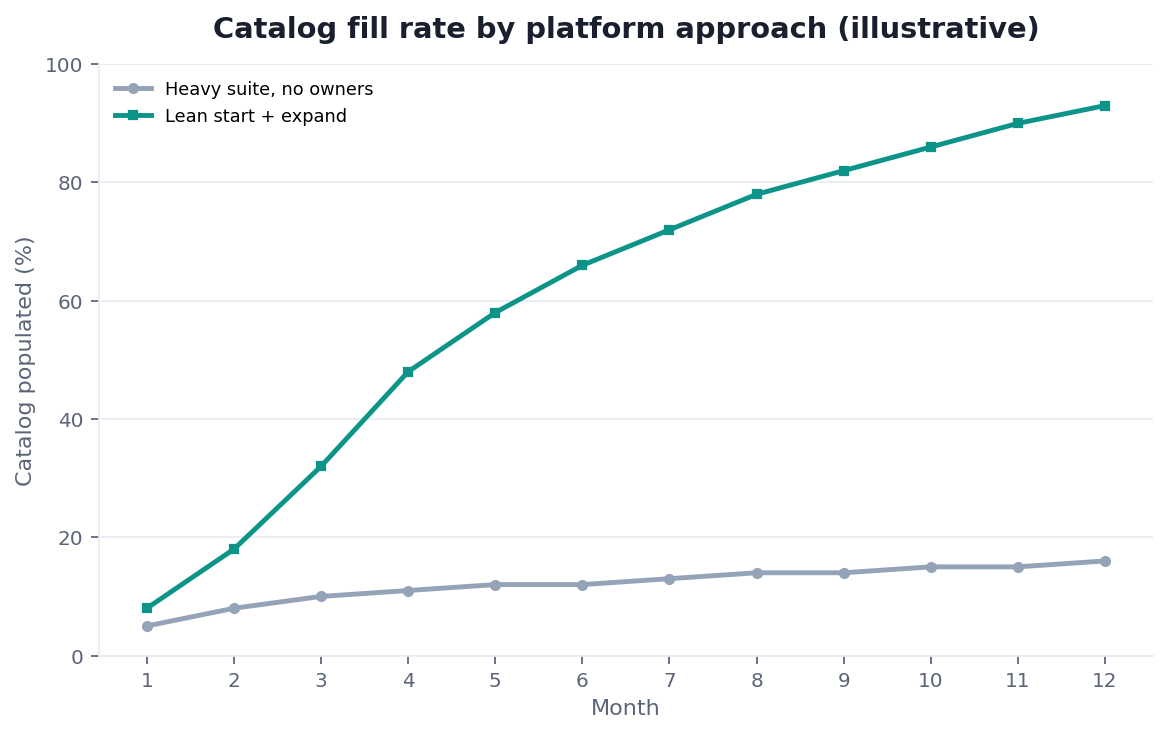
Choosing among data catalog platforms is only half the job; adoption decides value. The most reliable rollout populates one important domain completely — real owners, definitions, and lineage — before expanding, so the catalog proves useful early.
An empty catalog trains people to ignore it, so the first weeks with any of the data catalog platforms should focus on depth in one domain rather than thin coverage everywhere. This connects to the broader discipline of data lineage, because lineage is often the feature that makes a catalog indispensable — it answers "where did this number come from?" in seconds instead of days. A domain that is completely and accurately catalogued becomes the proof that pulls the next team in.
Common Mistakes
The mistakes we see with data catalog platforms are consistent. Choosing on feature count produces powerful tools nobody populates. Relying on manual entry produces catalogs that drift out of date. Ignoring integration produces metadata islands. And treating the catalog as a compliance artifact rather than a daily tool produces something people fill in but never consult.
A subtler mistake is neglecting search quality. Data catalog platforms only deliver value when people can find what they need quickly, so poor search quietly kills adoption. We weigh discoverability and everyday usability as heavily as governance features, because a catalog nobody searches is a catalog nobody trusts.
The Cost of an Empty Catalog
Implementation details are commonly grounded in Google Cloud AI overview when teams translate concepts into production practice.
The most expensive outcome of a catalog project is not a failed evaluation but a successful purchase that nobody populates. An empty or half-filled catalog does active harm: people search it, find nothing useful, and conclude the tool — and the whole idea of cataloging — is a waste of time. Rebuilding that credibility is far harder than earning it the first time.
Why catalogs go empty
The usual cause is a reliance on manual entry. When cataloging is a separate chore that competes with an engineer's real work, it loses every time, and the catalog decays. This is why we weigh automated discovery so heavily: the platforms that stay populated are the ones where metadata is captured as a byproduct of normal pipelines and queries rather than typed in by hand.
What populated looks like
A healthy catalog has real owners on its most important assets, definitions that match how the business actually talks, and lineage that traces to source. It is searched daily and trusted enough that people stop maintaining private spreadsheets of "where the real numbers live." Reaching that state in one domain is worth more than thin, automated coverage across a hundred.
Buying Versus Building
Some teams consider building a lightweight catalog instead of buying one, and for a small, homogeneous stack that can work. But most organizations underestimate the ongoing cost of connectors, search, and lineage capture, which is exactly where commercial platforms invest most.
The pragmatic path is to buy the discovery and lineage engine — the hard, undifferentiated plumbing — and invest your own effort in the parts that are specific to you: the definitions, the ownership model, and the workflows that get people to actually use it. Spending scarce engineering time reimplementing connectors rarely pays off, whereas spending it on adoption almost always does.
There is also a total-cost angle that buyers underweight. The sticker price of most platforms is small next to the ongoing human cost of stewardship and the opportunity cost of analysts hunting for data by hand. When you compare options, model the fully loaded cost — licensing, integration effort, and the steward hours needed to keep it current — rather than the license alone. The cheapest platform to buy is frequently the most expensive to run, because a tool that resists automation quietly consumes the very engineering time it was supposed to save.
Catalogs in the Age of AI
Teams evaluating this topic often cross-check Tableau Desktop documentation for a durable, vendor-neutral reference point.
AI sharply raises the value of data catalog platforms. When an autonomous agent reads your data to answer questions, it relies on the catalog's metadata to understand what each field means and where it came from; ungoverned or stale metadata produces inconsistent answers. The catalog becomes part of your AI infrastructure, not a back-office utility.
An AI-native platform closes the gap by binding governed definitions and lineage to the data an agent queries, an approach we describe in what AI-native data analysis means. In the InfiniSynapse web app, business definitions travel with the data as a semantic layer, so the metadata your data catalog platforms maintain directly improves the reliability of AI answers rather than sitting in a silo.
Selection Scorecard
Score each candidate (1 point each):
| Check | Pass? |
|---|---|
| It discovers data automatically | |
| Metadata refreshes on its own | |
| A steward can add context easily | |
| It traces lineage | |
| Search is fast and accurate | |
| It integrates with our stack | |
| It applies governance and access | |
| Agents can read its metadata |
6–8: strong choice. 3–5: pilot in one domain. Below 3: keep evaluating.
Common Misconceptions
Misconception 1: A catalog is a one-time inventory. Data catalog platforms must stay continuously current.
Misconception 2: More features are better. Automated population beats feature count.
Misconception 3: It is a compliance artifact. It is a daily tool people must want to use.
Misconception 4: Metadata is only for humans. AI agents rely on catalog metadata too.
Frequently Asked Questions
What are data catalog platforms?
Data catalog platforms are software systems that automatically discover an organization's data assets, capture their metadata — meaning, ownership, lineage, and quality — and make them searchable and governable. They turn scattered, undocumented data into a trusted inventory so people and systems can find and rely on the data they need, provided the catalog stays current.
What are the main categories?
The market splits into standalone catalogs (dedicated products focused on discovery, metadata, and search that integrate with any stack) and platform-embedded catalogs (built into a warehouse or lakehouse alongside the data). Standalone tools offer breadth and depth; embedded tools reduce integration effort and keep metadata close to the data it describes.
How do you evaluate them?
Score candidates on automated discovery and metadata refresh, ease of stewardship, integration breadth, and how they expose metadata to other systems. The platform that stays current beats the one with the longest feature list, because a catalog that drifts out of date misleads everyone who trusts it. Weigh search quality and everyday usability heavily.
How do you roll one out?
Populate one important domain completely — real owners, definitions, and lineage — before expanding, so the catalog proves useful early. An empty catalog trains people to ignore it. Depth in one domain, especially with working lineage that answers "where did this number come from?", becomes the proof that pulls the next team into adopting the platform.
How do catalogs support AI?
When an agent reads your data to answer questions, it relies on catalog metadata to understand what each field means and where it came from; stale or ungoverned metadata produces inconsistent answers. The catalog becomes part of your AI infrastructure, and an AI-native platform that carries definitions with the data ensures the metadata directly improves the reliability of agent answers.
Conclusion
Data catalog platforms turn scattered data into a trusted, searchable inventory — but their value depends entirely on staying current and getting used. In 2026 they are increasingly part of your AI infrastructure. Favor automated discovery, roll out one domain deeply, and treat the catalog as a daily tool.
To see how governed definitions and lineage travel with data into automated analysis, read what AI-native data analysis means and try the InfiniSynapse web app free on registration.