Data Analyst Jobs in 2026: Market and How to Land One
By the InfiniSynapse Data Team · Last updated: 2026-07-08 · We build an AI-native data analysis platform and work with hiring teams and analysts; this guide reflects the real 2026 market, not recycled listings advice.
Table of Contents
- TL;DR
- The 2026 Market for Data Analyst Jobs
- Where the Demand Is
- Types of Data Analyst Jobs
- What Employers Actually Want
- A Search Strategy That Works
- How AI Is Changing the Hiring Bar
- Standing Out When Everyone Has SQL
- Job-Search Scorecard
- The Long Game in an Analytics Career
- Failure Modes
- Frequently Asked Questions
- Conclusion
TL;DR
Direct answer: data analyst jobs remain in solid demand across 2026, though the bar has shifted: employers increasingly expect candidates to pair SQL and visualization with the ability to direct AI-native tools and communicate insight. The fastest way to land one is a portfolio of real analyses plus a targeted search rather than mass applications.
Who this is for: anyone searching for data analyst jobs or planning a move into the field in 2026.
What you'll learn: the state of the market, where demand concentrates, the job types, what employers want, a search strategy, and how AI is reshaping the hiring bar.
This guide sits under the data analyst career hub; for the entry point specifically, see entry-level data analyst jobs.
For related depth in this pillar, see Data Analyst Salary in 2026: By Level, Region, and I....
The 2026 Market for Data Analyst Jobs
The market for data analyst jobs in 2026 is healthy but more discerning than it was a few years ago. Organizations still generate more data than they can interpret, so the underlying demand is durable, but the arrival of AI-native tools has changed what a hire is expected to bring. Employers are less impressed by the ability to write a routine query—which a tool can now do—and more interested in whether a candidate can frame the right question and defend the answer.
This shift makes the market for data analyst jobs more rewarding for those who prepare correctly and harder for those relying on outdated expectations. The candidates who stand out demonstrate judgment and communication alongside technical fluency, a pattern the Stanford HAI AI Index documents across knowledge work as AI absorbs routine tasks. Understanding this repositioning is the first step to a successful search, because it tells you where to invest your preparation.
Where the Demand Is
Demand for data analyst jobs concentrates where data volume and decision stakes are both high. Technology and SaaS companies hire heavily for product and growth analytics; finance and insurance for risk and performance; healthcare for outcomes and operations; retail and e-commerce for customer and inventory analysis. Government and nonprofits also hire steadily, often with more stability if less pay.
Geographically, the rise of remote work has widened access to data analyst jobs well beyond traditional hubs, a trend we cover in remote data analyst jobs). This means a candidate is no longer limited to local employers, though it also means competing in a larger pool. The practical implication is to target industries whose questions genuinely interest you, since domain curiosity both sharpens your applications and sustains you once hired. The move toward augmented workflows, outlined in IBM's augmented analytics overview, frames how teams evaluate modern tooling.
Types of Data Analyst Jobs
Not all data analyst jobs are the same, and knowing the variety helps you aim. Entry-level and junior roles focus on executing defined analyses and building dashboards under guidance; we cover these in entry-level data analyst jobs) and junior data analyst jobs. Mid-level roles own analyses end to end, while senior roles set analytical direction and mentor others.
Beyond seniority, data analyst jobs specialize by function: product analysts, marketing analysts, financial analysts, operations analysts, and business intelligence analysts each apply the same core skills to different domains. Internships, covered in data analyst internship, offer a proven on-ramp for students. Matching your search to the right type—by both seniority and function—produces far better results than applying to every listing with "analyst" in the title, because tailored applications signal genuine fit.
What Employers Actually Want
Behind the varied listings, employers filling data analyst jobs consistently want the same things. Technically, they expect SQL fluency, spreadsheet mastery, and comfort with a visualization tool, plus increasingly the ability to use AI-native analysis tools effectively. Beyond tools, they want evidence that a candidate can turn data into a decision, which a portfolio demonstrates far better than a list of certifications.
The most underrated requirement in data analyst jobs is communication. Employers repeatedly report that they can teach tools but struggle to teach the ability to explain findings clearly to non-technical stakeholders. A candidate who shows, through a portfolio and interview, that they can translate a messy dataset into a clear recommendation has a decisive edge. We detail the full requirement set in data analyst skills and the standard scope in the data analyst job description.
A Search Strategy That Works
A disciplined search beats volume for data analyst jobs. Rather than mass-applying, build a portfolio of two or three polished analyses on real data, then target roles whose domain matches your demonstrated interest. Tailor each application to show how your portfolio maps to the specific role, and use your network, since referrals convert far better than cold applications. Enterprise adoption patterns in Google Cloud's AI overview mirror the shift from pilots to governed analytics.
Preparation for interviews matters as much as the application. Most data analyst jobs test SQL, a case-style analytical problem, and communication, so practice all three; our data analyst interview questions) guide covers the common ground, and data analyst resume) covers presentation. The candidates who land offers treat the search itself as an analytical project: define the target, measure what works, and iterate rather than spraying applications and hoping.
How AI Is Changing the Hiring Bar
The arrival of AI-native tools is the defining shift in data analyst jobs for 2026. Because tools can now handle routine cleaning and querying, employers weight the judgment-and-communication skills more heavily, and they increasingly value candidates who can direct an AI agent effectively rather than compete with it. Demonstrating this fluency has become a differentiator.
InfiniSynapse is representative of the tools reshaping the bar. It is not an NLP2SQL box or a ChatBI widget but a system that behaves like a professional data analyst, connecting to sources with one-click authorization and running multi-step analysis through InfiniSQL. A candidate who can show they use such a tool to work faster—while still validating and communicating results—signals exactly the modern competency employers now seek. We explore the paradigm in what AI-native data analysis means), and demonstrating this in a portfolio is a concrete way to stand out in a crowded field of applicants for data analyst jobs.
Standing Out When Everyone Has SQL
A decade ago, knowing SQL alone could open doors. Today it is table stakes, so the candidates who stand out do so on dimensions beyond the obvious technical checklist. The first differentiator is depth of portfolio: rather than a dozen shallow projects, two or three deep analyses that each frame a real question, wrangle messy data, and end in a clear recommendation demonstrate the full arc of the work. Hiring managers can tell the difference between a tutorial reproduced and a genuine investigation, and the latter earns interviews.
The second differentiator is storytelling. The ability to walk an interviewer through an analysis—why you framed the question that way, what surprised you in the data, how you validated the result, and what you recommended—signals exactly the judgment employers cannot easily teach. Practicing this narrative until it is natural turns a portfolio from a static artifact into a persuasive demonstration. Many strong technical candidates lose offers simply because they cannot explain their own work clearly, so rehearsing the story is time well spent. Warehouse-grounded analytics should align with Databricks documentation on SQL warehouses and data governance.
The third differentiator is focus. Candidates who specialize toward a domain they genuinely care about, learn its vocabulary, and tailor their portfolio to its questions consistently outperform generalists who apply everywhere. Specialization signals commitment and lets you speak an employer's language in the interview. Combined with active networking—reaching out to people in roles you want, asking thoughtful questions, and earning referrals—this focus compounds into a search that converts, because you are no longer one anonymous application among hundreds but a candidate who visibly fits a specific team.
Job-Search Scorecard
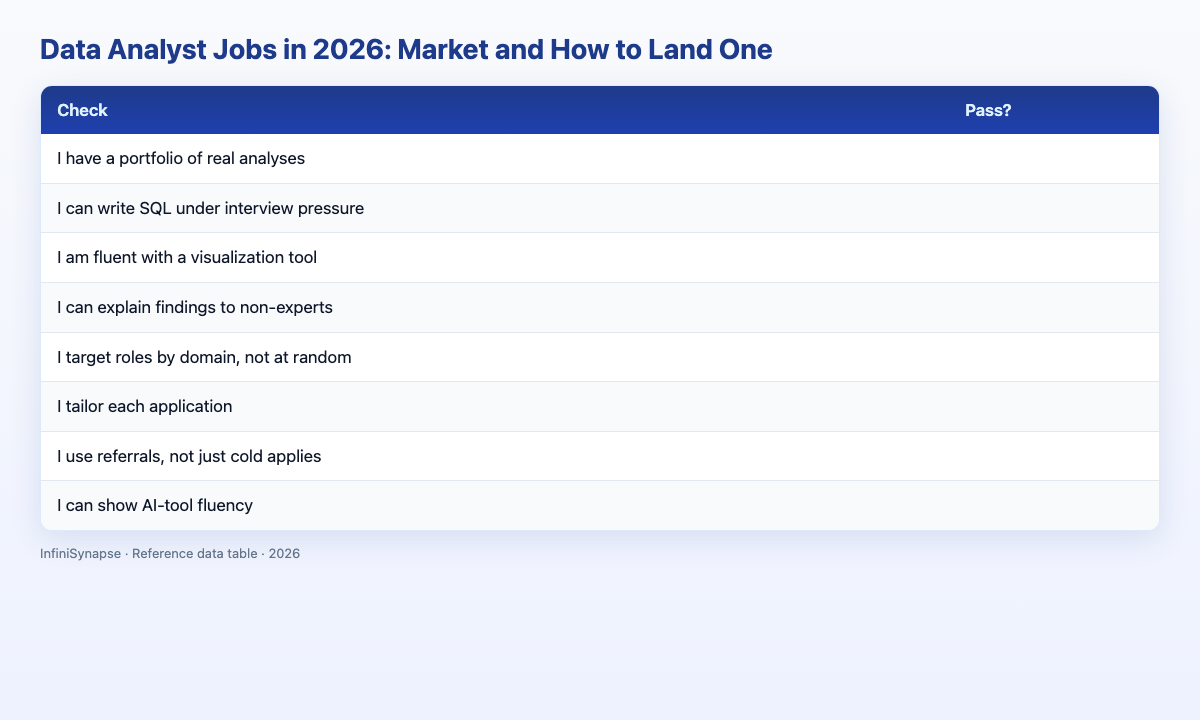
Assess your readiness to land data analyst jobs (1 point each):
| Check | Pass? |
|---|---|
| I have a portfolio of real analyses | |
| I can write SQL under interview pressure | |
| I am fluent with a visualization tool | |
| I can explain findings to non-experts | |
| I target roles by domain, not at random | |
| I tailor each application | |
| I use referrals, not just cold applies | |
| I can show AI-tool fluency |
6–8: strong candidate. 3–5: close a gap or two. Below 3: build the portfolio first.
The Long Game in an Analytics Career
Landing a role is the beginning, not the destination, and the strongest candidates think past the first offer. The analysts who build durable careers treat an initial position as a platform for compounding skill: they take on progressively harder problems, learn the business deeply, and build a reputation for turning analysis into decisions that matter. That reputation, more than any single credential, is what opens the next door and the one after that.
This long view also shapes how to evaluate an offer. A slightly lower starting figure at a company where you will learn from strong colleagues, own meaningful problems, and grow quickly often beats a higher figure in a role that plateaus. Early in a career, the rate of learning frequently matters more than the starting number, because skill compounds and the market rewards demonstrated growth. Weighing mentorship, problem quality, and growth trajectory alongside compensation is the mark of a candidate playing the long game rather than optimizing a single moment.
Finally, the field itself keeps evolving, so a durable career depends on continuous learning. The tools, expectations, and even the shape of the role shift over time, and analysts who keep pace—especially with the AI-native tools reshaping the work—stay valuable while those who stop learning drift toward obsolescence. Treating skill development as a permanent habit rather than a one-time investment is the surest way to keep a career resilient across a decade of change. The discipline follows the process described in the Wikipedia overview of data analysis.
Failure Modes
Failure 1: Mass applying. Spraying applications for data analyst jobs without tailoring wastes effort and signals no fit.
Failure 2: No portfolio. Certifications without demonstrated analyses rarely beat visible proof of skill.
Failure 3: Neglecting communication. Technical skill without clear explanation loses offers at the interview.
Failure 4: Ignoring AI tools. Pretending AI-native tools do not exist misreads the modern bar.
Frequently Asked Questions
Are \1programs still in demand\2?
Yes, data analyst jobs remain in solid demand because organizations still generate more data than they can interpret. The bar has shifted, though: employers now weight judgment, communication, and the ability to direct AI-native tools more heavily than routine query-writing, which tools increasingly handle.
What qualifications do require?
Most data analyst jobs require SQL fluency, spreadsheet mastery, and a visualization tool, plus increasingly the ability to use AI analysis tools. A portfolio of real analyses matters more than certifications, and communication skills are consistently what separate candidates who receive offers.
What is the best \1path\2?
The best way to find data analyst jobs is a targeted search: build a portfolio of two or three polished analyses, aim at roles whose domain matches your interest, tailor each application, and use referrals. This disciplined approach converts far better than mass-applying to every listing.
Which \1options fit beginners\2?
Technology and SaaS, finance and insurance, healthcare, and retail and e-commerce offer the most data analyst jobs, because data volume and decision stakes are high in each. Remote work has also widened access beyond traditional hubs, expanding options while increasing competition.
Will \1automation reduce demand\2?
AI is reshaping rather than eliminating data analyst jobs. Tools automate routine cleaning and querying, which shifts the role toward framing questions, validating results, and communicating insight. Candidates who can direct AI-native tools effectively gain an edge, while the underlying demand for turning data into decisions persists.
Conclusion
Data analyst jobs remain a strong career bet in 2026, but the market rewards those who pair technical fluency with judgment, communication, and AI-tool competency. Build a portfolio, target your search, and demonstrate that you can turn data into decisions.
To show the modern competency employers want, learn the tools reshaping the field in what AI-native data analysis means) and try the InfiniSynapse web app free on registration, no credit card required.