Data Analyst Job Description: A 2026 Template and Guide
By the InfiniSynapse Data Team · Last updated: 2026-07-09 · We build an AI-native data analysis platform and review hiring materials with many teams; this template reflects what strong 2026 job descriptions actually contain.
Table of Contents
- TL;DR
- How We Evaluated This Template
- What a Job Description Is For
- The Core Responsibilities Section
- The Required Skills Section
- The Preferred Skills Section
- A Full Template
- Modernizing the JD for the AI Era
- Tailoring the JD to Your Team
- Red Flags Candidates Watch For
- JD Scorecard
- Common Mistakes
- Frequently Asked Questions
- Conclusion
TL;DR
Direct answer: a strong data analyst job description states the mission, lists concrete responsibilities, separates required from preferred skills, and reflects the modern reality that analysts now direct AI-native tools. A good one attracts the right candidates and screens out mismatches before the interview stage.
Who this is for: hiring managers writing a data analyst job description, and candidates decoding one.
What you'll learn: how we evaluated the template, what the document is for, each section explained, a full copyable template, and how to modernize it for 2026.
This guide sits under the data analyst career hub; for the underlying skills, see analyst skills.
For related depth in this pillar, see Data Analyst Jobs in 2026: Market and How to Land One. Hiring a 0–2 year IC? Use the junior data analyst job description—this page stays the generic template.
How We Evaluated This Template
We built this guide from three inputs rather than recycled posting copy. First, we cross-referenced occupational data from the Bureau of Labor Statistics, which lists analytical, communication, and technical skills as core competencies for data analyst roles and projects continued demand for the profession. Second, we reviewed hiring-trend signals in LinkedIn's 2025 Future of Recruiting report, which notes that skills assessments and portfolio evidence increasingly influence hiring alongside formal credentials. Third, we aligned section expectations with the skill checklist in the four-group map and the role definition in what is a data analyst.
The table below summarizes the sections every strong data analyst job description should include in 2026 and the mistakes that weaken most postings. Treat it as a checklist before you publish.
| JD section | What strong 2026 postings include | Common mistake |
|---|---|---|
| Mission | Business outcome the hire enables | Vague buzzwords |
| Responsibilities | Named systems, questions, stakeholders | Generic "analyze data" |
| Required skills | Day-one SQL, viz, communication | Unnecessary tool laundry list |
| Preferred skills | Domain depth, Python, AI-tool fluency | Buried in required list |
| Team & growth | Tools, mentorship, senior path | Missing entirely |
Practical example: a hiring manager at a growth-stage SaaS company replaces a generic data analyst job description that lists twelve tools with one that names the warehouse, the product metrics the hire will own, and the stakeholders they will present to weekly. Applications drop in volume but rise in quality — candidates with relevant portfolio pieces self-select in, and mismatches decline before the first interview. That specificity is the pattern Harvard Business Review's skills-based hiring research describes as increasingly decisive when employers hire on demonstrated ability rather than credential checklists alone.
What a Job Description Is For
A data analyst job description serves two audiences at once, and understanding both is the key to writing a good one. For candidates, it communicates what the role actually involves and whether they are a fit, which either attracts strong applicants or, if vague, drowns the hiring team in mismatches. For the hiring team, it is a contract of expectations that aligns interviewers and shapes the evaluation.
The best version of a data analyst job description is specific rather than generic. A posting that lists "must be data-driven" and "strong analytical skills" tells a candidate nothing, while one that names the actual tools, the types of questions the analyst will answer, and the stakeholders they will serve lets a good candidate self-select in and a poor fit self-select out. This specificity, grounded in the real work described in the Wikipedia data analysis overview, is what separates a JD that fills a role well from one that wastes everyone's time.
The Core Responsibilities Section
The responsibilities section is the heart of any data analyst job description, and it should describe real activities rather than abstractions. Strong entries name concrete tasks: pulling and cleaning data from specific systems, building and maintaining dashboards, running analyses to answer defined business questions, and presenting findings to named stakeholder groups. The more concrete the language, the more useful the section. For the hours behind those bullets, see what does a data analyst do day to day. Enterprise adoption patterns in Google Cloud's AI overview mirror the shift from pilots to governed analytics.
A well-written responsibilities section in a data analyst job description also conveys the balance of the role. If eighty percent of the work is recurring reporting, say so; if the role involves ad-hoc deep dives and stakeholder collaboration, describe that. Candidates repeatedly report that the biggest surprises in a new role come from a JD that hid the true balance of the work, so honesty here improves both hiring quality and retention. This section should read like a realistic preview of a typical month, not an aspirational wish list.
The Required Skills Section
The required skills section of a data analyst job description should list only what is genuinely necessary on day one. Typically this includes SQL, spreadsheet proficiency, a visualization tool, and the analytical and communication abilities that define the role. Keeping this list tight matters, because every unnecessary "requirement" filters out capable candidates, and research consistently shows that overlong requirement lists deter strong applicants, especially those from underrepresented groups.
A disciplined data analyst job description distinguishes sharply between what a candidate must have and what they can learn on the job. SQL fluency is reasonably a requirement; knowledge of one specific proprietary tool the company uses usually is not, since a capable analyst learns it quickly. This discipline widens the candidate pool without lowering the bar, and it signals to applicants that the team thinks clearly about what actually predicts success in the role rather than padding a list to sound impressive.
The Preferred Skills Section
The preferred skills section of a data analyst job description captures the "nice to have" qualifications that strengthen a candidate without being essential. This is the right place for industry-specific experience, familiarity with a particular tool the team uses, statistical depth, or exposure to programming languages like Python or R. Separating these from the required list keeps the requirements honest while still signaling what would make a candidate stand out. The Stanford HAI AI Index documents how quickly AI capabilities are reshaping analytical work.
Using the preferred section well makes a data analyst job description both welcoming and informative. Candidates who meet the required list but only some of the preferred items know they can still apply with a real chance, while those who match many preferred items understand they would be especially competitive. This two-tier structure, required versus preferred, is one of the simplest and most effective improvements a hiring team can make to a job posting that currently lumps everything into one intimidating list.
A Full Template
Here is a copyable structure for a data analyst job description:
Mission (1–2 sentences). State the purpose: "We are hiring an analyst to turn our product and customer data into decisions that guide the roadmap."
Responsibilities (5–7 bullets). Concrete tasks: query and clean data from named systems; build and maintain key dashboards; run analyses answering defined questions; present findings to specific stakeholders; document methods and definitions.
Required skills (4–6 items). SQL; spreadsheet proficiency; a visualization tool; analytical thinking; clear written and verbal communication.
Preferred skills (3–5 items). Industry experience; Python or R; statistical depth; experience directing AI-native analysis tools; familiarity with the company's stack.
About the team and growth. Describe the team, the tools, and the path to more senior work.
This template turns a vague data analyst job description into a specific, honest document that attracts the right people and sets accurate expectations from the first read.
Modernizing the JD for the AI Era
The most important 2026 update to a data analyst job description is acknowledging AI-native tools. Because agents now handle much of the mechanical cleaning and querying, a modern JD should list the ability to direct such tools effectively as a preferred, and increasingly a required, skill. Ignoring this makes a posting read as dated to strong candidates who already work this way.
We explore the paradigm in what AI-native data analysis means, and the Stanford HAI AI Index tracks how rapidly these skills have become standard. A forward-looking data analyst job description frames the role around the higher-value work these tools enable — validating outputs, framing questions, communicating insight — rather than around mechanical query-writing that is increasingly automated.
Tailoring the JD to Your Team
A generic posting rarely attracts the right people, so the strongest hiring teams tailor each data analyst job description to their specific context, adapting the language to the team they actually have. A startup hiring its first analyst should describe a broad, scrappy role touching many parts of the business, while a large enterprise hiring into an established team should describe a more specialized scope. Naming the actual industry, the real data sources, and the specific stakeholders the analyst will serve turns a template into a posting that speaks directly to the candidate who will thrive in that particular seat.
Tailoring a posting also means being honest about the team's maturity and tools. A candidate joining a team with a modern warehouse and clean data faces very different work from one joining a team still wrestling spreadsheets into order, and pretending otherwise leads to early attrition when reality sets in. The most effective postings describe the environment truthfully, including its rough edges, because the candidates who opt in with eyes open are the ones who stay. This honesty costs nothing and dramatically improves the quality of the match, which is the entire point of writing the document carefully in the first place.
Red Flags Candidates Watch For
Candidates read a data analyst job description closely for warning signs, and hiring teams benefit from knowing what those are. An impossibly long requirements list signals a team that has not thought clearly about the role, or one hoping for a unicorn who does the work of three people. Vague, buzzword-laden language suggests the team does not actually know what it wants, which foreshadows unclear expectations once hired.
Another red flag is a mismatch between the seniority of the title and the responsibilities listed in the posting. A posting that advertises a junior role but lists senior responsibilities, or offers junior pay for senior scope, tells experienced candidates to look elsewhere. Strong candidates also notice whether the posting mentions growth, mentorship, and modern tools, since their absence hints at a stagnant environment. By auditing your own data analyst job description for these red flags before publishing, you avoid inadvertently repelling the very candidates you most want to attract.
JD Scorecard
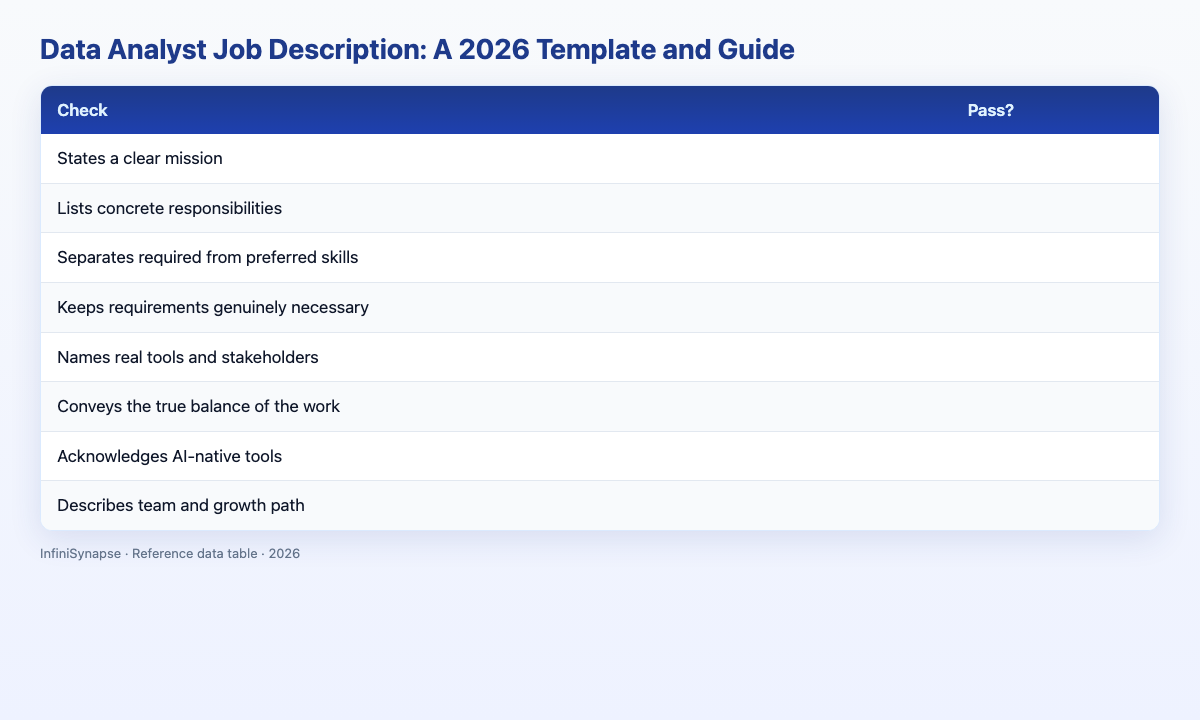
Rate your data analyst job description (1 point each). The move toward augmented workflows, outlined in IBM's augmented analytics overview, frames how teams evaluate modern tooling.
| Check | Pass? |
|---|---|
| States a clear mission | |
| Lists concrete responsibilities | |
| Separates required from preferred skills | |
| Keeps requirements genuinely necessary | |
| Names real tools and stakeholders | |
| Conveys the true balance of the work | |
| Acknowledges AI-native tools | |
| Describes team and growth path |
6–8: a strong JD. 3–5: tighten a section. Below 3: rewrite for specificity.
Common Mistakes
Mistake 1: Vague requirements. A data analyst job description full of "data-driven" clichés attracts mismatches.
Mistake 2: Overlong requirement lists. Every unnecessary requirement deters capable candidates.
Mistake 3: Hiding the real balance. Concealing that the role is mostly recurring reporting harms retention.
Mistake 4: Ignoring AI tools. A JD that pretends AI-native tools do not exist reads as dated.
Frequently Asked Questions
What should a data analyst job description include?
A data analyst job description should include a clear mission, concrete responsibilities, a tight list of required skills, a separate list of preferred skills, and a description of the team and growth path. It should name real tools and stakeholders and, in 2026, acknowledge the ability to direct AI-native tools.
What are the main responsibilities in a data analyst job description?
The main responsibilities are gathering and cleaning data from company systems, building and maintaining dashboards, running analyses to answer business questions, and presenting findings to stakeholders. A good data analyst job description states these concretely and conveys the true balance between recurring reporting and ad-hoc analysis.
What skills are required in a data analyst job description?
Required skills in a data analyst job description typically include SQL, spreadsheet proficiency, a visualization tool, and strong analytical and communication abilities. A disciplined posting keeps this list to genuine day-one necessities and moves everything a capable analyst can learn quickly into a preferred-skills section instead.
How do I write a data analyst job description?
Write a good data analyst job description by stating a clear mission, listing concrete responsibilities, separating required from preferred skills, naming real tools and stakeholders, and conveying the true balance of the work honestly. In 2026, also acknowledge AI-native tools to signal the team is current.
How is the data analyst job description changing in 2026?
AI is changing the data analyst job description by shifting emphasis from mechanical query-writing, which tools increasingly automate, toward directing AI-native tools and doing higher-value judgment and communication work. Modern descriptions list AI-tool fluency as a preferred or required skill and frame the role around what those tools enable.
Conclusion
A strong data analyst job description is specific, honest, and modern: it states a clear mission, lists concrete responsibilities, separates required from preferred skills, and acknowledges the AI-native tools that now shape the role. Done well, it attracts the right candidates and screens out mismatches before the interview. Run the live loop against the same data analyst interview questions you wrote into the JD.
To understand the tools a modern role centers on, read what AI-native data analysis means and try the InfiniSynapse web app free on registration, no credit card required.