What Is an Autonomous Data Agent?
By William Zhu & the InfiniSynapse Data Team · Published: 2026-06-09 · Last updated: 2026-08-07 · Last verified: 2026-08-07 · About: Editorial standards · About / team · Company Vision
Author credentials: William Zhu is cofounder of InfiniSynapse (GitHub @allwefantasy). Desk experience: shipping goal-driven analytics agents on production customer data for 18+ months. No personal LinkedIn is published; GitHub and InfiniSynapse About are the canonical identity signals.
COI / interest disclosure: InfiniSynapse publishes this guide and ships a Data Agent used as a reference implementation for goal-driven analytics agent workflows. Patterns below are labeled first-party where they come from our deployments. Product CTA is labeled commercial.
Fact-check / verification: Third-party anchors: Stanford HAI AI Index 2025 · OWASP Top 10 for LLM Applications · NIST AI RMF · Anthropic — Building effective agents · Gartner Peer Insights — Analytics & BI. Corrections: zhuhl@infinisynapse.com · editorial corrections.
Version history: 2026-06-09 · 2026-07-20 · 2026-08-07 EEAT · 2026-08-07B retarget primary keyword, numbered cites, behavior/self-correction SVGs. Marker:
DESK-ADA-20260807B.
Media note: No hosted product demo video (no
VideoObject). Use lifecycle, five-behaviors, pillars, and self-correction infographics as multimodal substitutes.
 Goal in → plan → execute → self-correct → inspectable package out.
Table of Contents
- TL;DR
- Industry context (third-party)
- Definition: Practice vs Executable Agents
- The Autonomy Pillar in Context
- 5 Behaviors That Prove Autonomy
- Self-Correction: How Agents Reroute Around Failure
- Agents vs Copilots vs Code Agents
- What Autonomy Looks Like in Production
- Cite this article
- FAQ
- References
- Conclusion
TL;DR
Canonical answer: An autonomous data agent is a system that takes one analytics goal, plans steps, queries sources, self-corrects on failure, and returns a defensible package—without the user driving each instruction. Autonomy is not “the model writes SQL.” It is goal-driven execution: phased planning, tool use across sources, self-correction, and an audit trail humans can inspect afterward. Copilots wait; goal-driven agents work.
Who this is for: data engineers, analytics leads, and PMs evaluating whether a vendor’s “agent” is truly autonomous or a multi-turn chatbot.
What you'll learn: a citable definition of goal-driven autonomy, how it fits Pillar 1 of AI-native analysis, five observable behaviors, three self-correction patterns, and a comparison with copilots and code agents.
Scope note: This article focuses on autonomy and self-correction. For memory, transparency, and multi-entry parity, see the 5-pillar primer in the AI-Native Data Analysis hub. For tool comparison, see Best Agentic Analytics (2026). For the category definition, see What Is a Data Agent?.
Account for prompt-injection and exfiltration risks in the OWASP Top 10 for LLM Applications [3]. Align production controls with the NIST AI Risk Management Framework [4].
Industry context (third-party)
Demand for goal-driven analytics autonomy sits inside a broader enterprise AI wave—cite the primaries, not vendor slides:
- Stanford HAI AI Index 2025 [1] — organizational AI use rose to 78% in 2024 (from 55% in 2023); generative AI used in at least one business function rose to 71% (from 33%).
- Same Index, agent performance [2] — RE-Bench (2024) shows agents can outperform humans on short time horizons (≈2 hours) but humans outscore AI about 2:1 at 32-hour budgets—evidence that unattended multi-step work still needs review gates.
- Peer markets (not endorsement): scan buyer feedback on analytics platforms via Gartner Peer Insights — Analytics & BI [7] when comparing “agent” claims to production trust.
These figures explain why buyers ask for an autonomous data agent; they do not prove any single vendor’s agent is L3-ready.
Definition: Practice vs Executable Agents
Key Definition (standalone, citable): An autonomous data agent is a goal-driven analytics system that receives a business goal in natural language, produces a reviewable execution plan, runs multi-step analysis across one or more sources using tools (SQL, Python, retrieval), self-corrects when steps fail, and returns an inspectable result package. The user sets the goal and reviews the outcome; the system owns the intermediate work. Related practice label: autonomous data science (the discipline); the executable unit is the agent.
| Term | Relationship |
|---|---|
| Data agent | Broader category; autonomy is the bar below. See What Is a Data Agent?. |
| Agentic analytics | Product category emphasizing multi-step planning. See Best Agentic Analytics (2026). |
| Code agent | Writes/runs code; may analyze data but usually lacks schema grounding, governance, and data-specific self-correction. |
When we say “autonomous,” we mean the system does not ask “what next?” after every step. It plans, executes, recovers, and reports. That bar defines credible autonomy—not a chatbot that chains three SQL calls.
The Autonomy Pillar in the 5-Pillar Framework
AI-native data analysis decomposes into five pillars. Autonomy is Pillar 1—the trigger that separates native agents from enabled copilots.
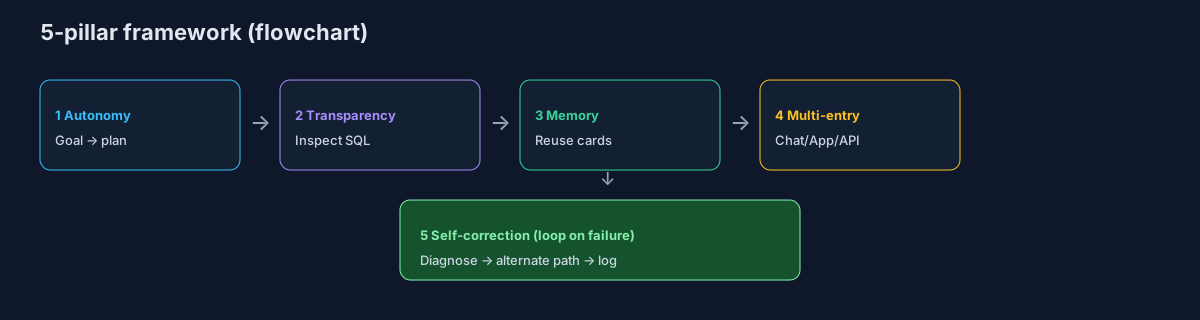 Five pillars—Autonomy is the trigger; self-correction is the operational proof.
[Goal] → Autonomy (plan) → Transparency (inspect) → Memory (reuse)
                ↓
         Self-correction (reroute on failure)
                ↓
         Multi-entry parity (chat / app / API)
| Pillar | One-line summary |
|---|---|
| 1. Autonomy | One goal → system plans many steps |
| 2. Process transparency | Every SQL and dataset inspectable |
| 3. Knowledge distillation | Tasks become reusable memory cards |
| 4. Multi-entry parity | Same capability via chat, web app, API |
| 5. Self-correction | Reroutes on failure, logs workaround |
An agent that plans five phases but stops at the first SQL timeout is planning-autonomous but not execution-autonomous. Production-grade autonomy must plan and recover without returning routine errors to the user.
Trust correlates with transparency and predictable behavior—not raw capability scores. Users need to see what the system did while they were away, including logged reroutes.
5 Behaviors That Prove a Data Agent Is Autonomous
Use these five checks to score whether a product behaves as an autonomous data agent—not a multi-turn chat wrapper.
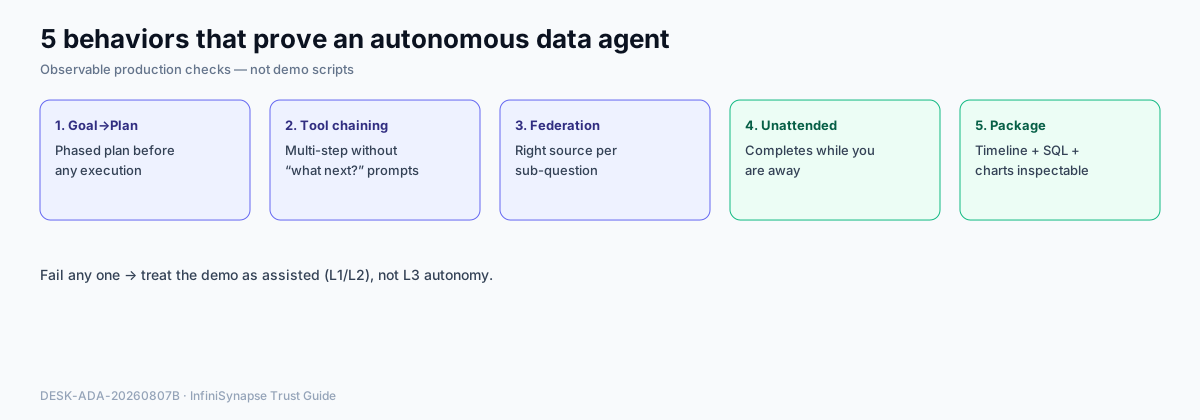 Figure: five observable autonomy behaviors (JSON-LD-friendly checklist).
1. Goal-to-Plan Translation
User submits one sentence. The system returns a phased plan (discover schema → join → metrics → visualize → summarize) before executing.
Anti-pattern: Immediate query with no stated intent.
2. Multi-Step Tool Chaining Without User Prompts
Executes phase 1, inspects results, changes a join for phase 2—all in one task.
Anti-pattern: “Should I proceed to step 2?” after every phase.
3. Cross-Source Federation
One goal spans MySQL revenue, a MongoDB user collection, and an uploaded XLSX segment file. The system picks the right source per sub-question.
Reference pattern (InfiniSynapse): data-source objectification and InfiniSQL load / connect with named intermediate tables. Treat this as one implementation pattern, not a requirement that every vendor use the same dialect.
4. Unattended Completion
User submits a goal, leaves for a meeting, returns to a finished task with charts and narrative.
Anti-pattern: Task pauses mid-run unless ambiguity is genuine.
5. Inspectable Completion Package
Finished task includes timeline, queries, intermediate datasets, charts—not just a chat message. Autonomy without transparency is a black box.
Hands-on observation (Q1–Q2 2026, first-party): Across internal pilots, “autonomous” failures were rarely “bad SQL on the first try.” They were “stopped at first error” or “completed with no audit trail.”
Self-Correction: How Agents Reroute Around Failure
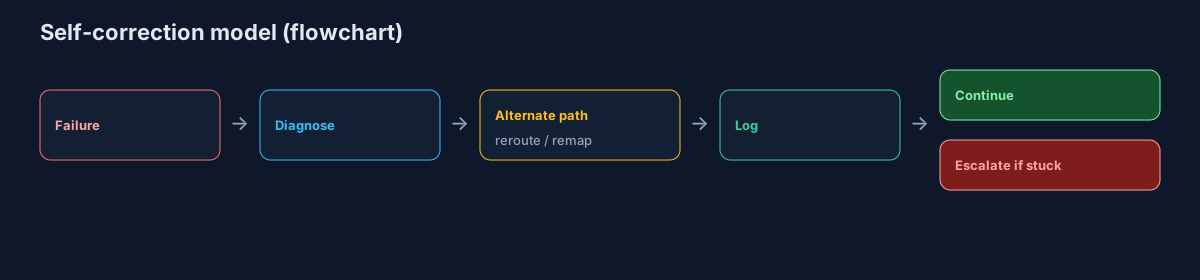
Self-correction is Pillar 5 and the operational proof of autonomy. Three production patterns:
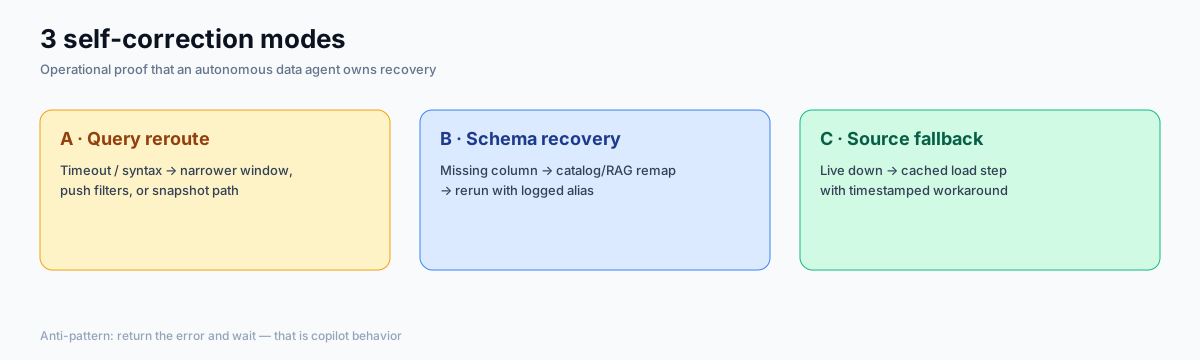 Figure: three self-correction modes buyers should force in a demo.
Pattern A: Query Reroute
Trigger: SQL timeout or syntax error.
Action: Narrower date range, push filters, or switch to a materialized snapshot.
UX: Task completes; timeline shows which variant succeeded.
Pattern B: Schema Recovery
Trigger: Column customer_id not found; catalog shows cust_id.
Action: Inspect schema/RAG definitions, remap, rerun.
Pattern C: Source Fallback
Trigger: Live connection unavailable mid-task.
Action: Use a cached snapshot from an earlier load step; log fallback with timestamp.

Case reference (May 2026, first-party): During phase 3 of a five-phase Excel analysis, the primary SQL engine became unavailable. The InfiniSynapse agent switched to a cached snapshot from phase 1 and finished while the analyst was in a client meeting. Demo script for any autonomy claim: force a mid-run failure and require a logged reroute.
Anti-pattern: Return Error: connection refused and wait—that is copilot behavior.
Anthropic’s guidance on effective agents [5] stresses tool use and iteration over single-shot answers.
Autonomous Agents vs Copilots vs Code Agents
| Dimension | Copilot | Code agent | Goal-driven agent system |
|---|---|---|---|
| Input | One instruction | One coding task | One analytics goal |
| Planning | User-driven | User-driven or single-file | System plans phases |
| Data grounding | Optional schema paste | None by default | Schema + business definitions |
| Failure handling | Returns error | Returns error | Self-corrects + logs |
| Output | Chat message | Code + stdout | Task package + memory |
| Best for | Assisted ad-hoc work | Software engineering | Recurring production analytics |
Copilot example: ChatGPT Advanced Data Analysis—excellent for “analyze this CSV,” but the user drives each follow-up.
Code agent example: A general coding agent against Postgres—powerful, but usually no governed metric layer.
Reference implementation: InfiniSynapse Data Agent—one goal, named SQL intermediates, RAG-grounded metrics, Task View audit trail, memory card on completion.
For why code agents struggle on enterprise analytics, see Code agent vs data agent and Code Interpreter vs Data Agent. Warehouse-native NL agents (e.g. Databricks Genie) can be strong L2 systems inside one catalog; compare them on multi-source + self-correction tests.
What Autonomy Looks Like in Production
Score production checks before labeling a program L3-ready:
| Check | Pass criteria |
|---|---|
| Unattended run | Completes a 5+ phase task without user messages |
| Failure recovery | At least one logged reroute in a real task |
| Audit | Stakeholder traces any headline number to SQL in <5 min |
| Repeat | Same goal next month reuses locked definitions |
| Entry | Same capability from web app and API |
Maturity rubric
| Level | Behavior | Production ready? |
|---|---|---|
| L0 | Text-to-SQL per prompt | No — copilot |
| L1 | Multi-step; user confirms each phase | No — assisted |
| L2 | Multi-step unattended; stops on first hard error | Partial — demos only |
| L3 | Unattended + self-correction + audit + memory | Yes — L3 autonomy |
Most vendor demos showcase L1 or L2. Procurement should require L3 evidence before calling the stack an autonomous data agent.
| Role | What autonomy changes |
|---|---|
| Data analyst | “Quick cuts” queue runs itself; analyst reviews |
| PM | Asks in plain English; gets a report without a ticket |
| Engineering lead | API-triggered checks in CI/CD or ops |
| Executive | Weekly KPI package with consistent definitions |
Cite this article
APA-style: Zhu, W., & InfiniSynapse Data Team. (2026). What is an autonomous data agent? (autonomous data science primer) InfiniSynapse. https://infinisynapse.com/en/blog/autonomous-data-agent
Plain citation: Zhu, W. (2026). Goal-driven agent primer—five autonomy behaviors and self-correction. InfiniSynapse. Accessed 2026-08-07.
Frequently Asked Questions
What is an autonomous data agent?
A goal-driven analytics system that plans, executes, self-corrects, and documents. It owns intermediate steps after you set one goal and returns an inspectable package. The broader practice is sometimes called autonomous data science.
How is that different from a standard data agent?
Autonomy is the bar. Goal-to-plan translation, unattended multi-step execution, and self-correction—not just text-to-SQL in chat. See What Is a Data Agent? and What Is a Data Agent? (deep dive).
Can it run without human oversight?
Unattended for execution; humans remain accountable for goals, assumptions, and conclusions before numbers go to executives or regulators.
What is self-correction?
Diagnose failure → try an alternative path → log the workaround. Cached data, remapped schema, narrower filters—without returning routine errors to the user.
Do I need a special query language?
Not necessarily. Named intermediate tables improve auditability. InfiniSQL-style load/connect is one implementation pattern.
How do I evaluate autonomy in a vendor demo?
Submit one goal with a real schema, leave for 15 minutes, then check: Did it finish? Is there a phased timeline? Did it recover from a forced failure? Can you trace every number to a query? If any answer is no, it is not yet production-grade autonomy.
References
- Stanford HAI — AI Index 2025: State of AI in 10 Charts — hai.stanford.edu — accessed 2026-08-07
- Stanford HAI — AI Index Report 2025 (PDF) — hai_ai_index_report_2025.pdf
- OWASP — Top 10 for LLM Applications — owasp.org
- NIST — AI Risk Management Framework — nist.gov
- Anthropic — Building effective agents — anthropic.com
- Databricks — Pushing the frontier of data agents with Genie — databricks.com
- Gartner — Peer Insights: Analytics & BI — gartner.com
- InfiniSynapse — Editorial standards — editorial-standards
Conclusion
An autonomous data agent is defined by what the system does when you are not watching: plan, execute, recover, document. SQL generation is table stakes; goal-driven execution with self-correction is the production bar. Mature buyers treat every pilot as an L3 qualification test—not a copilot demo.
Product recommendation (commercial)
Label: The following is a commercial product recommendation, separate from the editorial guidance above.
Try a governed workflow at https://app.infinisynapse.com/. Adjacent depth: Data Agent overview · Databricks Genie vs Data Agent · Code Interpreter vs Data Agent · AI-native data analysis.