
On this page本页目录
What is ecommerce returns reporting?什么是电商退货报告?
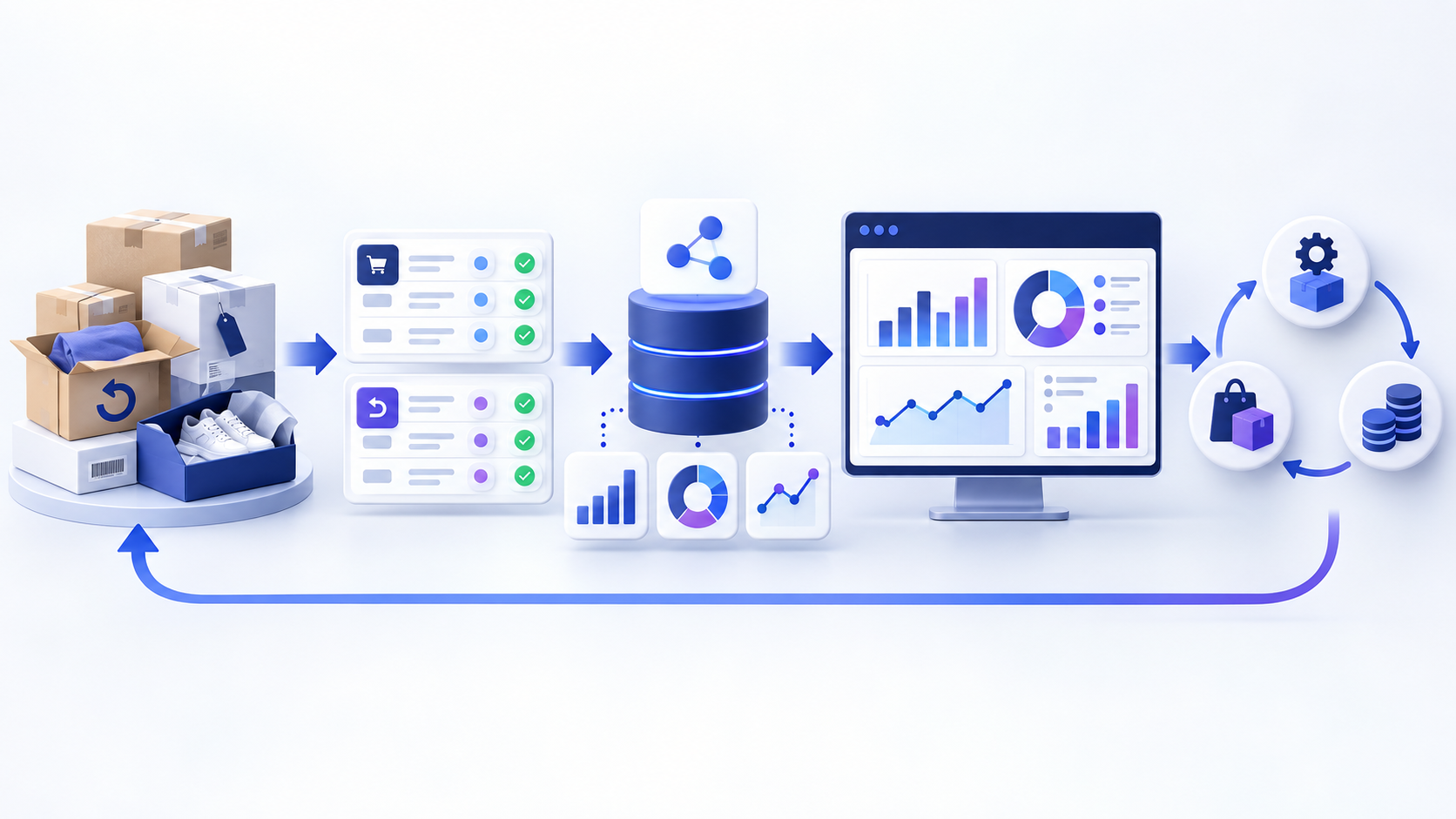
Ecommerce returns reporting is the repeatable process of turning order, return, refund, exchange, logistics, and inventory events into defined metrics, drill-downs, quality checks, owners, and actions. A useful report declares which orders are eligible, which date assigns an event to a period, what every metric counts, how complete the data is, and who must investigate exceptions. Reporting tells you what happened; deeper ecommerce returns analytics tests why it happened.
电商退货报告,是把订单、退货、退款、换货、物流和库存事件,持续整理成有明确定义的指标、下钻维度、质量检查、负责人和行动。一份可用报告必须说明哪些订单可计入、用哪个日期归属周期、每个指标计算什么、数据是否完整,以及谁负责调查异常。报告回答“发生了什么”;更深入的电商退货分析再检验“为什么发生”。
Returns reporting vs analytics vs dashboards退货报告、分析与看板有什么区别
| Layer层级 | Question回答的问题 | Output输出 | Decision决策用途 |
|---|---|---|---|
| Reporting报告 | What happened in a declared period?在声明周期里发生了什么? | Metrics, exceptions, status指标、异常与状态 | Monitor and assign review监控并分派复核 |
| Analytics分析 | Why did it happen?为什么发生? | Hypotheses, comparisons, tests假设、比较与验证 | Choose an intervention选择改进措施 |
| Dashboard看板 | How can recurring measures be scanned?如何快速浏览周期指标? | Interactive visual interface交互式可视界面 | Explore and monitor探索与监控 |
A dashboard can display a report, but a chart is not the reporting system. The system also needs definitions, ownership, refresh rules, quality checks, and a decision record. Shopify’s current guide similarly distinguishes reporting (“what happened”) from analytics (“why”), a useful vocabulary boundary rather than a universal platform rule.
看板可以呈现报告,但图表本身不是完整的报告系统。系统还需要口径、负责人、刷新规则、质量检查和决策记录。Shopify 当前指南也把 reporting 概括为“发生了什么”,把 analytics 概括为“为什么”;这里将其作为术语边界,而不是所有平台都必须遵循的规则。
Start with the reader and decision先确定读者和决策
This guide is for ecommerce operators, analysts, merchandising teams, CX leaders, finance partners, and warehouse owners who need one defensible view of returns. Do not begin by collecting every available field. Begin with three questions: which decision is due, who owns it, and what evidence is sufficient to act?
本指南面向需要统一退货视图的电商运营、分析师、商品团队、客服负责人、财务伙伴和仓库负责人。不要从“收集所有能拿到的字段”开始,而要先回答三个问题:现在需要做什么决策、由谁负责、达到什么证据条件才行动。
Trend, exposure, top exceptions, requested decision, and action status.
趋势、风险、主要异常、待决策事项与行动状态。
SKU and variant rates, reasons, value exposure, volume, and missing evidence.
SKU 与变体退货率、原因、金额风险、销量与缺失证据。
Open queue, age, processing time, carrier stage, disposition, and rework.
待处理队列、账龄、处理时长、物流阶段、库存处置与返工。
Refunded value, fees, incremental cost, write-offs, credits, and reconciliation gaps.
退款金额、费用、增量成本、减值、额度与对账差异。
Source data an ecommerce returns report needs电商退货报告需要哪些源数据
The minimum reliable model joins five subjects: order lines, return requests, returned items, financial resolutions, and inventory disposition. Carrier or warehouse events add processing and recovery timing. Adobe Commerce’s current example uses RMA, RMA-item, order, quantity, SKU, status, and requested-date fields, illustrating why return objects must connect to original order lines instead of treating every export row as a complete order.
最低限度的可靠模型需要连接五类对象:订单行、退货申请、退回商品、资金处理和库存处置。物流或仓库事件用于补充处理与回收时长。Adobe Commerce 当前示例使用 RMA、RMA 商品、订单、数量、SKU、状态和申请日期等字段,说明退货对象必须连接回原始订单行,不能把每条导出记录当成完整订单。
| Subject对象 | Required fields关键字段 | Purpose用途 |
|---|---|---|
| Order line订单行 | order_id, line_item_id, SKU, variant, quantity, item value, order/ship date, channel | Denominator and commercial context分母与交易上下文 |
| Return item退货商品 | return_id, line_item_id, requested/received/closed dates, quantity, status, reason | Physical event and lifecycle实物事件与生命周期 |
| Resolution处理结果 | refund_id, exchange_id, amount, currency, method, issued date, status | Refund, exchange, credit, or pending outcome退款、换货、额度或待处理结果 |
| Disposition库存处置 | condition, restock/repair/liquidate/scrap status, recovered value | Inventory recovery and write-off库存回收与减值 |
| Operating cost运营成本 | label, carrier, inspection, handling, refurbishment, disposal cost | Incremental cost beyond payment reversal付款冲回之外的增量成本 |
Privacy boundary: a shared analytical layer rarely needs names, emails, addresses, or unrestricted free-text notes. Use stable pseudonymous keys, restrict raw access, and remove unnecessary personal data. NIST SP 800-122 recommends protecting PII from inappropriate access, use, and disclosure.
隐私边界:共享分析层通常不需要姓名、邮箱、地址或不受限制的自由文本备注。应使用稳定的去标识键、限制原始数据访问,并删除非必要个人信息。NIST SP 800-122 建议保护 PII,避免不当访问、使用和披露。
Write the reporting contract before the chart画图之前先写报告口径合同
A reporting contract makes the same number mean the same thing next month. Record the grain, eligible population, date basis, return window, exclusions, currency, sign convention, refresh time, late-arriving rule, owner, and known gaps. If a definition changes, version it; do not silently splice the new calculation into the old trend.
报告口径合同保证同一个数字下个月仍然表示同一件事。需要记录粒度、可计入总体、日期基准、退货窗口、排除项、币种、正负号规则、刷新时间、迟到数据处理、负责人和已知缺口。若定义变化,应建立版本,不能悄悄把新算法接到旧趋势中。
Two time views are usually necessary. Use an order or shipment cohort to compare product performance after enough time has elapsed; use return-event date to manage current workload and cash movement. Label both. A young cohort can look artificially good because many customers have not reached the end of the return window.
通常需要两个时间视图。用下单或发货 cohort 在足够成熟后比较商品表现;用退货事件日期管理当前工作量和资金变动。两者都必须明确标注。过新的 cohort 可能显得异常优秀,因为许多订单尚未走完整个退货窗口。
Core ecommerce returns reporting KPIs电商退货报告的核心 KPI
Start with a small shared set and add only metrics tied to a decision. Keep physical return measures separate from financial refund measures; the returns vs refunds guide explains when they diverge. Put the denominator, exclusions, and time view beside every rate.
先建立少量共享指标,只增加能够支持决策的项目。实物退货指标与财务退款指标必须分开;退货与退款指南解释了二者何时会分离。每个比率旁边都要写清分母、排除项和时间视图。
| KPI指标 | Formula or definition公式或定义 | Decision决策 |
|---|---|---|
| Returned-unit rate退回件数率 | returned units ÷ eligible sold units | Product comparison商品比较 |
| Returned-order rate退货订单率 | orders with ≥1 returned unit ÷ eligible orders | Order incidence订单发生比例 |
| Refunded-value rate退款金额率 | merchant-refunded product value ÷ eligible product sales | Financial exposure资金风险 |
| Reason share原因占比 | units in reason group ÷ units with classified reason | Investigation direction调查方向 |
| Processing time处理时长 | closed timestamp − request or received timestamp | Queue performance队列表现 |
| Open-return backlog未结退货积压 | open returns by age band and stage | Work prioritization工作优先级 |
| Recovery rate回收率 | recovered units or value ÷ eligible received returns | Inventory disposition库存处置 |
| Incremental return cost增量退货成本 | label + carrier + handling + inspection + refurbishment + write-off | Economic priority经济优先级 |
| Data completeness数据完整率 | rows meeting required-field contract ÷ in-scope rows | Decision readiness决策可用性 |
For full formula treatment, use how to calculate return rate and the ecommerce returns metrics reference. Never sum refunded value, lost sales, and inventory write-off until the economic contract proves they do not overlap.
完整公式可查看如何计算退货率和电商退货指标参考。在经济口径证明不存在重叠前,不能把退款金额、销售损失和库存减值直接相加。
A decision-ready returns report layout可用于决策的退货报告结构
Scope and health. Show period, cohort maturity, refresh time, exclusions, currency, and completeness before performance.
范围与健康度。在表现指标前先展示周期、cohort 成熟度、刷新时间、排除项、币种和完整率。
Headline movement. Compare rate, volume, refunded value, and extra cost with a mature comparable cohort.
核心变化。将退货率、数量、退款金额和额外成本与成熟且可比的 cohort 比较。
Concentration. Rank SKU, variant, category, channel, warehouse, carrier, and reason by rate and exposure.
集中度。按比率与风险金额,对 SKU、变体、类目、渠道、仓库、承运商和原因排序。
Operational flow. Show open cases, age bands, processing stage, disposition, and exceptions.
运营流程。展示未结案例、账龄区间、处理阶段、库存处置与异常。
Interpretation. Separate observations from hypotheses and list evidence that could change the conclusion.
解释。区分观察与假设,列出可能改变结论的证据。
Action register. Name the owner, action, evidence required, due date, review window, and status.
行动登记。记录负责人、行动、所需证据、截止日期、观察窗口和状态。
Segment only when the split changes a decision只有能改变决策时才增加分组
A storewide rate is a starting point, not a diagnosis. Useful drill-downs include SKU and variant, category, channel, region, warehouse, carrier, supplier, return reason, resolution, and inventory disposition. Add a minimum-volume or uncertainty flag so a 1-of-3 result does not outrank a 200-of-2,000 result merely because the percentage is higher.
全店退货率只是起点,不是诊断。常用下钻维度包括 SKU 与变体、类目、渠道、地区、仓库、承运商、供应商、退货原因、处理结果和库存处置。应设置最低样本量或不确定性标识,避免“3 件中退 1 件”仅因百分比更高就排在“2,000 件中退 200 件”之前。
Match reporting cadence to decision speed让报告频率匹配决策速度
| Cadence频率 | Review复盘内容 | Owner负责人 |
|---|---|---|
| Daily每日 | Failed imports, backlog, aged cases, refund exceptions导入失败、积压、超期案例与退款异常 | Returns operations / CX退货运营/客服 |
| Weekly每周 | SKU, channel, reason, rate, value, cost, processingSKU、渠道、原因、比率、金额、成本和处理时长 | Operations + merchandising运营+商品 |
| Monthly每月 | Mature cohorts, reason shifts, cost, recovery, action results成熟 cohort、原因变化、成本、回收与行动结果 | Cross-functional review跨团队复盘 |
| Quarterly每季度 | Policy, supplier, carrier, assortment, and definition changes政策、供应商、承运商、商品组合与口径变化 | Leadership + accountable teams管理层+责任团队 |
Shopify’s 2026 guide suggests weekly review for return rate by SKU and monthly review for reasons and trends. Treat that as a starting pattern, then adjust for your return window, order volume, launch calendar, and capacity. Platform-specific service or performance thresholds must be checked against the platform’s current policy.
Shopify 2026 年指南建议每周查看 SKU 退货率,每月查看原因与趋势。可把它作为起点,再根据退货窗口、订单量、新品节奏和团队能力调整。任何平台服务或绩效阈值,都必须以该平台当前政策为准。
Seven-step ecommerce returns reporting workflow七步电商退货报告流程
Define the question. Choose one reader, decision, period, and the smallest metric set that can support it.
定义问题。确定一类读者、一个决策、一个周期和最小指标集。
Freeze the contract. Document grain, keys, denominators, dates, signs, exclusions, currencies, and maturity.
冻结口径。记录粒度、连接键、分母、日期、正负号、排除项、币种和成熟度。
Extract and preserve. Keep immutable source files with system, export time, timezone, and version.
提取并保留。保存不可变源文件,并记录系统、导出时间、时区和版本。
Normalize and join. Map sources to the common contract and deduplicate before aggregation.
标准化并连接。把各来源映射到统一合同,并在聚合前去重。
Validate. Reconcile counts, quantities, amounts, currencies, missing keys, signs, statuses, and late events.
校验。核对数量、金额、币种、缺失键、正负号、状态和迟到事件。
Publish. Put scope and health first, followed by totals, segments, exceptions, hypotheses, and actions.
发布。先呈现范围和健康度,再展示总量、分组、异常、假设和行动。
Record the decision. Save owner, due date, evidence, measurement window, and result; version definitions when business rules change.
记录决策。保存负责人、截止日期、证据、衡量窗口和结果;业务规则变化时建立口径版本。
Quality checks before anyone acts行动之前必须完成的质量检查
A polished chart can still be wrong. Reconcile at the order, line-item, return-item, financial-event, and inventory-event grains. Shopify warns that custom columns can produce multiple CSV rows for one order, so row count may exceed the order count shown in admin. Its product report defines net quantity as sold items minus returned items and excludes shipping from product-level sales, demonstrating why platform definitions and labels matter.
精美图表仍可能是错的。应分别在订单、订单行、退货商品、财务事件和库存事件粒度对账。Shopify 提醒,自定义列可能让一个订单在 CSV 中产生多行,因此导出行数可能高于后台订单数;其商品报告把净件数定义为售出件数减退回件数,并从商品层销售中排除运费。这说明平台定义和标签不能省略。
- Uniqueness: no duplicate event at the declared key and version.
- 唯一性:声明键和版本下没有重复事件。
- Completeness: required keys, quantities, dates, reason, currency, and resolution are present or explicitly unknown.
- 完整性:键、数量、日期、原因、币种和结果均存在,或明确标为未知。
- Integrity: each return item resolves to one eligible order line, with exceptions listed.
- 引用完整性:每个退货商品连接到一个可计入订单行,异常单独列出。
- Financial reconciliation: refund and credit totals match the chosen financial source within a documented tolerance.
- 财务对账:退款与额度总额在已记录容差内匹配指定财务来源。
- Freshness: the latest expected partition arrived and the report displays cutoff and lag.
- 新鲜度:最新预期分区已到达,报告显示截止时间和延迟。
Normalize channels without erasing source meaning统一渠道,但不要抹掉来源含义
Preserve raw reason, status, fee, and source fields, then map them to a documented common taxonomy. Walmart Returns Insights, for example, exposes SKU details, reasons, refunded GMV, processing fees, and a platform-defined refund rate; it also notes that the rate can differ from Seller Performance. Carry that warning into any cross-channel comparison. Report “not available” separately from zero.
应保留原始原因、状态、费用和来源字段,再映射到有文档说明的统一分类。例如,Walmart Returns Insights 提供 SKU 明细、原因、退款 GMV、处理费和平台定义的退款率,同时指出该比率可能不同于 Seller Performance。跨渠道比较时必须保留这项提醒,并把“不可用”与零分开。
Use the multichannel returns analytics guide for currency, comparability, and missing-field rules. Google Analytics 4 also accepts a refund event with transaction ID and optional item detail; use it for behavioral analysis, while reconciling finance to the designated commerce or payment source.
币种、可比性和缺失字段规则见多渠道退货分析指南。Google Analytics 4 也支持带 transaction ID 和可选商品明细的 refund 事件;它适合行为分析,而财务仍应与指定交易或支付来源对账。
Synthetic monthly returns report example模拟月度退货报告示例
Synthetic example only: these values demonstrate reporting logic. They are not InfiniSynapse customer data, market benchmarks, or expected product results.
仅为模拟示例:这些数字只用于演示报告逻辑,不是 InfiniSynapse 客户数据、行业基准或产品预期效果。
A mature shipment cohort has 10,000 eligible units and $780,000 in eligible product sales. It records 840 returned units, so the returned-unit rate is 8.40%. Merchant-issued product refunds total $42,600, giving a 5.46% refunded-value rate. “Size or fit” accounts for 270 of 840 returned units, or 32.14%; this is an observed code distribution, not proof that the size chart caused the returns.
一个成熟发货 cohort 包含 10,000 件可计入商品和 $780,000 可计入商品销售额,其中退回 840 件,退回件数率为 8.40%。商家商品退款共 $42,600,退款金额率为 5.46%。“尺码或合身”占 840 件中的 270 件,即 32.14%;这是原因码分布,不能证明尺码表就是根因。
Next, name the affected SKUs, confirm sample sizes, compare a mature prior cohort, inspect restricted evidence, and assign an owner. The report is complete only when it records the decision and the next measurement window.
接下来应列出受影响 SKU、确认样本量、与成熟的上一 cohort 比较、复核受限证据并指定负责人。只有记录决策和下一次衡量窗口,报告才算完整。
Download the ecommerce returns reporting specification下载电商退货报告规格表
Use a field-and-metric contract before building the dashboard.制作看板前先建立字段与指标合同。
The CSV lists 20 report components with their grain, source, definition, validation rule, cadence, owner, and decision. It is a free planning resource, contains no customer data, and does not claim automatic platform integration.
CSV 列出 20 个报告组件及其粒度、来源、定义、校验规则、复盘频率、负责人和决策用途。这是一份免费规划资源,不含客户数据,也不声称自动连接任何平台。
↓ Download CSV specification下载 CSV 规格表If you need a ready-to-fill workbook rather than a reporting method, use the separate returns report template. This intent boundary prevents the guide from duplicating the template page.
如果你需要的是可直接填写的工作簿,而不是报告方法,请使用单独的退货报告模板。这个意图区分可避免指南重复模板页。
Move from a clean report to reviewable analysis从干净报告进入可复核分析
After standardizing and inspecting a CSV or spreadsheet, Return Compass can support an analysis task that summarizes patterns, separates observations from hypotheses, prioritizes issues, and suggests follow-up questions. Verify current upload, privacy, retention, and product capabilities before using sensitive data. It does not automatically process returns, issue refunds, synchronize every storefront, or guarantee a lower return rate.
当完成 CSV 或表格的标准化和检查后,逆向罗盘可辅助汇总模式、区分观察与假设、排列问题优先级并提出后续问题。上传敏感数据前,应核实当前上传、隐私、保留和产品能力。它不会自动办理退货、发起退款、同步全部店铺,也不保证降低退货率。
Open InfiniSynapse打开 InfiniSynapseCommon ecommerce returns reporting mistakes常见电商退货报告错误
Orders use sale date while returns use request date, but the chart presents one unlabeled rate.
订单按销售日期、退货按申请日期分组,图表却呈现为一个未说明比率。
Line-item exports repeat order IDs and inflate the denominator or numerator.
订单行导出重复订单 ID,从而放大分母或分子。
Missing reason, cost, or disposition data is presented as no problem rather than incomplete evidence.
缺失原因、成本或处置字段被展示为没有问题,而不是证据不完整。
A reason spike identifies where to investigate; it does not prove the cause.
原因上升只能确定调查方向,不能证明根因。
Refund, lost sale, write-off, and replacement value overlap unless the contract separates them.
若口径未拆分,退款、销售损失、减值和换货价值可能重叠。
A dashboard becomes passive hindsight when no role owns evidence, action, and follow-up.
如果无人负责证据、行动和跟进,看板只会成为被动复盘。
Official sources and platform notes官方资料与平台说明
These sources support platform-specific definitions and implementation details. Verify them again at publication because interfaces, fields, thresholds, and policies can change.
以下资料支持平台特定定义与实现细节。由于界面、字段、阈值和政策可能变化,正式发布时应再次核实。
- Shopify — Ecommerce Reporting: Top Reports & Metrics to Track Performance
- Shopify Help Center — Sales reports
- Walmart Marketplace Learn — Returns Insights overview
- Adobe Commerce Intelligence — Analyzing returned orders
- Google Analytics — Measure ecommerce and refund events
- NIST SP 800-122 — Protecting the confidentiality of PII
Sources checked:资料核查日期: .
Ecommerce returns reporting FAQ电商退货报告常见问题
Include a declared cohort and denominator, returned units and orders, return and refund rates, refunded value, reasons, product and channel segments, processing time, disposition, extra cost, data-quality status, owners, and actions.
包括已声明 cohort 与分母、退回件数和订单数、退货率与退款率、退款金额、原因、商品与渠道分组、处理时长、库存处置、额外成本、数据质量状态、负责人和行动。
Review queues and quality failures daily, SKU and channel changes weekly, and mature cohort trends, reasons, cost, and action results monthly.
每天检查队列与质量失败,每周检查 SKU 和渠道变化,每月复盘成熟 cohort 趋势、原因、成本和行动结果。
Use order or shipment cohorts for product comparison and return-event dates for current workload. Publish both labels.
用订单或发货 cohort 比较商品表现,用退货事件日期管理当前工作量,并分别标注。
Start with returned-unit rate, returned-order rate, refunded-value rate, reasons, processing time, recovery, extra cost, backlog, and completeness.
从退回件数率、退货订单率、退款金额率、原因、处理时长、回收、额外成本、积压和完整率开始。
Record merchandise movement, payment resolution, exchange outcome, and inventory disposition separately.
分别记录商品移动、付款处理、换货结果和库存处置。
Yes, after mapping each source to a common contract. Preserve raw values, document missing fields, and do not assume platform-defined rates are comparable.
可以,但必须映射到统一合同。保留原始值,记录缺失字段,不要假设平台定义的比率可直接比较。
Make the report a controlled decision process让报告成为受控决策流程
Good ecommerce returns reporting is not a crowded dashboard. It is a controlled chain from source records to definitions, validation, metrics, interpretation, ownership, and follow-up. Start with one mature cohort, nine core measures, the reporting specification, and a weekly cross-functional review. Add complexity only when it changes a decision.
高质量电商退货报告不是塞满图表的看板,而是一条从源记录到口径、校验、指标、解释、负责人和跟进的受控链条。可以从一个成熟 cohort、九项核心指标、报告规格表和每周跨团队复盘开始;只有能改变决策时才增加复杂度。