What Competitor Intelligence Means竞争者情报是什么
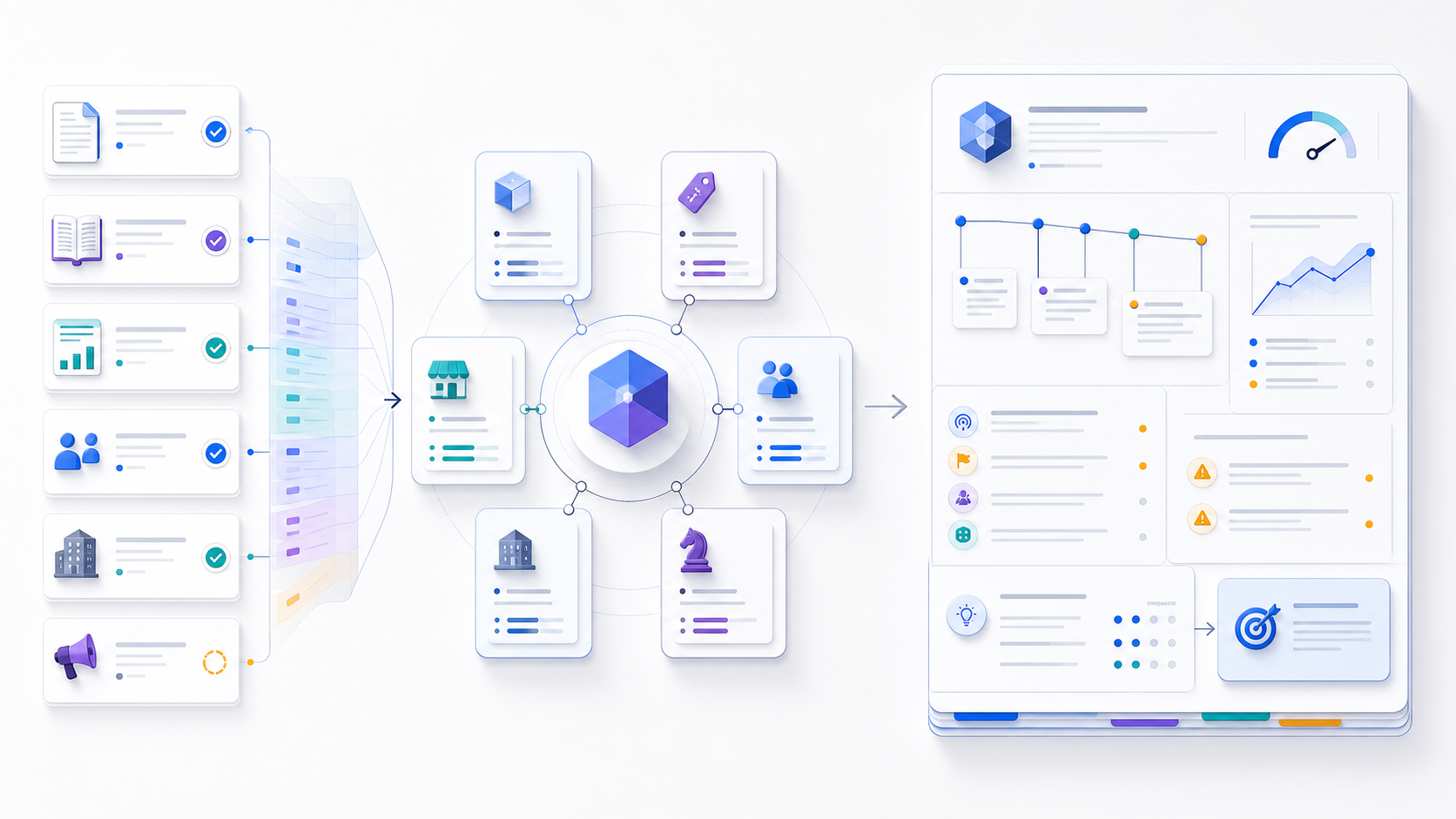
Competitor intelligence is a maintained, decision-focused account of one named rival: who the entity is, what it sells, how it prices and distributes, which customers it appears to serve, how its organization is changing, and what its observable moves may mean. Useful intelligence is not a pile of screenshots. Every material statement should retain its source, observation date, scope, and confidence so another reviewer can trace the reasoning.
竞争者情报是围绕一个明确竞争者持续维护、服务决策的记录:该实体是谁、销售什么、如何定价与分销、面向哪些客户、组织如何变化,以及可观察行动可能意味着什么。有效情报不是截图堆积。每项重要陈述都应保留来源、观察日期、适用范围与置信度,让其他审核者能够追溯推理。
Scope boundary: competitor intelligence goes deep on one rival. Competitive intelligence is the wider organizational discipline spanning markets, customers, substitutes, technologies, regulation, and multiple competitors. A competitive landscape analysis compares the structure and relationships across many players.
范围边界:竞争者情报深入研究单个对手;竞争情报是覆盖市场、客户、替代方案、技术、监管与多个竞争者的更广泛组织能力;竞争格局分析则比较多个参与者的结构与关系。
Start with a Decision, Not a Rival Name从决策开始,而不是从对手名称开始
A dossier becomes useful only when its scope matches a pending decision. Write one decision question, one accountable owner, one decision date, and the consequence of being wrong. “Should we change the onboarding promise for mid-market buyers before the October launch?” is workable. “Learn everything about Company X” is not. Define the market, geography, customer segment, product family, time horizon, and excluded topics. This prevents attractive but irrelevant facts from dominating the work.
只有当档案范围对应待解决决策时,它才有价值。写明一个决策问题、一名责任人、一个决策日期以及判断错误的后果。“我们是否应在十月发布前调整面向中型客户的上手承诺?”是可执行问题;“了解 X 公司的一切”不是。还要定义市场、地区、客户群、产品系列、时间范围和排除项,避免有趣但无关的信息主导工作。
Record a stopping rule before collection begins: for example, stop when every decision-critical claim has two independent sources or one authoritative primary source, all contradictions are logged, and unresolved unknowns have owners. This makes research auditable and limits endless browsing.
收集前还应定义停止规则,例如:每项关键主张已有两个独立来源或一个权威一手来源,所有矛盾都已记录,未解决未知项已有负责人。这样可以审计研究过程,也能避免无限搜集。
Resolve the Competitor Entity and Product Identity解析竞争者实体与产品身份
Before comparing anything, create an identity block. Capture the legal entity, trading names, parent and subsidiaries, official domains, product names, model numbers, editions, regions, release dates, and known aliases. Separate company-level facts from product-level facts. A review about an older regional variant should not silently become evidence about the current global offer.
比较前先建立身份区块,记录法律实体、商号、母子公司、官方网站、产品名称、型号、版本、地区、发布日期和已知别名。公司层事实与产品层事实必须分开;针对旧版地区型号的评价不能悄然变成当前全球产品的证据。
Assign a stable internal identifier to each entity and offer. When sources disagree, preserve both claims, the reason for the mismatch, and the verification status. Do not merge similarly named products until model, generation, geography, package, and observation period align.
为每个实体与产品分配稳定内部标识。来源冲突时,保留双方主张、不一致原因与核验状态。在型号、代际、地区、套餐和观察期一致前,不要合并名称相似的产品。
Use a Living Competitor Intelligence Dossier使用动态竞争者情报档案
Keep the dossier compact enough to review and structured enough to update. A practical record contains the following modules. Link every module back to the evidence register rather than copying unsupported conclusions into a presentation.
档案应足够精炼以便复核,也应足够结构化以便更新。实用记录可包含以下模块。每个模块都应回链证据台账,而不是把无来源结论复制到演示文稿。
Entities, offers, markets, segments, aliases, exclusions, owner, and decision date.
实体、产品、市场、客群、别名、排除项、负责人和决策日。
Capabilities, packages, published prices, terms, channels, partners, and switching implications.
能力、套餐、公开价格、条款、渠道、合作伙伴与转换影响。
Stated segments, public cases, recurring needs, complaints, and evidence limitations.
明确客群、公开案例、重复需求、投诉和证据限制。
Leadership, hiring, partnerships, filings, launches, exits, and testable strategic hypotheses.
领导层、招聘、合作、申报、发布、退出与可检验战略假设。
Build the Evidence Register Before Writing Conclusions先建立证据台账,再写结论
Give each evidence item an ID and store the exact claim, source URL or document reference, publisher, publication date, access date, geography, product or entity ID, extract or observation, evidence type, confidence, and reviewer. Label the item as fact, interpretation, hypothesis, or unknown. A confidence label without a reason is decoration, so add a short rationale.
为每项证据分配编号,并保存确切主张、来源链接或文档编号、发布者、发布日期、访问日期、地区、产品或实体编号、摘录或观察、证据类型、置信度与审核者。标明它属于事实、解释、假设还是未知项。没有理由的置信度只是装饰,因此要附简短依据。
| Status状态 | Meaning含义 | Required handling处理要求 |
|---|---|---|
| Verified fact已核事实 | Directly supported by a current authoritative record由当前权威记录直接支持 | Retain source, date, scope, and exact wording保留来源、日期、范围与准确措辞 |
| Corroborated interpretation交叉支持的解释 | Reasonable reading supported by independent evidence由独立证据支持的合理解释 | Show reasoning and credible alternatives展示推理与可信替代解释 |
| Working hypothesis工作假设 | A testable explanation, not an established fact可检验解释,并非既定事实 | Define confirming and disconfirming indicators定义支持与反驳指标 |
| Unknown未知项 | Decision-relevant information is missing缺少与决策相关的信息 | Assign owner, deadline, and fallback assumption分配负责人、期限与备用假设 |
Separate Current State, Change Timeline, and Watch Signals分开记录当前状态、变化时间线与监测信号
A snapshot answers “what appears true now”; a timeline answers “what changed, when, and in what sequence.” Log launches, price changes, packaging changes, executive moves, partnerships, filings, channel entries, customer announcements, and product retirements as dated events. Link each event to evidence and mark whether the date is the event date, announcement date, or observation date.
快照回答“现在似乎是什么”,时间线回答“什么在何时、按何顺序发生变化”。把发布、价格与套餐变化、高管变动、合作、申报、渠道进入、客户公告和产品退市记录为带日期事件,并链接证据,标明是事件日、公告日还是观察日。
Convert important unknowns into watch signals. A signal must specify what observable event matters, where it may appear, who checks it, and what threshold triggers review. “Monitor pricing” is vague. “Recheck the official pricing page and distributor list after a package-name change or a published discount above the agreed threshold” is actionable. This is a human-governed review process, not a claim of automatic or real-time monitoring.
把重要未知项转化为监测信号。信号应说明关注什么可观察事件、可能出现在哪里、由谁检查,以及达到什么阈值触发复核。“监测价格”太模糊;“套餐名称变化或公开折扣超过约定阈值后,复核官网定价页与经销商名单”才可执行。这是人工治理的复核流程,不代表自动或实时监控。
Turn Observations into Testable Hypotheses把观察转化为可检验假设
Do not leap from an isolated move to intent. Write hypotheses in conditional form: “If the new partner program is designed to expand the mid-market channel, we should observe X and Y by date Z.” Then list supporting evidence, counter-evidence, alternative explanations, confidence, next indicator, and the decision that would change. This keeps the dossier useful when the original interpretation proves wrong.
不要从孤立行动直接推断意图。用条件句写假设:“如果新伙伴计划旨在扩展中型市场渠道,那么在 Z 日期前应观察到 X 与 Y。”随后列出支持证据、反证、替代解释、置信度、下一指标及会受影响的决策。即使原解释被证伪,档案仍然有用。
Require a disconfirming indicator for every high-impact hypothesis. Analysts naturally collect confirming evidence; an explicit falsification test reduces narrative lock-in. Where evidence remains weak, use scenario ranges instead of a single confident forecast.
每个高影响假设都应有反驳指标。分析人员天然倾向收集支持证据,明确的证伪检验可以减少叙事锁定。证据薄弱时,使用情景区间而不是单一确定预测。
A Repeatable Competitor Intelligence Workflow可重复的竞争者情报流程
- Frame the decision. Record owner, deadline, scope, exclusions, required confidence, and stopping rule.界定决策。记录负责人、期限、范围、排除项、所需置信度与停止规则。
- Resolve identity. Separate legal entities, brands, products, models, editions, markets, and dates.解析身份。区分法律实体、品牌、产品、型号、版本、市场与日期。
- Design the evidence plan. List critical claims, preferred primary sources, corroboration needs, and access constraints.设计证据计划。列出关键主张、优先一手来源、交叉验证需求与访问限制。
- Collect lawfully. Use authorized public or licensed material and preserve provenance, dates, and scope.合法收集。使用获授权的公开或许可材料,保留出处、日期与范围。
- Normalize and classify. Align units and definitions; label facts, interpretations, hypotheses, contradictions, and unknowns.标准化并分类。对齐单位与定义,标记事实、解释、假设、矛盾与未知项。
- Analyze alternatives. Test the leading explanation against counter-evidence and competing explanations.分析替代解释。用反证与竞争性解释检验主要解释。
- Brief the decision. State what changed, why it matters, confidence, options, risks, and the owner of each action.交付决策摘要。说明变化、意义、置信度、选项、风险与每项行动负责人。
- Schedule review. Set the next date and event-driven triggers, then archive superseded claims without erasing history.安排复核。设定下次日期和事件触发条件,归档被取代的主张但不删除历史。
Use AI for Structure, Not Unverified Discovery用 AI 组织结构,而非未经核验的发现
AI can help normalize supplied fields, summarize authorized documents, suggest comparison dimensions, surface contradictions, and draft hypotheses. It cannot establish provenance, confirm that two product names refer to the same offer, guarantee completeness, or turn a model output into market fact. Keep original evidence beside every generated statement and require human review for sensitive, strategic, legal, financial, or customer-facing decisions.
AI 可以帮助标准化已提供字段、总结获授权文档、建议比较维度、发现矛盾并起草假设,但不能建立出处、确认两个产品名称属于同一产品、保证完整性,或把模型输出变成市场事实。每项生成陈述旁都应保留原始证据,敏感、战略、法律、财务或面向客户的决策必须人工复核。
For a prepared physical-product comparison, the InfiniSynapse Competitor Benchmarking Analyzer accepts user-entered products, parameters, supported reference files, and a natural-language instruction. Its visible outputs include a five-dimension radar, parameter comparison, pain-point insights, and differentiation suggestions. The interface requires sign-in to submit and should not be described as automatic competitor discovery, web scraping, continuous monitoring, or a real-time feed. See the competitor analysis tool workflow for preparation and review details.
对于已准备好的实体产品比较,InfiniSynapse 竞品对标分析器接收用户输入的产品、参数、受支持参考文件与自然语言指令。可见输出包括五维雷达、参数对比、痛点洞察和差异化建议。界面要求登录后提交,不应描述为自动发现竞争者、网页抓取、持续监控或实时信息流。准备与复核细节见竞品分析工具流程。
Enter aligned product parameters and authorized reference files, request a bounded comparison, and transfer only human-verified findings into the competitor dossier.
输入已对齐的产品参数与获授权参考文件,请求有边界的比较,仅把人工核验后的发现写入竞争者档案。
Hypothetical Example: A Rival Changes Its Channel Offer虚拟案例:竞争者改变渠道产品
Illustrative scenario: a fictional rival adds a partner-only package and changes a product page. The analyst first verifies the entity, package name, region, publication date, and archived page. A distributor announcement supports the event, while customer impact remains unknown. The dossier records a verified packaging change, not an unproven “channel takeover.”
演示情景:某虚构竞争者新增仅面向伙伴的套餐并修改产品页。分析人员先核实实体、套餐名称、地区、发布日期和存档页面。经销商公告支持该事件,但客户影响仍未知。档案记录的是已核验套餐变化,而不是未经证明的“渠道接管”。
The working hypothesis is that the rival wants partners to serve smaller accounts. Supporting indicators would include partner recruitment, enablement material, deal-registration terms, and small-account case studies. Counter-indicators would include direct-sales hiring or withdrawal of the package. The team schedules a 30-day review and agrees that only a confirmed shift in win/loss evidence will change sales enablement. This connects evidence to a reversible action without pretending to know intent.
工作假设是该竞争者希望伙伴服务较小客户。支持指标包括伙伴招募、赋能材料、报备条款与小客户案例;反向指标包括扩招直销或撤下套餐。团队安排 30 天后复核,并约定只有胜负单证据确认变化时才调整销售赋能。这样能把证据连接到可逆行动,而不假装知道对方意图。
Set Review Cadence, Triggers, and Accountable Handoffs设定复核节奏、触发条件与责任交接
Choose cadence from decision volatility, not habit. A launch team may review weekly; a stable annual planning question may need monthly or quarterly review. Event triggers should override the calendar when a defined launch, filing, price move, leadership change, partnership, litigation milestone, or product retirement appears. Every review should identify what changed, which prior claims are now stale, and which actions require approval.
复核节奏应由决策波动性决定,而不是习惯。发布团队可能每周复核;稳定的年度规划问题可能按月或按季度复核。当既定发布、申报、价格变化、领导层变动、合作、诉讼里程碑或产品退市出现时,事件触发应优先于日历。每次复核都要说明发生了什么、哪些旧主张已过时,以及哪些行动需要批准。
Use a short handoff: decision question, three material findings, confidence and caveats, options, recommended reversible next step, owner, due date, and trigger for escalation. Store the full evidence register separately. For a reusable field structure, adapt the competitor analysis template; for the larger analytical process, connect the dossier to the competitor analysis framework.
使用简短交接:决策问题、三项重要发现、置信度与限制、选项、建议的可逆下一步、负责人、截止日期和升级触发条件。完整证据台账另行保存。字段结构可调整竞品分析模板;更大分析流程可连接竞品分析框架。
Preserve version history instead of overwriting yesterday’s assessment. Mark claims as current, superseded, disputed, or withdrawn; retain the reason and reviewer. Access should follow legitimate business need, applicable law, contracts, and internal policy. Competitive work must never rely on deception, unauthorized access, misappropriated confidential information, or instructions to evade a source’s controls.
保留版本历史,不要覆盖昨天的判断。把主张标为当前、已取代、有争议或已撤回,并保留原因与审核者。访问应符合正当业务需要、适用法律、合同与内部政策。竞争研究不得依赖欺骗、未经授权的访问、被不当获取的机密信息,或规避来源控制的指令。
Frequently Asked Questions常见问题
It is a decision-focused record of a specific rival’s identity, products, pricing, channels, customers, organization, strategic moves, and changes, supported by dated sources and explicit confidence.
它是围绕特定竞争者身份、产品、定价、渠道、客户、组织、战略行动与变化的决策记录,并由带日期来源和明确置信度支持。
Include scope, entity and product identifiers, an evidence register, current facts, change timeline, hypotheses, unknowns, watch signals, review triggers, owners, and action records.
应包含范围、实体与产品标识、证据台账、当前事实、变化时间线、假设、未知项、监测信号、复核触发条件、负责人和行动记录。
Competitor intelligence usually examines one named rival in depth. Competitive intelligence is the broader discipline covering markets, customers, substitutes, technologies, regulation, and multiple competitors.
竞争者情报通常深入研究一个明确对手;竞争情报是覆盖市场、客户、替代方案、技术、监管与多个竞争者的更广泛能力。
Use a regular cadence based on decision speed, plus event-driven reviews for defined launches, price changes, filings, channel moves, or leadership changes.
根据决策速度设定固定节奏,并在既定发布、价格变化、申报、渠道行动或领导层变动时触发复核。
AI can structure supplied evidence and surface comparisons, but humans must verify identity, provenance, dates, uncertainty, legality, and decision relevance. The InfiniSynapse analyzer is not represented as automatic discovery or real-time monitoring.
AI 可以组织已提供证据并展示比较,但仍须人工核验身份、出处、日期、不确定性、合法性和决策相关性。InfiniSynapse 分析器不被描述为自动发现或实时监控工具。