What a Competitive Analysis Tool Should Do竞争分析工具应该做什么
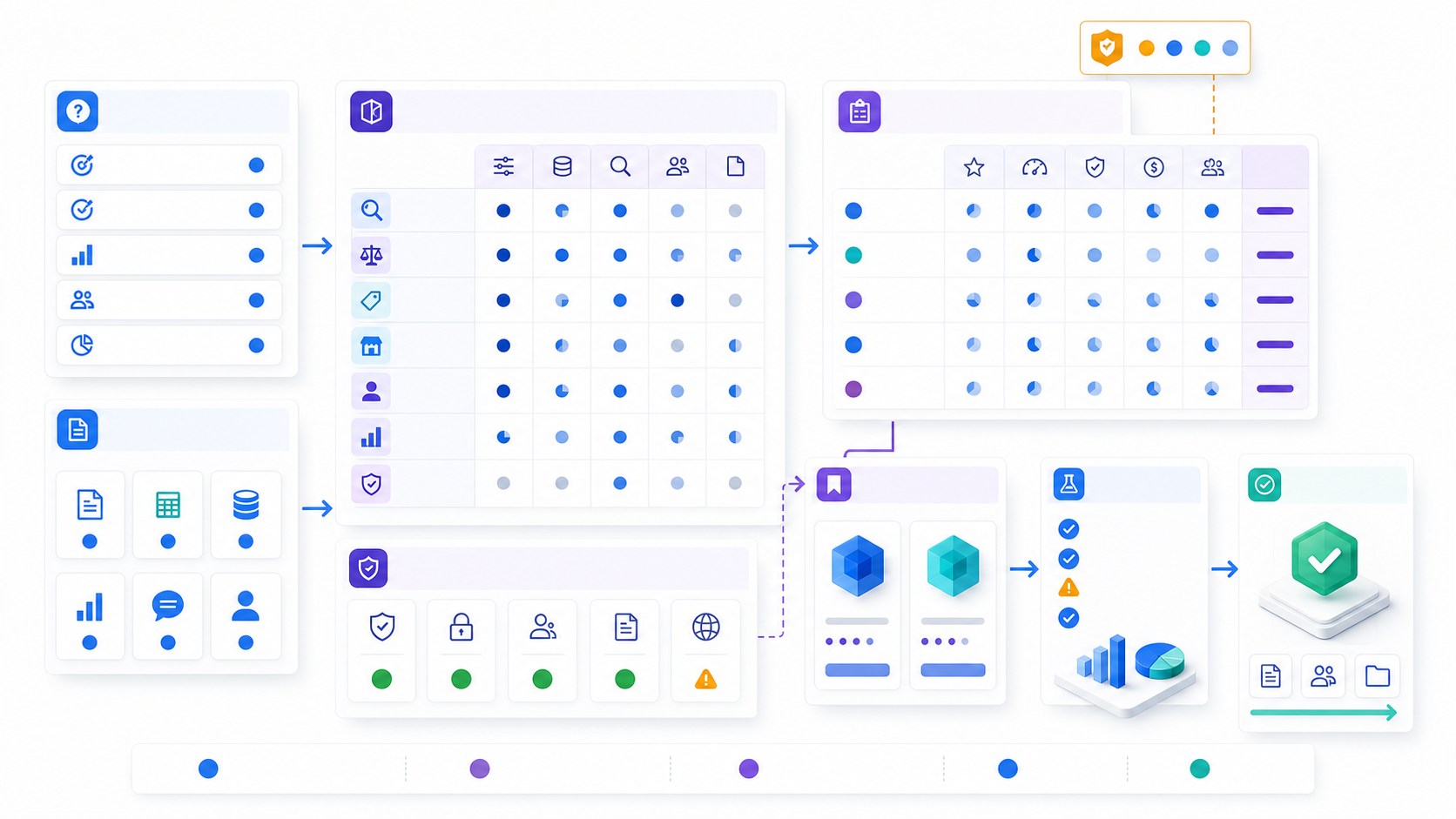
A competitive analysis tool helps a team collect, organize, compare, or communicate evidence about markets, competitors, products, prices, channels, customers, and changes for a defined decision. The right tool is the one that improves a specific workflow with traceable evidence, manageable review effort, and appropriate controls—not the product with the longest feature list.
竞争分析工具帮助团队围绕明确决策收集、组织、比较或传达市场、竞争者、产品、价格、渠道、客户和变化证据。合适工具应以可追溯证据、可管理复核工作量与适当控制改善具体流程,而不是拥有最长功能列表。
Use this method to compare commercial tools through defined requirements and a controlled pilot. If your team already uses the InfiniSynapse analyzer and needs to prepare product parameters and reference files, follow the competitor analysis tool workflow. For a broader purchasing decision that includes ongoing operations, users, integrations, support, governance, and total cost, use the competitor analysis software selection guide.
当团队需要依据明确需求和受控试点比较商业工具时,可采用这套方法。如果已经使用 InfiniSynapse 分析器,需要准备产品参数和参考文件,请按照竞品分析工具操作流程执行;如果需要评估持续运营、用户、集成、支持、治理和总成本,请使用竞品分析软件选型指南。
Define the Decision Before Comparing Tools比较工具前先定义决策
Start with one recurring decision, its owner, deadline, frequency, acceptable error, and evidence standard. “Help product managers compare two known physical products before a concept review” is testable. “Give everyone competitive insights” is not. List the people who prepare inputs, review evidence, approve conclusions, receive outputs, and administer access. Tool requirements change when these roles are different teams or jurisdictions.
从一个重复决策开始,写明负责人、期限、频率、可接受错误和证据标准。“在概念评审前帮助产品经理比较两款已知实体产品”可测试;“向所有人提供竞争洞察”不可测试。列出准备输入、复核证据、批准结论、接收输出和管理权限的人员。角色跨团队或跨法域时,工具要求会变化。
Define success as an observable workflow improvement: reduced preparation time without lower evidence quality, fewer identity or unit errors, faster review, clearer uncertainty, or more consistent decision records. Do not use number of generated pages, alerts, summaries, or recommendations as a proxy for decision quality.
把成功定义为可观察的流程改善:在不降低证据质量的前提下减少准备时间、降低身份或单位错误、加快复核、明确不确定性或形成更一致的决策记录。不要把生成页面、提醒、摘要或建议数量当作决策质量替代指标。
Match Tool Categories to the Research Task让工具类别匹配研究任务
Competitive analysis is not one data problem. A category map prevents teams from scoring unrelated products in one table. Some tools provide data; some structure user-supplied evidence; others monitor a bounded source, analyze a channel, or communicate findings. A single product rarely excels at every job.
竞争分析不是单一数据问题。类别图可避免团队在一张表里评分完全不同的产品。有些工具提供数据,有些组织用户提供的证据,另一些监测有限来源、分析渠道或传达发现。单一产品很少在所有任务上都表现优秀。
Company filings, industry structure, funding, patents, hiring, and strategic signals.
公司申报、行业结构、融资、专利、招聘与战略信号。
Features, specifications, packages, published prices, experience, claims, and evidence gaps.
功能、规格、套餐、公开价格、体验、主张与证据缺口。
SEO, advertising, content, social, reviews, marketplaces, distributors, or bounded website changes.
SEO、广告、内容、社交、评价、市场、经销商或有限网页变化。
Evidence repositories, matrices, scorecards, battlecards, reports, collaboration, and decision handoff.
证据库、矩阵、评分卡、对战卡、报告、协作与决策交接。
Map Required Inputs, Sources, and Evidence Rights映射所需输入、来源与证据权利
For each decision-critical field, identify the preferred source, update frequency, geography, entity and product identifiers, permitted use, retention need, and fallback when data is missing. Separate first-party records supplied by your team, public primary sources, licensed data, customer research, and model-generated interpretation. A vendor should explain which category its output belongs to.
对每个决策关键字段,明确优先来源、更新频率、地区、实体与产品标识、允许用途、保留需要以及缺失数据时的备用方案。区分团队提供的一方记录、公开一手来源、许可数据、客户研究与模型生成解释。供应商应说明其输出属于哪一类。
Confirm collection method and authority before the pilot. A polished interface does not authorize scraping, bypassing access controls, uploading confidential documents, or reusing licensed material outside its terms. Ask how the tool preserves original URLs or document references, publication and access dates, extracts, transformations, and reviewer notes. Without provenance, output may be convenient but difficult to defend.
试点前确认收集方式与权限。精美界面不等于授权抓取、绕过访问控制、上传机密文档或超出条款复用许可材料。询问工具如何保留原始链接或文档编号、发布与访问日期、摘录、转换和审核备注。没有出处的输出或许方便,但难以辩护。
Build a Competitive Analysis Tool Requirements Matrix建立竞争分析工具需求矩阵
Turn the workflow into measurable requirements before seeing demos. Mark each requirement must-have, should-have, optional, or excluded. Add a test method and pass threshold. “Uses AI” is not a requirement. “For every generated comparison claim, a reviewer can reach the supplied source record in two actions” is testable.
观看演示前把工作流转化为可测需求。将每项要求标为必须、应该、可选或排除,并增加测试方法与通过阈值。“使用 AI”不是需求;“审核者可在两步操作内从每项生成比较主张到达已提供来源记录”才可测试。
| Requirement area需求领域 | Evidence to request要求证据 | Example pilot test试点测试示例 |
|---|---|---|
| Input and identity输入与身份 | Supported formats, limits, entity matching, versions, units, and missing fields支持格式、限制、实体匹配、版本、单位与缺失字段 | Load one clean and one deliberately ambiguous record载入一份干净记录和一份刻意含糊记录 |
| Traceability可追溯性 | Source references, dates, extracts, transformations, confidence, and reviewer history来源、日期、摘录、转换、置信度与审核历史 | Trace every material output claim to evidence把每项重要输出主张追溯到证据 |
| Governance治理 | Access, retention, deletion, export, location, terms, incident, and vendor controls访问、保留、删除、导出、位置、条款、事件与供应商控制 | Verify the proposed configuration and responsibility owner验证拟议配置与责任人 |
| Decision output决策输出 | Comparison, unknowns, caveats, options, action fields, export, and collaboration比较、未知项、限制、选项、行动字段、导出与协作 | Run the normal approval and handoff process运行正常批准与交接流程 |
Weight the Scorecard Without Hiding Trade-offs加权评分但不隐藏取舍
Use gating requirements first: a product that fails a lawful-use, security, identity, provenance, or critical export condition should not recover by scoring highly on presentation features. For remaining candidates, weight categories according to the target decision. Keep weights fixed during the pilot and use anchored scores, such as zero for unsupported, one for manual workaround, two for partial support, three for acceptable, and four for verified strong performance.
先使用门槛要求:如果产品不满足合法使用、安全、身份、出处或关键导出条件,就不能靠展示功能高分弥补。对剩余候选,根据目标决策加权。试点期间保持权重不变,并使用锚定分数,例如零代表不支持、一代表人工变通、二代表部分支持、三代表可接受、四代表经验证表现优秀。
Report raw evidence beside each score, not only a total. Totals can hide a fatal weakness or create false precision when reviewers disagree. Run a sensitivity check: if a modest weight change reverses the winner, the decision is fragile and should be escalated rather than presented as objective.
每项分数旁都应报告原始证据,而不只是总分。总分可能隐藏致命弱点,也可能在审核者意见不同时制造虚假精确。开展敏感性检查:如果小幅调整权重就改变胜者,决策并不稳健,应升级讨论而不是包装成客观结论。
Control the Demonstration Instead of Watching a Script控制演示,而不是观看脚本
Give every vendor the same bounded scenario, representative de-identified inputs, ambiguous records, missing fields, expected reviewer questions, and output format. Ask the demonstrator to show identity correction, source tracing, uncertainty, a changed assumption, reviewer comments, export, deletion, and permission behavior. Record whether a capability is live, configured, roadmap-only, or requires another product.
向每个供应商提供相同的有限场景、代表性去标识输入、含糊记录、缺失字段、预期审核问题和输出格式。要求演示身份纠正、来源追溯、不确定性、假设变化、审核评论、导出、删除与权限行为。记录能力是已上线、需配置、仅在路线图中,还是需要其他产品。
Do not allow a hand-picked vendor dataset to substitute for your pilot. A demo tests communication and surface fit; it cannot establish accuracy, workload, data compatibility, governance, or business value in your environment.
不要让供应商精选数据集替代你的试点。演示只能测试沟通与表面适配,不能证明工具在你的环境中具备准确性、工作量、数据兼容性、治理或业务价值。
Run a Controlled Competitive Analysis Tool Pilot运行受控竞争分析工具试点
- Freeze the protocol. Set participants, evidence set, tasks, weights, pass thresholds, timing, and escalation rules before results are visible.冻结方案。结果出现前确定参与者、证据集、任务、权重、通过阈值、时间和升级规则。
- Prepare a gold-standard review. Include verified records, known ambiguities, missing information, contradictions, and expected caveats without exposing the answer key to vendors.准备基准复核。包含已核记录、已知含糊项、缺失信息、矛盾与预期限制,但不向供应商暴露答案。
- Observe the full workflow. Measure setup, correction, analysis, review, export, handoff, and rework—not just generation speed.观察完整流程。衡量设置、纠错、分析、复核、导出、交接和返工,而不只是生成速度。
- Score independently. Have at least two relevant reviewers record evidence before reconciling ratings and disagreements.独立评分。至少两名相关审核者先独立记录证据,再协调分数与分歧。
- Test failure handling. Change a unit, source date, identity, permission, or assumption and observe whether the result and audit trail update correctly.测试失败处理。改变单位、来源日期、身份、权限或假设,观察结果与审计轨迹是否正确更新。
- Decide with conditions. Approve, reject, or extend only with documented evidence, owners, safeguards, unresolved risks, and a review date.带条件决策。只有记录证据、负责人、保障措施、未解决风险和复核日期后,才批准、拒绝或延长。
Validate Accuracy, Traceability, and Decision Usefulness验证准确性、可追溯性与决策价值
Sample material claims and verify entity, product version, geography, date, definition, unit, source, transformation, and confidence. Count unsupported claims, missed contradictions, identity errors, unit errors, and stale records. Review omissions as carefully as confident statements: a tool can be factually correct yet decision-poor if it hides unknowns or fails to surface critical counter-evidence.
抽样重要主张,核验实体、产品版本、地区、日期、定义、单位、来源、转换与置信度。统计无支持主张、遗漏矛盾、身份错误、单位错误和过时记录。像审查自信陈述一样审查遗漏:如果工具隐藏未知项或未发现关键反证,即使事实正确,也可能不利于决策。
Measure human effort and downstream use. Did reviewers reach evidence faster? Did the output fit the approval meeting? Were caveats preserved in exports? Could a new owner understand the record? Did the tool encourage reversible, evidence-linked action? A time saving is valuable only when error, risk, and review burden remain acceptable.
还要衡量人工工作量与下游使用。审核者是否更快到达证据?输出是否适合批准会议?导出后限制是否保留?新负责人能否理解记录?工具是否促进可逆且连接证据的行动?只有错误、风险与复核负担仍可接受时,节省时间才有价值。
Review Governance, Security, and Total Workflow Cost审查治理、安全与完整流程成本
Before purchase, assign owners for data rights, privacy, security, legal review, records, model risk, procurement, administration, and business approval. Confirm access controls, data locations, retention and deletion, vendor and subprocessors, incident handling, export, termination, acceptable use, and any human-review obligations. Requirements depend on data sensitivity, jurisdiction, contract, and organizational policy; vendor marketing is not evidence of compliance.
采购前,为数据权利、隐私、安全、法律复核、记录、模型风险、采购、管理和业务批准分配负责人。确认访问控制、数据位置、保留与删除、供应商与分包商、事件处理、导出、终止、可接受使用和人工复核义务。要求取决于数据敏感性、法域、合同和组织政策;供应商营销不是合规证据。
Estimate total workflow cost, not license price alone: implementation, configuration, data, seats, usage, integration, migration, training, administration, analyst preparation, reviewer time, correction, export, archiving, and exit. Compare the finalist with a documented manual baseline. A focused tool may produce better value than a platform when the task is narrow and inputs are already prepared.
估算完整流程成本,而不只是许可价格:实施、配置、数据、席位、用量、集成、迁移、培训、管理、分析准备、审核时间、纠错、导出、归档与退出。把候选工具与有记录的人工基线比较。任务狭窄且输入已准备时,专用工具可能比平台更有价值。
Where the InfiniSynapse Analyzer FitsInfiniSynapse 分析器适合什么任务
The verified InfiniSynapse Competitor Benchmarking Analyzer is a candidate when a team already knows the two physical products to compare and can prepare product names, models, aligned parameter names, values, units, authorized reference files, and a bounded instruction. The visible interface supports CSV, Excel, PDF, Word, and text uploads, displays a 20 MB limit per file, and requires sign-in to submit.
当团队已经知道要比较的两款实体产品,并能准备产品名称、型号、对齐的参数名称、数值、单位、获授权参考文件和有限指令时,经核验的 InfiniSynapse 竞品对标分析器可作为候选。可见界面支持 CSV、Excel、PDF、Word 和文本上传,显示单文件限制为 20 MB,并要求登录后提交。
Visible outputs include a five-dimension radar, parameter comparison, pain-point insights, and differentiation suggestions. These are inputs to human review, not verified market facts. The tool should not be represented as automatic competitor discovery, web scraping, continuous monitoring, real-time feeds, audited market share, or connected SEO, advertising, pricing, patent, financial, or customer systems.
可见输出包括五维雷达、参数对比、痛点洞察和差异化建议。它们是人工复核的输入,不是已核市场事实。不能把该工具描述为自动发现竞品、网页抓取、持续监控、实时信息流、经审计市场份额,或已连接 SEO、广告、定价、专利、财务或客户系统。
Review detailed preparation and capability boundaries in the product comparison tool guide, then include the analyzer in the same pilot protocol used for any finalist.
在产品对比工具指南中查看详细准备与能力边界,然后让分析器接受与其他候选相同的试点方案。
Enter aligned product parameters and authorized reference files, define a bounded question, and evaluate the visible comparison outputs against your scorecard and original evidence.
输入对齐的产品参数与获授权参考文件,定义有限问题,并根据评分卡与原始证据评估可见比较输出。
Hypothetical Example: Selecting a Product Comparison Tool虚拟案例:选择产品比较工具
Illustrative scenario: a product team needs to compare two invented smart speakers before a concept review. Its must-haves are aligned model and unit fields, document references, clear missing-data handling, exportable comparison evidence, and reviewer comments. Automatic competitor discovery and website monitoring are explicitly out of scope. The team creates one clean dataset and one test set containing a regional model mismatch, a stale specification, and incompatible power units.
演示情景:某产品团队需要在概念评审前比较两款虚构智能音箱。必须项包括对齐型号与单位字段、文档引用、明确缺失数据处理、可导出的比较证据和审核评论。自动发现竞争者与网页监控明确排除。团队创建一份干净数据集和一份包含地区型号不匹配、过时规格及不兼容功率单位的测试集。
Two reviewers independently score setup, error detection, traceability, useful output, correction, and handoff. A candidate with a more attractive dashboard loses because it hides the unit mismatch; a simpler candidate remains because reviewers can trace and correct every material field. The team approves only a limited pilot, names an owner for validation, and schedules a review after three real comparisons. All names and results are hypothetical.
两名审核者独立评分设置、错误发现、可追溯性、输出价值、纠正和交接。仪表板更漂亮的候选因隐藏单位不匹配而落选;较简单的候选因审核者可以追溯并纠正每个重要字段而保留。团队仅批准有限试点,指定验证负责人,并在三次真实比较后复核。所有名称与结果均为虚构。
Common Competitive Analysis Tool Selection Mistakes竞争分析工具选型常见错误
A broad promise cannot substitute for a defined decision, user, evidence set, and approval workflow.
宽泛承诺不能替代明确决策、用户、证据集与批准流程。
Unused options increase complexity; score observable performance on essential tasks.
未使用功能增加复杂度;应评分关键任务中的可观察表现。
Use the same representative, ambiguous, and incomplete evidence for every finalist.
让每个候选使用相同的代表性、含糊与不完整证据。
Fast output without source, date, scope, and transformation history is difficult to verify.
没有来源、日期、范围与转换历史的快速输出难以验证。
Deliberately test identity, unit, permission, missing-data, contradiction, and export failures.
刻意测试身份、单位、权限、缺失数据、矛盾与导出失败。
Keep accountable humans responsible for evidence, uncertainty, legality, judgment, and action.
由明确人员对证据、不确定性、合法性、判断与行动负责。
Frequently Asked Questions常见问题
It helps a team collect, organize, compare, or communicate evidence about markets, competitors, products, prices, channels, customers, and changes for a defined decision.
它帮助团队围绕明确决策收集、组织、比较或传达市场、竞争者、产品、价格、渠道、客户和变化证据。
Define the decision and users, map required sources and outputs, set governance requirements, score only essential capabilities, and test finalists with the same representative evidence and review criteria.
定义决策与用户,映射所需来源和输出,设定治理要求,只评分关键能力,并用相同代表性证据和复核标准测试候选。
Usually not. Product comparison, website change tracking, SEO research, pricing intelligence, customer evidence, and reporting often require different data sources and controls.
通常不应该。产品比较、网页变化跟踪、SEO 研究、定价情报、客户证据和报告往往需要不同数据来源与控制。
Test input accuracy, entity matching, provenance retention, output traceability, missing-data handling, collaboration, export, access controls, reviewer effort, and decision usefulness.
测试输入准确性、实体匹配、出处保留、输出追溯、缺失数据处理、协作、导出、访问控制、审核工作量和决策价值。
No. AI may structure supplied evidence and surface patterns, but accountable reviewers must verify identity, sources, dates, uncertainty, legality, significance, and actions.
不能。AI 可以组织已提供证据并发现模式,但明确责任的审核者必须核验身份、来源、日期、不确定性、合法性、重要性与行动。