InfiniSynapse Vibe Coding Hackathon 2026
Startup Hackathons and a Small-Business Decision
Startup hackathons here mean an app a shop, school, or small team would run. Entry is free and online. The published cash pool is three thousand dollars.
By InfiniSynapse · Last updated October 2, 2026
1st Global Edition
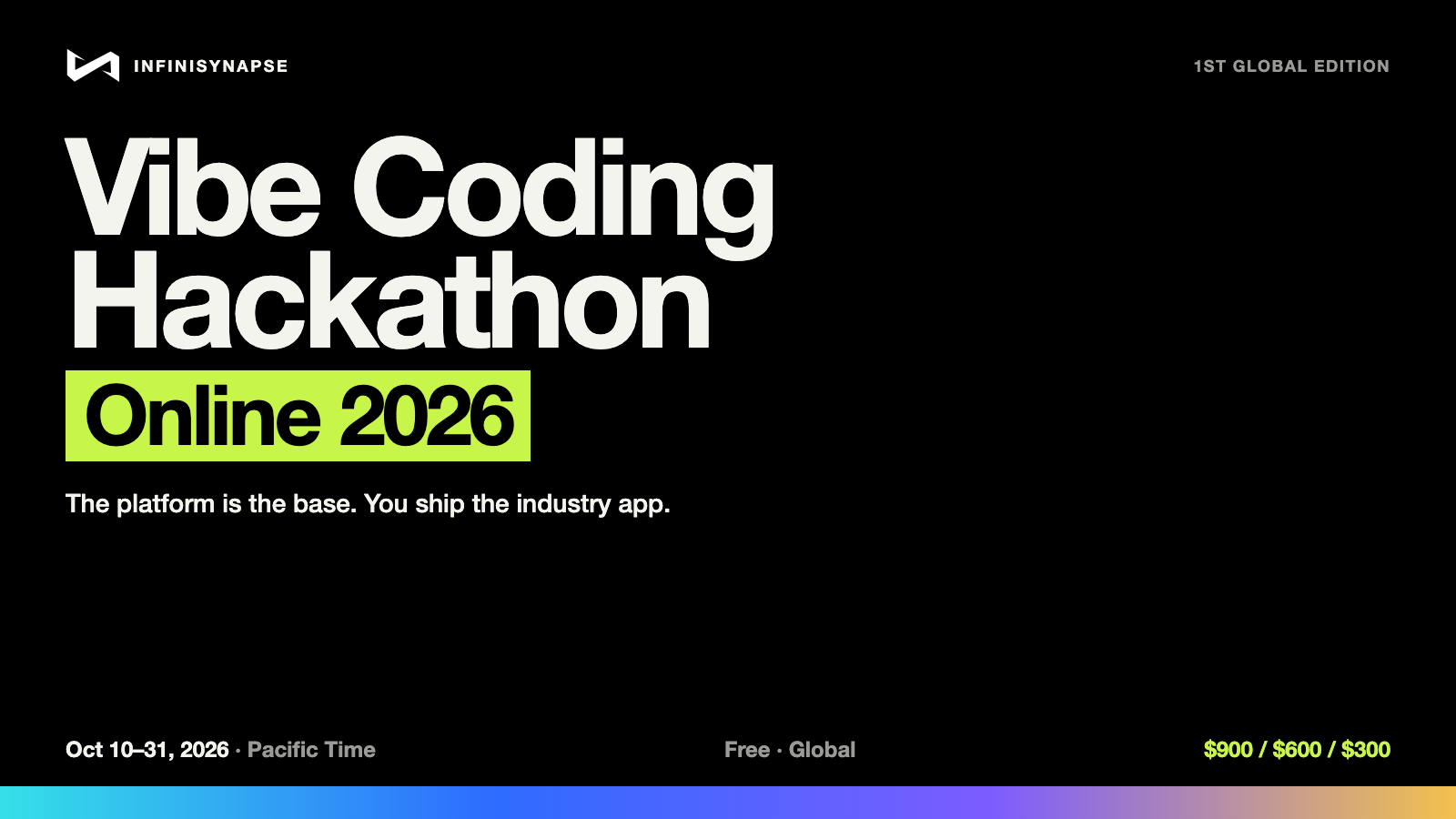
Vibe CodingHackathon
Online 2026
Oct 10–31, 2026 · Pacific Time
Free · Global
$900 / $600 / $300
Prize pool
$3,000
| Place | Award | Seats |
|---|---|---|
| 1st | $900 | 1 |
| 2nd | $600 | 2 |
| 3rd | $300 | 3 |
Repository stars are not part of the score.
TL;DR
Startup hackathons on this page mean the InfiniSynapse Vibe Coding Hackathon 2026: an online, free build of an app a shop, a school, or a small team would actually run. InfiniSynapse hosts it. There is no public hall. The window is October 10, 2026, 12:00 AM through October 31, 2026, 11:59 PM Pacific Time. During that window Pacific Time is PDT, UTC−7. The start is 07:00 UTC on October 10. The end is 06:59 UTC on November 1. Startup hackathons here are not a pitch contest for a slide-only company story.
The rewarded form is a working web, mobile, or desktop app. Left out: slide-only pitches, notebooks with no app, fake JSON, and a generic chat box on a spreadsheet. Six tracks are starting points on one registration: Education, Retail & Replenishment, Hit-product Analysis, SMB Operations, Growth for Operators, and Open Industry. The published cash pool is $3,000: one award of $900, two of $600, and three of $300. Judging is scenario value 40%, technical completeness 35%, and innovation 25%. GitHub stars are not scored. William Zhu, Co-founder of InfiniSynapse, is a confirmed judge. Age, region, and team size are not published on the event page. Payout timing, taxes, judging dates, a winner date, capacity, and a submission deadline separate from the build window are not published. Register only on Luma. Directions below are illustrative, not customer case studies. Startup hackathons on this site use that bar for every track.
A decision a small operator repeats
Startup hackathons are useful when the demo matches a decision that already happens on a Tuesday, not a fictional market the reviewer cannot picture.
Shop, school, or small team
A shop watches stock and lead time. A school or training provider watches who finishes. A small team watches which channel deserves the next week of effort. An owner watches orders, costs, and sales that do not sit in one place. A merchandiser watches a product that jumped and needs restock, feature, or watch. Startup hackathons for this event ask you to pick one of those people and show the next move.
The event page publishes the tracks, the window, and the prize pool in one place. Scene-level starting points live on ideas you can demo for an operator. Rules you can check against the official listing are on the competition page for this event. Startup hackathons in those neighbors use the same dates and the same exclusions.
What small means on public pages
A small business is a privately held firm that is small relative to larger enterprises in its field, often with limited staff and capital. A startup company is a young firm built to search for a repeatable way to serve customers, often under uncertainty. Those are public definitions, not eligibility tests for this event. The event page has not published age, region, or team-size rules, and it has not published a revenue cap. Startup hackathons here still want the app to fit a shop, a school, or a small team you can name.
Agencies that are not sponsors
The About SBA page describes the U.S. Small Business Administration and its public role. The USA.gov business page points to government information for people starting or running a business in the United States. Neither agency sponsors this event, and neither page is a data source you must import. Startup hackathons can still learn from those primers what a small operator juggles: money, customers, and time. Your demo should show one of those pressures with fields you may use.
One loop, not a company pitch
Name the user, the data, the analysis, and the action. A valuation story, a logo, and a total addressable market do not replace that loop. Startup hackathons that stop at the market slide are outside the rewarded set, because the reviewer cannot try a decision. Put the verb on the screen: reorder, contact, reprice, feature, watch, or assign.
Register only at the official Luma listing for this event. The Discord join stays on that listing. This page does not publish a separate invite. The InfiniSynapse Vibe Coding Guide is the product guide for the build. Startup hackathons get interface help there. There is no second registration form.
Tracks a small operator would recognize
Startup hackathons keep one signup. The track is the scene, not a second contest.
Five published scenes plus an open row
Education: enrollment, attendance or completion, the course list, and assessment results, then where to intervene. Retail and replenishment: on-hand inventory, recent sales, and supplier lead time, then reorder, wait, or raise a SKU. Hit-product analysis: sales over time, category, and a price or promotion flag you may use, then restock, feature, or watch. SMB operations: orders, costs, and sales for the same period, then the next operational move. Growth for operators: leads or visits by channel, conversion events, and repeat activity, then one focus for the next week. Startup hackathons map cleanly onto those five because each one already names a person and a verb.
When your industry is not listed
Open Industry is the row for a loop the other five do not cover. Define the user, the data, the analysis, and the action yourself. This is an illustrative direction, not a customer case study: a clinic office manager repeats a weekly staffing choice from appointment volume and no-show rates. The app lists sessions to rebalance and the reason. If you cannot say the weekly decision in one breath, pick a published track. Startup hackathons in the open row are judged on that loop, not on how unusual the industry sounds.
Two more illustrative directions
Illustrative direction, not a case study: a shop file with on-hand units, four weeks of unit sales, and lead time. The app marks the top SKUs "reorder now" when days of cover fall below lead time. Illustrative direction, not a case study: order lines with revenue and cost. The app lists orders to review first and a move such as renegotiate, reprice, or stop, with margin beside the verb. Startup hackathons should print the figure the verb depends on. A score with no unit is not a decision.
| Track | Small-operator question | Verb on the screen |
|---|---|---|
| Education | Which course loses learners? | Contact or reassign |
| Retail | What stocks out this week? | Reorder or wait |
| Hit product | Why did this item jump? | Restock, feature, or watch |
| Operations | Which orders hurt margin? | Review, reprice, or stop |
| Growth | Which channel gets next week? | Focus effort |
| Open | What does this person repeat? | The action you defined |
Money, score, and what is blank
Startup hackathons publish a cash pool. They do not publish a payout calendar.
Three thousand dollars, six seats
The pool is $3,000. One first prize is $900. Two second prizes are $600 each. Three third prizes are $300 each. That is six seats, not a limit on how many people may register. Capacity is not published. Payout timing and tax handling are not published. Startup hackathons do not let you treat the seat table as a tax guide or as a payment date.
| Place | Award | Seats |
|---|---|---|
| First | $900 | 1 |
| Second | $600 | 2 |
| Third | $300 | 3 |
How the app is judged
Real-world scenario value is 40%. Technical completeness is 35%. Innovation is 25%. A shop, school, or small team that a reviewer recognizes raises the first weight. A client that runs and shows inputs, a result, and a next step raises the second. A useful twist beyond a stock layout raises the third. Tie-break rules are not published. GitHub stars are not scored. William Zhu, Co-founder of InfiniSynapse, is a confirmed judge. Startup hackathons are not a popularity contest beside that rubric.
The window in Pacific Time
Build from October 10, 2026, at 12:00 AM Pacific Time through October 31, 2026, at 11:59 PM Pacific Time. That is 07:00 UTC on the first day and 06:59 UTC on November 1. Free tickets on the current Luma listing open on October 10. An earlier open date is not published. A submission deadline separate from the window is not published. There is no submit button until an entry point is live. Eastern Daylight Time is three hours ahead during this window. Startup hackathons should be cold-open ready before 11:59 PM Pacific on October 31.
Judging dates and a winner announcement date are not published. Age, region, and team size are not published. Do not import those limits from another program. Startup hackathons you can enter today need the Luma ticket, the guide, one operator, and the window.
What the app must not be
Startup hackathons reject artifacts that look like a company update and do not run.
Pitch materials
A deck can sit beside the build. If the file a reviewer opens is only slides, it is outside the rewarded set. A notebook full of charts, with no application around it, is outside too. Fake JSON that stands in for a live path is outside. A generic chat window on a spreadsheet, with no named operator and no next step, is outside. Startup hackathons keep that negative list even when the story is about a real shop.
Scope that a small team could run
One upload, one question, one ranked list, one verb. The sample can be twenty courses, fifty SKUs, or a hundred order lines. Label it synthetic when it is synthetic. A login wall that hides the sample stops the review. Startup hackathons reward the path a stranger can retry, not a roadmap of features you will build after the window.
Rehearse the Tuesday decision
Read the screen as if you were the owner on a busy morning. If the verb needs a sentence you have not typed, type it. If the file source is unclear, label it. Then hand the client to someone who has not heard the pitch. Fix only the step that stopped them. Startup hackathons are won on that Tuesday path, inside the published weights, not on a longer vision.
A build order for operators
Startup hackathons stay finishable when the order of work matches the decision, not the org chart of a future company.
First the person, then the file
Write the job title and the weekly pain. List the columns the decision uses. Mark whether you may use those columns or must synthesize them. Choose web, mobile, or desktop, and stop. Startup hackathons lose days when the builder designs a multi-sided platform before the first verb exists.
Then the client, then the cold open
Load the small file. Show the rank. Attach the verb. Cut a second chart that does not change the verb. Rehearse without notes on a day that is still inside the window. Startup hackathons that save the demo for an unpublished later deadline are planning against a date the event page has not posted.
The same order fits education, retail, hit products, operations, growth, and an open industry you can name. Startup hackathons do not ask you to cover all six. One loop, finished, is the entry.
A shop does not need a platform story to reorder. A school does not need a new brand to see which course loses learners. A small team does not need twelve charts to pick a channel for next week. Write the decision in the operator's words, then make the screen say only that. If lead time is the reason a SKU moves up, show lead time. If margin is the reason an order is reviewed, show margin. If completion is the reason a cohort is contacted, show completion. Keep the file small enough to explain in a minute, and label it when the rows are synthetic. Startup hackathons on this listing reward that Tuesday decision inside a working client. A longer company narrative can wait. It is not what the reviewer is asked to try, and it is not what the three weights measure.
Questions about this event
Is this only for incorporated startups?
No published rule requires a company form. Startup hackathons here mean an app a shop, a school, or a small team would run. Age, region, and team size are not published.
Does the SBA run the event?
No. The SBA and USA.gov pages are public references about small business, not sponsors and not a registration path. Register only on Luma.
Is the cash pool three thousand dollars?
Yes. The published pool is $3,000: one prize of $900, two of $600, and three of $300. Payout timing and tax handling are not published.
Can the entry be slides about a startup?
No. The rewarded form is a working web, mobile, or desktop app. A slide-only company story is outside the brief.
Is there a deadline after the window?
A submission deadline separate from the build window is not published. The published close is October 31, 2026, at 11:59 PM Pacific Time.