InfiniSynapse Vibe Coding Hackathon 2026
Online Hackathons: Dates, Time Zone, and Access
Online hackathons run October 10–31, 2026, Pacific Time, with no public venue. Register on the single Luma page, then build from wherever you already work.
By InfiniSynapse · Last updated October 2, 2026
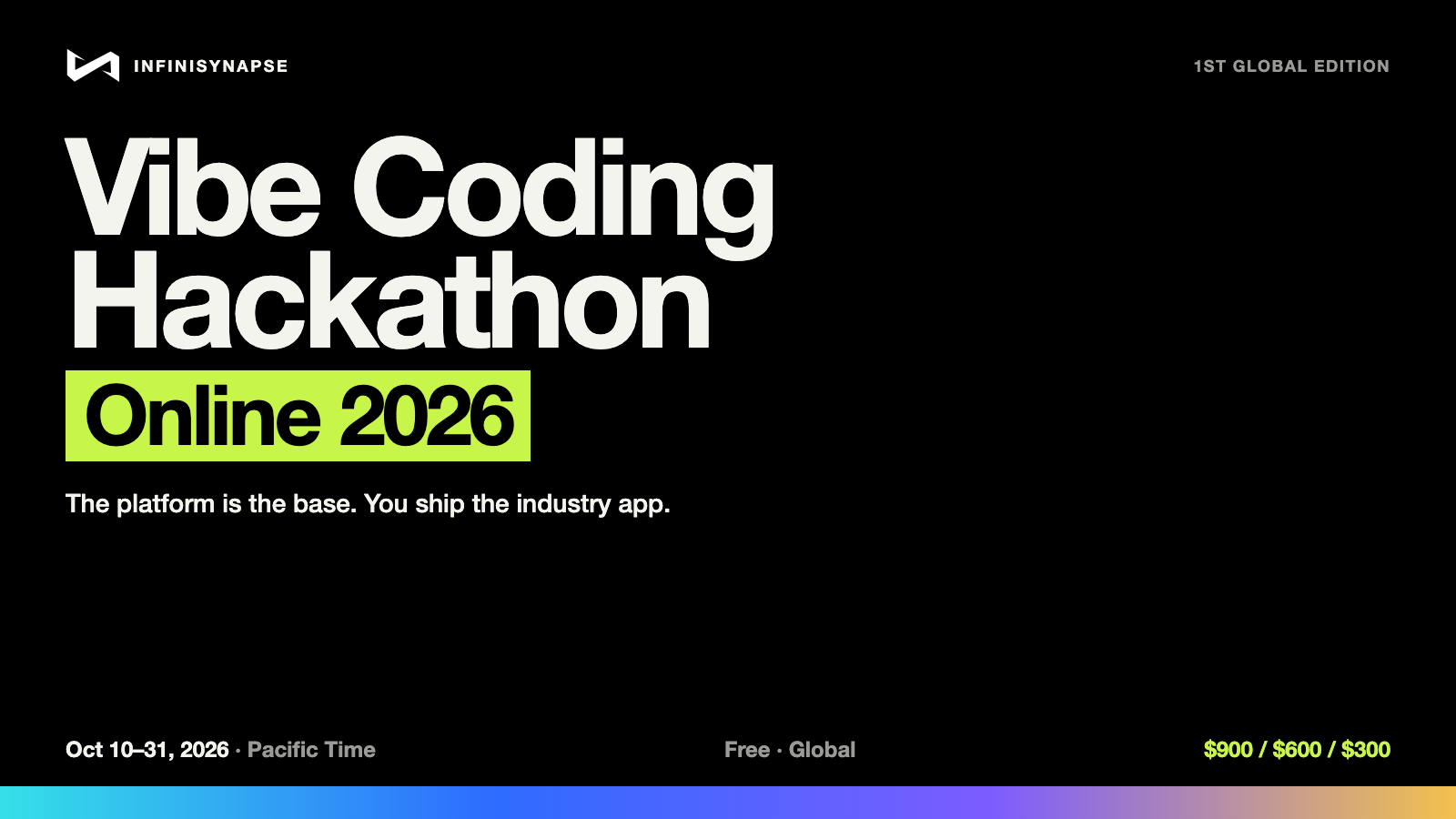
1st Global Edition
Vibe CodingHackathon
Online 2026
Oct 10–31, 2026 · Pacific Time
Free · Global
$900 / $600 / $300
Published
Event window
October 10–31, 2026
Starts October 10, 2026, 00:00 Pacific Time (07:00 UTC). Ends October 31, 2026, 23:59 Pacific Time (November 1, 2026, 06:59 UTC).
Coming soon
Registration opens
Not published as its own date
The current Luma listing opens free tickets on October 10, 2026, the same day as the event window. An earlier open date is not published.
Coming soon
Submission deadline
Coming soon
Coming soon
Judging
Coming soon
Coming soon
Winners announced
Coming soon
TL;DR
Online hackathons on this page mean the InfiniSynapse Vibe Coding Hackathon 2026. InfiniSynapse hosts it. It is online and free, with no public venue. The build window is October 10, 2026, 12:00 AM through October 31, 2026, 11:59 PM Pacific Time. During that window Pacific Time is PDT, UTC−7. The start is 07:00 UTC on October 10. The end is 06:59 UTC on November 1. Online hackathons here use that single clock, not the zone on your laptop menu.
You ship a working web, mobile, or desktop app. Slide-only pitches, notebooks without an app, fake JSON standing in for a workflow, and a generic chat box on a spreadsheet are outside the brief. Six tracks are starting points for one registration. The cash pool is $3,000: one prize of $900, two of $600, and three of $300. Judging is scenario value 40%, technical completeness 35%, and innovation 25%. GitHub stars are not scored. William Zhu, Co-founder of InfiniSynapse, is a confirmed judge. The event page has not published age, region, or team-size rules. Register only on Luma. Online hackathons do not add a second signup form.
Where the event runs
Online hackathons skip the hall, the badge line, and the room number. You build from wherever you already work, and a reviewer tries the app the same way.
No public venue
There is no address to travel to. A cafe, a campus, or a kitchen table all sit outside the scoring sheet. What sits on the sheet is the app. The Wikipedia page for the Pacific Time Zone is the public map for the clock this listing uses, covering the US West Coast and matching parts of Canada and Mexico. You do not need to be in that zone to enter. You do need to read the open and close in that zone. Online hackathons with a published Pacific window fail quietly when a builder treats local midnight as the close.
One registration page
Register only at the official Luma listing. Free tickets on the current listing open October 10, 2026, the same day the window starts. An earlier open date is not published. Online hackathons in this series do not collect a second RSVP on the product site. The event page is where the tracks, prizes, and blanks are written down. The Luma page is where you register.
Discord stays on that page
The Discord join stays on the Luma listing. This guide does not publish an invite URL. If a social post offers a different link, ignore it and return to Luma. Online hackathons keep the community step on the same page as the ticket so you are not chasing a second host.
How to read the clock
Online hackathons are won or missed on the timestamp. Write the open and the close with a numeric offset before you plan the last evening.
Pacific Time for the whole window
The window opens October 10, 2026, at 12:00 AM Pacific Time and closes October 31, 2026, at 11:59 PM Pacific Time. US daylight time in 2026 ends on Sunday, November 1. The close on October 31 at 11:59 PM still falls in PDT, UTC−7. The matching UTC instants are 07:00 on October 10 and 06:59 on November 1. Online hackathons that publish those two instants are the ones you can convert without guessing.
The IANA time zone database is the public list of zone names and the rules that shift their offsets. America/Los_Angeles is the usual name for Pacific Time on the US West Coast. This page states the offset for the event window directly: UTC−7 for the whole build. Online hackathons do not ask you to maintain that database. They ask you to honor the offset already printed.
UTC offsets you can check
A practical check is a single line with a date, a time, and an offset. RFC 3339 is the common internet profile for that line. You might write the open as 2026-10-10T00:00:00-07:00 and the close as 2026-10-31T23:59:00-07:00. Those strings are a planning aid. They are not a new rule beyond the Luma window. Online hackathons become easier to share across a distributed group when everyone pastes the same offset.
| Moment | Pacific Time | UTC |
|---|---|---|
| Window opens | October 10, 2026, 12:00 AM PDT | October 10, 2026, 07:00 |
| Window closes | October 31, 2026, 11:59 PM PDT | November 1, 2026, 06:59 |
| Free tickets on the current listing | October 10, 2026 | Same calendar day as the open |
A timestamp you can write down
Put the close on a calendar in Pacific Time, then add a second reminder two hours earlier in your own zone. The two-hour gap is a buffer, not an official grace period. A submission deadline separate from the build window is not published. Online hackathons here give you the build window and stop there. Do not invent an extra day after October 31.
What you can build from anywhere
Online hackathons still ask for a product a reviewer can open. Location does not relax the artifact.
The client you ship
Ship a working web, mobile, or desktop app. One client is enough. The Schema.org Event type is a public vocabulary for start date, end date, and location, including events attendees join remotely. You are not required to publish that markup. The useful idea is the same one the listing already uses: a start, an end, and no street address. Online hackathons defined that way still judge the app, not the markup.
The Vibe Coding Guide explains how to build with InfiniSynapse during the window. The InfiniSynapse app is the login. Work there from any network you already trust. Online hackathons do not ship a special VPN or a lab image for this listing.
Tracks as starting points
Six names share one registration: Education, Retail & Replenishment, Hit-product Analysis, SMB Operations, Growth for Operators, and Open Industry. They are starting points, not six events and not six tickets. Each row names an operator, the data, the decision, and what a demo shows. Online hackathons use those rows so a remote reviewer knows which job the screen is for. The phrase people search when they want the definition of the artifact is covered in what builders are asked to ship. The October dates as a calendar, including the point that a later submission date is not published, are in the October build window.
An illustrative remote demo
This is an illustrative direction, not a customer case study. A coordinator in one city loads a labeled roster. A reviewer in another city opens the same web app, sees courses ordered by drop-off, and reads a suggested follow-up. No one books a room. The data path is on the screen: attendance or completion, the course list, and the action. If the roster is synthetic, the screen says so. Online hackathons can be judged on that path because both people are looking at the app, not at a hallway conversation.
A second illustrative direction, also not a case study: a store operator ranks SKUs by stockout risk from on-hand units, recent sales, and lead time, and the app suggests an order priority. The reviewer tries that list without a screenshare script. Online hackathons reward that try.
Money, score, and blanks
Online hackathons on this listing publish the cash and the weights. They do not publish a travel stipend, because there is nowhere to travel.
Prize seats
The pool is $3,000. One first prize is $900. Two second prizes are $600. Three third prizes are $300. Payout timing and tax handling are not published. Capacity is not published. The seat numbers are prize counts. Online hackathons do not turn those counts into a registration cap.
Weights and stars
Real-world scenario value is 40%. Technical completeness is 35%. Innovation is 25%. GitHub stars are not part of the score. William Zhu, Co-founder of InfiniSynapse, is a confirmed judge. Judging dates and a winner announcement date are not published. Online hackathons scored this way care about the operator, the running app, and a choice that is more than a stock layout.
What is not on the calendar
The event page has not published age, region, or team-size rules. Required materials, format, repository rules, demo rules, and an official submit link are not published. There is no submit button until an entry point is live. Online hackathons leave those lines blank on purpose. A blank is not a hidden limit you can guess.
Access from the product
Online hackathons still need a product login and a guide. The rest of the access story is the clock and the single listing.
Guide and app
Read the guide, then sign in to the app, then pick one track. Write the operator and the question before you polish the layout. Keep fields visible. Label synthetic files. Finish with a click a reviewer can repeat. Online hackathons are accessible only if that click works without you in the room to narrate it.
Convert the close before you book that pass. The published offset for the whole window is UTC−7. Eastern Daylight Time in October is UTC−4, so Pacific midnight is 3:00 AM Eastern, and 11:59 PM Pacific on October 31 is 2:59 AM Eastern on November 1. Central Daylight Time is UTC−5, two hours ahead of Pacific. India Standard Time is UTC+5:30 all year, so the open is 12:30 PM in India on October 10, and the close is 12:29 PM in India on November 1. These lines are arithmetic from the published offset. They are not extra deadlines.
| Your clock | Window opens | Window closes |
|---|---|---|
| Pacific, UTC−7 | Oct 10, 12:00 AM | Oct 31, 11:59 PM |
| Eastern, UTC−4 | Oct 10, 3:00 AM | Nov 1, 2:59 AM |
| Central, UTC−5 | Oct 10, 2:00 AM | Nov 1, 1:59 AM |
| India, UTC+5:30 | Oct 10, 12:30 PM | Nov 1, 12:29 PM |
Use the row for the clock you actually live on, then put a private reminder two hours earlier. That reminder is yours. The listing does not grant a grace period. If you share the plan with someone in another city, send the Pacific line and the UTC line together so a calendar app does not silently shift the date. Check the shift once when you RSVP and once on October 30. A laptop that traveled can wake up in a new zone and show the wrong evening.
Keep the demo file small enough to upload on an ordinary connection. A reviewer should not need your screen share to see the fields. Name the file, say whether it is synthetic, and show the action on the first result view. If a filter changes the rank, leave the filter on the screen. Write one sentence above the result that restates the operator's question in their words. That sentence is for the reviewer who was never in a call with you.
Block the last afternoon in Pacific Time for a full pass: open the app as if you were the reviewer, upload the labeled file, read the action, and fix any step that depends on a verbal aside. If your local zone is ahead of Pacific Time, that pass may fall on the next calendar morning for you. If your zone is behind, it may fall late at night. Either way, convert before you start. A two-person group can split the pass, one person on the data labels and one on the click path, without any published rule about team size. Online hackathons simply need the app to stand alone at the end of that pass.
Unpublished eligibility
The event page has not published age, region, or team-size rules. Until it does, do not treat a rumor about who may enter as official. Online hackathons here tell you the format, the price, the window, and the artifact. That is the access list you can use today.
Questions about joining from home
Do I need to be in the Pacific Time Zone?
No. You can build from another zone. Online hackathons on this listing still open and close on Pacific Time, PDT, UTC−7, for the whole window.
Is there a venue or a travel plan?
No public venue is published. Online hackathons in this event are remote. There is no hall, and no travel stipend is listed with the prizes.
Where do I register and find Discord?
Register only on the Luma listing. The Discord join stays there. Online hackathons do not add a second invite in this guide.
Is a later submit date published?
A submission deadline separate from the build window is not published. Online hackathons give you October 10 through October 31, 2026, Pacific Time, and stop there.
Are age and team size set?
The event page has not published age, region, or team-size rules. Online hackathons do not fill those blanks on this page. Use the Luma RSVP, the guide, and the October window.