InfiniSynapse Vibe Coding Hackathon 2026
Hackathon 2026: The October Build Window
Hackathon 2026 on this page is October 10–31, Pacific Time. Registration is free and stays on one Luma page. A later submission date is not published.
By InfiniSynapse · Last updated October 2, 2026
1st Global Edition
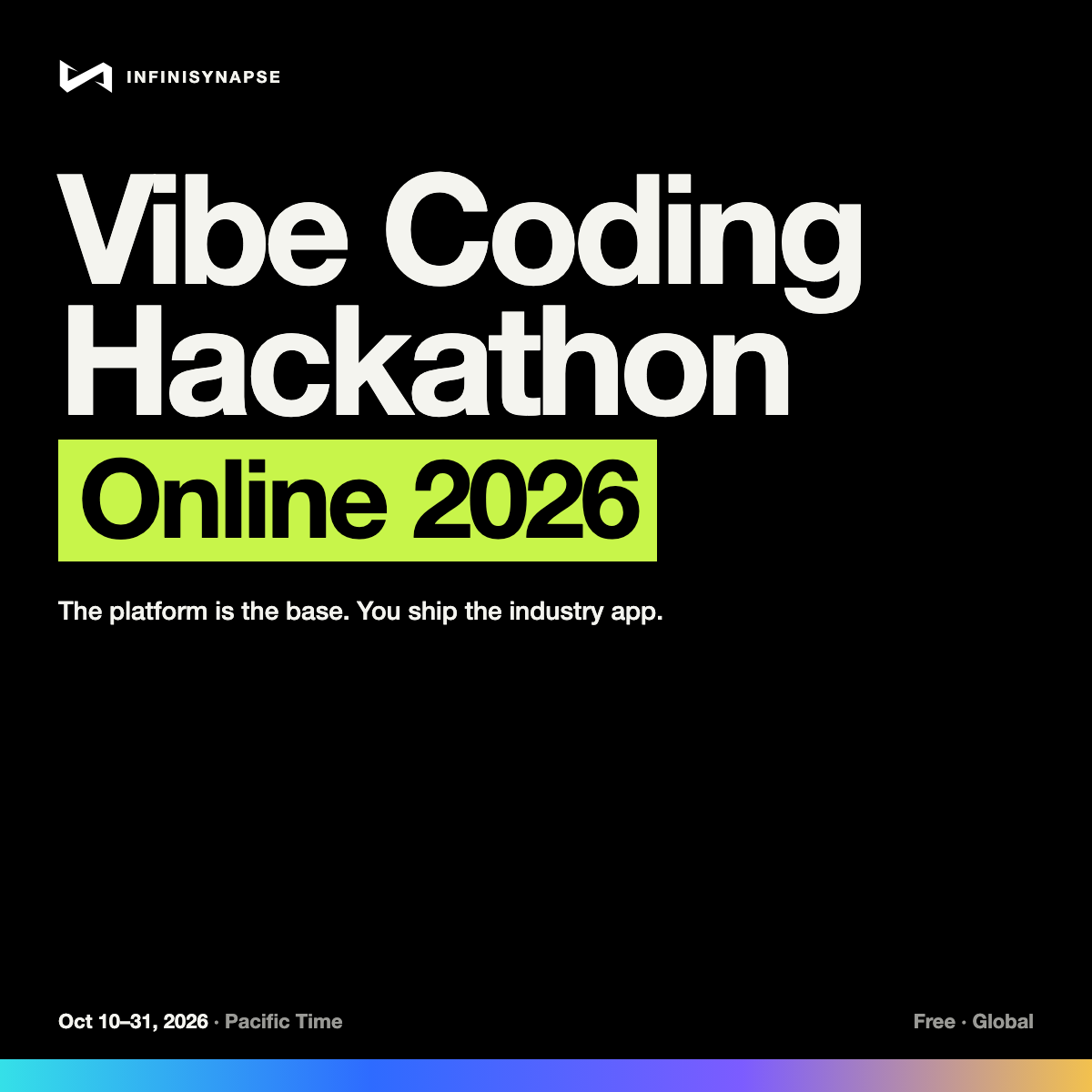
Vibe CodingHackathon
Online 2026
Oct 10–31, 2026 · Pacific Time
Free · Global
$900 / $600 / $300
Published
Event window
October 10–31, 2026
Starts October 10, 2026, 00:00 Pacific Time (07:00 UTC). Ends October 31, 2026, 23:59 Pacific Time (November 1, 2026, 06:59 UTC).
Coming soon
Registration opens
Not published as its own date
The current Luma listing opens free tickets on October 10, 2026, the same day as the event window. An earlier open date is not published.
Coming soon
Submission deadline
Coming soon
Coming soon
Judging
Coming soon
Coming soon
Winners announced
Coming soon
TL;DR
Hackathon 2026 on this page is the InfiniSynapse Vibe Coding Hackathon, hosted by InfiniSynapse. It is online and free. The build window runs October 10, 2026, at 12:00 AM through October 31, 2026, at 11:59 PM Pacific Time. In that window Pacific Time is PDT, UTC−7. The open is 07:00 UTC on October 10. The close is 06:59 UTC on November 1. Hackathon 2026 does not publish a later submission date.
Registration stays on one Luma page. You ship a working web, mobile, or desktop app. Slide-only pitches, notebooks without an app, fake JSON standing in for a workflow, and a generic chat box on a spreadsheet sit outside the brief. Six tracks are starting points for one registration. The cash pool is $3,000: one prize of $900, two of $600, and three of $300. Judging is scenario value 40%, technical completeness 35%, and innovation 25%. GitHub stars are not in the score. William Zhu, Co-founder of InfiniSynapse, is a confirmed judge. The event page has not published age, region, or team-size rules. Hackathon 2026 entry starts with the Luma RSVP and the published window.
What the window covers
Hackathon 2026 is a date range you can put on a calendar, plus an artifact you can open. The range is the part people misread when they live outside Pacific Time.
Open and close
The first minute is October 10, 2026, 12:00 AM Pacific Time. The last minute is October 31, 2026, 11:59 PM Pacific Time. US daylight time in 2026 ends on Sunday, November 1, after this close, so the whole range stays on PDT, UTC−7. Hackathon 2026 builders who convert only the calendar date, and not the clock, miss the last evening.
A time zone is a region that shares a standard offset from UTC, with rules for seasonal shifts. That definition is why two builders can share a project and still disagree about "end of day" until they name the zone. Hackathon 2026 names it: Pacific Time.
One zone for every builder
Los Angeles civil time is the practical face of Pacific Time for this listing. The Los Angeles time zone page at timeanddate shows how that city relates to UTC, including daylight time. Use it as a reference for the zone, not as a second set of event dates. Hackathon 2026 dates remain the ones on the Luma listing and on the event page.
The NIST Time and Frequency Division is the US public home for official timekeeping. You do not need a lab clock to enter. You need a normal calendar set to the published offset. Hackathon 2026 treats 11:59 PM Pacific on October 31 as the close you can plan around.
How to write the offset
Write 2026-10-10T00:00:00-07:00 for the open and 2026-10-31T23:59:00-07:00 for the close. Eastern Daylight Time is UTC−4 in October, three hours ahead, so the open is 3:00 AM Eastern on October 10 and the close is 2:59 AM Eastern on November 1. Central Daylight Time is UTC−5, two hours ahead. India Standard Time is UTC+5:30, so the open is 12:30 PM in India on October 10 and the close is 12:29 PM in India on November 1. Hackathon 2026 conversions are arithmetic from UTC−7. They do not add grace time.
| Clock | Opens | Closes |
|---|---|---|
| Pacific, UTC−7 | Oct 10, 12:00 AM | Oct 31, 11:59 PM |
| Eastern, UTC−4 | Oct 10, 3:00 AM | Nov 1, 2:59 AM |
| Central, UTC−5 | Oct 10, 2:00 AM | Nov 1, 1:59 AM |
| India, UTC+5:30 | Oct 10, 12:30 PM | Nov 1, 12:29 PM |
Registration during that window
Hackathon 2026 registration is free. The current Luma listing opens free tickets on October 10, the same day the window starts. An earlier open date is not published.
Free tickets on the open day
Plan to RSVP when the window opens if you have not already, and do not assume a September ticket desk that this page does not list. The event page is the overview. Dates, zone math, and remote access are spelled out in dates, time zone, and access for a remote build. What to do before the open is in how to prepare before October 10. Hackathon 2026 preparation can start earlier. The published ticket day is still October 10.
A single listing
Register only at the official Luma listing. There is no second form on the product site. Hackathon 2026 signup is that one RSVP. If another page asks you to pay, it is not this event.
Discord on the same page
The Discord join stays on the Luma listing. This guide does not publish an invite URL. Hackathon 2026 community access is the button on that listing, not a link copied from a chat repost.
What you ship inside the window
Hackathon 2026 asks for a working app by the close, with a data path a reviewer can try. The window is long enough for one operator, one question, and one action. It is a poor fit for a platform with six unfinished modules.
A working client
Web, mobile, or desktop all qualify. One client is enough. A virtual location is the public Schema.org type for an event people attend without a street address. The listing already matches that idea: online, no hall. Hackathon 2026 does not require you to publish that markup. It requires the app.
The Vibe Coding Guide is the product guide. The InfiniSynapse app is where you sign in. Use both from the network you already have. Hackathon 2026 does not mail a device or a dataset.
Six starting points
Education, Retail & Replenishment, Hit-product Analysis, SMB Operations, Growth for Operators, and Open Industry are starting points, not six registrations. Pick one. Name the operator, the fields, and the next step. Hackathon 2026 scoring still uses the same three weights no matter which row you pick.
| Track | Bring these fields | End on this action |
|---|---|---|
| Education | Enrollment, attendance or completion, course list, results | Who to contact or which course to change |
| Retail & Replenishment | On-hand units, recent sales, lead time | Reorder, wait, or raise a SKU |
| Hit-product Analysis | Sales over time, category, promotion flag you may use | Restock, feature, or watch |
| SMB Operations | Orders, costs, and sales for one period | The next operational move |
| Growth for Operators | Channel, visits or leads, conversions | The focus for the next week |
| Open Industry | The data that weekly decision uses | The decision, the reason, the action |
An illustrative week-by-week cut
This is an illustrative direction, not a customer case study. Week one of the window: register, read the guide, and freeze the question. Week two: connect fields you are allowed to use, or label a synthetic file. Week three: put the action on the screen and delete any step that needs you to explain it live. The last weekend: run the app in Pacific Time, once as the builder and once as a reviewer who has never seen it. Hackathon 2026 does not require this calendar. It is a way to spend the published days. A store example of the same shape, also illustrative: rank SKUs by stockout risk and show an order priority before October 31.
Count the days before you stack features. October 10 through October 31 is 22 calendar days, inclusive. A realistic cut is four blocks. Days 1 to 3: RSVP, read the guide, sign in, and write the operator's question in one sentence. Days 4 to 9: lock the fields and label the file as permitted data or as a synthetic set. Days 10 to 16: put the rank and the verb on one screen and remove any control that does not change that verb. Days 17 to 22: repeat the path on a cold open, fix the label a stranger would miss, and stop adding tracks. Six tracks on the event page are a menu. Building all six in 22 days produces six half screens. One finished path is the brief.
A cold open means you hand the app to someone who did not sit in the design conversation. They should see the question, the upload or the sample file, the fields that drove the result, and a next step they could take this week. If they need a paragraph from you, the paragraph belongs on the screen. Keep the file small enough for a home connection. Leave filters visible when they change the order of the list. Name the time zone of any "this week" label so a reviewer in another city does not apply their own Monday.
Use the same cold open for a course roster or a margin list. The roster version orders courses by drop-off and suggests a follow-up. The margin version lists orders where cost is eating revenue and says which orders to review first. Both are illustrative directions, not customer case studies, and neither promises a product feature beyond the public docs. Pick one. Finish it. Then use the last two evenings, converted into Pacific Time, for the pass you would be willing to show without a call.
Prizes and the score
Hackathon 2026 publishes the cash and the weights. It does not publish payout timing, tax handling, judging dates, or a winner announcement date.
Cash seats
The pool is $3,000. One first prize is $900. Two second prizes are $600. Three third prizes are $300. Those are prize seats, not a cap on how many people may RSVP. Capacity is not published. Hackathon 2026 cash is the current listing as a total of six prize seats.
Weights
Real-world scenario value is 40%. Technical completeness is 35%. Innovation is 25%. GitHub stars are not part of the score. William Zhu, Co-founder of InfiniSynapse, is a confirmed judge. Hackathon 2026 review, when it happens, uses that rubric. The date of review is not on this page.
What the calendar does not say
Hackathon 2026 is specific about the build window and silent about several dates builders often expect.
No later submission date
A later submission date is not published. A submission deadline separate from the build window is not published. There is no submit button on the event page until an official entry point is live. Required materials, format, repository rules, and demo rules are not published. Hackathon 2026 planning should assume the window you can already read, and nothing past 11:59 PM Pacific on October 31.
Eligibility still blank
The event page has not published age, region, or team-size rules. Do not invent them from a template you used at another event. Hackathon 2026 access that you can act on today is the free Luma RSVP, the guide, the app, and a track you can demo inside the window.
If a teammate lives in another offset, send both the Pacific line and the UTC line. A calendar invite that says "Friday night" will land on the wrong evening. October 30 is a Friday in 2026. A pass at 4:00 PM Pacific that day is 7:00 PM Eastern and 4:30 AM Saturday in India. Those three clocks are the same instant. Agree on the Pacific one.
Block October 30 on your own calendar for a full pass in Pacific Time. Open the app, load the labeled file, and read the action without a narrator. If your zone is ahead of Pacific Time, that pass may land on October 31 locally. If your zone is behind, it may land late on October 30. Convert with the table above before you promise a teammate a time. Keep the file small. Leave the question in the operator's words at the top of the result. Hackathon 2026 demos that survive a cold open are the ones that match the brief.
Questions about the dates
When does the window open and close?
Hackathon 2026 opens October 10, 2026, at 12:00 AM Pacific Time and closes October 31, 2026, at 11:59 PM Pacific Time. The offset for the whole window is UTC−7.
Is registration free, and where?
Yes. Hackathon 2026 registration is free and stays on the single Luma page. The Discord join stays on that page too.
Is there a submission date after October 31?
A later submission date is not published. Hackathon 2026 does not add a second deadline on this page.
Do stars or a venue matter?
GitHub stars are not part of the score. There is no public venue. Hackathon 2026 is online, and the score is scenario value, completeness, and innovation.
Are age and team size published?
The event page has not published age, region, or team-size rules. Hackathon 2026 does not fill those blanks here. Payout timing, judging dates, and a winner announcement date are not published either.