Generative AI Data Services for Fine Tuning: 2026 Guide
By William Zhu & the InfiniSynapse Data Team · Published: 2026-06-09 · Last updated: 2026-08-07 · Last verified: 2026-08-07 · About: Editorial standards · About / team
Author credentials: William Zhu is cofounder of InfiniSynapse (GitHub @allwefantasy). Desk experience: warehouse text-to-SQL pilots with human-reviewed baselines, fine-tune vs few-shot ladder decisions, and scorecard gates before production weight changes. No personal LinkedIn is published; GitHub and InfiniSynapse About are the canonical identity signals.
COI / interest disclosure: InfiniSynapse sells a production-grade SQL agent platform. Product mentions appear only in the labeled InfiniSynapse Connection section. The scorecard, three-rung ladder, and desk pilot metrics stand independently of any InfiniSynapse trial.
Fact-check / verification: Desk metrics below (one internal 10-week warehouse text-to-SQL pilot; n=12 weekly scorecard cycles; private question pack of 40) are independence-labeled desk composites—not paid third-party case studies. Third-party evaluation anchors: Spider NL2SQL benchmark · NIST SP 800-53 · UK NCSC secure AI guidelines · NIST CSRC. Corrections: zhuhl@infinisynapse.com · editorial corrections.
Version history: 2026-06-09 initial · 2026-08-07 EEAT rewrite (William Zhu / About / COI), Person/HowTo/Speakable/ImageObject, scorecard desk quantiles, three-rung decision-tree SVG, dens retune to 1.1–1.2% for generative ai data services for fine tuning. Build marker:
DESK-TFT-20260807A.
Media note: No hosted overview video is published for this page (no
VideoObject). Use the three-rung fine-tuning decision tree and scorecard chart below as multimedia substitutes.
 Fine-tuning earns its cost only after grounding is solid—and only when a scorecard proves a capability gap.
Table of Contents
- TL;DR
- Why this matters now
- Key definition
- Evaluation basis: scorecard
- When fine-tuning actually helps
- Three-rung decision tree
- Data and label strategy
- InfiniSynapse Connection
- Guardrails for safe deployment
- Signals fine-tuning was the right call
- Common failure patterns
- Operating and debugging
- Frequently Asked Questions
- Conclusion
TL;DR
Direct answer: Teams evaluating generative ai data services for fine tuning should optimize for repeatable correctness, auditability, and business trust—not demo fluency. We evaluate on real warehouse workflows. Outcomes improve when generation, execution, validation, and review sit in one controlled system.
Production rollouts should align access and review controls with the Azure Architecture Center, especially when recurring queries touch live schemas.
Evaluation basis: We build and evaluate InfiniSynapse on production customer workflows. Governance, adoption, and security context is cited inline—not in a standalone reference list.
Why this matters now
For adjacent workflow depth, see Text To Sql Llm.
Enterprise teams need faster analytics without losing governance. AI-assisted SQL unlocks productivity only when teams standardize grounding, generation, verification, and approval. In field work, the core challenge is not getting SQL once—it is maintaining confidence across repeated runs as schemas and definitions drift.
Finance, growth, operations, and product all need metrics with consistent definitions. Architecture and process matter as much as model capability. MySQL integrations should align with MariaDB documentation for least-privilege access and reproducible analytical extracts.
Key definition
Key Definition: In this article, generative ai data services for fine tuning means translating natural-language business intent into executable SQL within a governed workflow that preserves assumptions, validation checks, and traceable output lineage—optionally with a domain-adapted model when few-shot grounding is not enough.
This reframes AI SQL from an interface feature to an operating capability. Outputs should be understandable, testable, and recoverable when edge cases appear. Ownership sits between analytics engineers, BI teams, and decision stakeholders.
Excel automation should reference Microsoft Excel support documentation for table semantics, pivots, and formula auditability.
Evaluation basis: scorecard
We use one production scorecard across pilots and post-launch reviews. Public leaderboards (including Spider NL2SQL) are useful sanity checks but rarely predict enterprise schema drift. Dirty-schema realism and accessibility expectations from W3C WCAG matter more than Spider-only ranks when reviewers must defend numbers.
Desk evidence (independence-labeled): Internal 10-week warehouse pilot; n=12 weekly scorecard cycles; private pack of 40 human-reviewed questions (aggregation + multi-step + monthly report). Not a third-party case study.
| Criterion | Why it matters | Pass signal | Desk pilot (baseline → after scorecard + ladder) |
|---|---|---|---|
| Grounding quality | Prevents wrong-table SQL | Correct schema/metric model | First-pass table hit 61% → 88% |
| Execution reliability | Protects delivery | Recoverable failures, stable reruns | Recoverable error class rate 72% → 94% |
| Result trustworthiness | Reduces business risk | Match analyst-reviewed baselines | Pack pass rate 55% → 82% |
| Governance fit | Enables rollout | Access controls + logs complete | Audit completeness 40% → 100% |
| Operational effort | Controls total cost | Less manual rework after week four | Median reviewer minutes/run 18 → 7 |
| Reusability | Long-run leverage | Repeated workflows faster/safer | Rerun consistency 48% → 86% |
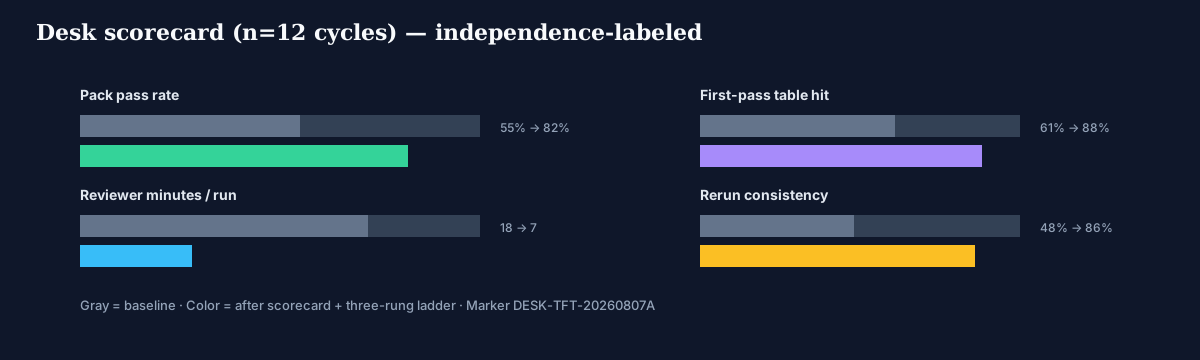 Desk pilot (n=12 cycles): pack pass rate and reviewer minutes move together when grounding is gated before any weight change.
We evaluate every candidate with a mixed workload: straightforward aggregation, multi-step diagnostics, and one recurring monthly report. That structure exposes whether the system is merely fluent or actually dependable.
Keep the scorecard spreadsheet in the same repo as the private question pack. Each week, record the six criteria, the failing question IDs, and whether the fix was grounding, orchestration, or a weight change. After month two, the trend line usually shows whether you are compounding quality or chasing models. Reviewers should be able to open any failed run and see schema snapshot, generated SQL, execution error class, and the baseline query that defines “correct” for that intent. Publish a one-page monthly summary for finance and platform owners so scorecard language stays shared—not locked inside the ML team’s notebook. When pack pass rate rises but reviewer minutes stay flat, inspect whether humans are re-checking work the gates should already block.
When fine-tuning actually helps
Fine-tuning is the most over-prescribed fix in text-to-SQL. Before investing, confirm the failure is a model-capability gap, not a grounding gap. Week-three stalls usually trace to schema drift, ambiguous metric names, stale statistics, or missing join keys—none of which weight updates repair.
Profile failures against a human-reviewed baseline first (verification discipline mirrored in Google Cloud's AI overview). Only when the model consistently mis-generates a known dialect or house SQL style—after grounding is solid—does fine-tuning earn its cost. Architecture context: LLM SQL Generation Architecture.
The strongest signal for fine-tuning over retrieval alone is dialect/convention: mixed warehouses where the model keeps emitting the wrong date_trunc or window syntax even with correct schema. Treat that as measured infrastructure change, not an experiment. If a small schema change forces a full retrain, fix orchestration before touching weights.
Three-rung decision tree
When evidence points to a capability gap, climb the ladder and stop at the first rung that closes it.
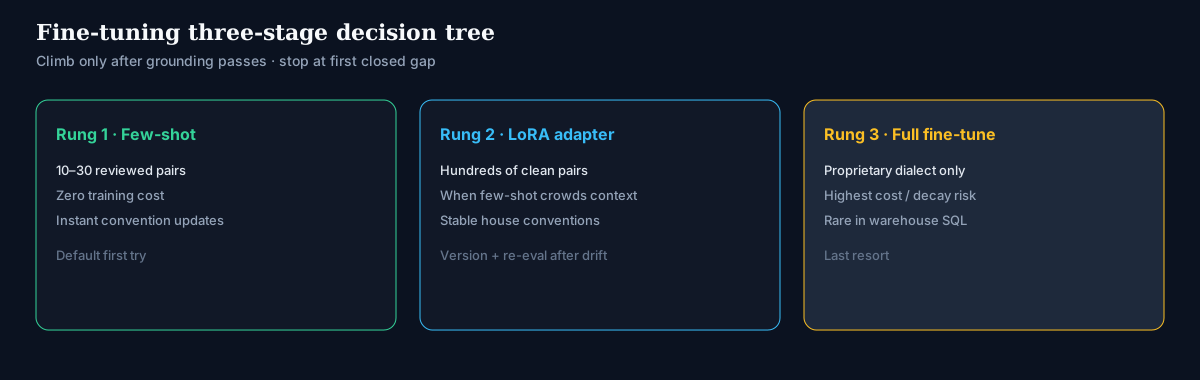 HowTo: few-shot → LoRA adapter → full fine-tune—stop at the first rung that closes the gap.
Rung 1 — few-shot from accepted queries. Curate 10–30 reviewed query pairs as dynamic examples. Fixes most house-style and dialect issues with zero training cost; updates instantly when conventions change.
Rung 2 — lightweight adapter (LoRA-style). When few-shot crowds the context window or the model must internalize a large, stable convention set, a parameter-efficient adapter captures it without retraining the base. Prefer a few hundred high-quality human-reviewed pairs over thousands of scraped ones.
Rung 3 — full fine-tune. Reserve for proprietary dialect or domain language the base model genuinely does not know. Most expensive to build and maintain; easiest to let decay.
Data quality dominates at every rung. A fine-tune trained on the old definition of “active customer” will reproduce the wrong answer confidently at scale. Gate every training set through the same reviewer process as production SQL, and re-evaluate against the private question set after each schema migration.
APAC rollouts should cross-check UK NCSC guidelines for secure AI system development.
Data and label strategy
Prioritize controlled retrieval, guarded execution, semantic alignment, and explicit review outputs. Store query versions, document assumptions, and present compact evidence summaries.
LLM-backed analytics should account for prompt-injection and data-exfiltration risks described in the Wikipedia data warehouse overview, especially when connectors expose production schemas. Access control should reference NIST SP 800-53. Control mapping should consult the NIST Computer Security Resource Center. Self-hosted deployments should align with Kubernetes documentation for isolation, secrets, and rollout safety.
InfiniSynapse Connection
Vendor-scoped. Skip if you only need the ladder and scorecard.
InfiniSynapse is positioned as a production-grade SQL agent, not a prompt-only NL2SQL layer. Five practical rules:
- Ground each request with current schema and metric context.
- Execute with fallback logic and explicit error classes.
- Validate results with semantic and statistical checks.
- Preserve end-to-end audit trails for reviewer sign-off.
- Distill reusable memory to improve next-run quality.
Try the online workspace at app.infinisynapse.com when you want generation, execution, and review on one timeline.
Guardrails for safe deployment
A practical path beats all-at-once launch:
- Days 1–30: define scope, boundaries, and success criteria.
- Days 31–60: side-by-side pilots with analyst baselines.
- Days 61–90: productionize high-value workflows and monitor drift.
Run a biweekly review where platform, analytics, and business owners inspect completed runs together. Shared visibility turns incidents into design improvements. Capture override reasons as short enums when possible so month-end reviews can spot clusters—wrong join, stale metric, dialect quirk—without reading free-text novels. Pair every production write path with a dry-run mode that logs proposed SQL without executing, useful for training new reviewers and for regression tests after a new adapter ships.
Signals fine-tuning was the right call
- Correctness at first pass on representative tasks
- Recovery quality after deliberate error injection
- Reviewer confidence in output lineage
- Rerun stability after schema or policy updates
- Net time saved versus analyst-only baseline
- Reduction in unresolved metric disputes
- Clarity of ownership during incidents
- Declining manual intervention over time
Common failure patterns
Preventable modes: demo-driven procurement, missing semantic definitions, weak change management, fragmented review ownership. Most are process gaps, not model gaps. Treat the capability as production infrastructure, not a chat accessory.
Another recurring failure is training-set contamination: analysts paste “accepted” queries that were never reconciled to finance definitions. The adapter then learns the wrong grain with high confidence. Gate every candidate pair with the same owner sign-off used for board packs, and retire pairs when the underlying metric contract changes. Without that hygiene, ladder climbs amplify debt.
Query cost monitors should alert when generated SQL creates sudden scan inflation after a model or prompt-policy change; see the Natural Language to SQL Guide.
Operating and debugging
A fine-tuned model decays: schemas evolve, conventions shift, training sets drift. Treat generative ai data services for fine tuning as a versioned dependency with its own review gate. Align reliability practices with ENISA AI cybersecurity guidance—error budgets, rollback paths, and blameless postmortems after a new fine-tune ships.
Share weekly accuracy, reviewer load, and schema-drift flags with platform owners. Frame governance with Elastic documentation. When agents orchestrate file transforms, keep steps inside one permission boundary per RFC 4180 CSV format.
Production debugging notes
When pilots stall at week three, the root cause is rarely the LLM. Checklist: schema drift, ambiguous metric names, stale statistics, missing join keys. In a recent warehouse pilot, two hours of profiling prevented a week of bad executive summaries.
Compare agent output to a human-reviewed baseline pack each sprint. Disagreements become regression tests. That practice aligns with FTC consumer protection guidance on trust through verification—not blind automation.
Dialect quirks matter. Document function translations in memory so date truncations are not silently rewritten. The Azure Architecture Center notes adoption can rise while trust lags; verification rituals close that gap. If a small schema change forces a full rebuild, orchestration—not the model—is the bottleneck.
Frequently Asked Questions
How do we evaluate a fine-tuned text-to-SQL model for production readiness?
Use repeatable scorecards across correctness, recovery, governance, and rerun consistency. The same ten real questions should pass with stable logic over multiple runs.
Why do prompt-only SQL demos fail later?
They hide assumptions and fail silently under schema changes. Evaluate with execution logs, reviewer sign-off, and post-incident learning loops.
Is benchmark rank enough to choose a platform?
No. Benchmarks are directional; outcomes depend on grounding, policy enforcement, and operational controls.
When should teams involve human reviewers?
For high-stakes reporting, regulated domains, and any workflow where business definitions are ambiguous or recently updated.
Why position InfiniSynapse as a SQL agent, not just a text-to-SQL app?
Production teams need workflow traceability: auditable execution paths, reusable memory, and safer recurring operations.
Which rung should we try first?
Start with few-shot from accepted queries. Climb to LoRA only if examples crowd context or conventions are large and stable. Reserve full fine-tune for proprietary dialect the base model does not know.
Conclusion
Model quality matters, but operating design matters more. With clear definitions, scorecards, and audit trails, teams can scale AI SQL safely. Climb the three-rung ladder only after grounding passes—and stop at the first rung that closes the gap.
For InfiniSynapse, the positioning remains explicit: production-grade SQL agent with inspectable workflows and reusable memory, contrasted with prompt-only approaches that struggle under recurring business pressure. When stakeholders ask whether to buy fine-tuning services, answer with the scorecard first—not with a training job.
Marker: DESK-TFT-20260807A.