Structured Data for AI Search: Extractable Is Not Markup
By William Zhu · Cofounder, InfiniSynapse · Last updated: 2026-09-10 · Last verified: 2026-09-10 · Methods: Compared extractable desk paragraphs with present JSON-LD on the same URLs. Citation in an answer is not markup. Not an official Google score. Observed CLI contract 2026-09-10 on
infinitegrowth@0.1.1:seo-health check --format jsoncan exit 0 whileissues[].statusiserror.
Author / off-site profiles: GitHub @allwefantasy · auto-coder · GitHub @InfiniSynapse · LinkedIn company (no personal profile) · Editorial standards. No personal LinkedIn or vendor badge. Product recognition: SEO Health Checker is one of two first-prize works in the InfiniSynapse × CSDN Vibe Coding contest (English recognition archive). InfiniSynapse co-hosted the contest. That list is not a review of this article.
Reviewed by: InfiniSynapse Data Team · method review 2026-09-10. First-party method review, not a third-party award.
Trust / COI: About · Corrections · Publishing principles · Privacy · Terms. SEO Health is commercial. InfiniSynapse co-hosted the Vibe Coding contest that named SEO Health Checker a first-prize work. The issues[] table below is observed. Topic desks stay illustrative. The InfiniSynapse Data Team publishes this desk method.
Table of Contents
- TL;DR
- What structured data for AI search is
- An extractable-versus-markup framework
- Citation versus a shipped type
- Landscape of answers and JSON-LD
- How to keep the two jobs apart
- Desk sample: prose versus markup
- Selection scorecard
- Failure modes that confuse a cite with a type
- Cluster guides for markup and answers
- Frequently Asked Questions
- Conclusion
TL;DR
Direct answer: **Structured data for AI search** is not the same job as an extractable paragraph. An answer engine can cite a page that shipped zero JSON-LD. A page can ship valid Article markup and never appear in an answer. Markup is a type list. Extraction is readable prose.
What you will learn: why structured data for AI search is not “we were cited, so schema worked”; how to keep extractable body and @type on two tickets; an illustrative prose × markup table; four steps that refuse to sell a quote as a parse.
Paste a public URL at aimeetup.center/seo-tools#check for the eight lights on that page. Those lights are not a Google 100. Structured data for AI search does not replace them.
We evaluate structured data for AI search hands-on as the InfiniSynapse Data Team. We build InfiniSynapse when a missing type needs a punch list, not when an answer cited a paragraph.
What structured data for AI search is
Key Definition: Structured data for AI search is the typed JSON-LD (or RDFa / Microdata) you ship so a machine can read an entity, plus the separate fact that an answer engine may extract prose whether or not that markup exists. It is not a citation score, not a rich-result ticket, and not proof that extractable text is a schema.
Observed page CLI (2026-09-10, infinitegrowth@0.1.1): seo-health check https://developers.google.com/search/docs/appearance/structured-data/sd-policies --format json --lang en exited 0. issues[].status listed Title Length (warning). Process exit 0 is not a clean page.
issues[].name | issues[].status |
|---|---|
| Title Length | warning |
| H1 Tag | good |
| URL | good |
| Robots.txt | good |
| Sitemap.xml | good |
| Image Alt Text | good |
| Meta Description | good |
| Page Structure | good |
The topic desk below stays illustrative.
Independent citation: According to [schema.org documents](https://schema.org/docs/documents.html), Schema.org defines a shared vocabulary for marking entities on a page. Schema.org's schema.org documents page is the third-party rule this write-up holds to. Illustrative desks below are not that rule.
People search structured data for AI search when a screenshot of a cited paragraph is waved as “our schema is working.” That screenshot is extraction. It is not a type list.
Knowledge extraction is pulling facts from text. Generative artificial intelligence is how some answer products write a new sentence from those facts. Stanford HAI’s AI Index tracks the industry, not your @graph. Google Cloud’s explainer on what artificial intelligence is is vocabulary, not a validator. The schema.org documents are the markup book. W3C RDF 1.1 concepts are how a typed graph is supposed to look. Structured data for AI search that cites the AI Index as a parse proof is citing the wrong shelf.
The hub for the type list is the schema markup audit. JSON-LD parse is local. Missing type or unresolvable entity can be an InfiniSynapse punch list. Structured data for AI search does not skip that parse because a chatbot quoted you.
Extractable is a body job
A paragraph a model can lift is a writing job: a clear claim, a named entity, a date, a URL a reviewer can open. A page that ships only that paragraph still has no @type until you add one.
Markup is a type job
A valid Article or Organization block is a parse job. A page that ships only that block still has nothing extractable if the body is empty or noindex. Read how to validate schema for local parse, then official tester. That order does not prove a citation.
An extractable-versus-markup framework
Keep prose and types on two rows. A single “AI ready” cell will hide an empty body behind valid JSON-LD.
| Object | What a reviewer can prove | What it cannot prove |
|---|---|---|
| Extractable paragraph | A human can quote the claim from the HTML | That JSON-LD exists |
| Shipped type | Local parse lists @type | That an answer will cite you |
| Official eligibility | Tester names a rich result | That an answer will cite you |
| Answer citation | A screenshot of a quote | That markup exists |
A matrix that puts “cited” under “has schema” is the category error this page exists to stop.
Two tickets, two owners
Prose belongs to the writer. Types belong to the template owner. Assigning both to “the AI person” will ship FAQPage on a page with no questions, or ship a perfect Article block on a two-sentence stub.
The Article-type sibling is Article schema SEO. Use it for dates and a named author. Do not use it as a citation tracker.
Eight lights still apply
A cited URL can still fail title, canonical, or speed. Run the SEO health checker on the URL in the screenshot. Framing the screenshot as a health pass is a slide.
Citation versus a shipped type
A citation is someone else’s sentence that points at you. A shipped type is your script tag. Treating those as one KPI will “fix schema” when the real gap was a vague H2.
Keep the two books on two shelves
If the job is “we need Organization markup,” parse it. If the job is “the body cannot be quoted,” rewrite the body. Structured data for AI search does not add more @graph nodes to thicken a thin paragraph.
Eligibility is a third book. Rich results eligibility is the official tester. A green tester is still not an answer cite. Structured data for AI search that pastes the tester into a citation retro is mixing Google’s rich result with a chatbot quote.
Landscape of answers and JSON-LD
The landscape is answer products that read HTML, crawlers that honor robots, and templates that ship JSON-LD. Collapsing those into “AI SEO” will sell a type as a mention.
Crawler access stays on the AI crawler access audit. If GPTBot cannot fetch, no amount of Article markup is a fetch. If GPTBot can fetch an empty body, no amount of access is extractable prose.
Query overlays stay in Search Console. Analyze Search Console with AI reads an export. That export is not an answer-citation ledger.
Where a cite is allowed to have no markup
A docs page with clear steps and no JSON-LD can still be quoted. That is extraction. Structured data for AI search should say “cited, markup absent” and decide whether a type is even the next ticket. Often the next ticket is still the body.
How to keep the two jobs apart
Run structured data for AI search as four inspectable steps when a screenshot lands in Slack.
Step 1 — Name the object in the screenshot
Is it a quoted paragraph, a rich result, or a type list? If it is a quote, you have extraction evidence. Structured data for AI search that files that screenshot as “schema works” has already failed the split.
Step 2 — Parse the URL locally
Extract JSON-LD on the machine. List types. Resolve the entity. If the block is missing, that is a markup gap whether or not you were cited. Structured data for AI search does not skip the parse because the quote felt like proof.
Step 3 — Read the body as a human
Can you lift the same claim from the HTML without the script tag? If no, the citation—if it exists—came from a title, an alt, or a different URL. Structured data for AI search that never opens the body will add FAQPage to a marketing hero.
Step 4 — Assign one gap
Missing type → punch list on the hub method. Thin body → rewrite. No fetch → access sibling. Official ineligible → eligibility sibling. Structured data for AI search that assigns “do AI” will reopen next week.
Re-paste the live URL at aimeetup.center/seo-tools#check after you ship either job.
Independent citation 2: According to [RDF 1.1 concepts](https://www.w3.org/TR/rdf11-concepts), this W3C document is an independent web-standards reference, not a ranking certificate. A second independent source, from W3C, keeps this page claim from resting only on first-party lights.
Desk sample: prose versus markup
The table below is illustrative. It is a first-party desk composite (DESK-IG1013-20260909A), not a customer win. Two dimensions: extractable prose × markup present. Structured data for AI search that reports only “AI cited us” will hide a page with zero types.
| URL role (illustrative) | Extractable body | Markup | Answer cite (desk) | Desk note |
|---|---|---|---|---|
| Docs | Yes | None | Cited | Extraction, not schema |
| Article | Yes | Article valid | Cited | Two jobs both present |
| Stub | No | Article valid | Not cited | Markup theater |
| FAQ landing | Thin | FAQPage | Not cited | Type without questions |
| Product | Yes | Product, dead SKU | Cited | Cite ≠ resolvable entity |
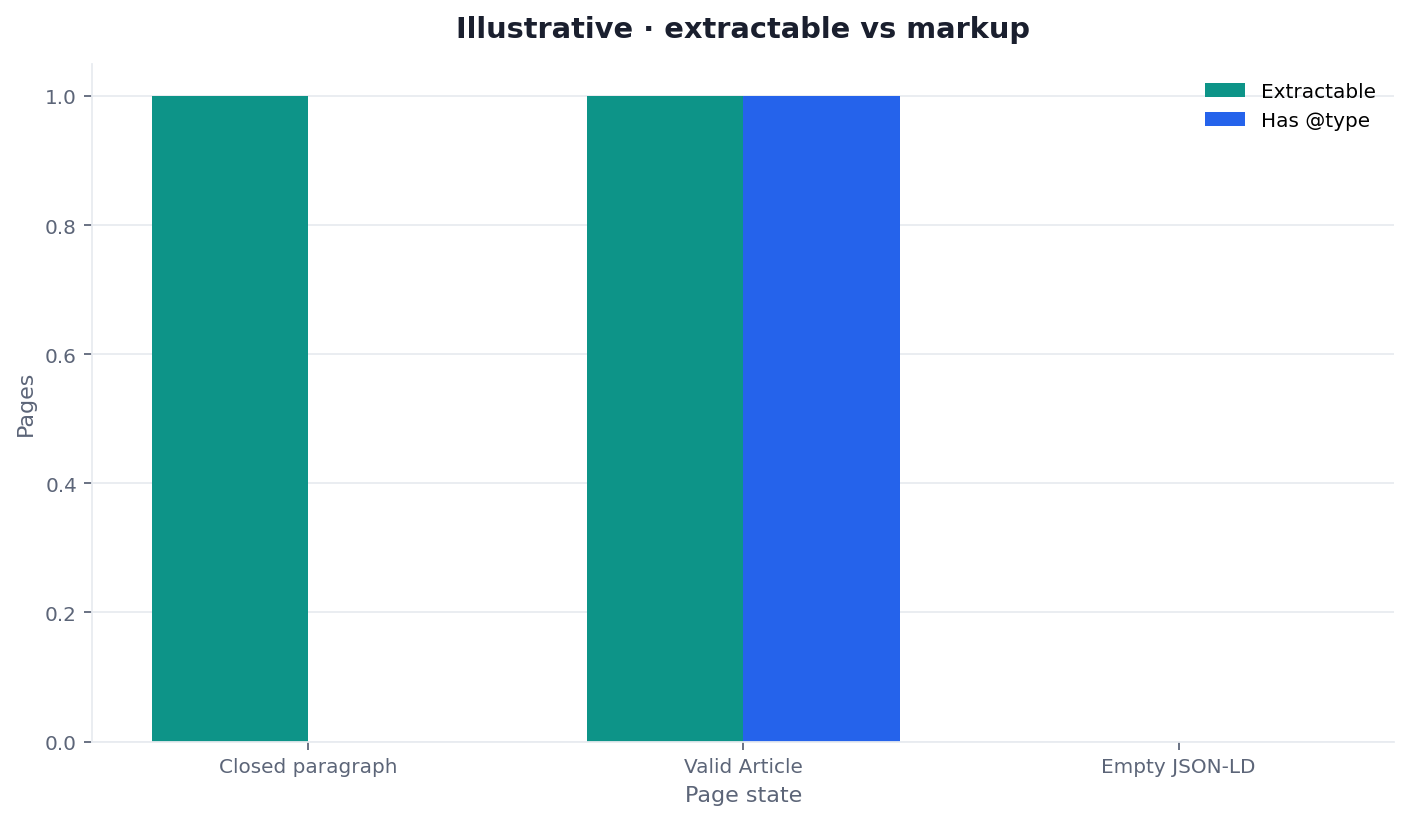
Two dimensions on the illustrative chart
The chart encodes the same two dimensions: extractable prose and markup present. Caption: illustrative / two dimensions. The structured data for AI search desk does not publish a citation rate. A cited row is not a type list. Social cut: ./images/og-cover.png.
Selection scorecard
Use this scorecard when someone asks for structured data for AI search today. Each row is inspectable. None of the rows is an official Google health score.
| Test | Pass | Fail |
|---|---|---|
| Object is named | Quote, type, or tester | “AI SEO” |
| Parse is local | Type list on the URL | Screenshot as parse |
| Body is readable | Claim lives in HTML | Empty body plus JSON-LD |
| Cite is not markup | Two tickets | “Cited, so schema works” |
| structured data for AI search scope | Extractable ≠ markup | Mention rank sold as @type |
A row that fails the last test is a tracking request. This page will not take it.
Failure modes that confuse a cite with a type
Most disappointment after structured data for AI search is a template change that did not cause the quote and a quote that did not prove the template.
Filing a schema ticket from a chatbot screenshot
The screenshot is extraction evidence. Open the URL. Parse. Then decide. Structured data for AI search that starts in the @graph will churn types that were never in the quote.
The second failure is adding FAQPage because “AI likes FAQs.” If the page has no questions, you shipped abuse risk without extractable answers.
The third failure is treating GPTBot Allow as structured data. Allow is fetch policy.
The fourth failure is calling extractable prose “implicit schema.” It is prose.
The fifth failure is an official-tester screenshot sold as an answer cite. Different book.
Parse the URL in the screenshot
Paste the public page, read the eight lights, then decide whether the gap is prose, a type, or a fetch.
Run SEO Health CheckerCluster guides for markup and answers
This page is the split between extractable prose and shipped types. Open one row when you have that job.
| Job you actually have | Guide to open next | What this page will not do |
|---|---|---|
| Type list and punch list | Schema markup audit (hub) | Retarget the hub as this Target |
| Local parse, then official tester | How to validate schema | Call a cite a validation |
| Dates and a named author | Article schema SEO | Track answer mentions there |
| Official tester as its own book | Rich results eligibility | Equate a star with a chatbot quote |
| Public UA fetch matrix | AI crawler access audit | Treat Allow as markup |
Keep structured data for AI search as extractable is not markup.
Frequently Asked Questions
If an answer cited us, do we have schema?
Bottom line: Not necessarily. Structured data for AI search treats a cite as extraction. Parse the URL before you celebrate a type.
If we ship Article JSON-LD, will AI cite us?
Bottom line: No promise. Structured data for AI search keeps markup and citation on two books. A valid type can sit on an unquoted stub.
Is extractable prose a kind of schema?
Bottom line: No. Prose is prose. Structured data for AI search reserves “schema” for a typed block you can parse.
Is this an official Google score?
Bottom line: No. Traffic lights are eight modules. Structured data for AI search is a job split. Neither object is an official Google health score.
Conclusion
Structured data for AI search earns trust when a citation screenshot and a type list stay on two tickets. Extractable is not markup. Markup is not a cite. Parse locally. Read the body. Assign one gap. Leave fetch to the access sibling. Leave eligibility to the official tester.
Keep the eight lights honest on the live URL. Open the InfiniSynapse web app only when a missing type or unresolvable entity needs that punch list written as a task. Until then, the useful sentence is extractable is not markup.