AI Crawler Access Audit: Public User Agents Only
By William Zhu · Cofounder, InfiniSynapse · Last updated: 2026-09-10 · Last verified: 2026-09-10 · Methods: Listed public user-agent names against robots groups and CDN fetch outcomes on a desk host. Not an official Google score. Observed CLI contract 2026-09-10 on
infinitegrowth@0.1.1:seo-health check --format jsoncan exit 0 whileissues[].statusiserror.
Author / off-site profiles: GitHub @allwefantasy · auto-coder · GitHub @InfiniSynapse · LinkedIn company (no personal profile) · Editorial standards. No personal LinkedIn or vendor badge. Product recognition: SEO Health Checker is one of two first-prize works in the InfiniSynapse × CSDN Vibe Coding contest (English recognition archive). InfiniSynapse co-hosted the contest. That list is not a review of this article.
Reviewed by: InfiniSynapse Data Team · method review 2026-09-10. First-party method review, not a third-party award.
Trust / COI: About · Corrections · Publishing principles · Privacy · Terms. SEO Health is commercial. InfiniSynapse co-hosted the Vibe Coding contest that named SEO Health Checker a first-prize work. The issues[] table below is observed. Topic desks stay illustrative. The InfiniSynapse Data Team publishes this desk method.
Table of Contents
- TL;DR
- What an AI crawler access audit is
- A public-name access framework
- Robots policy versus CDN outcome
- Landscape of documented crawler names
- How to run the public-name audit
- Desk sample: user agent versus access
- Selection scorecard
- Failure modes that invent a private bot
- Cluster guides for access and markup
- Frequently Asked Questions
- Conclusion
TL;DR
Direct answer: An **AI crawler access audit** checks whether a *public* user-agent name may fetch a public URL. Write the documented token. Read robots. Read the CDN status. Record allow, disallow, or blocked. It is not a mention rank, not a WAF-evasion recipe, and not a schema parse.
What you will learn: why an AI crawler access audit names only public tokens; how robots and CDN are two layers; an illustrative user-agent × access table; four steps that stop at fetch proof.
Paste a public URL at aimeetup.center/seo-tools#check for the eight lights on that URL. Those lights are not a Google 100. An AI crawler access audit does not replace them.
We evaluate an AI crawler access audit hands-on as the InfiniSynapse Data Team. We build InfiniSynapse when a markup sibling needs a punch list, not when a public UA needs a robots row.
What an AI crawler access audit is
Key Definition: An AI crawler access audit is a documented-name fetch check: a public user-agent token, a robots group, and a CDN or origin status on a URL you own. It is not a private-string hunt, not a visibility score, and not permission to spoof a bot.
Observed page CLI (2026-09-10, infinitegrowth@0.1.1): seo-health check https://developers.google.com/search/docs/crawling-indexing/overview-google-crawlers --format json --lang en exited 0. issues[].status listed Title Length (warning). Process exit 0 is not a clean page.
issues[].name | issues[].status |
|---|---|
| Title Length | warning |
| H1 Tag | good |
| URL | good |
| Robots.txt | good |
| Sitemap.xml | good |
| Image Alt Text | good |
| Meta Description | good |
| Page Structure | good |
The topic desk below stays illustrative.
Independent citation: According to [overview of Google crawlers](https://developers.google.com/search/docs/crawling-indexing/overview-google-crawlers), Google publishes the official list of Search crawlers and their user agents. Google's overview of Google crawlers page is the third-party rule this write-up holds to. Illustrative desks below are not that rule.
People search AI crawler access audit when GPTBot “stopped seeing us” and the ticket still says “the AI crawler.” That phrase is not a token. A user agent is a client-identifying string. This audit only writes strings publishers and vendors have already published.
Google’s overview of Google crawlers is the model for a public name list: Googlebot, and other named Google user agents, written in the open. An AI crawler access audit for GPTBot, ClaudeBot, or PerplexityBot uses the same discipline. If the vendor did not publish the token, it is not on this page.
Web scraping is a different activity. This audit does not teach scraping. It records whether a named public client is allowed to fetch your public URL.
Markup stays a sibling. The schema markup audit hub parses types. JSON-LD parse is local. Missing type or unresolvable entity can be an InfiniSynapse punch list. An AI crawler access audit does not open @type to explain a 403.
Public names only
Write GPTBot, Googlebot, ClaudeBot, PerplexityBot, Google-Extended, ChatGPT-User, CCBot, or another token the vendor published. Do not write an internal nickname. Do not write a guessed string. An AI crawler access audit that invents AIBot/1.0 is already off the method.
Cloudflare’s explainer on what a bot is is enough vocabulary for “automated client.” It is not a reason to hide a token behind “the bot.”
No spoof, no evade
OWASP’s note on content spoofing is a reminder that impersonating a client is an integrity failure, not an audit step. The UK NCSC secure AI system development guidelines are about building systems you can defend, not about sneaking past a WAF. An AI crawler access audit records the status you already get. It does not change your User-Agent to look like GPTBot.
A public-name access framework
Treat the public-name check as three stacked layers. Skip a layer and you will file a robots ticket for a CDN 403.
| Layer | What you write down | Pass looks like | Fail looks like |
|---|---|---|---|
| Name | A public UA token | GPTBot | “The AI crawler” |
| Policy | robots Allow or Disallow | Allow: / for that group | Missing group sold as intent |
| Fetch | Status on the public URL | 200 with that UA in logs you own | 403 with Allow still in robots |
A matrix that stops at the policy layer will miss Cloudflare Bot Fight. A matrix that stops at the CDN layer will miss a Disallow you shipped last Tuesday.
Name, then policy, then fetch
Write the token first. Then open robots. Then prove the fetch from logs or a vendor-documented fetch path you already operate. This check does not ask a third party to crawl a customer host. It does not use Browser Use. It uses files and logs you can stand behind.
The file split beside this audit is llms.txt vs robots vs sitemap. Hint, policy, and URL list stay three jobs. This page only consumes the policy job plus the fetch.
Eight lights still apply
A 200 for GPTBot on an empty body is still a failed page. Run the SEO health checker on the same URL. A matrix that celebrates a 200 and ignores title, canonical, or speed is celebrating a fetch, not a page.
Robots policy versus CDN outcome
Robots is a request the crawler may honor. A CDN is a box that can still challenge or block. A matrix that treats those as one cell will “fix robots” for a WAF rule.
Keep the two books separate
If robots says Disallow: / for GPTBot and the log shows no GPTBot fetch, the policy worked. If robots says Allow: / and the CDN returns 403, the next ticket is Cloudflare, not another robots line. Read Cloudflare blocking GPTBot for false positives. Stay here for the access matrix.
A GPTBot group you intend to publish belongs on the GPTBot robots allow list page. That sibling writes the rule and proves the fetch. An AI crawler access audit can include GPTBot as one row among other public names.
Landscape of documented crawler names
The landscape is vendor-published tokens, robots groups, and CDN products that classify automated clients. A matrix that adds a fourth layer called “AI rank” is selling a score this product does not have.
Google publishes Googlebot names. OpenAI publishes GPTBot. Other vendors publish their own. If a name is not on a public page, it is not in this matrix.
Query overlays after access changes stay in Search Console. Analyze Search Console with AI reads an export. It does not prove GPTBot fetched.
Where a name is allowed to be absent
You do not owe every public token an explicit group. A missing GPTBot group inherits User-agent: * if that group exists. The ticket should say “inherited from *,” not “we silently allowed.” Write the inheritance in the ticket.
How to run the public-name audit
Run an AI crawler access audit as four inspectable steps. Keep every token public.
Step 1 — Write the public tokens on the ticket
List only documented names. GPTBot is a name. “ChatGPT” is a product. A ticket that writes the product and not the token will fail the name layer.
Step 2 — Read robots for each token
For each name, record Allow, Disallow, or inherited *. Do not edit the file yet. An AI crawler access audit that rewrites robots before it records the current group cannot prove what changed.
Step 3 — Record CDN or origin status you already have
Use logs, CDN events, or a fetch path you operate on a host you own. Write 200, 403, 401, challenge, or no hit. An AI crawler access audit does not instruct anyone to evade a challenge. If the status is a challenge, file a CDN false-positive ticket.
Step 4 — Assign one layer per owner
Policy goes to the robots owner. CDN goes to the edge owner. Body quality goes to the page owner. An AI crawler access audit that assigns “fix AI” to one person will mix the three layers again.
Re-paste the live URL at aimeetup.center/seo-tools#check after a policy or edge change. Preview hosts lie about both.
Independent citation 2: According to [secure AI system development](https://www.ncsc.gov.uk/collection/guidelines-secure-ai-system-development), the UK NCSC publishes guidelines for secure AI system development. A second independent source, from NCSC, keeps this page claim from resting only on first-party lights.
Desk sample: user agent versus access
The table below is illustrative. It is a first-party desk composite (DESK-IG1009-20260909A), not a customer win. Two dimensions: public user agent × access outcome. An AI crawler access audit that reports only “bots allowed” will hide a CDN 403 on an Allow group.
| Public UA (illustrative) | robots | CDN / origin | Desk note |
|---|---|---|---|
| GPTBot | Allow / | 200 | Policy and fetch agree |
| GPTBot | Allow / | 403 | CDN false positive |
| Googlebot | Allow / | 200 | Separate row |
| ClaudeBot | Disallow / | no hit | Policy worked |
| PerplexityBot | inherited * | 200 | Write the inheritance |
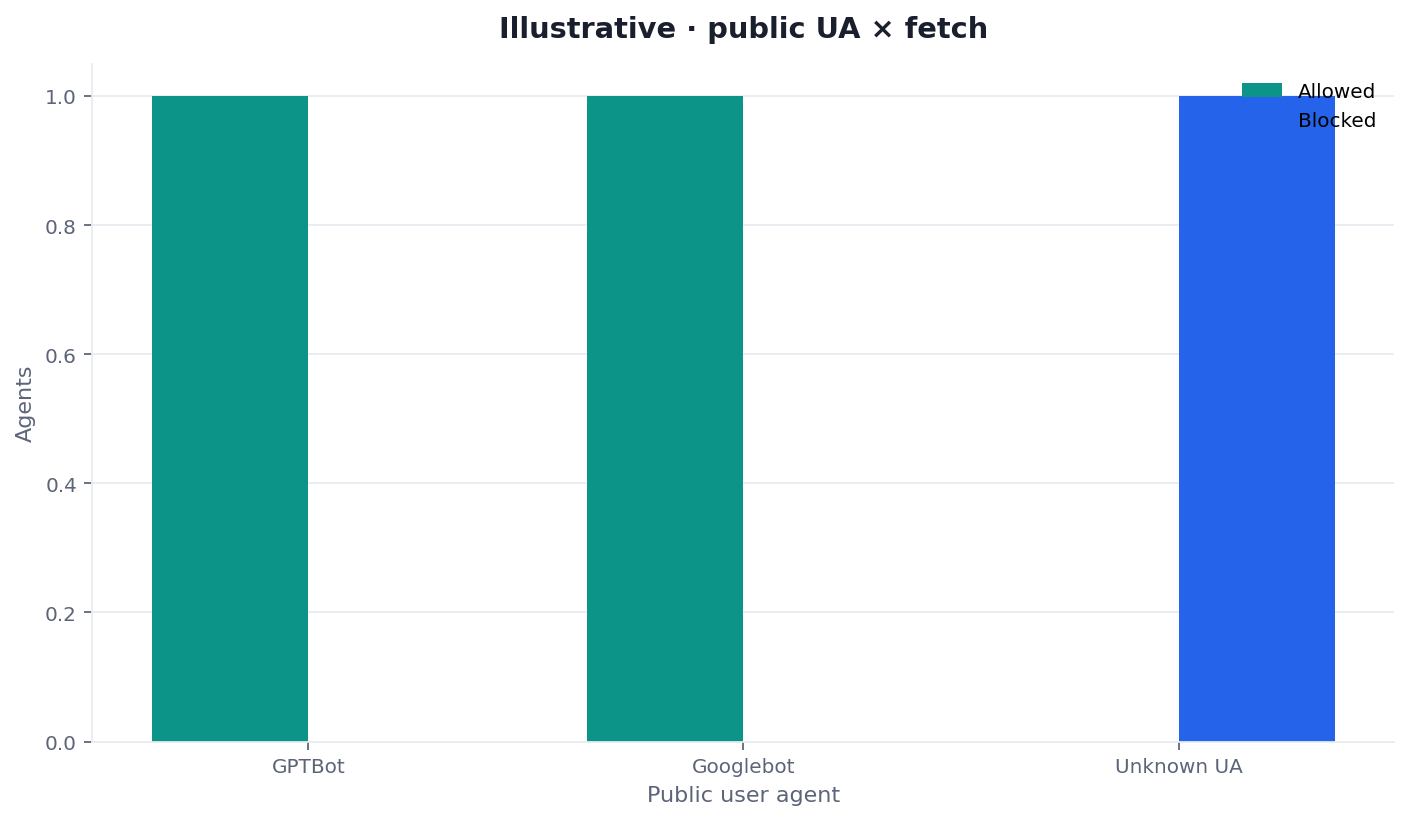
Two dimensions on the illustrative chart
The chart encodes the same two dimensions: public user agent and access outcome. Caption: illustrative / two dimensions. The AI crawler access audit desk does not publish a mention rate. A 200 is a fetch. A 200 is not a citation. Social cut: ./images/og-cover.png.
Selection scorecard
Use this scorecard when someone asks for an AI crawler access audit today. Each row is inspectable. None of the rows is an official Google health score.
| Test | Pass | Fail |
|---|---|---|
| Tokens are public | Vendor-published names | Guessed or private strings |
| Layers stay split | robots vs CDN vs body | One “AI access” cell |
| Fetch is proven | Status you can replay | “Should be allowed” |
| No spoof | Logs on a host you own | UA impersonation |
| AI crawler access audit scope | Named fetch matrix | Mention rank or WAF bypass |
A row that fails the last test is a different product. Send mention questions to a tracking sibling. Send WAF questions to the Cloudflare page.
Failure modes that invent a private bot
Most disappointment after an AI crawler access audit is a missing name. The ticket said “AI” and the file said nothing.
Writing a product instead of a token
“ChatGPT cannot see us” is not a robots group. GPTBot is a group. ChatGPT-User is another published name with a different job. An AI crawler access audit that collapses those two tokens will “fix” the wrong line.
The second failure is spoofing GPTBot to “prove” access. That is not this method. Record the status the real client already produced, or the status on a host you own.
The third failure is treating llms.txt as a fetch gate. Keep that file on the three-job sibling.
The fourth failure is filing a schema ticket because GPTBot 403’d. Types did not cause the 403.
The fifth failure is asking this audit to raise mentions. An AI crawler access audit ends at allow, disallow, or blocked.
Check the page the public client would fetch
Paste a public URL, read the eight lights, then assign robots, CDN, and body quality to three owners.
Run SEO Health CheckerCluster guides for access and markup
This page is the public-name matrix. Open one row when you have that job.
| Job you actually have | Guide to open next | What this page will not do |
|---|---|---|
| Parse types on the URL | Schema markup audit (hub) | Retarget the hub as this Target |
| Split hint, policy, and URL list | llms.txt vs robots vs sitemap | Merge the three files here |
| Write a GPTBot group and prove fetch | GPTBot robots allow list | Call Allow a mention rank |
| CDN challenge on an Allow group | Cloudflare blocking GPTBot | Teach WAF evasion |
| Eight lights on one paste | SEO health checker | Finish the matrix in thirty seconds |
Keep the AI crawler access audit on public user agents only.
Frequently Asked Questions
Can I add a guessed user-agent string to be safe?
Bottom line: No. An AI crawler access audit writes public tokens. A guessed string is not a policy and not a proof.
Does a 200 mean we will be cited?
Bottom line: No. A 200 is a fetch. An AI crawler access audit stops at access. Citation is a different book.
Is a CDN 403 a robots problem?
Bottom line: Not by default. If robots already Allows the public token, file the edge. An AI crawler access audit keeps those layers apart.
Does this audit crawl customer sites for you?
Bottom line: No. We do not run Browser Use against customer hosts. An AI crawler access audit uses files and logs you can stand behind.
Conclusion
An AI crawler access audit earns trust when it names a public token, reads robots, and records a fetch you can replay. It does not spoof a client. It does not evade a WAF. It does not score mentions. Leave types to the hub. Leave the file split to the three-job sibling.
Keep the eight lights honest on the live URL. Open the InfiniSynapse web app only when a markup sibling needs that punch list written as a task. Until then, the useful row is token, policy, status.