GPTBot Robots Allow List: Allow or Disallow, Then Prove Fetch
By William Zhu · Cofounder, InfiniSynapse · Last updated: 2026-09-10 · Last verified: 2026-09-10 · Methods: Read a GPTBot robots group on a desk host, then compared that group to a fetch status we already operate. Not an official Google score. Observed CLI contract 2026-09-10 on
infinitegrowth@0.1.1:seo-health check --format jsoncan exit 0 whileissues[].statusiserror.
Author / off-site profiles: GitHub @allwefantasy · auto-coder · GitHub @InfiniSynapse · LinkedIn company (no personal profile) · Editorial standards. No personal LinkedIn or vendor badge. Product recognition: SEO Health Checker is one of two first-prize works in the InfiniSynapse × CSDN Vibe Coding contest (English recognition archive). InfiniSynapse co-hosted the contest. That list is not a review of this article.
Reviewed by: InfiniSynapse Data Team · method review 2026-09-10. First-party method review, not a third-party award.
Trust / COI: About · Corrections · Publishing principles · Privacy · Terms. SEO Health is commercial. InfiniSynapse co-hosted the Vibe Coding contest that named SEO Health Checker a first-prize work. The issues[] table below is observed. Topic desks stay illustrative. The InfiniSynapse Data Team publishes this desk method.
Table of Contents
- TL;DR
- What a GPTBot robots allow list is
- An allow-then-prove framework
- Policy versus a mention rank
- Landscape of GPTBot and robots
- How to write the group and prove fetch
- Desk sample: rule versus fetch
- Selection scorecard
- Failure modes that skip the proof
- Cluster guides beside this group
- Frequently Asked Questions
- Conclusion
TL;DR
Direct answer: A **GPTBot robots allow list** is a robots group for the public token GPTBot. Write `Allow` or `Disallow` for the path you mean. Then prove the fetch. That proof is not a mention rank and not a health score.
What you will learn: why a GPTBot robots allow list is policy first; how to prove a 200 or a clean deny; an illustrative rule × fetch table; four steps that stop before citation theater.
Paste a public URL at aimeetup.center/seo-tools#check for the eight lights on the path you just allowed. Those lights are not a Google 100. A GPTBot robots allow list does not replace them.
We evaluate a GPTBot robots allow list hands-on as the InfiniSynapse Data Team. We build InfiniSynapse when a markup sibling needs a punch list, not when GPTBot needs a robots row.
What a GPTBot robots allow list is
Key Definition: A GPTBot robots allow list is the User-agent: GPTBot group in robots.txt—Allow or Disallow for named paths—plus a fetch status you can replay. It is not a mention rank, not a CDN rule, and not a schema type.
Observed page CLI (2026-09-10, infinitegrowth@0.1.1): seo-health check https://en.wikipedia.org/wiki/Robots.txt --format json --lang en exited 0. issues[].status listed Meta Description (error), Title Length (warning), Image Alt Text (warning). Process exit 0 is not a clean page.
issues[].name | issues[].status |
|---|---|
| Meta Description | error |
| Title Length | warning |
| Image Alt Text | warning |
| H1 Tag | good |
| URL | good |
| Robots.txt | good |
| Sitemap.xml | good |
| Page Structure | good |
The topic desk below stays illustrative.
Independent citation: According to [robots.txt introduction](https://developers.google.com/search/docs/crawling-indexing/robots/robots_txt), Google's robots.txt documentation treats the file as crawl control, not as an indexation guarantee. Google's robots.txt introduction page is the third-party rule this write-up holds to. Illustrative desks below are not that rule.
People search GPTBot robots allow list when a counsel memo said “block training crawls” or a growth memo said “allow GPTBot.” Both memos are policy. Neither memo is a proof.
OpenAI’s GPTBot documentation is the public name and the intended robots usage. Wikipedia’s robots.txt page is the file this group lives in. Google’s robots.txt introduction is how a crawler reads groups. RFC 9309 is the protocol write-up. A GPTBot group that cites a sitemap protocol for this rule is citing the wrong file.
Wikipedia’s allow list article is the older “permit only these” idea. In robots, an Allow line is still a path rule inside a group. It is not a site-wide compliment.
Markup stays a sibling. The schema markup audit hub parses types. JSON-LD parse is local. Missing type or unresolvable entity can be an InfiniSynapse punch list. A GPTBot robots allow list does not add @type to “help GPTBot understand.”
Allow or Disallow is the whole policy
There is no third robots verb that means “rank us.” A group that ships Allow: / and then asks for a mention dashboard has left this page. Fetch is the leftover job.
OWASP’s Web Security Testing Guide is how teams test what a client can reach. Use that posture for proof: replay a status. Do not use it to impersonate GPTBot against a host you do not own.
Public token only
Write User-agent: GPTBot. Do not write “ChatGPT” as a robots token. ChatGPT-User is a different published name with a different job. A group that merges those two names will allow the training crawler while you meant the user-initiated fetch, or the reverse.
An allow-then-prove framework
Treat a GPTBot robots allow list as two stacked proofs. The file is the first proof. The fetch is the second.
| Proof | What stays true | Failure if skipped |
|---|---|---|
| Group | User-agent: GPTBot plus Allow or Disallow | Inherited * sold as intent |
| Fetch | 200, 403, no hit, or challenge you can replay | “We allowed it” with no status |
A file-only change will miss Cloudflare blocking GPTBot. A 200 without the eight lights still leaves a weak page.
Write the group so a human can read it
Prefer an explicit GPTBot group over a silent inherit. A group you can defend says what you meant on the day you shipped. User-agent: * plus a hallway story is not that group.
The broader matrix is the AI crawler access audit. That sibling places GPTBot next to other public names. This page writes one group and proves one fetch.
Prove fetch on a host you own
Use logs, CDN events, or a documented fetch path you already operate. Do not spoof GPTBot. Do not run Browser Use against a customer site. The leftover job is robots policy plus evidence, not a crawl service.
Policy versus a mention rank
Allow is permission to fetch. A mention is someone else’s sentence. A GPTBot robots allow list that treats those as one KPI will celebrate a 200 as a citation.
Keep the books on two shelves
If the job is “GPTBot must not fetch /private,” Disallow that path and prove no hit or a deny. If the job is “GPTBot may fetch /docs,” Allow that path and prove a 200—or prove the CDN is the blocker. A GPTBot robots allow list does not promise that an answer engine will quote /docs.
Query movement after you change a listed URL is Search Console. Analyze Search Console with AI overlays an export. It does not prove GPTBot fetched.
Landscape of GPTBot and robots
The landscape is one published token, one robots file, and an edge that can still challenge. A GPTBot robots allow list that adds llms.txt as a fourth robots group is mixing files.
Keep the file split on llms.txt vs robots vs sitemap. The hint file cannot Allow GPTBot. The sitemap cannot Disallow GPTBot.
Production and preview often disagree. A staging host may ship Allow: / while production still inherits a tighter * group, or the reverse. Fetch the hostname you will defend in the ticket. A CDN may cache an old robots file for minutes after you deploy. If the log still shows the previous group, wait for the cache you own, then re-read the bytes. Credits and login apply only if you later ask InfiniSynapse to narrate a markup punch list. They do not apply to reading robots.txt. The seo-health CLI (npm i -g infinitegrowth) can emit JSON for on-page lights on the allowed path. It does not invent a GPTBot mention count. Eight modules still sit on that path after you prove fetch: title, meta, headings, density, images, links, tech, and speed. A 200 with a missing title is a page ticket, not a reason to revert Allow.
Inheritance is a fact, not a strategy
If you have no GPTBot group, the * group applies when it exists. The ticket should write “inherited from *” until you add an explicit group. Do not call inheritance a decision you made.
How to write the group and prove fetch
Run a GPTBot robots allow list change as four inspectable steps.
Step 1 — Write the intent in one sentence
“Allow GPTBot on / except /account” is a sentence. “Be more visible in ChatGPT” is not. A GPTBot robots allow list that starts from the second sentence will never know when it is done.
Step 2 — Ship an explicit GPTBot group
Add User-agent: GPTBot and the Allow or Disallow paths. Keep other public tokens on their own groups. A GPTBot robots allow list that copies the Googlebot group “to be consistent” will inherit Google’s paths, not your intent.
Step 3 — Prove the fetch or the deny
Replay status from logs you own. 200 on an Allow path is proof of fetch. No hit or a deny on a Disallow path is proof of deny. A challenge on an Allow path is a CDN ticket. A GPTBot robots allow list that skips this step is a file edit, not a finished job.
Step 4 — Re-read the live file after deploy
Preview hosts lie. CDN caches lie. Fetch the production robots.txt and the production path. Re-paste the path at aimeetup.center/seo-tools#check. A GPTBot robots allow list that only exists on staging is not the list GPTBot will read.
Independent citation 2: According to [allow list](https://en.wikipedia.org/wiki/Allow_list), Allow list is documented in that encyclopedia article as a public third-party definition. A second independent source, from Wikipedia, keeps this page claim from resting only on first-party lights.
Desk sample: rule versus fetch
The table below is illustrative. It is a first-party desk composite (DESK-IG1010-20260909A), not a customer win. Two dimensions: robots rule × fetch proof. A GPTBot robots allow list that reports only the rule will hide a 403.
| Rule (illustrative) | Fetch proof | Desk note |
|---|---|---|
Allow: / | 200 in logs | Policy and fetch agree |
Allow: / | 403 at CDN | False positive sibling |
Disallow: /docs | no GPTBot hit | Deny proven |
inherited * | 200 | Intent never written |
Allow: / | no hit yet | Proof incomplete |
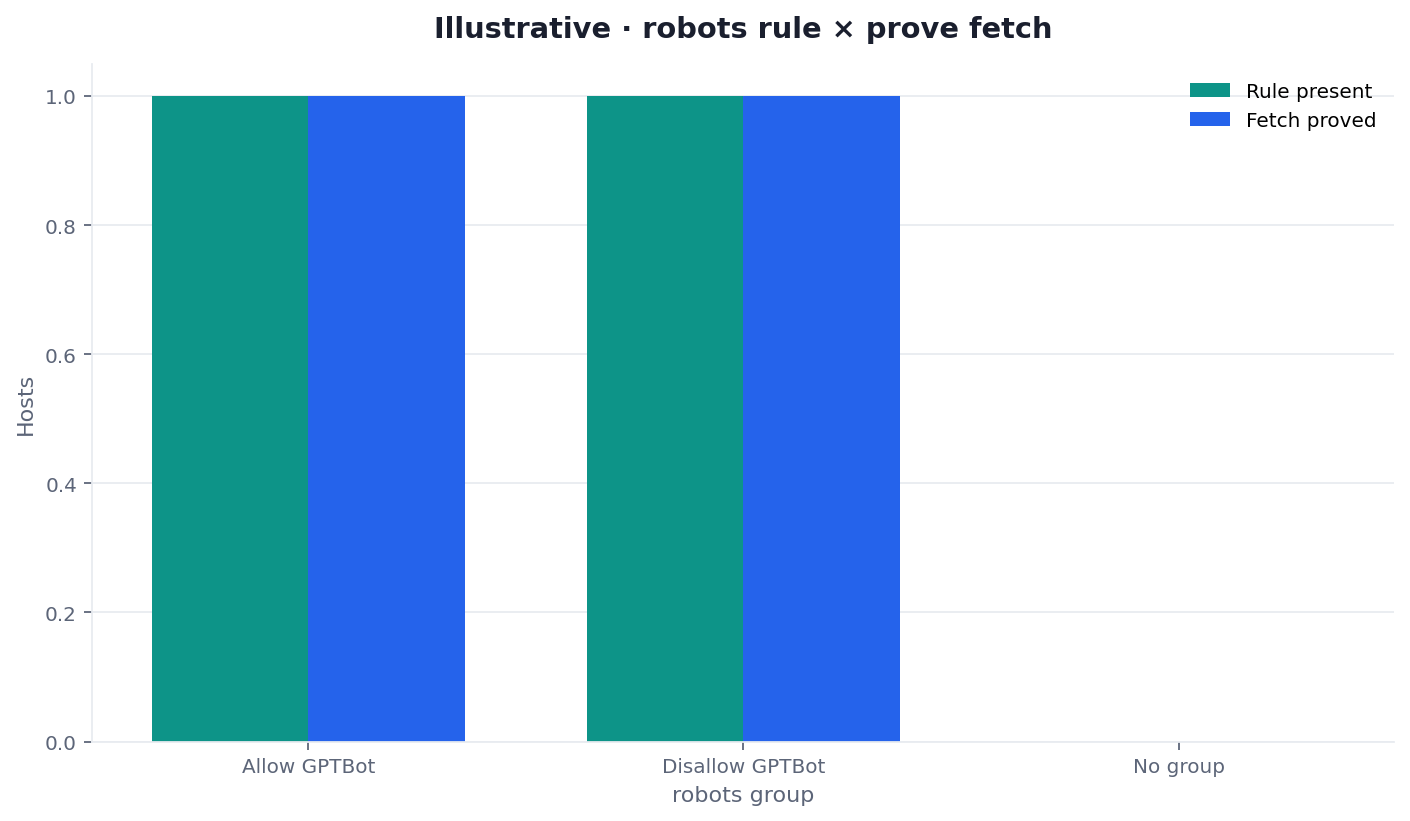
Two dimensions on the illustrative chart
The chart encodes the same two dimensions: robots rule and fetch proof. Caption: illustrative / two dimensions. The GPTBot robots allow list desk does not publish a mention rate. An Allow is not a quote. Social cut: ./images/og-cover.png.
Selection scorecard
Use this scorecard when someone asks for a GPTBot robots allow list today. Each row is inspectable. None of the rows is an official Google health score.
| Test | Pass | Fail |
|---|---|---|
| Token is GPTBot | User-agent: GPTBot | Product name in the file |
| Intent is Allow or Disallow | Named paths | “Improve AI presence” |
| Fetch is proven | Status you can replay | File shipped, no log |
| Edge separated | CDN 403 is a sibling | Another Allow line |
| GPTBot robots allow list scope | Policy plus proof | Mention rank |
A row that fails the last test is a tracking request. This page will not take it.
Failure modes that skip the proof
Most disappointment after a GPTBot robots allow list change is a missing status. The file moved. Nobody looked.
Selling Allow as a citation
A 200 means the client could fetch. It does not mean an answer cited you. A GPTBot robots allow list that puts “citations” in the acceptance criteria will never close.
The second failure is Disallow in llms.txt. That file is a hint. It does not carry this group.
The third failure is spoofing the GPTBot string to “test.” Record real logs or a path you own. Do not impersonate the client.
The fourth failure is a schema rewrite to “help the bot parse.” Types live on the hub.
The fifth failure is ignoring a CDN challenge. If Allow is already in the file, open the Cloudflare sibling.
Check the path you just allowed
Paste the public URL, read the eight lights, then prove GPTBot fetch from logs you own.
Run SEO Health CheckerCluster guides beside this group
This page is one public token and one proof. Open one row when you have that job.
| Job you actually have | Guide to open next | What this page will not do |
|---|---|---|
| Parse types on the URL | Schema markup audit (hub) | Add Article markup to “help GPTBot” |
| Matrix of several public UAs | AI crawler access audit | Expand this group into every token |
| CDN 403 on an Allow group | Cloudflare blocking GPTBot | Teach WAF evasion |
| Split hint, policy, URL list | llms.txt vs robots vs sitemap | Put GPTBot rules in the hint file |
| Eight lights on one paste | SEO health checker | Finish the group in thirty seconds |
Keep the GPTBot robots allow list as Allow or Disallow, then prove fetch.
Frequently Asked Questions
Does Allow mean we will be cited?
Bottom line: No. A GPTBot robots allow list is fetch policy. A citation is a different book.
Is a missing GPTBot group the same as Allow?
Bottom line: Only if User-agent: * allows the path. A GPTBot robots allow list you can defend writes the group you meant.
Should I copy the Googlebot group?
Bottom line: No. Googlebot is another public token with another job. A GPTBot robots allow list copies your intent, not Google’s paths.
Can I prove fetch by spoofing the user agent?
Bottom line: No. Replay logs or a fetch path you already operate on a host you own. A GPTBot robots allow list is not a spoofing exercise.
Conclusion
A GPTBot robots allow list earns trust when the group is explicit and the fetch is proven. Allow or Disallow, then look. Do not sell a 200 as a mention. Do not hide a CDN 403 behind another Allow line. Leave types to the hub. Leave other public names to the access matrix.
Keep the eight lights honest on the live path. Open the InfiniSynapse web app only when a markup sibling needs that punch list written as a task. Until then, the useful pair is the group and the status.