 InfiniSynapse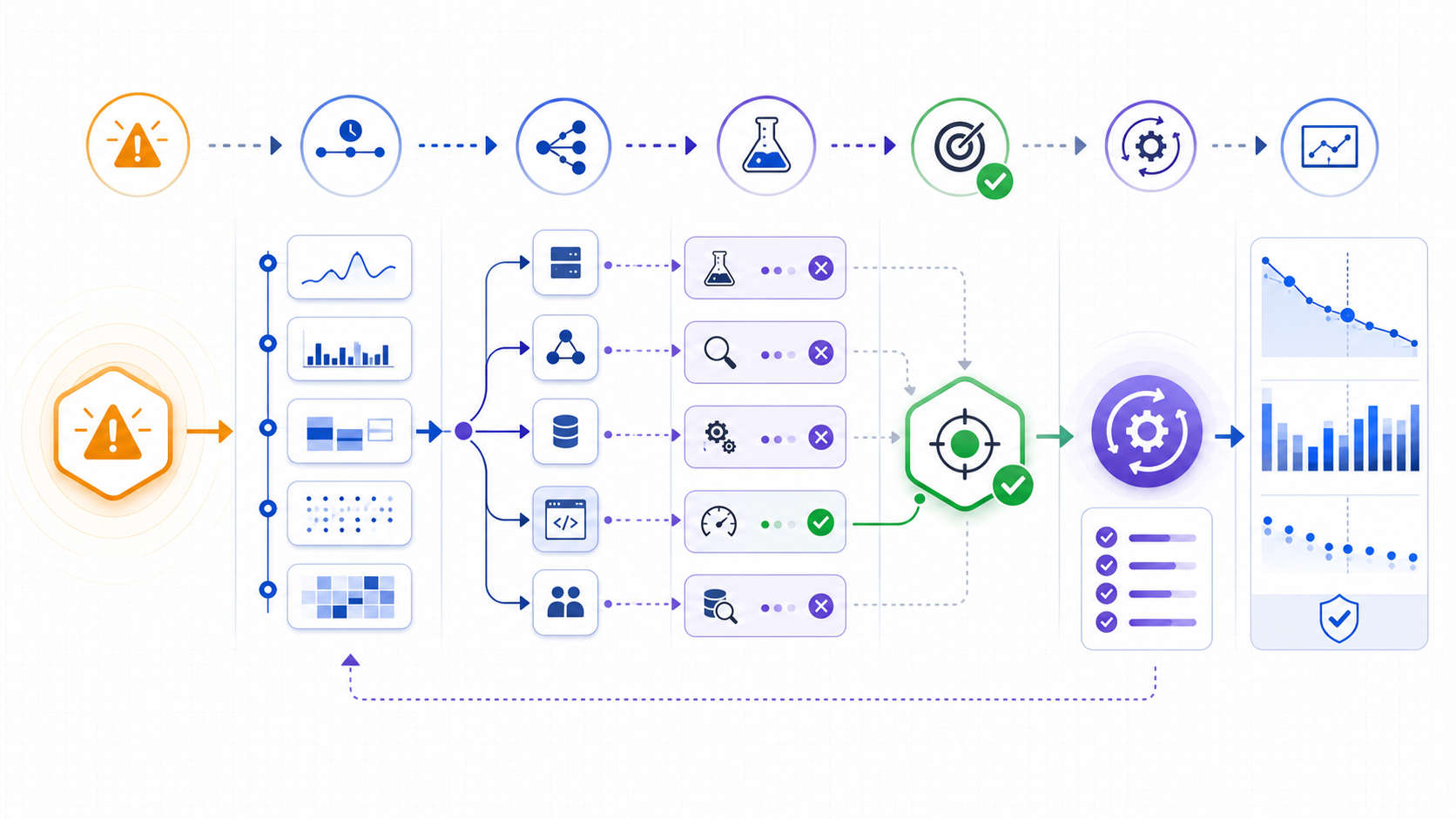
Root cause identification: the quick answer根因识别:快速回答
For the full topic map and the neighboring methods that support this workflow, continue with the anomaly detection and root cause analysis guide.
如需查看完整主题结构以及支撑本流程的相邻方法,请继续阅读异常检测与根因分析指南。
To identify a root cause, define the failure precisely, reconstruct what changed, generate more than one causal explanation, and test every link against evidence. Accept a cause only when it explains the timing, scope, and mechanism better than alternatives—and when controlling it produces a measurable change.
识别根因时,应精确定义故障、重建变化过程、提出多个因果解释,并用证据检验每一条链路。只有当某个原因比替代解释更好地说明时间、范围和机制,而且控制该原因能产生可测变化时,才应接受它。
A symptom describes what you observed. A trigger starts an event. A contributing condition increases likelihood or severity. A root cause is an underlying factor whose removal or control materially reduces recurrence. Real systems can have several root causes, and “human error” is usually a stopping point that still requires examination of training, interface, workload, controls, and process design.
症状描述观察到了什么;触发因素启动事件;促成条件增加发生概率或严重程度;根因是移除或控制后能实质降低复发风险的底层因素。真实系统可能存在多个根因;“人为错误”通常只是尚需继续调查的停点,还要检查培训、界面、工作负荷、控制和流程设计。
Identification is not the whole analysis识别不是整次分析
Root cause identification names the cause and tests it. The fix, the lessons, and the check that it does not return belong to the rest of root cause analysis. Five Whys and a fishbone diagram are methods for this naming stage. They are not the whole investigation. When the event is a failed component, continue with root cause failure analysis so the preserved evidence and the mechanism are on the record.
根因识别只负责点名并检验原因。纠正措施、教训,以及确认问题不再回来,属于 根因分析的其余部分。5 Why 和鱼骨图用在点名这一步,不是整次调查。事件是一个失效零件时,继续做 根本原因故障分析,把已保护的证据和失效机制写进记录。
When root cause identification is useful—and when it is not何时适合根因识别,何时不适合
Investigate repeated defects, incidents, outages, safety events, audit findings, quality escapes, or anomalies where the remedy must be durable and accountable.
适用于重复缺陷、事故、停机、安全事件、审计发现、质量漏检,或需要持久且可问责修复的异常。
Protect people, data, customers, and equipment first. RCA supports prevention after stabilization; it does not replace emergency response, specialist diagnosis, or regulatory reporting.
应先保护人员、数据、客户和设备。RCA 在局势稳定后支持预防,不能替代应急响应、专业诊断或监管报告。
For a one-off, low-impact issue with an obvious verified fix, a full investigation may cost more than it returns. Use proportional depth: the greater the consequence, uncertainty, or recurrence, the stronger the evidence and independent review should be.
对于一次性、低影响且修复已明确验证的问题,完整调查的成本可能高于收益。调查深度应与风险成比例:后果、未知程度或复发性越高,证据强度和独立复核要求越高。
Prepare the evidence before identifying a cause识别原因前先准备证据
Start with a factual problem statement: object or process, expected state, observed deviation, location, first and last known time, scale, consequence, and how the event was detected. Freeze volatile evidence where permitted. Record data provenance, timestamps, time zones, units, missingness, transformations, and access limitations.
先写出事实性问题陈述:对象或流程、预期状态、观察偏差、位置、首次与最后已知时间、规模、后果及发现方式。在允许范围内保存易失证据,并记录数据来源、时间戳、时区、单位、缺失情况、转换过程与访问限制。
- Build a common timeline from logs, metrics, tickets, work orders, deployments, configuration changes, interviews, images, and documents.用日志、指标、工单、维护记录、部署、配置变更、访谈、图片和文档建立统一时间线。
- Compare affected and unaffected cases, earlier normal periods, and the same process under different conditions.比较受影响与未受影响案例、此前正常时段,以及不同条件下的同一流程。
- Separate observed facts from interpretations. Keep source links and confidence notes beside every claim.区分观察事实与解释;每项主张旁保留来源链接和置信说明。
A repeatable root cause identification process可重复执行的根因识别流程
- Contain and define控制并定义问题Stabilize the situation, define investigation boundaries, and avoid embedding an assumed cause in the problem statement.稳定局势、确定调查边界,避免在问题陈述中预设原因。
- Reconstruct the sequence重建事件顺序Align evidence on one timeline and mark gaps, contradictory timestamps, and changes before the event.把证据对齐到同一时间线,标记缺口、冲突时间戳和事件前变化。
- Generate competing hypotheses提出竞争性假设Use process mapping, fishbone categories, change analysis, fault trees, or 5 Whys to expand candidates without treating brainstorms as findings.用流程图、鱼骨分类、变更分析、故障树或五问法扩展候选项,但不要把头脑风暴当结论。
- Test causal links检验因果链路Ask what each hypothesis predicts, what would falsify it, and whether affected and unaffected cases differ as expected.明确每个假设的预测、可推翻它的证据,以及受影响与未受影响案例是否按预期不同。
- Verify and act验证并行动Select the explanation best supported by the full evidence, design a control tied to it, and measure both side effects and recurrence.选择最符合完整证据的解释,设计与其直接关联的控制措施,并衡量副作用与复发。
Choose an identification method by problem shape按问题形态选择识别方法
| Method方法 | Best fit适合场景 | Main limitation主要局限 |
|---|---|---|
| 5 Whys | A narrow, traceable causal chain狭窄且可追踪的因果链 | Can follow facilitator bias or stop at a symptom可能跟随主持人偏见或停在症状层 |
| fishbone diagram鱼骨图 | Broad hypothesis generation across categories跨类别广泛提出假设 | Branches are ideas until evidence tests them分支在证据检验前只是想法 |
| Change analysis变更分析 | A failure begins after a known transition故障始于已知变更之后 | Coincident changes can be mistaken for causes同期变化可能被误认作原因 |
| Fault tree故障树 | Interacting conditions and AND/OR logic交互条件与 AND/OR 逻辑 | Depends on completeness and valid assumptions依赖完整性与有效假设 |
| Controlled comparison受控比较 | A safe intervention or natural comparison exists存在安全干预或自然对照 | Confounding and operational risk need control需要控制混杂与操作风险 |
Example: identify the root cause of a recurring data failure示例:识别重复数据故障的根因
Consider a hypothetical daily report that begins showing duplicate orders after a weekend release. The symptom is an inflated order count; “the release” is only a temporal clue. The team compares affected and unaffected regions, reconstructs deployment and ingestion times, and finds that only records retried after a timeout are duplicated. Logs show the retry creates a new request identifier, so the destination cannot recognize an earlier successful write.
假设某日报在周末发布后开始出现重复订单。症状是订单数虚高;“这次发布”只是时间线索。团队比较受影响与未受影响区域,重建部署和摄取时间,发现只有超时后重试的记录重复。日志显示重试会创建新的请求标识,因此目标系统无法识别此前已成功写入的记录。
The candidate cause is not merely “timeout” because timeouts existed before without duplication. The test replays a safe fixture in staging with the old and new identifier behavior. Duplicates appear only when retry identifiers change. A corrective action preserves an idempotency key across retries; the team then monitors duplicate rate, retry volume, write failures, and latency. All figures and system details here are illustrative, not an InfiniSynapse customer case.
候选原因不只是“超时”,因为此前也有超时却未重复。团队在测试环境用安全样本分别重放旧版和新版标识逻辑;仅当重试标识改变时才出现重复。纠正措施是在重试之间保留幂等键,随后监控重复率、重试量、写入失败与延迟。这里的数字和系统细节仅为说明,并非 InfiniSynapse 客户案例。
How to verify a root cause before closing the investigation结案前如何验证根因
A plausible story is not enough. Write a cause statement that links condition, mechanism, and observed outcome. Then test whether it explains when the event started, where it occurred, which cases escaped, and why controls failed. Check alternative explanations using evidence not originally chosen to support the preferred hypothesis.
看似合理的故事还不够。原因陈述应连接条件、机制和观察结果;再检验它是否解释事件何时开始、在哪里发生、哪些案例未受影响,以及控制为何失效。还要使用并非为支持偏好假设而挑选的证据检查替代解释。
Verification rule: define the observation that would make the team reject the cause. Where intervention is safe, control the candidate cause and observe whether the predicted outcome changes. Where intervention is unsafe, use converging evidence, natural comparisons, simulations, specialist review, or prospective monitoring.
验证规则:预先定义什么观察结果会让团队否决该原因。若干预安全,可控制候选原因并观察结果是否按预测改变;若不安全,则使用相互印证的证据、自然对照、模拟、专家复核或前瞻监测。
Naming a controllable system cause is the system-level root cause capabilities a safety review has to show, especially when the event is a patient-safety case.
指出一个可控的系统原因,就是安全复核必须展示的系统层根因能力,患者安全案件尤其如此。
Common root cause identification mistakes根因识别的常见错误
- Stopping at the first answer: “operator error,” “bad data,” and “software bug” name categories, not verified mechanisms.停在第一个答案:“操作员错误”“坏数据”和“软件缺陷”只是类别,不是已验证机制。
- Confusing correlation with cause: a factor may move with the outcome because both share another driver.把相关性当因果:某因素可能因共同驱动项而与结果同步变化。
- Using only confirming evidence: require competing hypotheses and explicit falsification criteria.只使用确认性证据:必须保留竞争假设并明确反证条件。
- Ignoring detection and control failures: ask both why the event occurred and why safeguards did not prevent or reveal it sooner.忽略检测与控制失效:既要问事件为何发生,也要问保障措施为何未能预防或更早发现。
- Closing on implementation: completion of an action is not proof of effectiveness; measure recurrence and unintended effects.实施后立即结案:措施完成不等于有效,必须衡量复发和非预期影响。
Investigate candidate causes with connected evidence用关联证据调查候选原因
Before opening the workspace, prepare a factual problem statement, stable record IDs, normalized timestamps, relevant metrics, logs, database tables, documents, change records, and access permissions. InfiniSynapse supports AI-assisted joint analysis across connected databases, files, documents, audio, and video. Use it to retrieve and compare prepared evidence, summarize timelines, and explore hypotheses; do not treat generated explanations or correlations as proof of causation.
打开工作区前,请准备事实性问题陈述、稳定记录 ID、规范化时间戳、相关指标、日志、数据库表、文档、变更记录和访问权限。InfiniSynapse 支持跨已连接数据库、文件、文档、音频与视频的 AI 辅助联合分析,可用于检索和比较已准备证据、汇总时间线并探索假设;不得把生成解释或相关性当作因果证明。
Open InfiniSynapse for connected evidence analysis打开 InfiniSynapse 进行关联证据分析Best practices and next steps最佳实践与下一步
Assign an investigation owner, preserve a versioned evidence register, and distinguish hypotheses, tests, findings, corrective actions, and verification records. Use blame-free language that focuses on system conditions. Reopen the investigation when recurrence, new evidence, or unintended effects contradict the accepted explanation.
指定调查负责人,保留带版本的证据登记表,并区分假设、检验、结论、纠正措施与验证记录。使用关注系统条件而非责备个人的语言。当复发、新证据或非预期影响与既有解释矛盾时,应重新开启调查。
For adjacent workflows, compare the InfiniSynapse tool catalog and review the product documentation. The planned companion guides on RCA techniques, methodology, and software cover method selection and tool governance; their deployment must be confirmed before production cross-linking.
对于相邻工作流,可查看 InfiniSynapse 工具目录和产品文档。计划中的 RCA 技术、方法论和软件配套指南将覆盖方法选择与工具治理;生产环境交叉链接前必须确认这些页面已部署。
Frequently asked questions about root cause identification根因识别常见问题
What is root cause identification?什么是根因识别?
Root cause identification names the controllable cause, not the symptom. Test more than one explanation before you close the case. It is the naming stage of root cause analysis, not the whole investigation.
根因识别点名可控制的原因,而不是症状。结案前要检验不止一个解释。它是根因分析里的点名阶段,不是整次调查。
How do you identify the root cause of a problem?如何识别问题的根因?
Define the event precisely, build a timeline, collect evidence, generate competing explanations, test each causal link, and verify that controlling the selected cause changes the outcome.
精确定义事件、建立时间线、收集证据、提出竞争解释、检验每条因果链,并验证控制所选原因后结果确实改变。
How do you know a root cause is correct?如何知道根因是否正确?
A credible root cause explains the timing, scope, and mechanism, fits the evidence better than alternatives, predicts observations, and leads to a corrective action whose effect can be measured.
可信根因应解释时间、范围和机制,比替代解释更符合证据,能够预测观察结果,并导向效果可测的纠正措施。
Can a problem have multiple root causes?一个问题能有多个根因吗?
Yes. Complex events can involve a trigger, enabling conditions, failed controls, and detection gaps. Record each causal role instead of forcing one label to explain everything.
可以。复杂事件可能同时包含触发因素、促成条件、控制失效与检测缺口;应分别记录其因果角色,而不是强迫一个标签解释一切。
Is 5 Whys enough for root cause identification?五问法足以完成根因识别吗?
Not always. It is useful for a narrow chain, but complex, high-risk, or weakly observed problems need broader hypothesis generation, stronger evidence, and tests against competing explanations.
不一定。五问法适合狭窄因果链,但复杂、高风险或可观测性弱的问题需要更广泛的假设、更强证据,以及与竞争解释的对照检验。
Use a root cause identification format that supports review使用便于复核的根因识别记录格式
A useful investigation record is more than a final cause sentence. Start with the approved problem statement and scope, then list the event timeline, evidence sources, known gaps, affected and unaffected cases, candidate causes, causal mechanisms, tests, results, and confidence. For every candidate, record its owner, supporting evidence, contradictory evidence, the observation that would falsify it, and the decision to retain or reject it. This keeps uncertainty visible and prevents a polished diagram from hiding unsupported assumptions.
有用的调查记录不能只有一句最终原因。应从批准的问题陈述与范围开始,随后列出事件时间线、证据来源、已知缺口、受影响与未受影响案例、候选原因、因果机制、检验、结果和置信度。对每个候选项,记录负责人、支持证据、矛盾证据、可推翻该假设的观察结果,以及保留或排除的决定。这样能让不确定性保持可见,避免精美图表掩盖未经支持的假设。
Write the accepted cause as a testable chain: under a defined condition, a specific mechanism produced the observed deviation because a named prevention or detection control was absent, ineffective, or bypassed. Keep the trigger, contributing conditions, and control failures as separate fields. Then connect every corrective action to one of those fields; an action with no causal target is a general improvement, not evidence that the identified root cause has been addressed.
应把接受的原因写成可检验链条:在明确条件下,某个具体机制产生了观察偏差,因为某项已命名的预防或检测控制缺失、无效或被绕过。触发因素、促成条件和控制失效应作为不同字段记录。随后把每项纠正措施连接到其中一个字段;没有因果目标的措施只是一般改进,并不能证明已处理识别出的根因。
Close the investigation only when the evidence register is complete enough for an independent reviewer to reproduce the reasoning, accountable owners have accepted the actions, and verification measures have a baseline, target, data source, review window, and reopening rule. A short observation window may confirm implementation but not long-term effectiveness. If demand, sampling, reporting, or operating conditions change, state why the before-and-after comparison remains valid. Preserve the decision record so later recurrence can be compared with the original mechanism instead of starting from memory.
只有当证据登记表足以让独立复核者重现推理、责任人已接受措施,而且验证指标具备基线、目标、数据来源、复核窗口与重新开启规则时,才能结案。短观察窗口可以确认措施已实施,却未必证明长期有效。如果需求、抽样、报告方式或运行条件发生变化,应说明前后比较为何仍然有效。保存决策记录,以便复发时与原机制对照,而不是依赖记忆重新开始。
Official sources and verification notes官方来源与验证说明
- AHRQ Patient Safety Network primer on root cause analysis
- CMS Five Whys root cause analysis tool
- USDA Five Whys guidance
These sources support the structured-investigation boundary, team-based questioning, and cause-verification principles used here. The example, selection table, and record format are editorial synthesis rather than universal rules. Apply the governing requirements for the organization and risk level.
这些来源支持本文采用的结构化调查边界、团队追问与原因验证原则。示例、选择表和记录格式均为编辑整理,并非通用规则;请应用与组织和风险等级相适应的治理要求。