 InfiniSynapse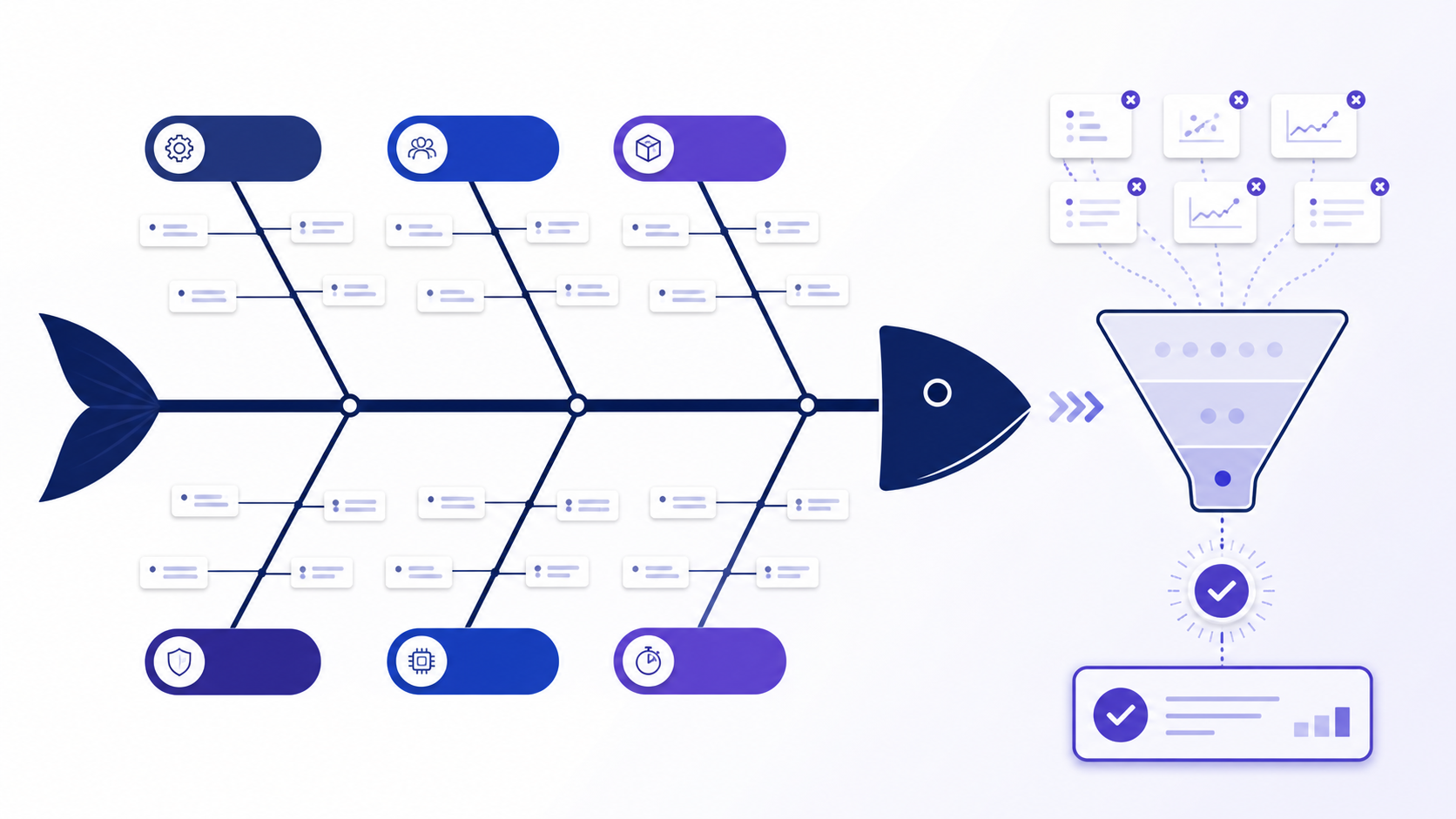
On this page本页目录
What is a fishbone diagram template?什么是 fishbone diagram template 鱼骨图模板?
Place this specific workflow in context with the anomaly detection and root cause analysis guide, which connects the definitions, alternatives, validation steps, and related implementation guides.
可通过异常检测与根因分析指南理解本专题在整体流程中的位置;该指南串联了定义、替代方案、验证步骤与相关实施文章。
A fishbone diagram template is a reusable cause-and-effect worksheet that places one clearly defined problem at the head, major cause categories on the large bones, and specific candidate causes on smaller branches. Use it to explore a broad set of explanations before testing them. A filled diagram is a hypothesis map, not proof of root cause. Naming the cause you will test is root cause identification.
Fishbone diagram template 鱼骨图模板是一种可复用的因果分析工作表:把一个清晰定义的问题放在“鱼头”,把主要原因类别放在大骨上,再把具体候选原因写入小分支。它用于在检验前广泛探索解释。填写完成的图是候选假设地图,不是根因证明。点名将要检验的原因,就是根因识别。
The method is also called an Ishikawa diagram or cause-and-effect diagram. The U.S. Administration for Children and Families fishbone handout provides a root-cause-analysis template and facilitation prompts. The Institute for Healthcare Improvement cause-and-effect tool presents classic and process-oriented versions. Both sources support the tool's exploratory purpose; neither makes brainstorming equivalent to causal confirmation.
这种方法也称 Ishikawa diagram(石川图)或 cause-and-effect diagram(因果图)。美国儿童与家庭管理局的鱼骨图讲义提供了根因分析模板和主持提示;医疗保健改进研究所的因果图工具还介绍了经典版与按流程组织的版本。两者都支持其探索用途,但都不意味着头脑风暴等同于因果确认。
When a fishbone template fits—and when it does not鱼骨图模板何时适用、何时不适用
Choose a fishbone when a recurring defect, delay, outage, service failure, or quality deviation may have causes across several teams or process stages. It is especially useful before the group has selected a favored explanation.
当重复缺陷、延误、中断、服务失败或质量偏差可能跨越多个团队或流程阶段时使用鱼骨图,尤其适合团队尚未选定偏好解释的早期阶段。
Do not rely on the diagram alone for safety-critical decisions, statistical attribution, interaction logic, or corrective-action approval. Use measurements, experiments, logs, fault trees, change analysis, or qualified domain review as the case requires.
不要仅凭图表做出安全关键决策、统计归因、交互逻辑判断或纠正措施审批。应按情况使用测量、实验、日志、故障树、变更分析或合格领域复核。
A fishbone is weaker when the problem is not yet bounded, when participants lack process knowledge, or when the event requires explicit AND/OR logic between failures. A narrow, mostly linear issue may be handled faster with 5 Whys. A complex hazardous system with interacting safeguards may need fault tree or barrier analysis. A process-type fishbone can be more useful than 6M when failures align naturally with sequential stages.
如果问题尚未界定、参与者不了解流程,或事件需要明确表示故障之间的 AND/OR 逻辑,鱼骨图会比较薄弱。范围较窄且近似线性的问题可能更适合五问法;涉及交互防护的复杂高风险系统可能需要故障树或屏障分析;当故障天然对应连续流程阶段时,流程型鱼骨图往往比 6M 更合适。
Prepare evidence before filling the fishbone diagram template填写鱼骨图模板前先准备证据
Write the effect as an observable deviation: what happened, where, when, how often, compared with which baseline, and with what impact. “Checkout failures rose from the normal weekly range during release window B” is more useful than “the release was bad.” The first statement can be checked; the second embeds blame and a presumed cause.
先把结果写成可观察的偏差:发生了什么、在哪里、何时、频率如何、相对于哪条基线、造成什么影响。“结账失败在版本 B 发布窗口内高于正常周范围”比“这次发布很糟”更有用;前者可检验,后者已经包含归责和预设原因。
- Scope: process boundary, affected population, time window, exclusions, and investigation owner.范围:流程边界、受影响对象、时间窗口、排除项和调查负责人。
- Baseline: expected performance, comparable normal cases, definitions, units, and data-quality notes.基线:预期表现、可比较正常案例、定义、单位与数据质量说明。
- Evidence: timestamps, logs, measurements, photos, records, interviews, configuration versions, and recent changes.证据:时间戳、日志、测量、照片、记录、访谈、配置版本和近期变更。
- Participants: people who operate, design, maintain, receive, and govern the process—not only managers.参与者:实际操作、设计、维护、接收和治理流程的人员,而不只是管理者。
Template rule: keep a separate evidence register with source, timestamp, owner, and reliability. The fishbone should link to evidence IDs instead of becoming an unreadable archive.
模板规则:单独维护证据登记表,记录来源、时间、负责人和可靠性。鱼骨分支应链接证据 ID,而不是把整张图变成难以阅读的档案库。
Copy-ready blank fishbone diagram template fields可直接复制的空白鱼骨图模板字段
A useful template is more than six empty ribs. Copy the fields below into a whiteboard, document, slide, or spreadsheet before the session. Keep the visual diagram for concise labels and use a linked register for definitions, evidence, decisions, and ownership. Give every cause a stable ID such as MTH-03 or DATA-07 so the same hypothesis can be traced across meeting notes, queries, tests, and corrective-action records.
实用模板不只是六根空白鱼骨。会前可把下列字段复制到白板、文档、幻灯片或电子表格中。可视化图只保留简洁标签,定义、证据、决策和责任则放在关联登记表中。为每个原因分配稳定 ID,例如 MTH-03 或 DATA-07,使同一假设能在会议记录、查询、检验和纠正措施记录之间追踪。
| Field字段 | What to record记录内容 | Quality check质量检查 |
|---|---|---|
| Effect结果 | Object, deviation, location, mode, time window, and impact对象、偏差、位置、模式、时间窗口与影响 | Observable and neutral; no presumed cause可观察且中性,不预设原因 |
| Category类别 | Process-specific prompt and its boundary流程特定提示及其边界 | Participants interpret it consistently参与者理解一致 |
| Candidate cause候选原因 | Condition, mechanism, event ID, and deeper why条件、机制、事件 ID 与更深层原因 | Specific enough to test or disprove具体到可检验或证伪 |
| Evidence plan证据计划 | Prediction, source, comparison, owner, and due date预测、来源、比较、负责人和截止日期 | Includes confirming and disconfirming evidence同时包含支持与反证 |
| Decision决策 | Open, unsupported, contributing, verified, or rejected待定、不支持、促成因素、已验证或已排除 | Reviewer and decision date are recorded记录复核者与决策日期 |
Start a new version when the effect definition, process boundary, category model, or material evidence changes. Do not overwrite rejected branches: retain their status and rationale so a later team does not repeat the same test. For printing, leave generous space around each rib and place the evidence register on a second page. For remote workshops, lock the fish head and category labels while allowing participants to add candidate notes; this prevents accidental changes to scope.
当结果定义、流程边界、分类模型或关键证据发生变化时,应创建新版本。不要覆盖已排除分支;保留其状态和理由,避免后续团队重复同一检验。打印时在每根大骨周围留足空间,并把证据登记放在第二页。远程研讨时可锁定鱼头和类别标签,只允许参与者添加候选便签,防止误改范围。
Choose 6M fishbone categories or adapt the branches选择 6M 鱼骨图分类或调整分支
| Context场景 | Useful category prompts可用分类提示 | Watch for注意事项 |
|---|---|---|
| Manufacturing 6M制造业 6M | People, Machine, Method, Material, Measurement, Environment人员、机器、方法、材料、测量、环境 | Do not force a cause into every category不要强行给每个类别填原因 |
| Service 4P服务业 4P | People, Process, Policy, Place or Platform人员、流程、政策、场所或平台 | Define terms so categories do not overlap先定义术语,避免分类重叠 |
| Software and data软件与数据 | Code, configuration, data, infrastructure, dependencies, operations, detection代码、配置、数据、基础设施、依赖、运维、检测 | Include observability and change history包含可观测性与变更历史 |
| Process stages流程阶段 | Intake, preparation, execution, handoff, review, delivery接收、准备、执行、交接、复核、交付 | Useful when timing identifies the failing stage适合时间线已定位故障阶段时 |
The 6M fishbone diagram template is a memory aid, not a standard that must fit every domain. Rename “Manpower” to “People” when clearer, and use “Environment” for physical or operating conditions rather than dumping every uncategorized idea there. If two categories repeatedly contain the same mechanism, merge or redefine them. Category quality is measured by whether it prompts relevant, distinct questions—not by whether it preserves an acronym.
6M 鱼骨图模板是一种记忆提示,不是所有领域都必须套用的标准。需要时可把 “Manpower” 改为更清晰的 “People”;“Environment” 应用于物理或运行条件,而不是收纳所有无法归类的想法。如果两个类别反复出现相同机制,就应合并或重新定义。分类质量取决于它能否引出相关且不同的问题,而不是是否保留缩写。
Retain People, Machine, Method, Material, Measurement, and Environment when they map to the production flow. Add supplier, tooling, or maintenance sub-branches only when their boundaries are clear. Link batch, fixture, line, shift, calibration, and environmental readings to stable evidence IDs.
当人员、机器、方法、材料、测量和环境能对应生产流程时保留 6M。仅在边界清楚时增加供应商、工装或维护子分支,并把批次、夹具、产线、班次、校准与环境读数链接到稳定证据 ID。
Use Customer, People, Policy, Process, Channel, Information, and System when handoffs and waiting dominate. Separate work time from queue time, and avoid putting every delay under People. Record request type, entry channel, exception path, approval rule, and ownership transition.
当交接和等待占主导时,可使用客户、人员、政策、流程、渠道、信息与系统。应区分工作时间与排队时间,不要把所有延迟都归入人员;记录请求类型、进入渠道、例外路径、审批规则和责任转移。
Use Code, Data, Infrastructure, Dependency, Deployment, Observability, and Operations. Preserve version, region, feature flag, schema, workload, retry, and external-service identifiers. A label such as “database” is too broad; name the query, resource, configuration, or contention mechanism to be tested.
可使用代码、数据、基础设施、依赖、发布、可观测性和运维。保留版本、区域、功能开关、模式、负载、重试和外部服务标识。“数据库”过于宽泛,应写出待检验的查询、资源、配置或争用机制。
Use Patient or Task, People, Procedure, Equipment, Information, Environment, and Policy only within the approved investigation process. Protect privacy, distinguish system conditions from individual blame, preserve immediate safety actions, and route consequential conclusions through qualified clinical, safety, or regulatory review.
只能在获批调查流程内使用患者或任务、人员、程序、设备、信息、环境与政策分类。保护隐私,区分系统条件与个人归责,保留即时安全措施,并让重要结论接受合格的临床、安全或监管复核。
How to fill a fishbone diagram template step by step如何逐步填写 fishbone diagram template
- Put one measurable effect at the head.在鱼头写入一个可测量结果。State the deviation without a cause, solution, or blame. Confirm that all participants are analyzing the same event and boundary.描述偏差,不写原因、解决方案或归责,并确认所有参与者分析的是同一事件和边界。
- Select categories that match the process.选择与流程匹配的分类。Start with 6M, 4P, process stages, or custom branches. Remove categories that add no useful questions.可从 6M、4P、流程阶段或自定义分支开始,并删除不能产生有效问题的类别。
- Generate candidate causes separately from evaluation.把候选原因生成与评价分开。Invite observations from every role. Write specific mechanisms such as “retry policy multiplies duplicate writes,” not vague labels such as “system issue.”邀请不同角色提供观察。应写“重试策略导致重复写入倍增”等具体机制,而不是“系统问题”等模糊标签。
- Drill into each promising branch.深入重要分支。Ask what condition produced the cause and what evidence should exist if the mechanism is true. Stop when the branch becomes testable and actionable, not after an arbitrary number of whys.追问什么条件产生该原因,以及机制为真时应看到何种证据。当分支已经可检验、可行动时停止,而不是机械追问固定次数。
- Consolidate and prioritize hypotheses.合并并排序假设。Remove duplicates, distinguish triggers from contributing conditions, and rank candidates by explanatory power, evidence availability, consequence, and test cost.删除重复项,区分触发因素与促成条件,并按解释力、证据可得性、后果和检验成本排序。
- Test, decide, and verify outside the diagram.在图外进行检验、决策和验证。Record confirming and disconfirming evidence, test alternatives, assign corrective actions only after review, and monitor recurrence plus side effects.记录支持与反证证据,检验替代解释,经复核后再分派纠正措施,并监控复发与副作用。
Run a focused 45-minute fishbone workshop主持一场聚焦的 45 分钟鱼骨图研讨会
Send the effect statement, scope, baseline, category definitions, and known evidence before the meeting. The facilitator protects the method; the process owner supplies context; a recorder assigns IDs and captures exact wording; and participants contribute observations from different stages of the work. If hierarchy may suppress dissent, collect ideas silently for the first round and discuss them without naming the contributor.
会前发送结果陈述、范围、基线、类别定义和已知证据。主持人维护方法纪律,流程负责人提供背景,记录员分配 ID 并保留原始措辞,参与者从不同工作阶段贡献观察。如果层级可能压制异议,第一轮应匿名静默收集想法,再在不点名贡献者的情况下讨论。
Read the effect and exclusions aloud. Confirm the decision the investigation must support, immediate containment, and what is outside this session.
朗读结果与排除项,确认调查要支持的决策、立即遏制措施,以及本次会议不处理的内容。
Move category by category. Ask for mechanisms and observations, not solutions. Write one cause per note and place uncertainty in the wording.
逐类推进,询问机制和观察而非解决方案。每张便签只写一个原因,并在措辞中保留不确定性。
Merge duplicates, connect deeper whys, and ask what prediction follows from each promising branch. Record alternative explanations beside it.
合并重复项,连接更深层原因,并追问每个重要分支能产生什么预测;同时记录替代解释。
Choose the first evidence tests, not the winning cause. Assign an owner, source, comparison, due date, and review point for every selected hypothesis.
选择首批证据检验,而不是“获胜原因”。为每个选中假设指定负责人、来源、比较方式、截止日期和复核节点。
Prioritize tests with a simple transparent rubric. Score each candidate from one to three for explanatory reach, consequence if missed, evidence accessibility, and ability to distinguish it from alternatives; score test cost and risk in the opposite direction. The total is a scheduling aid, not a causal score. A low-cost log comparison may come before an expensive physical test, while a safety-critical hypothesis may require immediate escalation regardless of its total. Record minority views and revisit the order when new evidence changes plausibility.
可用简单透明的规则为检验排序。对每个候选原因的解释范围、遗漏后果、证据可得性和区分替代解释的能力按 1–3 分评分;测试成本与风险则反向评分。总分只是安排顺序的工具,不是因果得分。低成本日志比较可以先于昂贵实物测试,但安全关键假设无论总分如何都可能需要立即升级。应记录少数意见,并在新证据改变合理性时重新排序。
Exit criterion: the session ends with owned tests and an agreed review date—not with a branch labeled “root cause.” Keep containment, corrective action, and effectiveness verification in separate records so urgent protection does not get confused with causal proof.
结束标准:会议应以已分派的检验和约定复核日期结束,而不是把某个分支标成“根因”。把遏制措施、纠正措施和有效性验证分别记录,避免把紧急保护与因果证明混为一谈。
Fishbone diagram example: recurring data-pipeline delay鱼骨图示例:反复发生的数据管道延迟
Hypothetical example: a daily pipeline normally completes before 06:00, but it finished late on four consecutive Mondays. The effect at the fish head is “Monday pipeline completion exceeds 06:00,” with the reporting layer and downstream users defined as the impact boundary. The team uses software-and-data categories rather than forcing manufacturing 6M labels.
假设示例:某每日数据管道通常在 06:00 前完成,但连续四个星期一延迟。鱼头结果写为“星期一管道完成时间晚于 06:00”,并把报表层与下游用户定义为影响边界。团队采用软件与数据分类,而不强套制造业 6M 标签。
| Branch分支 | Candidate cause候选原因 | Evidence or test证据或检验 | Result结果 |
|---|---|---|---|
| Data数据 | Weekend file changed from incremental to full export周末文件从增量导出变为全量导出 | Compare manifests, sizes, row counts, and replay timing比较清单、大小、行数与回放耗时 | Supported支持 |
| Infrastructure基础设施 | Compute saturation slowed ingestion计算资源饱和导致摄取变慢 | Review utilization and queue telemetry during affected and normal runs复核异常与正常运行期间的利用率和队列遥测 | Not supported不支持 |
| Operations运维 | Size guardrail and early alert were absent缺少文件大小防护和提前告警 | Inspect preflight rules and alert configuration history检查预检规则与告警配置历史 | Supported contributing condition支持为促成条件 |
The team restores incremental export, adds a maximum-size preflight check, and alerts on abnormal input growth before ingestion. It verifies later Monday runs and checks completeness so a faster pipeline does not silently omit records. The diagram helped widen the search; manifests, telemetry, replay, and follow-up established the finding. The scenario and numbers are illustrative, not an InfiniSynapse customer or performance claim.
团队恢复增量导出,增加最大文件大小预检,并在摄取前对异常输入增长告警;随后验证多个星期一运行,并检查完整性,避免为了提速而静默漏掉记录。鱼骨图扩大了搜索范围,清单、遥测、回放和后续观察才建立结论。此场景和数字仅用于说明,不代表 InfiniSynapse 客户案例或性能声明。
Choose an editable fishbone diagram format选择可编辑的鱼骨图模板格式
| Format格式 | Best for适合 | Main tradeoff主要取舍 |
|---|---|---|
| Whiteboard | Fast live brainstorming and rearranging branches快速现场讨论和重排分支 | Needs export, versioning, and evidence links afterward会后需要导出、版本管理和证据链接 |
| Word / Docs | Narrative reports and controlled review叙述性报告与受控复核 | Shapes can become difficult to maintain图形可能难以维护 |
| PowerPoint / Slides | Presentations and workshop facilitation演示与研讨会主持 | Weak for structured evidence registers不适合结构化证据登记 |
| Excel / Sheets | Cause register, owners, priorities, and test status原因登记、负责人、优先级和检验状态 | Diagram layout is less fluid图形布局不够灵活 |
| Printing or locked review copies打印或锁定复核版本 | Poor for iterative editing unless fillable除非可填写,否则不利于迭代编辑 |
A practical package often uses two artifacts: a visual fishbone for workshop thinking and a structured cause-and-test register for follow-through. Preserve the problem statement, category definitions, participants, session date, version, unresolved minority views, evidence references, owner, and test status. A beautiful diagram without this record is difficult to audit or resume.
实用交付通常包含两个产物:用于讨论的可视化鱼骨图,以及用于跟进的结构化“原因—检验”登记表。应保留问题陈述、分类定义、参与者、会议日期、版本、未解决的少数意见、证据引用、负责人和检验状态。缺少这些记录的漂亮图表很难审计或继续调查。
Use connected evidence to test fishbone hypotheses使用关联证据检验鱼骨图假设
Before opening the workspace, prepare a neutral problem statement, stable record IDs, a time window, baseline cases, relevant measurements, logs, files, and the candidate questions from your fishbone. InfiniSynapse supports AI-assisted analysis across connected databases, files, documents, audio, and video; it is not presented here as a dedicated fishbone diagram editor. Use it to explore evidence and relationships, then record consequential findings and corrective actions through your approved RCA process.
打开工作区前,请准备中性问题陈述、稳定记录 ID、时间窗口、基线案例、相关测量、日志、文件以及鱼骨图产生的候选问题。InfiniSynapse 支持跨关联数据库、文件、文档、音频和视频的 AI 辅助分析;本页不把它描述为专用鱼骨图编辑器。可用它探索证据与关系,再通过组织批准的 RCA 流程记录重要结论和纠正措施。
Open InfiniSynapse for connected evidence analysis打开 InfiniSynapse 分析关联证据Common fishbone diagram mistakes and controls常见鱼骨图错误与控制方法
- Writing a presumed cause at the head: restate the effect in observable terms before the session.在鱼头写入预设原因:会前用可观察语言重写结果。
- Blaming people: examine interface, workload, training, controls, incentives, staffing, and detectability around an action.归责个人:检查某个动作周围的界面、工作负荷、培训、控制、激励、人员配置和可检测性。
- Forcing the 6M template: customize categories to the actual process and define their boundaries.强套 6M 模板:按真实流程调整类别,并明确边界。
- Voting a cause into existence: voting can prioritize tests; it cannot establish causation.靠投票“选出”原因:投票可帮助排序检验,但不能建立因果。
- Mixing causes and solutions: keep proposed controls in an action log until the mechanism is supported.混合原因与方案:在机制得到支持前,把拟议控制措施保留在行动日志中。
- Closing after the workshop: assign hypothesis tests, record disconfirming evidence, and verify the effect after change.讨论结束即结案:分派假设检验,记录反证,并在变更后验证效果。
Risk boundary: retrospective RCA is vulnerable to hindsight bias, missing records, hierarchy, and overly simple stories. Preserve uncertainty and dissent. For healthcare, safety, legal, financial, or regulated events, use the organization's approved procedure and qualified reviewers; this general template does not replace those obligations.
风险边界:回顾性 RCA 容易受到后见之明偏差、记录缺失、层级关系和过度简化故事的影响。应保留不确定性和异议。涉及医疗、安全、法律、金融或监管事件时,应使用组织批准的程序和合格复核人员;本通用模板不能替代这些义务。
Turn the cause-and-effect diagram into verified action把因果图转化为经过验证的行动
For each high-priority branch, record the causal mechanism, expected evidence if true, evidence that would disconfirm it, test method, owner, due date, result, and review decision. A strong candidate explains the timing and scope of the effect, survives comparison with reasonable alternatives, and predicts what should change when controlled. Separate “supported contributing factor” from “verified root cause” when the evidence does not justify stronger language.
对每个高优先级分支,记录因果机制、为真时预期证据、可否定它的证据、检验方法、负责人、截止日期、结果和复核决定。可靠候选原因应解释结果发生的时间与范围,经受合理替代解释的比较,并能预测控制后应发生的变化。当证据不足以支持更强结论时,应把“得到支持的促成因素”与“已验证根因”分开。
For corrective action, define the baseline, target, measurement rule, implementation date, observation window, leading control, recurrence measure, and possible side effects. Completion is not effectiveness. If the problem recurs, the measurement changes, or the intervention creates another risk, reopen the analysis. Use the live InfiniSynapse tool catalog to confirm available capabilities and the InfiniSynapse documentation to prepare a supported analysis workflow.
对纠正措施,应定义基线、目标、测量规则、实施日期、观察窗口、前置控制、复发指标和可能副作用。完成不等于有效。如果问题复发、测量方式改变或干预产生新风险,应重新开启分析。使用已上线的 InfiniSynapse 工具目录确认当前可用能力,并参考 InfiniSynapse 文档准备受支持的分析工作流。
Fishbone diagram template FAQFishbone diagram template 常见问题
What is a fishbone diagram template?什么是鱼骨图模板?
A fishbone diagram template is a reusable cause-and-effect worksheet with a problem at the head, a central spine, major cause categories, and smaller branches for candidate contributing causes. It structures exploration but does not prove that any branch is causal.
鱼骨图模板是一种可复用的因果工作表,包含鱼头处的问题、中央主干、主要原因类别以及记录候选促成原因的小分支。它可以组织探索,但不能证明任何分支具有因果性。
What are the 6M categories in a fishbone diagram?鱼骨图的 6M 分类是什么?
The common manufacturing 6M categories are People or Manpower, Machine, Method, Material, Measurement, and Mother Nature or Environment. They are prompts, not mandatory universal categories; service, healthcare, and software teams should rename them to fit the process.
制造业常用 6M 分类是人员、机器、方法、材料、测量以及自然条件或环境。它们只是提示,并非强制通用分类;服务、医疗和软件团队应按自身流程重新命名。
How do I use a fishbone diagram for root cause analysis?如何用鱼骨图进行根因分析?
Define one neutral effect, gather a cross-functional team and baseline evidence, choose relevant categories, brainstorm causes, drill into mechanisms, consolidate duplicates, prioritize testable hypotheses, test them against evidence, and track verified corrective actions separately.
先定义一个中性结果,召集跨职能团队并准备基线证据;选择相关分类,讨论原因并深入机制;合并重复项,排序可检验假设,用证据检验,再单独跟踪已验证的纠正措施。
Is a fishbone diagram the same as 5 Whys?鱼骨图与五问法相同吗?
No. A fishbone diagram explores several categories and branches, while 5 Whys follows a causal chain by repeatedly asking why. Teams often use a fishbone first, then apply 5 Whys to a supported branch.
不同。鱼骨图探索多个类别和分支,五问法则通过反复追问“为什么”沿一条因果链深入。团队通常先使用鱼骨图,再对得到支持的分支应用五问法。
Can a completed fishbone diagram prove the root cause?填写完成的鱼骨图能证明根因吗?
No. A completed diagram records hypotheses generated by the team. A root-cause claim needs supporting observations, a plausible mechanism, tests against alternatives, and post-change verification showing that the corrective action affected recurrence without unacceptable side effects.
不能。完成的图表记录的是团队生成的假设。根因主张需要支持性观察、合理机制、替代解释检验,以及变更后验证,以证明纠正措施影响了复发且没有不可接受的副作用。
Official sources and verification notes官方来源与验证说明
- U.S. Administration for Children and Families: Fishbone Diagram Handout — a government root-cause-analysis template and facilitation guide.美国儿童与家庭管理局:鱼骨图讲义——政府机构提供的根因分析模板与主持指南。
- Institute for Healthcare Improvement: Cause and Effect Diagram — classic and process-type guidance with a downloadable tool.医疗保健改进研究所:因果图工具——经典版和流程版说明及可下载工具。
Use the blank structure to begin, but judge the work by the quality of the problem statement, evidence register, hypothesis tests, corrective-action ownership, and effectiveness review. If the diagram becomes crowded, move details into the register and keep only category, cause, and evidence IDs on the visual.
可从空白结构开始,但应依据问题陈述、证据登记、假设检验、纠正措施责任和有效性复核的质量来评价成果。如果图表过于拥挤,就把细节移到登记表中,在图上只保留类别、原因和证据 ID。