 InfiniSynapse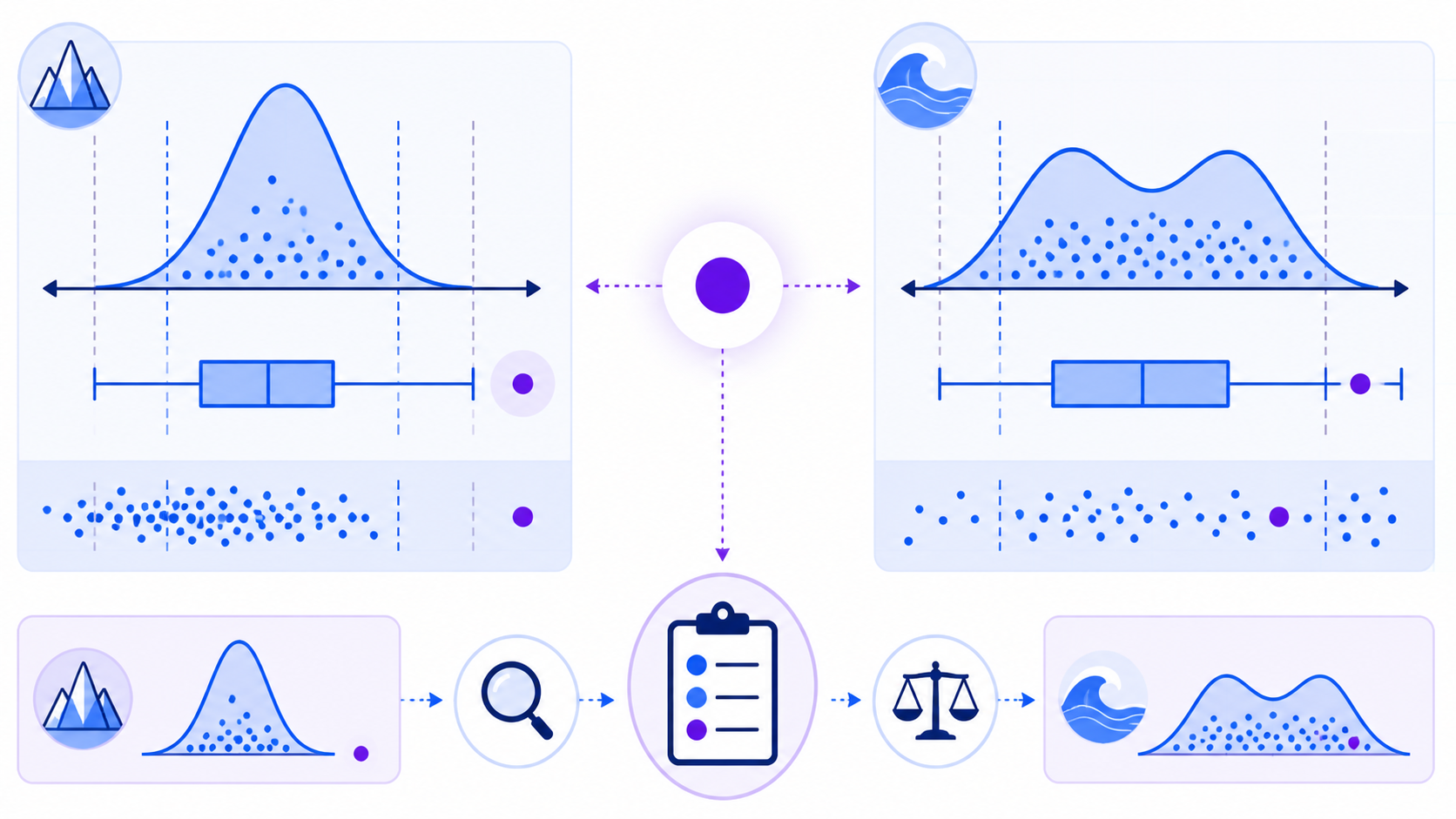
On this page本页目录
Outlier meaning: a precise dictionary-style answer异常值含义:准确的词典式解释
This terminology page is part of the complete statistical outlier guide. Use the pillar guide for the full detection and validation framework.
本文是术语解释页,属于完整的统计异常值指南内容集群。如需完整的检测与验证框架,请阅读基石指南。
Outlier means an observation that is notably inconsistent with the pattern expected for its stated comparison group, model, or context. The term describes a relationship, not a cause. It means “this observation differs enough to examine,” not “this observation is false.”
异常值是指:相对于明确的比较群体、模型或语境,与预期模式明显不一致的观测。这个术语描述的是一种关系,不是原因;它表示“该观测差异足够大,需要检查”,而不是“该观测一定是假的”。
A complete use of the word should identify three things: the observation being described, the reference used for comparison, and the rule or reasoning that makes the difference notable. Without a reference, “outlier” becomes a vague label.
完整使用这个词时,应说明三件事:被描述的观测、用于比较的参照,以及让这种差异显著的规则或理由。没有参照,“异常值”就会变成模糊标签。
Outlier, anomaly, extreme value, error, and influential point异常值、异常事件、极端值、错误与高影响点
| Term术语 | What it means含义 | What it does not prove不能证明 |
|---|---|---|
| Outlier异常值/离群值 | An observation differs notably from a stated reference.某个观测与明确参照明显不同。 | That the observation is wrong.该观测一定错误。 |
| Extreme value极端值 | A value lies near an observed or theoretical boundary.某个值接近观测或理论边界。 | That it is unexpected for the distribution.它对该分布而言一定出乎意料。 |
| Anomaly异常事件/异常模式 | A record, sequence, or relationship departs from expected behavior.记录、序列或关系偏离预期行为。 | That one numeric field is extreme.某个数值字段一定极端。 |
| Error错误 | Evidence shows a capture, entry, unit, or processing failure.证据表明存在采集、录入、单位或处理失败。 | That every unusual value is erroneous.每个不寻常值都有错误。 |
| Influential point高影响点 | Including the observation materially changes a fitted model or decision.加入该观测会显著改变拟合模型或决策。 | That it is visually far from the group.它在图上一定远离群体。 |
These terms can overlap, but they answer different questions. A verified rare event can be an outlier without being an error. A data-entry mistake can be an error without looking extreme. A sequence can be anomalous even when every single value stays inside a normal range.
这些术语可能重叠,但回答的问题不同。经核验的罕见事件可以是异常值,却不是错误;录入错误可能没有表现为极端值;一个序列也可能在每个单值都处于正常范围时仍呈现异常模式。
How outlier meaning changes across contexts异常值含义如何随语境变化
The word often refers to a value beyond a box-plot fence or otherwise separated from the bulk of a univariate distribution.
通常指超出箱线图围栏,或在单变量分布中与主体明显分离的数值。
The important distinction is among an unusual outcome, a large residual, high leverage, and strong influence on coefficients.
需要区分异常结果、大残差、高杠杆以及对系数产生强影响。
A value may be unusual relative to recent trend, season, or operating state even if it is ordinary in the full historical range.
某个值即使在全部历史范围内普通,也可能相对于近期趋势、季节或运行状态异常。
Teams may use “outlier” as a review label for unusual orders, costs, delays, or quality results. The operational rule should be documented.
团队可能把“异常值”作为异常订单、成本、延迟或质量结果的复核标签,并应记录运营规则。
Meaning also changes with the unit of analysis. A hospital, patient visit, laboratory result, and individual measurement are different units. Before reporting an outlier, name the unit and the eligible comparison set.
含义还会随分析单位变化。医院、患者就诊、实验室结果和单次测量是不同单位。报告异常值前,应明确分析单位和符合条件的比较集合。
What can the outlier label mean in practice?在实践中,异常值标签可能意味着什么?
| Interpretation解释 | Evidence to seek应寻找的证据 | Careful wording谨慎表述 |
|---|---|---|
| Possible data-quality issue可能的数据质量问题 | Source record, unit, decimal, duplicate, join, device status源记录、单位、小数点、重复、连接、设备状态 | “Flagged for source verification”“已标记,待核对来源” |
| Rare valid event真实罕见事件 | Independent confirmation and domain explanation独立确认与领域解释 | “Unusual but verified”“不寻常但已核验” |
| Unmodeled subgroup模型未覆盖的子群 | Role, region, product, device, age, or other group attributes角色、地区、产品、设备、年龄或其他群体属性 | “Consistent within subgroup”“在所属子群内一致” |
| Process or regime change流程或状态变化 | Change log, policy date, maintenance record, time pattern变更日志、政策日期、维护记录、时间模式 | “May indicate a baseline shift”“可能表示基线发生变化” |
| Inadequate comparison model比较模型不充分 | Residual pattern, missing variable, nonlinearity, seasonality残差模式、遗漏变量、非线性、季节性 | “Model fit requires review”“模型拟合需要复核” |
Distance alone cannot choose among these interpretations. The same numerical score can describe a confirmed typo in one record and a valuable operational incident in another. Evidence assigns meaning.
仅靠距离无法在这些解释中作选择。相同的数值分数,在一条记录中可能对应确认的输入错误,在另一条记录中可能对应有价值的运营事件。真正赋予含义的是证据。
How to use “outlier” accurately in a report如何在报告中准确使用“异常值”
Avoid sentences such as “we removed the bad outliers.” They combine an unusualness label, a quality judgment, and a treatment decision without showing evidence. Separate those claims.
避免使用“我们删除了坏的异常值”这类句子。它把不寻常标签、质量判断和处理决定混在一起,却没有展示证据。应把这些主张分开。
“Three outliers were removed because they were too high.”
“三个异常值因为太高而被删除。”
“The pre-specified 1.5×IQR screen flagged three records. Source review confirmed one unit error, which was corrected; two verified events were retained. The conclusion was unchanged in a sensitivity comparison.”
“预先设定的 1.5×IQR 筛查标记了三条记录。来源复核确认其中一条存在单位错误并完成修正;另外两条为真实事件并予以保留。敏感性比较显示结论未变化。”
A complete statement names the comparison set, method and threshold, number and rate flagged, evidence reviewed, disposition, and effect on the result. If the threshold was selected after inspecting the data, describe it as exploratory.
完整表述应说明比较集合、方法与阈值、标记数量及比例、核验证据、处理结果和对结论的影响。如果阈值是在查看数据后选择,应明确说明其探索性。
Outlier in Chinese: 异常值 or 离群值?Outlier 中文应写“异常值”还是“离群值”?
Both terms are used. 离群值 emphasizes separation from a group and often reads more narrowly statistical. 异常值 is common in analytics and business contexts but can be confused with the broader word “anomaly.” Choose one primary term for a document, define it on first use, and keep the English term in parentheses when precision matters.
两个词都有人使用。离群值更强调与群体分离,统计含义通常更窄;异常值在分析和业务语境中更常见,但可能与范围更广的 anomaly 混淆。建议在同一文档中选择一个主称谓,首次出现时给出定义,并在需要精确区分时保留英文术语。
Recommended first-use form: “outlier(离群值,本文亦称异常值)” followed by the comparison-specific definition used in the analysis.
推荐首次表述:“outlier(离群值,本文亦称异常值)”,随后给出本次分析所采用、包含比较参照的具体定义。
Questions about the meaning of outlier关于异常值含义的常见问题
What does “outlier” literally mean in data?在数据中,“outlier”字面表示什么?
It means an observation that lies notably outside or conflicts with the pattern expected for a stated comparison group, model, or context.
它表示某个观测明显位于明确比较群体、模型或语境的预期模式之外,或与该模式不一致。
Does “outlier” mean “mistake”?“异常值”等于“错误”吗?
No. Outlier describes unusualness; mistake describes a cause supported by evidence. A verified rare event can be unusual and correct.
不等于。异常值描述不寻常程度;错误描述由证据支持的原因。经核验的罕见事件可以既不寻常又正确。
Why can the same value be an outlier in one dataset but not another?为什么同一个值在一个数据集中异常,在另一个数据集中却不异常?
Because the label depends on the reference population, variables, time window, units, model, and purpose—not on the number alone.
因为这个标签取决于参考总体、变量、时间窗口、单位、模型和目的,而不只取决于数字本身。
What wording should replace “bad outlier”?应该用什么表述替代“坏的异常值”?
State the evidence and status: for example, “flagged for review,” “confirmed unit error,” “verified rare event,” or “influential observation retained in sensitivity analysis.”
应说明证据和状态,例如“已标记待复核”“确认的单位错误”“经核验的罕见事件”或“敏感性分析中保留的高影响观测”。
A terminology checklist before publishing发布前的术语检查清单
- Name the observation and its unit of analysis.说明观测及其分析单位。
- Name the comparison group, model, or time baseline.说明比较群体、模型或时间基线。
- Separate the detector flag from the confirmed cause.把检测标记与确认原因分开。
- Use “error” only when source evidence supports it.只有来源证据支持时才使用“错误”。
- Report the disposition and whether conclusions changed.报告处理方式以及结论是否变化。
Sources and terminology notes来源与术语说明
The distinction between an unusual observation and a confirmed error was checked against the NIST/SEMATECH explanation of outliers. Regression terminology can require separate residual, leverage, and influence diagnostics; see the NIST regression diagnostics overview.
“不寻常观测”与“已确认错误”的区别,参考了 NIST/SEMATECH 异常值说明。回归语境中还需分别诊断残差、杠杆与影响,可参考 NIST 回归诊断概述。