 InfiniSynapse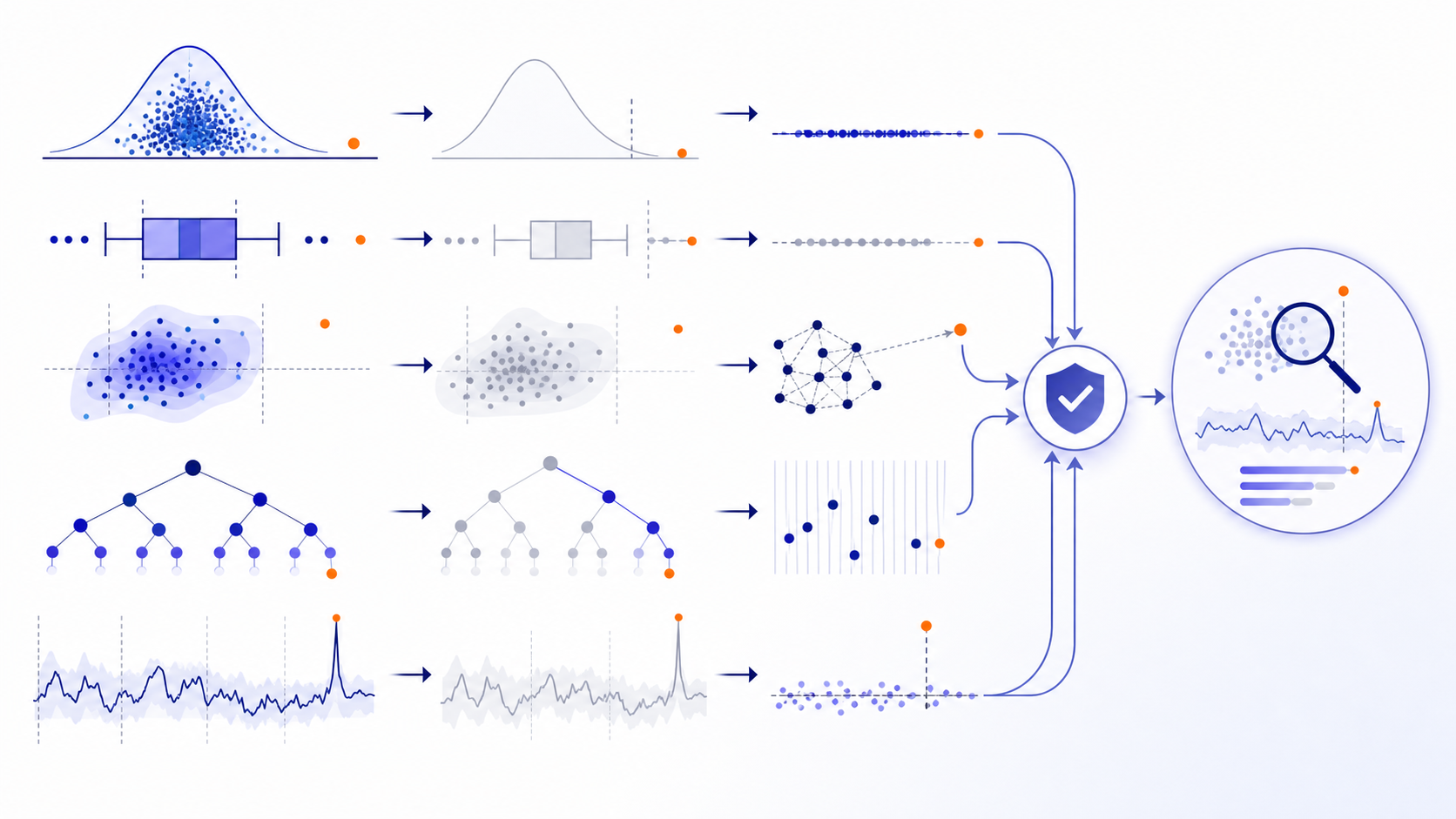
Outlier detection异常值检测
For the full topic map and the neighboring methods that support this workflow, continue with the complete statistical outlier guide.
如需查看完整主题结构以及支撑本流程的相邻方法,请继续阅读完整的统计异常值指南。
Outlier detection fits the dense region of a training set that already contains outliers. Novelty detection scores new points against a clean set of normal observations. Start with plots and a robust univariate rule such as IQR or MAD when one variable is enough; use LOF or Isolation Forest when local density or many features define normal. Every output is a candidate flag, not proof of error.
异常值检测是在已经混有离群点的训练集里拟合密集区域。新颖性检测用一份干净的正常样本给新观测打分。单一变量先用图形和 IQR、MAD;局部密度或多个特征决定“正常”时再用 LOF 或 Isolation Forest。任何输出都只是候选标记,并非错误证明。
The best method is therefore conditional, not universal. A z-score may be readable for approximately normal measurements, IQR is often safer for skewed univariate data, robust covariance can describe an elliptical multivariate cloud, Local Outlier Factor (LOF) can expose a sparse point inside uneven densities, and residual-based methods can separate a time-series spike from trend and seasonality. Method selection begins with the data-generating process and the consequence of being wrong.
因此,最佳方法取决于条件,并不存在通用冠军。Z 分数适合近似正态且易解释的测量;IQR 往往更适合偏态单变量数据;稳健协方差可描述近似椭圆的多变量点云;局部异常因子(LOF)能在密度不均的数据中发现局部稀疏点;基于残差的方法则可把时间序列尖峰与趋势、季节性分开。方法选择应从数据生成过程和判断错误的后果出发。
Outlier detection vs novelty detection异常值检测与新颖性检测
| Task任务 | Training data训练数据 | What you score给什么打分 | LOF modeLOF 用法 |
|---|---|---|---|
| Outlier detection异常值检测 | The set already contains outliers数据里已经混有离群点 | Points in that same set同一批点 | fit_predict; leave novelty false用 fit_predict;novelty 保持关闭 |
| Novelty detection新颖性检测 | A clean set of normal observations一份干净的正常样本 | New, unseen points新的、未见过的点 | novelty=True; predict only on new datanovelty=True;只对新数据 predict |
Neighborhood settings stay on the local outlier factor guide. Ranking and thresholds for many features stay on Isolation Forest anomaly detection.
邻域参数留在 Local Outlier Factor 指南。多特征排序和阈值留在 Isolation Forest 异常检测。
Define “outlier” before choosing a method选择方法前先定义“异常”
An outlier exists only relative to comparable observations, a model, or a context. A high transaction may be globally rare but normal for a wholesale account. A 30 °C reading may be ordinary in summer and anomalous for a refrigerated warehouse. A point may be unremarkable in every single column yet inconsistent with the relationship between pressure, flow, and temperature. These are global, contextual, and multivariate questions, and they require different detection logic.
异常值只能相对于可比较观测、模型或语境成立。高额交易在全局上罕见,却可能对批发账户很正常;30°C 在夏季天气中普通,在冷藏仓库里却异常;某条记录在每个单列中都不极端,却可能违背压力、流量与温度之间的关系。这些分别属于全局、上下文和多变量问题,需要不同检测逻辑。
Define one row, event, customer, machine cycle, or time window. Confirm units, joins, duplicates, missingness, and stable IDs.
明确一行、一次事件、一个客户、一个设备周期或一个时间窗。核对单位、连接、重复、缺失与稳定 ID。
State the population, subgroup, season, operating mode, distribution, or learned boundary against which observations are judged.
明确用于判断的总体、子群、季节、运行模式、分布或学习边界。
Estimate the harm of missed incidents, false alarms, delayed review, and inappropriate removal. The threshold belongs to this decision.
估计漏报、误报、复核延迟和不当删除的损失。阈值是该决策的一部分。
Record labels, provenance, timestamps, feature meaning, known incidents, and reviewer capacity. Unlabeled scores still need evaluation.
记录标签、来源、时间戳、特征含义、已知事件与复核能力。无标签得分同样需要评估。
If you need the concept first, use the related outlier definition. For a narrower sequence of practical checks, use the workflow for finding outliers.
如需先理解概念,可查看异常值定义与类型指南。如需更聚焦的实践检查顺序,可查看异常值查找工作流。
Which outlier detection method should you use?应该使用哪种异常值检测方法?
| Method方法 | Good starting point when适用起点 | Assumption or control假设或控制项 | Main limitation主要局限 |
|---|---|---|---|
| IQR fences | One numeric variable; skew or tail behavior is possible单一数值变量;可能偏态或重尾 | Quartile convention and fence multiplier四分位算法与围栏倍数 | Ignores relationships and context忽略关系与语境 |
| Z-score | Approximately normal, stable measurements近似正态且稳定的测量 | Mean, standard deviation, and cutoff均值、标准差与阈值 | Extremes influence its own reference极端值会影响其参考量 |
| MAD / modified Z | Robust univariate screening is needed需要稳健单变量筛查 | Median, MAD definition, zero-MAD handling中位数、MAD 定义与零 MAD 处理 | Still cannot see multivariate structure仍看不到多变量结构 |
| Grubbs-type test | A formal test fits one suspected univariate extreme正式检验适合一个疑似单变量极端值 | Approximate normality and significance plan近似正态与显著性计划 | Narrow scope; repeated testing changes error rates范围狭窄;重复检验改变错误率 |
| Robust covariance | Continuous multivariate data form an elliptical cloud连续多变量数据形成近似椭圆点云 | Scaling, covariance estimate, dimension-to-sample ratio缩放、协方差估计、维度样本比 | Weak fit for complex manifolds or mixed types不适合复杂流形或混合类型 |
| Local Outlier Factor | Local density differs across clusters不同簇的局部密度不同 | Distance metric, scaling, and neighborhood size距离度量、缩放与邻居数量 | Sensitive to representation and neighborhood choice对特征表示和邻域选择敏感 |
| Isolation Forest | Unsupervised multivariate ranking at useful scale需要可扩展的无监督多变量排序 | Features, sampling, score threshold, contamination use特征、采样、得分阈值与污染率设置 | Score is not a causal explanation得分不是因果解释 |
| Residual / change methods | Trend, seasonality, or regime defines normal趋势、季节性或状态决定正常 | Time order, baseline model, window, retraining时间顺序、基线模型、窗口与重训 | Poor baselines create systematic false alarms糟糕基线会制造系统性误报 |
Finish the task split above, then use this table to select a starting family, not a winner. Plot score distributions, inspect the top-ranked records, and compare defensible alternatives. More complex methods are useful only when they capture structure the simpler method cannot and when their extra tuning and monitoring burden is justified.
先完成上面的任务区分,再用该表选择起始方法族,而不是宣布赢家。应绘制得分分布、检查排名最高的记录,并比较合理的替代方案。只有复杂方法确实捕捉到简单方法看不到的结构,且额外调参与监控负担值得时,复杂度才有价值。
Statistical outlier detection methods for one variable单变量统计异常值检测方法
IQR: sort the observations, calculate Q1 and Q3 under a documented quartile convention, let IQR = Q3 − Q1, and flag values below Q1 − 1.5×IQR or above Q3 + 1.5×IQR. The 1.5 multiplier is a conventional screening fence, not a universal error boundary. Ties, discrete data, very small samples, and different quartile algorithms can change the result.
IQR:排序观测,按有记录的四分位约定计算 Q1 和 Q3,令 IQR = Q3 − Q1,再标记低于 Q1 − 1.5×IQR 或高于 Q3 + 1.5×IQR 的数值。1.5 倍数是传统筛查围栏,不是通用错误边界。并列值、离散数据、小样本以及不同四分位算法都可能改变结果。
Z-score: compute z = (x − mean) / standard deviation. A cutoff such as |z| > 3 is meaningful only inside a stated mean-and-variance model; it is not proof that a row is wrong. Because extremes shift the mean and inflate the standard deviation, mask effects are possible. Check a histogram or Q–Q plot, use consistent sample/population conventions, and compare with a robust alternative.
Z 分数:计算 z = (x − 均值) / 标准差。只有在明确的均值—方差模型中,|z| > 3 等阈值才有意义;它不能证明记录错误。极端值会移动均值并抬高标准差,因此可能产生掩蔽效应。应检查直方图或 Q–Q 图,统一样本/总体约定,并与稳健方法比较。
MAD and modified z-score: center observations on the median and scale absolute deviations by their median. This reduces the influence of extreme values, but a constant or heavily tied variable may have MAD = 0. Define a fallback—such as exact-match review, domain tolerance, or another robust scale—rather than dividing by zero or inventing tiny noise.
MAD 与修正 Z 分数:以中位数为中心,再用绝对偏差的中位数进行缩放。它能降低极端值影响,但常量或大量并列值变量可能出现 MAD = 0。此时应预先定义精确匹配复核、领域容差或其他稳健尺度等后备方案,不要除以零或人为添加微小噪声。
Formal tests: a test such as Grubbs’ test answers a narrower inferential question under distributional and multiplicity assumptions. The NIST Grubbs test documentation scopes it to one suspected outlier in approximately normal univariate data. Do not apply it repeatedly until an inconvenient set disappears.
正式检验:Grubbs 检验等方法在分布与多重性假设下回答更狭窄的推断问题。NIST Grubbs 检验文档将其范围限定为近似正态的单变量数据且只怀疑一个异常值的情况。不要反复检验,直到“不方便”的数据消失。
Multivariate, density, and isolation-based methods多变量、密度与隔离型检测方法
Multivariate outliers are unusual in their combination of features. Standardize or otherwise scale numeric features according to meaning, encode categorical values carefully, remove leakage, and examine collinearity before trusting distances. Robust covariance and Mahalanobis-style distances can work for approximately elliptical continuous data, but ordinary covariance itself can be distorted by contamination and becomes unstable when dimensions approach the sample size.
多变量异常值的“异常”来自特征组合。信任距离前,应按特征含义标准化或缩放数值变量,谨慎编码类别,去除信息泄漏,并检查共线性。稳健协方差与马氏距离式方法适合近似椭圆的连续数据,但普通协方差本身会受污染影响,且当维度接近样本量时会不稳定。
LOF compares each point’s local density with the densities of its neighbors. This can reveal a sparse point near a dense subcluster even when a single global boundary fails. The scikit-learn Local Outlier Factor reference explains that locality comes from nearest-neighbor distances. That also exposes the limitation: feature scaling, distance metric, categorical representation, and neighborhood size directly shape the result.
LOF 将每个点的局部密度与邻居密度比较。即使单一全局边界失效,它也可能在致密子簇附近发现稀疏点。scikit-learn 局部异常因子参考说明其局部性来自最近邻距离。这也揭示了局限:特征缩放、距离度量、类别表示与邻居数量都会直接塑造结果。
Isolation Forest recursively partitions feature space; observations isolated in fewer splits receive stronger anomaly signals. It is useful for unsupervised ranking, not for explaining root cause. A contamination parameter or percentile threshold can mechanically impose a flag count, so select the operational review rate from evidence and cost—not because the library accepts a convenient number. The scikit-learn outlier and novelty detection guide also distinguishes fitting on contaminated data from novelty detection on new observations. Parameter choices for the forest are on Isolation Forest anomaly detection.
隔离森林递归切分特征空间;用更少切分即可隔离的观测会获得更强异常信号。它适合无监督排序,不负责解释根因。污染率参数或分位阈值可能机械地规定标记数量,因此运营复核率应由证据与成本决定,而不是因为软件接受一个方便的数字。scikit-learn 异常检测与新颖性检测指南还区分了在含污染数据上拟合与对新观测进行新颖性检测。森林的参数选择见 Isolation Forest 异常检测。
Outlier detection methods for time-series data时间序列数据的异常值检测方法
Time order changes the reference. A global IQR rule may flag every seasonal peak, while a rolling z-score may leak future information or adapt so quickly that it hides a persistent shift. First define whether the target is a point spike, level shift, variance change, collective episode, or forecast error. Then build a baseline that accounts for trend, seasonality, calendar effects, missing intervals, and known interventions.
时间顺序会改变参考范围。全局 IQR 可能标记每个季节峰值;滚动 Z 分数则可能泄漏未来信息,或适应过快而隐藏持续偏移。应先明确目标是单点尖峰、水平位移、方差变化、群体事件还是预测误差,再建立包含趋势、季节性、日历效应、缺失间隔与已知干预的基线。
Detect on residuals when the baseline is credible, using robust scale or prediction intervals that match the model. Preserve causally correct train/validation/test order, backtest across quiet and incident periods, and monitor drift. Change-point detection answers whether the generating regime changed; it is related to but not identical with flagging one extreme observation. For online use, measure alert delay, duplicate alerts, recovery behavior, and reviewer workload in addition to point-wise precision and recall.
当基线可信时,可在残差上检测,并使用与模型匹配的稳健尺度或预测区间。应保持因果顺序正确的训练/验证/测试划分,在平稳期与事故期回测并监控漂移。变点检测回答数据生成状态是否变化,它与标记单个极端观测有关但并不相同。在线使用时,除逐点精确率与召回率外,还要测量告警延迟、重复告警、恢复行为和复核工作量。
A repeatable workflow to apply outlier detection methods应用异常值检测方法的可复现工作流
- Frame the decision界定决策Name the observation, comparison group, target anomaly, action, reviewer, and cost of each error type.明确观测单位、比较群体、目标异常、后续动作、复核者与各类错误成本。
- Preserve and audit inputs保留并审计输入Keep immutable raw values and stable IDs; check units, joins, duplicates, missingness, impossible values, timestamps, and source changes.保留不可变原始值与稳定 ID;检查单位、连接、重复、缺失、不可能值、时间戳和来源变更。
- Visualize relevant structure可视化相关结构Use distributions, box plots, scatterplots, grouped views, time plots, and missingness patterns before choosing a score.选择得分前使用分布图、箱线图、散点图、分组视图、时间图和缺失模式。
- Choose a baseline and challenger选择基线与挑战方法Start with the simplest defensible method and one alternative that tests the main vulnerability, such as IQR versus MAD or LOF versus Isolation Forest.从最简单且站得住脚的方法开始,再选择一个针对主要弱点的替代方案,例如 IQR 对 MAD,或 LOF 对隔离森林。
- Fit without leakage无泄漏拟合Separate tuning from evaluation, preserve temporal order, scale on training data, record software versions, random seeds, features, thresholds, and missing-value rules.将调参与评估分开,保持时间顺序,仅用训练数据缩放,并记录软件版本、随机种子、特征、阈值和缺失规则。
- Review candidate flags复核候选标记Show original records, provenance, score components, nearby observations, subgroup context, and known incidents. Assign reason and decision codes.展示原始记录、来源、得分构成、邻近观测、子群语境与已知事件,并分配原因和决定代码。
- Validate and monitor验证与监控Measure labeled performance where possible; otherwise test stability, agreement, sensitivity, workload, drift, and downstream impact. Version every change.有标签时测量性能;无标签时检查稳定性、一致性、敏感性、工作量、漂移和下游影响,并版本化每次变更。
Document an outlier detection method before production在生产应用前记录异常值检测方法规范
A method is not reproducible when its name is the only documentation. “We used Isolation Forest” leaves unanswered which records were eligible, how features were built, whether scaling used future data, which implementation and random seed were used, how the threshold was selected, and what happened after a flag. Write a compact method specification before deployment, and version it whenever data, code, thresholds, or review policy changes.
如果文档只记录方法名称,就无法复现。“我们使用了隔离森林”仍未说明哪些记录符合条件、特征如何构建、缩放是否使用未来数据、采用哪个实现和随机种子、阈值如何选择,以及标记后采取什么行动。应在部署前编写简明的方法规范,并在数据、代码、阈值或复核政策变化时更新版本。
| Specification block规范模块 | Questions to answer需要回答的问题 |
|---|---|
| Population and inputs总体与输入 | What is one observation? Which groups, dates, units, exclusions, labels, and source versions define the eligible population?一个观测是什么?哪些分组、日期、单位、排除条件、标签和来源版本定义了符合条件的总体? |
| Feature pipeline特征流水线 | How are missing values, categories, scaling, transformations, lags, windows, and leakage prevented?如何处理缺失值、类别、缩放、变换、滞后和窗口,并如何防止数据泄漏? |
| Method and parameters方法与参数 | Which formula or library version, quartile convention, distance metric, neighborhood size, estimator count, seed, and fallback rules are used?使用什么公式或库版本、四分位约定、距离度量、邻居数量、估计器数量、随机种子和后备规则? |
| Threshold and review阈值与复核 | Is the cutoff fixed, label-optimized, capacity-based, or subgroup-specific? Who reviews flags, with what evidence and decision codes?阈值是固定的、按标签优化的、按容量确定的,还是分组专用的?由谁使用哪些证据和决定代码复核? |
| Validation and monitoring验证与监控 | Which labeled, stability, sensitivity, workload, latency, subgroup, and drift metrics trigger approval, retraining, recalibration, or rollback?哪些标签、稳定性、敏感性、工作量、延迟、子群与漂移指标会触发批准、重新训练、重新校准或回滚? |
Keep the specification beside the output manifest: record IDs, raw and transformed values, scores, thresholds, model or rule version, run timestamp, and reviewer disposition. Then rerun a small known dataset as a regression test after every change. A method that produces plausible flags today but cannot recreate yesterday’s flags is not ready for consequential decisions.
应将规范与输出清单放在一起,记录 ID、原始值与变换值、得分、阈值、模型或规则版本、运行时间戳及复核处置。每次变更后,都应使用一个已知的小型数据集重新运行回归测试。一个今天能生成看似合理标记、却无法重现昨天结果的方法,不适合用于重要决策。
Worked example: compare IQR, context, and local structure计算示例:比较 IQR、语境与局部结构
Hypothetical example: eight same-unit delivery times are 4, 5, 5, 6, 6, 7, 8, and 30 minutes. Under the “median of each half” quartile convention, Q1 = 5 and Q3 = 7.5, so IQR = 2.5. The upper fence is 7.5 + 1.5×2.5 = 11.25; 30 is therefore a candidate outlier. This calculation is transparent, but it does not tell us whether 30 is an entry error, a valid traffic delay, or a different service class.
假设示例:八个相同单位的配送时长为 4、5、5、6、6、7、8、30 分钟。按“上下半段分别取中位数”的四分位约定,Q1 = 5、Q3 = 7.5,因此 IQR = 2.5。上围栏为 7.5 + 1.5×2.5 = 11.25,所以 30 是候选异常值。计算过程透明,但不能说明 30 是录入错误、真实拥堵延误还是不同服务类别。
Now add route distance and service tier. If the 30-minute delivery was the only long delay among nearby short routes, a multivariate or local-density method may reinforce review priority. If it belongs to a remote-route cluster whose neighbors also take 25–35 minutes, a global IQR flag is contextually misleading. The correct action comes from inspecting the source record, grouping logic, and operational event—not from voting among algorithms.
再加入路线距离与服务等级。如果该 30 分钟记录是近距离路线中唯一长延误,多变量或局部密度方法可能提高其复核优先级;如果它属于偏远路线簇,而邻居普遍耗时 25–35 分钟,那么全局 IQR 标记就会误导语境。正确行动来自检查来源记录、分组逻辑与运营事件,而不是让算法投票。
Interpretation rule: agreement among methods can prioritize review, but shared inputs and assumptions mean it is not independent proof. Disagreement is useful evidence about scale, density, context, or time structure.
解释规则:方法一致可提高复核优先级,但由于共享输入与假设,它不是独立证明。方法分歧反而能揭示尺度、密度、语境或时间结构问题。
How to validate outlier detection results如何验证异常值检测结果
With trustworthy labels, report precision, recall, false-positive rate, precision–recall curves for rare events, and performance by subgroup and time. Select thresholds on validation data, reserve untouched test data, and include operational measures such as alerts per reviewer-hour, detection delay, and missed-incident severity. Accuracy alone can look excellent when anomalies are rare.
有可信标签时,应报告精确率、召回率、误报率、适用于稀有事件的精确率—召回率曲线,以及按子群和时间拆分的性能。在验证集上选择阈值,保留未触碰的测试集,并加入每复核工时告警数、检测延迟和漏报事件严重度等运营指标。异常稀少时,单看准确率可能非常漂亮却没有意义。
Without labels, validation is weaker but not optional. Review a stratified sample across high, medium, and low scores; compare thresholds and feature sets; test stability under resampling and adjacent time windows; inspect the score distribution; seek known incidents; and record expert judgments with uncertainty. Compare downstream analysis before and after any proposed treatment. If coefficients, rankings, or conclusions reverse under one reasonable choice, disclose that sensitivity.
无标签时验证更弱,但绝不能省略。应从高、中、低得分分层抽样复核;比较阈值与特征集;在重采样和相邻时间窗下测试稳定性;检查得分分布;寻找已知事件;记录带不确定性的专家判断。对任何拟议处理,都要比较处理前后下游分析。若一个合理选择就使系数、排名或结论反转,应披露该敏感性。
| Field字段 | Why it matters用途 | Example示例 |
|---|---|---|
| Raw and derived value原始值与派生值 | Prevents destructive overwriting防止破坏性覆盖 | raw_duration, cleaned_duration原始时长、清洗时长 |
| Method, version, score, threshold方法、版本、得分、阈值 | Makes the flag reproducible让标记可复现 | IQR 1.5; upper fence 11.25IQR 1.5;上围栏 11.25 |
| Reference group and time window参考群体与时间窗 | Preserves context保留判断语境 | local routes; current quarter本地路线;当前季度 |
| Reason, reviewer, decision date原因、复核者、决定日期 | Supports audit and reversal支持审计与撤销 | valid delay; retained真实延误;保留 |
Investigate reviewed outlier flags with connected evidence结合关联证据调查已复核的异常标记
Prepare a governed dataset with stable record IDs, raw and derived values, timestamps, group labels, method names, scores, thresholds, review status, and relevant source files or documents. InfiniSynapse is an AI-powered workspace for analysis across connected databases, files, and documents; this guide does not present it as a dedicated outlier calculator or formal statistical-test package. Use it to explore reviewed flags beside business context and supporting evidence, then verify conclusions before operational use.
请准备受治理的数据集,包括稳定记录 ID、原始值与派生值、时间戳、分组标签、方法名称、得分、阈值、复核状态及相关来源文件或文档。InfiniSynapse 是面向关联数据库、文件和文档的 AI 辅助分析工作区;本指南不会把它描述成专用异常值计算器或正式统计检验软件。可用它把已复核标记与业务语境及支持证据一起探索,并在业务使用前验证结论。
Open InfiniSynapse for connected data analysis打开 InfiniSynapse 进行关联数据分析Common mistakes, limits, and safe next steps常见误区、局限与安全下一步
- Using one cutoff everywhere: groups, seasons, units, and error costs differ. Segment only when the segment is meaningful and adequately sampled.处处使用同一阈值:群体、季节、单位与错误成本不同。只有分组有意义且样本足够时才分群。
- Scaling after the split incorrectly: fit scaling and feature transformations on training data only; otherwise evaluation can leak information.错误地在划分后缩放:缩放与特征转换只能在训练数据上拟合,否则评估可能泄漏信息。
- Treating contamination as truth: forcing 1% of rows to be anomalous does not establish that the real anomaly rate is 1%.把污染率当真相:强制标记 1% 的记录,并不能证明真实异常率就是 1%。
- Deleting every flag: valid rare events may carry the safety, fraud, quality, or opportunity signal the analysis needs.删除全部标记:真实罕见事件可能正是安全、欺诈、质量或机会分析所需的信号。
- Ignoring model drift: distribution, process, sensor, schema, and reviewer behavior can change. Monitor score and alert distributions by source and group.忽略模型漂移:分布、流程、传感器、模式与复核行为都会变化。应按来源和群体监控得分与告警分布。
The safe sequence is flag → investigate → decide → validate → document. Correct confirmed entry or measurement errors; exclude only under a defensible rule; retain and report valid rare events; transform, cap, segment, or model only when that treatment answers the analytical question without hiding risk. For a second practical framing, compare the related guide to identifying outliers.
安全顺序是:标记 → 调查 → 决策 → 验证 → 记录。确认的录入或测量错误可以修正;只有合理规则支持时才排除;真实罕见事件应保留并报告;只有处理方式符合分析问题且不会掩盖风险时,才转换、缩尾、分群或建模。还可对照异常值识别指南获取另一种实践框架。
Frequently asked questions about outlier detection methods关于异常值检测方法的常见问题
What is outlier detection?什么是异常值检测?
Outlier detection fits the dense region of a training set that already contains outliers. Novelty detection scores new points against a clean set of normal observations. A flag is a candidate, not proof of error.
异常值检测是在已经混有离群点的训练集里拟合密集区域。新颖性检测用一份干净的正常样本给新观测打分。标记是候选,不是错误证明。
What is the best outlier detection method?最好的异常值检测方法是什么?
There is no universally best method. Choose from the data structure, distribution assumptions, labels, dimensionality, time dependence, and cost of false positives and false negatives; then validate on representative cases.
不存在通用最佳方法。应根据数据结构、分布假设、标签、维度、时间依赖以及误报与漏报成本选择,再用有代表性的案例验证。
Should I use IQR or z-scores for outlier detection?异常值检测应使用 IQR 还是 Z 分数?
Use IQR as a robust, distribution-light starting point for univariate data. Use z-scores when a mean-and-standard-deviation model is defensible and the data are approximately normal, while checking sensitivity to extremes.
IQR 可作为稳健、较少依赖分布的单变量起点。当均值—标准差模型合理且数据近似正态时使用 Z 分数,同时检查其对极端值的敏感性。
When should I use Local Outlier Factor or Isolation Forest?何时应使用局部异常因子或隔离森林?
Use LOF when local density differences are meaningful and feature scaling and neighborhood size are defensible. Consider Isolation Forest for multivariate unsupervised screening, then tune and validate the resulting ranking.
当局部密度差异有意义,且特征缩放与邻居数量合理时使用 LOF。多变量无监督筛查可考虑隔离森林,再对所得排序进行调参与验证。
Does an outlier flag mean the record should be deleted?异常值标记是否意味着应该删除记录?
No. A flag is a candidate for investigation. Correct or exclude only with documented evidence; retain, segment, transform, model, or escalate valid rare events as the analytical purpose requires.
不是。标记只是待调查候选。只有有记录证据时才修正或排除;真实罕见事件应按分析目的保留、分群、转换、建模或升级调查。
How do I validate outlier detection without labels?没有标签时如何验证异常值检测?
Review top-ranked cases, test threshold and feature sensitivity, compare multiple defensible methods, examine stability across time and groups, and preserve provenance. Agreement supports prioritization but is not proof.
复核排名最高的案例,测试阈值与特征敏感性,比较多个合理方法,检查跨时间与群体的稳定性,并保留来源。方法一致可支持优先级,但不是证明。
Authoritative sources and verification notes权威来源与核验说明
Definitions, visual checks, distribution assumptions, and cautions were verified against the NIST/SEMATECH handbook section on outlier detection. The limits of formal testing were checked against the NIST Grubbs documentation linked above. LOF behavior, estimator controls, and the distinction between outlier and novelty detection were checked against current scikit-learn documentation.
定义、图形检查、分布假设与注意事项参考了 NIST/SEMATECH 工程统计手册的异常值检测章节。正式检验的边界核对了上文的 NIST Grubbs 文档;LOF 行为、估计器控制项及异常检测与新颖性检测的区别核对了当前 scikit-learn 文档。
All numbers in the worked example are hypothetical and are not customer, benchmark, or product-performance claims. Library defaults, quartile conventions, model implementations, and product capabilities can change; record the exact implementation and verify current official documentation. This page provides a selection and validation framework, not medical, safety, financial, or regulatory decision automation.
计算示例中的全部数字均为假设,不代表客户数据、基准或产品性能。库默认值、四分位约定、模型实现与产品能力可能变化;应记录准确实现并核对最新官方文档。本页提供方法选择与验证框架,不用于自动化医疗、安全、金融或监管决策。