Multilingual SEO Checker: One Locale URL at a Time
By William Zhu · Cofounder, InfiniSynapse · Last updated: 2026-09-10 · Last verified: 2026-09-10 · Methods: SEO Health checks at aimeetup.center — eight-module lights on one locale URL at a time. Not an official Google score. Observed CLI contract 2026-09-10 on
infinitegrowth@0.1.1:seo-health check --format jsoncan exit 0 whileissues[].statusiserror.
Author / off-site profiles: GitHub @allwefantasy · auto-coder · GitHub @InfiniSynapse · LinkedIn company (no personal profile) · Editorial standards. No personal LinkedIn or vendor badge. Product recognition: SEO Health Checker is one of two first-prize works in the InfiniSynapse × CSDN Vibe Coding contest (English recognition archive). InfiniSynapse co-hosted the contest. That list is not a review of this article.
Reviewed by: InfiniSynapse Data Team · method review 2026-09-10. First-party method review, not a third-party award.
Trust / COI: About · Corrections · Publishing principles · Privacy · Terms. SEO Health is commercial. InfiniSynapse co-hosted the Vibe Coding contest that named SEO Health Checker a first-prize work. The issues[] table below is observed. Topic desks stay illustrative. The InfiniSynapse Data Team publishes this desk method.
Table of Contents
- TL;DR
- What a multilingual SEO checker measures
- The eight-light framework per locale URL
- Per-URL lights versus a site language score
- Landscape of locale pages in 2026
- How to run a multilingual SEO checker in four steps
- Desk sample: three locale URLs on one host
- Selection scorecard
- Failure modes that invent a language score
- Cluster guides for this pillar
- Frequently Asked Questions
- Conclusion
TL;DR
Direct answer: A **multilingual SEO checker** reads one locale URL and returns eight traffic lights — title, meta, headings, density, images, links, tech, and speed. It is not a site language score and not an hreflang crawl. Paste `/en/...`, then `/zh/...`, then the next public locale.
What you will learn: why a multilingual SEO checker stays per URL; eight modules versus a vanity 100; free lights versus credited EEAT; an illustrative locale × module table; four repeatable steps.
Open https://aimeetup.center/seo-tools#check and paste the first locale you will defend. For older on-page diagnosis language, use the on-page SEO tool page.
We evaluate a multilingual SEO checker hands-on as the InfiniSynapse Data Team. We build InfiniSynapse: eight-module lights stay in SEO Health. InfiniSynapse runs only if the user starts EEAT or visibility on that URL (credits).
What a multilingual SEO checker measures
Key Definition: A multilingual SEO checker is a one-URL pass over the live HTML of a single locale route. It scores eight deterministic modules with red, amber, or green lights. It does not print a host-wide language grade, and it does not crawl every hreflang sibling from a homepage paste.
Observed page CLI (2026-09-10, infinitegrowth@0.1.1): seo-health check https://infinisynapse.com/login --format json --lang en exited 0. issues[].status listed H1 Tag (error), Title Length (warning). Process exit 0 is not a clean page.
issues[].name | issues[].status |
|---|---|
| H1 Tag | error |
| Title Length | warning |
| URL | good |
| Robots.txt | good |
| Sitemap.xml | good |
| Meta Description | good |
| Page Structure | good |
The topic desk below stays illustrative.
Independent citation: According to [W3C Internationalization Activity](https://www.w3.org/International), W3C Internationalization publishes guidance for language and locale on the web. W3C's W3C Internationalization Activity page is the third-party rule this write-up holds to. Illustrative desks below are not that rule.
People type multilingual SEO checker when zh, zh-Hant, and en share a host and they want a punch list for the page they are about to ship: empty title on /zh/pricing, a missing H1 on /en/pricing, or HTML that only exists on one locale. They do not want a “site is 80% multilingual” trophy.
The practice of internationalization and localization splits one product into many public URLs, and each of those URLs needs its own paste. A multilingual SEO checker is the narrow instrument that inspects one of them, then stops.
A useful multilingual SEO checker run will not say the locale is “ready for EEAT,” forecast clicks, or replace a Search Console export. Those jobs start only when you ask for them.
One locale URL, not the whole host
The product on aimeetup.center scores title, meta, headings, density, images, links, tech, and speed on the URL you paste. Each module gets a traffic light. The board is a punch list for that locale, not a language certificate for the host.
A green title on /en/home does not fix /zh/home. A green tech light does not mean the locale is indexed. The multilingual SEO checker reports what that HTML and response show. Treat green as “this module did not fail the rule we shipped.” Then paste the next locale.
What this page will not score
Hreflang pairs, return tags, and x-default belong on indexation work, not on this Target. A multilingual SEO checker will not walk the sibling set from one homepage.
Language localisation is the work of adapting copy, dates, and currency for a market; the checker still only scores the HTML you paste. If a stranger cannot open the locale URL, the multilingual SEO checker is the wrong input.
The eight-light framework per locale URL
Run a multilingual SEO checker as a board, not as a single grade. Read red first, then amber, then green. Fix the module that blocks understanding on that locale before you polish density on another language.
Two people who paste the same public locale URL should see the same lights. That repeatability is the point. Narrative write-ups are a different job.
Title, meta, and headings per locale
Title and meta describe this locale URL to a result page. Headings describe it to a reader and a parser. If any of the three is empty, duplicated, or off the visible H1, a multilingual SEO checker should go red or amber before you debate a translation memory.
A missing H1 on /zh/pricing is a heading failure on that URL. Five H1s on /en/pricing are a heading failure on that URL. A title that still says the English product name on a Chinese route is a title failure on that URL. Those rows are assignable. They are not a Google score.
Language tags in RFC 5646 name a locale; they do not tell SEO Health to crawl every sibling path from a homepage. Paste the URL that carries the tag you mean.
Density, images, links, tech, and speed
Density flags stuffing and thin copy on the pasted locale. It is a heuristic, not a legal limit. Images flag missing alt text and obvious weight problems. Links flag empty hrefs the checker can already see.
A green density light on English does not prove the Chinese page is helpful. It only says the English copy is not a keyword pile or an empty shell. Run the multilingual SEO checker again on the Chinese URL if that is the page you shipped.
Tech looks at robots directives, canonical hints, HTTPS, and other signals the module is built to read on this URL. Speed is a coarse load signal, not a lab certificate. If tech is red because this locale looks unindexable, stop polishing adjectives on a different path.
Per-URL lights versus a site language score
A multilingual SEO checker answers what is wrong on this locale URL. A site language score would pretend the host has one grade. Mixing them wastes a release.
Use the per-URL board when you changed a title or a hero on /zh/pricing and want lights in half a minute. Use a 50–500 sitemap sample when the same template ships across dozens of locale paths. The pillar hub for the one-URL board is the SEO health checker guide, which teaches the same eight lights without a locale story.
The multilingual SEO checker will not find a 404 that exists only on /zh-hant/pricing. Run the locale you are editing first. If you also need the one-URL rule without a locale frame, open the one URL SEO health check cluster after this page; the lights do not change.
Landscape of locale pages in 2026
Suites sell a 100. Extensions sell a badge. Desktop crawlers sell a site file. A multilingual SEO checker that only promises eight lights on one locale URL is easier to defend because it promises less.
The W3C Internationalization Activity publishes the web-facing rules for language and direction; it does not print a site-wide language score you can paste once. Direction and language tags still live on each document.
A pass through Cloud Translation can mint a draft locale page; it cannot turn eight lights into a language-quality certificate. Machine output is a draft. The board is the HTML.
The same limit holds for Azure AI Translator: a translated string is not a green board on the public locale URL. Paste the URL you will ship, not the glossary.
If the locale site is a Nuxt host, continue on the Nuxt SEO cluster and still paste one public route. The multilingual SEO checker does not change modules when the stack changes.
Browser, CLI, and Chrome on a locale host
Three doors, one board. The browser form teaches: paste, wait, read. The CLI repeats: seo-health check after npm i -g infinitegrowth. Chrome stays local unless you start AI EEAT.
Do not paste cookies, preview tokens, or admin locales. If you would not email the URL to a stranger, do not run a multilingual SEO checker on it.
How to run a multilingual SEO checker in four steps
Eight-module lights stay in SEO Health. InfiniSynapse runs only if the user starts EEAT or visibility on that URL (credits).
That boundary is the method. The multilingual SEO checker in the next four steps is the free board. Do not expect a long-form EEAT memo from a paste.
Step 1 — Paste one public locale URL
Open https://aimeetup.center/seo-tools#check. Paste the canonical public locale URL, not localhost and not a signed cloud URL.
If you are checking Chinese pricing, paste that locale’s URL. A multilingual SEO checker does not infer /zh/pricing from /en/pricing.
Step 2 — Wait for eight lights
Give the run about 30 seconds. When the board settles, you should see title, meta, headings, density, images, links, tech, and speed.
If a module stays empty, treat that as a failed run. Re-paste once. A blocked fetch is already a finding on a freshly deployed locale.
Step 3 — Read red and amber first
Write every red module in one sentence, then amber. Ignore green until the red list is empty. The multilingual SEO checker is useful only if someone owns the next edit on that locale.
Assign title to metadata owners for that language, images to CMS media owners, and tech to whoever can change robots or canonicals on that path.
Step 4 — Re-run after the fix, then paste the next locale
Ship the edit. Paste the same locale URL. Compare lights. If title went green and tech went red, you did not finish. A second multilingual SEO checker pass is cheaper than arguing that the translation ticket fixed it.
Then paste the next locale. For older checker wording after this loop, continue on the on-page SEO checker. Keep each re-run on one URL.
Independent citation 2: According to [RFC 5646](https://www.rfc-editor.org/rfc/rfc5646), this IETF RFC is an independent protocol specification, not a product score. A second independent source, from IETF, keeps this page claim from resting only on first-party lights.
Desk sample: three locale URLs on one host
The table is an illustrative desk composite, not a customer win. It records how three public locale URLs on one host looked to a multilingual SEO checker at the InfiniSynapse desk on 2026-09-08 (DESK-IG107-20260908A).
| Locale URL | Title | Meta | Headings |
|---|---|---|---|
/en/pricing | Amber | Green | Green |
/zh/pricing | Red | Amber | Green |
/zh-hant/pricing | Amber | Red | Amber |
Two dimensions: locale URL × module. Lights differ by path. We will not average them into a site language score.
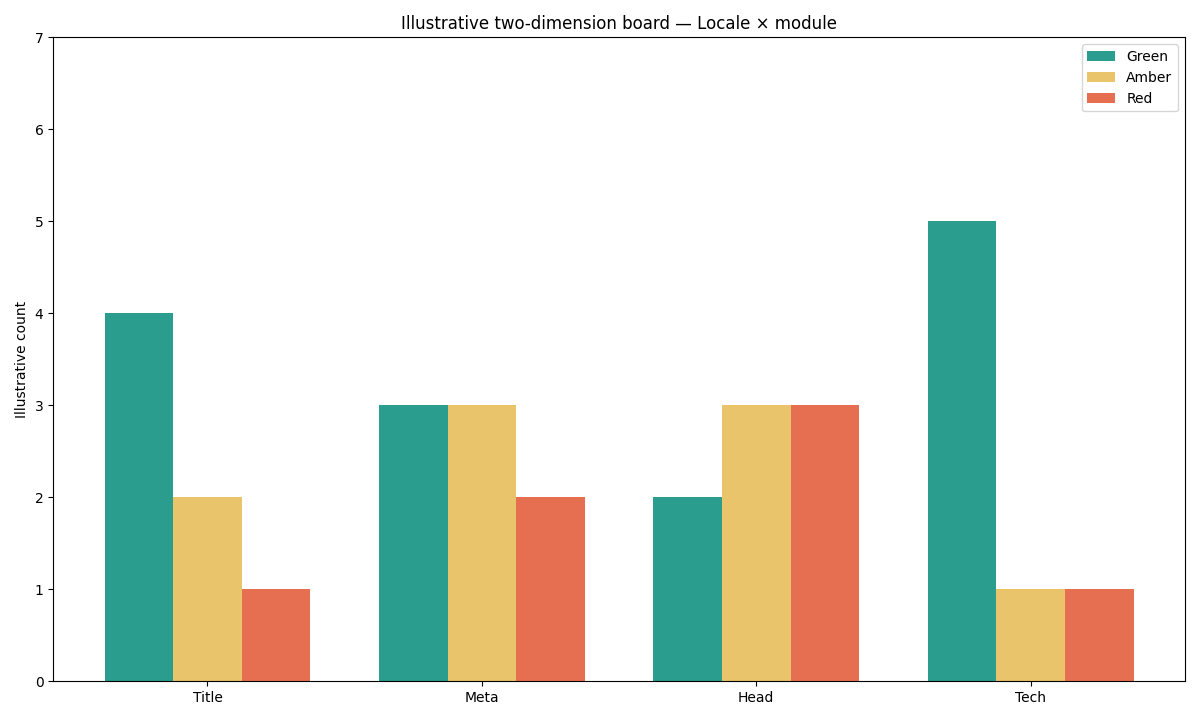
Figure: illustrative grouped bars — locale URL × module light. Two dimensions. Not a Google score and not a customer lift.
How to read the grouped bars
Each cluster is one locale URL. A tall red title bar on /zh/pricing means fix that title before you argue English density. A tall green headings bar on /en/pricing means that module did not fail on English, not that Chinese ranks.
If your multilingual SEO checker run differs, trust your run. The figure teaches the axes.
Selection scorecard
Score each row 0–2 when someone asks whether a multilingual SEO checker is the right tool today. A row at 0 means pick a different job.
| Question | 0 | 1 | 2 |
|---|---|---|---|
| Do you have one public locale URL to defend? | Homepage only, or a secret host | Staging with a public share | Live canonical locale |
| Do you need lights in about 30 seconds? | You need a week-long crawl | You can wait a few minutes | You need the board now |
| Are eight modules enough to start? | You need hreflang pairs or EEAT scores | You also need a later sample | Title through speed is the job |
| Can you assign a human to each red? | No owner | Shared inbox | Named owner per locale |
| Will you paste the next locale after the fix? | One screenshot and done | Maybe next sprint | Same day, next path |
Under 6 means pick another instrument. 8–10 means paste the first locale URL. A multilingual SEO checker is for one page and one board.
Failure modes that invent a language score
The first failure is pasting the homepage and expecting every locale. A multilingual SEO checker does not walk hreflang from one URL.
The second failure is averaging three boards into “the site is 70% multilingual.” Lights are per URL. An average is a story, not a measurement.
The third failure is starting EEAT by accident and then complaining about credits. The eight lights are free. The long write-up is not.
The fourth failure is treating a machine-translated draft as the shipped locale. Re-run the multilingual SEO checker on the canonical you put in the sitemap.
A 50–500 sitemap sample is a different product job.
Cluster guides for this pillar
Use the table as a routing sheet, not as homework.
| Job you actually have | Guide to open next | What this page will not do |
|---|---|---|
| Same lights, no locale story | SEO health checker hub | Invent a site language score |
| One URL, no locale frame | One URL SEO health check | Crawl the host |
| Nuxt public route | Nuxt SEO | Change the eight modules |
| Older on-page wording | On-page SEO tool / checker | Retarget those phrases here |
Open one row when you have that job.
Paste one locale URL, then the next
Read title, meta, headings, density, images, links, tech, and speed on the locale you will ship. Then paste the next public locale.
Run SEO Health CheckerFrequently Asked Questions
Is this an official Google language score?
Bottom line: No. A multilingual SEO checker is a first-party rule board with eight traffic lights on one locale URL. Google does not publish a site “language” number that this product reprints, and we will not invent one.
Should I paste the homepage and expect every locale?
Bottom line: No. Paste each public locale URL. The multilingual SEO checker does not infer /zh/... from /en/..., and it does not walk hreflang from the homepage.
Do credits change the eight lights?
Bottom line: No. Credits buy optional narrative, not a new light engine. The eight-module board stays deterministic. A model write-up must not silently replace red with green.
Does this replace an hreflang review?
Bottom line: No. Hreflang pairs and return tags are indexation work. This page stays with eight lights on one locale URL. Run a multilingual SEO checker for the punch list; take pairing to the indexation hub.
Conclusion
A multilingual SEO checker is eight lights on one public locale URL. Paste, wait about 30 seconds, fix red, re-run, then paste the next locale. That loop is the product. It is not a Google score, not a site language trophy, and not an hreflang crawl.
Keep the board in SEO Health. If you later want a credited write-up on the same URL, start that action on purpose from the InfiniSynapse web app after the lights are honest. Until then, the next useful click is the locale you are about to ship.