One URL SEO Health Check: Paste the Canonical Address
By William Zhu · Cofounder, InfiniSynapse · Last updated: 2026-09-10 · Last verified: 2026-09-10 · Methods: SEO Health checks at aimeetup.center — one public URL, about 30 seconds, eight-module lights. Not an official Google score. Observed CLI contract 2026-09-10 on
infinitegrowth@0.1.1:seo-health check --format jsoncan exit 0 whileissues[].statusiserror.
Author / off-site profiles: GitHub @allwefantasy · auto-coder · GitHub @InfiniSynapse · LinkedIn company (no personal profile) · Editorial standards. No personal LinkedIn or vendor badge. Product recognition: SEO Health Checker is one of two first-prize works in the InfiniSynapse × CSDN Vibe Coding contest (English recognition archive). InfiniSynapse co-hosted the contest. That list is not a review of this article.
Reviewed by: InfiniSynapse Data Team · method review 2026-09-10. First-party method review, not a third-party award.
Trust / COI: About · Corrections · Publishing principles · Privacy · Terms. SEO Health is commercial. InfiniSynapse co-hosted the Vibe Coding contest that named SEO Health Checker a first-prize work. The issues[] table below is observed. Topic desks stay illustrative. The InfiniSynapse Data Team publishes this desk method.
Table of Contents
- TL;DR
- What a one URL SEO health check actually covers
- The eight-module board on a single address
- One paste versus a sitemap sample
- Landscape of single-address checks in 2026
- How to run a one URL SEO health check in four steps
- Desk sample: homepage paste versus canonical paste
- Selection scorecard
- Failure modes that waste a paste
- Cluster guides beside this page
- Frequently Asked Questions
- Conclusion
TL;DR
Direct answer: A **one URL SEO health check** reads one public address and returns eight traffic lights — title, meta, headings, density, images, links, tech, and speed — in about 30 seconds. Paste the canonical URL you will ship. A homepage paste does not prove templates.
What you will learn: what a one URL SEO health check will and will not claim; why / is a different resource than /blog/slug; how one paste differs from a 50–500 sample; an illustrative address-type × module table; four repeatable steps.
Open https://aimeetup.center/seo-tools#check and paste the live canonical URL. For older on-page diagnosis language, use the on-page SEO tool page.
We evaluate one URL SEO health check hands-on as the InfiniSynapse Data Team. We build InfiniSynapse so eight-module lights stay in SEO Health. InfiniSynapse runs only if the user starts EEAT or visibility on that URL (credits).
What a one URL SEO health check actually covers
Key Definition: A one URL SEO health check is a single fetch of one public address that scores eight deterministic modules with red, amber, or green lights. It does not crawl the host, it does not infer sibling templates, and it does not invent an official Google health score.
Observed page CLI (2026-09-10, infinitegrowth@0.1.1): seo-health check https://infinisynapse.com/guides/what-is-agentic-analytics --format json --lang en exited 0. No warning or error on issues[]. Process exit 0 is still not a Google score.
issues[].name | issues[].status |
|---|---|
| H1 Tag | good |
| Title Length | good |
| URL | good |
| Robots.txt | good |
| Sitemap.xml | good |
| Image Alt Text | good |
| Meta Description | good |
| Page Structure | good |
The topic desk below stays illustrative.
Independent citation: According to [RFC 3986](https://www.rfc-editor.org/rfc/rfc3986), RFC 3986 defines the generic syntax of a URI, including the URL a crawler requests. IETF's RFC 3986 page is the third-party rule this write-up holds to. Illustrative desks below are not that rule.
People type one URL SEO health check when they changed a hero, a title, or a canonical and want a board. They want the page they are about to ship, not a million-page crawl.
The hub for the product name is the SEO health checker page. This cluster page is the scope rule: one address, one board, one claim. Stay here when someone pastes / and then announces the whole template family is green.
A public URL is the only honest input for this board, because the checker fetches the address you typed and does not invent sibling paths. A one URL SEO health check stops at that address.
The address you paste is the address you prove
If you paste the homepage, you proved the homepage. If you paste a localized path, you proved that locale. If you paste a preview with a token, you proved a secret you should not have pasted.
A one URL SEO health check will not infer hreflang from /. It will not certify /pricing because / went green. It will not certify a CMS template because one published row looked clean.
For older one-page diagnosis language, continue on the on-page SEO checker. Keep the first run on the canonical you put in the sitemap.
What the fetch can already see
That fetch travels over HTTP, so a blocked response is already a finding before any module light can turn green. A timeout, a 404, or a login wall is the result. Do not call it a failed product.
RFC 3986 is the URI standard that tells you why a trailing slash, a locale prefix, or a query string makes a different resource than the homepage you remembered. A one URL SEO health check respects that difference. Your habit of “just check the home” does not.
Tech looks at robots directives, canonical hints, and HTTPS on that response. Speed is a coarse load signal on that response. Neither row is a site certificate.
The eight-module board on a single address
Run a one URL SEO health check as a board, not as a grade. Read red first, then amber, then green. Fix the module that blocks understanding on this address before you polish density on a different path.
Two people who paste the same public URL should see the same lights. That repeatability is the point. A site-wide narrative is a different job.
Title, meta, headings, and density
Title and meta describe this URL to a result page. Headings describe it to a reader and a parser. Density flags stuffing and thin copy on the HTML that arrived.
A green title on / does not write the title on /blog/slug. A one URL SEO health check will not copy lights across templates. If you shipped a shared header and a unique H1, paste the unique URL.
Empty title, missing H1, or five H1s are assignable on this page. They are not a Google score. A one URL SEO health check reports this document only.
Images, links, tech, and speed
Images flag missing alt and obvious weight on this document. Links flag empty hrefs the checker can already see. Tech and speed read this response.
A green image light on the homepage hero does not prove alt text on a product gallery three routes down. Paste that gallery if that is the page you changed. The one URL SEO health check will not follow you there.
Eight-module lights stay in SEO Health. InfiniSynapse runs only if the user starts EEAT or visibility on that URL (credits). A one URL SEO health check does not start those jobs by existing.
One paste versus a sitemap sample
A one URL SEO health check answers what is wrong on this page. A sampled site audit answers what is wrong on a slice of the host. Mixing them wastes a week.
Use the single paste when you changed a title or a hero and want lights in about 30 seconds. Use a sample when the same template ships across dozens of URLs. The sample is 50–500 sitemap pages, not a million-page desktop crawl.
The single paste will not find a 404 that exists only on URL 187. Run the page you are editing first. A one URL SEO health check is not a sample.
If you later want the step list in more detail, open how to run an SEO health check. This page stays on the scope rule: one address.
If you later want the release habit, open SEO health check after deploy. A one URL SEO health check after a ship still proves only the URL you pasted.
Landscape of single-address checks in 2026
Suites sell a site file. Extensions sell a badge on whatever tab is open. A one URL SEO health check that only promises eight lights on one paste is easier to defend because it promises less.
Google's chapter on monitoring distributed systems treats one probe as a sample of one target, not a proof that every replica is healthy — the same humility applies to one paste.
IBM's explainer on a URL describes it as a locator, not as a site map, which is why a homepage paste cannot speak for a template family.
Google Cloud's note on web application architecture reminds you that routes, templates, and environments differ; checking / does not certify /blog/[slug].
Do not paste localhost, signed cloud URLs, or admin paths. Keep every one URL SEO health check on a public address you can stand behind.
Browser, CLI, and Chrome
Three doors, one address rule. The browser form teaches: paste, wait, read. The CLI repeats: seo-health check. Chrome stays local unless you start AI EEAT.
Install with npm i -g infinitegrowth. The CLI still checks one URL unless you switch to an audit sample. Do not confuse seo-health check with seo-health audit --pages 50-500.
If you are checking a localized page, paste that locale’s URL. A one URL SEO health check does not translate, and it does not hop hreflang.
How to run a one URL SEO health check in four steps
Eight-module lights stay in SEO Health. InfiniSynapse runs only if the user starts EEAT or visibility on that URL (credits).
The method below is the free board on one address, not a crawl or a credited memo.
Step 1 — Copy the canonical public address
Open the live page. Copy the address from the bar after redirects settle. Prefer the canonical you put in the sitemap over a campaign query string.
Open https://aimeetup.center/seo-tools#check. Paste that address. If you paste localhost, you did not run a one URL SEO health check that anyone else can repeat.
Step 2 — Wait about 30 seconds for eight lights
Give the run about 30 seconds. When the board settles, you should see title, meta, headings, density, images, links, tech, and speed.
If a module stays empty, treat that as a failed run. Re-paste once. A blocked fetch is already a finding. A one URL SEO health check that never fetched has no green to celebrate.
Step 3 — Read red and amber on this address only
Write every red module in one sentence, then amber. Ignore green until the red list is empty. Do not “also fix the homepage” unless the homepage was the paste.
Assign title to metadata owners, images to CMS media owners, and tech to whoever can change robots or canonicals on this URL.
Step 4 — Re-run the same address after the fix
Ship the edit. Paste the same URL. Compare lights. If title went green and tech went red, you did not finish.
If you shipped a template and only re-checked /, you still have not run a one URL SEO health check on the template URL. Paste the URL that changed.
Independent citation 2: According to [URL](https://en.wikipedia.org/wiki/URL), URL is documented in that encyclopedia article as a public third-party definition. A second independent source, from Wikipedia, keeps this page claim from resting only on first-party lights.
Desk sample: homepage paste versus canonical paste
The table is an illustrative desk composite, not a customer win. It records how two pastes looked during a one URL SEO health check at the InfiniSynapse desk on 2026-09-08 (DESK-IG109-20260908A).
| Address type | Red modules | Amber modules | Green modules |
|---|---|---|---|
Homepage / | 1 | 2 | 5 |
| Canonical article URL | 3 | 2 | 3 |
| Locale path | 2 | 3 | 3 |
| Preview with token (rejected) | 0 | 0 | 0 |
Two dimensions: address type × light count. Counts are module tallies on one paste each. We will not turn those ones into a percentage uplift.
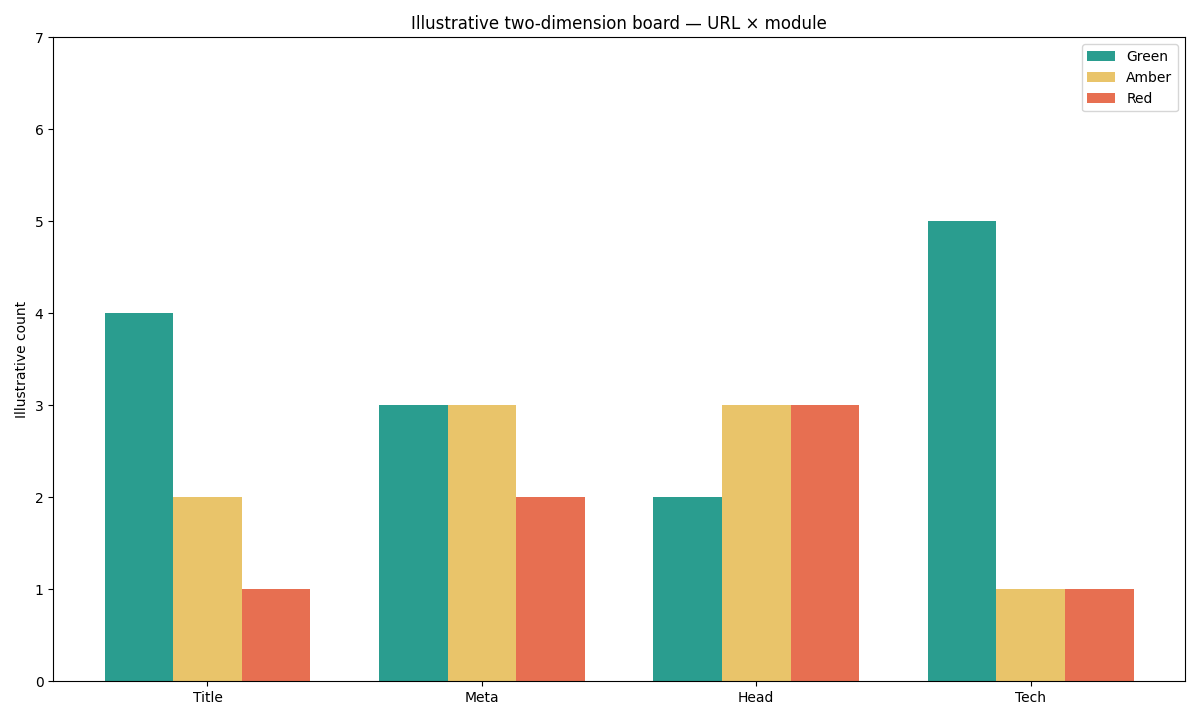
Figure: illustrative grouped bars — address type × red/amber/green counts. Two dimensions. Not a Google score and not a customer lift.
How to read the grouped bars
Each cluster is one address type. A short red bar on / and a tall red bar on the article URL is the lesson: the homepage paste hid the page you shipped.
If your one URL SEO health check differs, trust your run. The figure teaches the axes. The preview row is empty because the desk refused the secret URL.
Selection scorecard
Score each row 0–2 when someone asks whether a one URL SEO health check is the right tool today. A row at 0 means pick a sample or a different job.
| Question | 0 | 1 | 2 |
|---|---|---|---|
| Do you have one public canonical to defend? | No URL, or a secret host | Staging with a public share | Live canonical URL |
| Is this page the one that changed? | You changed a template and pasted / | You think it is the same | You copied the shipped address |
| Do you need lights in about 30 seconds? | You need a week-long crawl | You can wait a few minutes | You need the board now |
| Are eight modules enough to start? | You need backlinks or EEAT scores | You also need a later sample | Title through speed is the job |
| Will you re-run the same address? | One screenshot and done | Maybe next sprint | Same URL, same day |
Under 6 means pick another instrument. 8–10 means paste the URL that changed. A one URL SEO health check is for one page and one board.
Failure modes that waste a paste
The first failure is pasting / after you edited a template. The homepage can be green while the article URL is red. A one URL SEO health check will not warn you that you picked the wrong address; it will faithfully score the wrong address.
The second failure is pasting a URL nobody can open. Signed links, basic-auth admin, and localhost are not a public one URL SEO health check input.
The third failure is treating green as a rank promise or a site certificate. Eight lights on one URL are not an indexation guarantee.
The fourth failure is starting EEAT by accident and then complaining about credits. The eight lights are free. The long write-up is not. The paste itself is still one URL.
Cluster guides beside this page
This page is the scope rule. Open one row when you have that job.
| Job you actually have | Guide to open next | What this page will not do |
|---|---|---|
| Need the click-by-click paste | How to run an SEO health check | Repeat every button label |
| Check the page after a release | SEO health check after deploy | Become the CI pillar |
| Want the product name hub | SEO health checker | Re-teach every sibling |
| Sample 50–500 URLs | SEO website audit | Crawl a million pages |
| Someone wants a vanity 100 | SEO score checker | Print an official Google grade |
Paste the address you will actually ship
Run eight lights on one public canonical URL in about 30 seconds. A homepage paste does not prove a template.
Run SEO Health CheckerFrequently Asked Questions
Does a homepage paste prove every template?
Bottom line: No. A homepage paste proves the homepage. A one URL SEO health check does not infer sibling paths, shared templates, or other locales from /.
How long should the board take to settle?
Bottom line: About 30 seconds for eight modules on one public URL. If a module stays empty, treat the run as failed and re-paste once. A blocked fetch is already a finding.
Can I paste localhost or a signed preview?
Bottom line: No. Paste a public canonical address. Localhost, basic-auth admin, and signed cloud URLs are not a repeatable one URL SEO health check. Do not paste secrets.
Is this an official Google score?
Bottom line: No. A one URL SEO health check is a first-party rule board with eight traffic lights. Google does not publish a page “health” number that this product reprints, and we will not invent one.
Conclusion
A one URL SEO health check is eight lights on the address you pasted. Paste the canonical you will ship, wait about 30 seconds, fix red, re-run the same URL. A homepage paste does not prove templates. A green board is not a Google score and not a site crawl.
Keep the board in SEO Health. If you later want a credited write-up on that same URL, start that action on purpose from the InfiniSynapse web app after the lights are honest. Until then, the next useful click is the public address you are about to ship.