 InfiniSynapse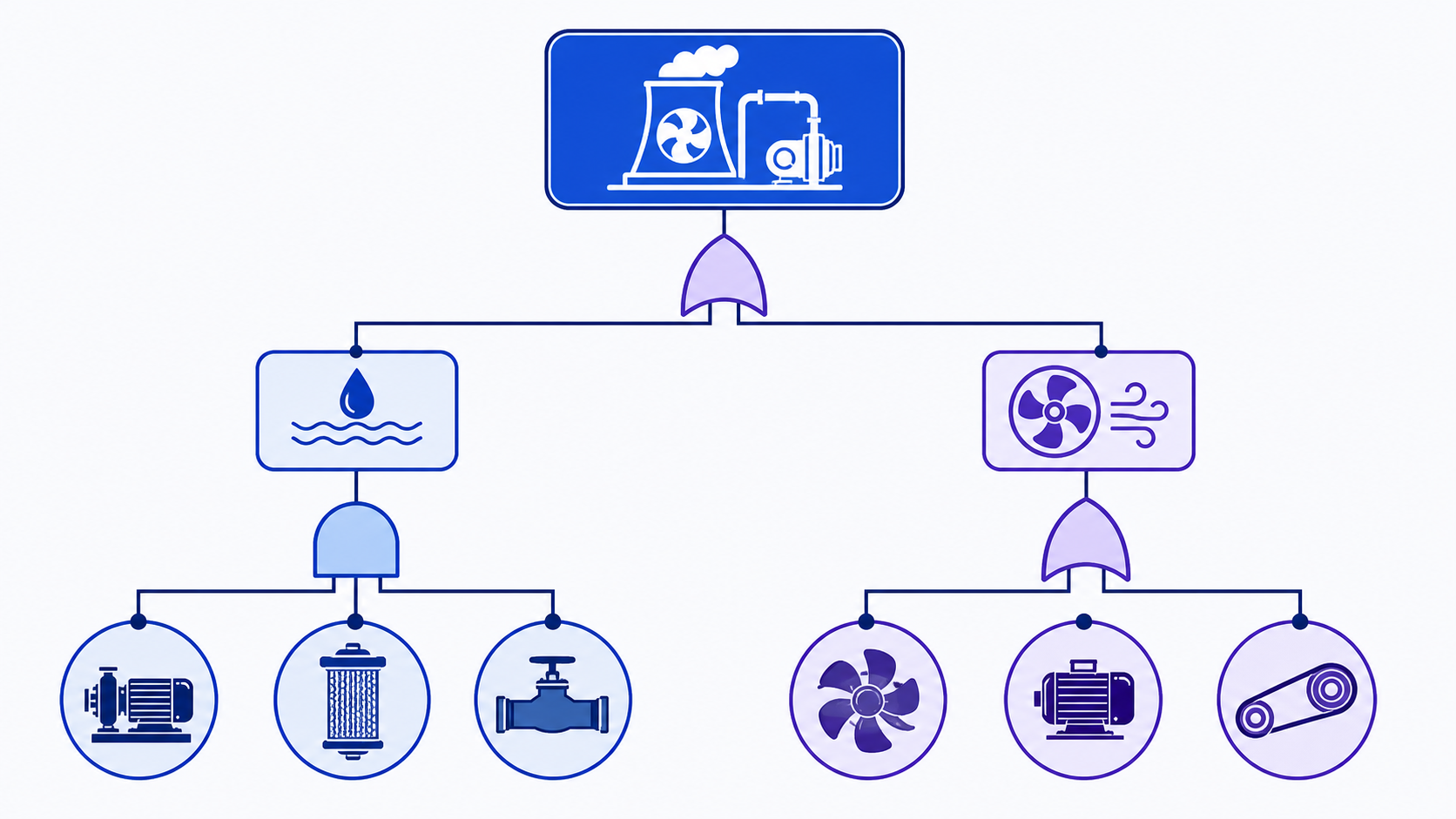
Fault tree analysis example: the quick answer故障树分析示例:快速回答
This fault tree analysis example is cooling lost during one demand: circulation fails through an AND gate, heat rejection through an OR gate. Minimal cut sets are {P, S, C}, {F}, {M}, and {B}. AND multiplies only under an independence assumption; shared causes need another model. Copy the tree below, then swap in your top event. With labeled hypothetical probabilities, top-event P is 0.044597, or about 4.46% per demand.
本故障树分析示例的顶事件是一次需求内冷却功能丧失:循环失效走 AND 门,散热失效走 OR 门。最小割集为 {P, S, C}、{F}、{M}、{B}。AND 只在独立性假设下相乘;有共因时不要套公式。先抄这棵树,再换成你的顶事件。假设概率下顶事件 P 为 0.044597,即每次需求约 4.46%。
Place this specific workflow in context with the anomaly detection and root cause analysis guide, which connects the definitions, alternatives, validation steps, and related implementation guides.
可通过异常检测与根因分析指南理解本专题在整体流程中的位置;该指南串联了定义、替代方案、验证步骤与相关实施文章。
What a fault tree analysis example actually shows故障树分析示例究竟展示什么
Fault tree analysis (FTA) is a deductive, top-down technique. You define a system state that must be prevented, then ask which immediate events are sufficient to produce it. Each intermediate event is decomposed until the team reaches basic events that are measurable, independently testable, outside the chosen scope, or intentionally left undeveloped. The U.S. Nuclear Regulatory Commission’s Fault Tree Handbook (NUREG-0492) remains a primary reference for constructing and evaluating fault trees.
故障树分析(FTA)是一种自上而下的演绎技术。首先定义必须防止的系统状态,再判断哪些直接事件足以导致它。每个中间事件继续分解,直到团队到达可测量、可独立检验、超出既定范围或被有意停止展开的基本事件。美国核管理委员会的 《Fault Tree Handbook (NUREG-0492)》是构建与评估故障树的一手参考资料。
There is a specific hazard or loss to explain; combinations and redundancy matter; reviewers need traceable logic; or qualitative causes must connect to quantitative risk.
需要解释特定危险或损失;事件组合与冗余很重要;审查者需要可追踪逻辑;或定性原因需要连接定量风险。
The problem is still vague, the process is exploratory, sequence after an initiating event matters more, or reliable probability and dependency data do not exist.
问题仍很模糊、过程处于探索阶段、初始事件之后的后果序列更重要,或缺少可靠概率与依赖数据。
Prepare the inputs before drawing the fault tree绘制故障树前准备输入与范围
A polished diagram cannot rescue a poorly bounded question. Record the system boundary, operating mode, mission or demand interval, environmental conditions, success criteria, exclusions, and evidence date. Collect architecture diagrams, functional descriptions, maintenance history, alarm and sensor data, test records, change logs, and known common-cause mechanisms. Assign one owner to maintain event names and definitions.
边界不清的问题无法靠精美图形挽救。应记录系统边界、运行模式、任务或需求区间、环境条件、成功标准、排除项与证据日期;收集架构图、功能说明、维护历史、告警与传感器数据、测试记录、变更日志,以及已知共因机制;并指定一名负责人维护事件名称与定义。
Top-event quality test: write one observable state, one system boundary, and one time basis. “Cooling is bad” is unusable. “Cooling function unavailable when demanded for 30 minutes in operating mode A” is testable.
顶事件质量测试:写清一个可观察状态、一个系统边界和一个时间基准。“冷却不好”无法使用;“运行模式 A 下需要连续 30 分钟冷却时功能不可用”才可检验。
Worked fault tree analysis example: cooling function lost完整故障树分析示例:冷却功能丧失
This is a hypothetical teaching example, not field reliability data or a safety claim. All probabilities refer to the same single-demand interval. The top event T occurs when water circulation is lost (W) or heat rejection is lost (H).
这是用于教学的假设示例,不代表现场可靠性数据或安全结论。所有概率均对应同一个单次需求区间。顶事件 T 在水循环丧失(W)或散热能力丧失(H)时发生。
- Water circulation lost, W: primary pump fails (P = 0.02) AND standby pump is unavailable (S = 0.10) AND bypass path remains closed (C = 0.05).水循环丧失 W:主泵失效(P = 0.02)AND 备用泵不可用(S = 0.10)AND 旁路保持关闭(C = 0.05)。
- Heat rejection lost, H: cooling fan fails (F = 0.03) OR fan motor fails (M = 0.01) OR drive belt breaks (B = 0.005).散热能力丧失 H:冷却风扇失效(F = 0.03)OR 风扇电机失效(M = 0.01)OR 传动带断裂(B = 0.005)。
The structure is therefore T = W ∪ H, W = P ∩ S ∩ C, and H = F ∪ M ∪ B. Before calculating, reviewers should challenge whether P, S, and C really are independent. A shared power supply, maintenance error, flooding, temperature, or control command could invalidate that assumption.
因此,结构为 T = W ∪ H、W = P ∩ S ∩ C、H = F ∪ M ∪ B。计算前,审查者必须质疑 P、S 与 C 是否真正独立。共享电源、维护错误、进水、高温或控制命令都可能使独立性假设失效。
How to build the fault tree step by step如何分步构建故障树
- Define the top event without implying a cause.定义顶事件,不要预设原因。Specify state, boundary, mode, and interval. Avoid combining several consequences in one box.说明状态、边界、模式与区间,避免把多个后果塞进同一事件框。
- Identify immediate sufficient causes.识别直接且充分的原因。Ask what conditions immediately below T can make it true. In this example, either W or H is sufficient.询问 T 下方哪些条件足以使其成立。本例中,W 或 H 任一成立即可。
- Choose gates from logic, not appearance.根据逻辑而非外观选择门。Use OR when any input is sufficient; use AND only when every named input is required. State assumptions for voting, inhibit, or sequence logic.任一输入足够时用 OR;只有所有输入都必需时才用 AND。表决、条件或顺序逻辑必须写明假设。
- Stop decomposition deliberately.有意识地停止分解。End at events with actionable ownership and usable evidence. Label undeveloped events; never hide missing knowledge as a basic event.在有明确责任与可用证据的事件处结束。标记未展开事件,不要把知识缺口伪装成基本事件。
- Find minimal cut sets and quantify carefully.识别最小割集并谨慎量化。Reduce the Boolean expression, use probabilities from a consistent basis, model dependencies, and retain calculation precision separately from reporting precision.化简布尔表达式,使用同一基准的概率,建模依赖关系,并区分计算精度与报告精度。
- Review, test, and control the model.复核、测试并受控管理模型。Trace every branch to evidence, invite operations and maintenance challenge, test sensitivity, version the tree, and record approvals.把每个分支追溯到证据,邀请运行与维护人员质疑,开展敏感性测试,对树进行版本控制并记录批准。
Fault tree probability calculation with AND and OR gates使用 AND 与 OR 门计算故障树概率
Under the explicit teaching assumption that all basic events are independent, multiply inputs at an AND gate:
在明确的教学假设——所有基本事件相互独立——下,AND 门的输入概率相乘:
P(W) = P(P) × P(S) × P(C) = 0.02 × 0.10 × 0.05 = 0.0001
For independent OR inputs, calculate the complement of none occurring:
对于相互独立的 OR 输入,先计算全部不发生的补事件:
P(H) = 1 − (1 − 0.03)(1 − 0.01)(1 − 0.005) = 0.0445015
The top event is also an OR gate:
顶事件同样是 OR 门:
P(T) = 1 − (1 − 0.0001)(1 − 0.0445015) = 0.04459704985 ≈ 4.46%
The minimal cut sets are {P, S, C}, {F}, {M}, and {B}. They are minimal because removing any member from {P, S, C} makes that combination insufficient, while each single event under H is already sufficient. The result suggests that heat-rejection single points dominate this simplified model—but that is a model observation, not proof of what will fail in the real system.
最小割集为 {P, S, C}、{F}、{M} 与 {B}。之所以“最小”,是因为从 {P, S, C} 中去掉任一事件,该组合就不再充分;而 H 下的每个单事件本身已足够。结果表明,在这个简化模型中,散热侧单点事件占主导,但这只是模型观察,并不是现实系统必然如何失效的证明。
Interpret the result without overstating precision解释结果时不要夸大精度
| Check检查项 | Question问题 | Action if weak不足时的行动 |
|---|---|---|
| Logic completeness逻辑完整性 | Could the top event occur through a path not shown?是否存在图中未显示但能导致顶事件的路径? | Run multidisciplinary review and operating-scenario walkthroughs.开展跨专业复核与运行场景走查。 |
| Probability basis概率基准 | Do inputs use the same interval, mode, population, and data date?输入是否采用相同区间、模式、总体与数据日期? | Normalize exposure and document uncertainty.统一暴露基准并记录不确定性。 |
| Dependencies依赖关系 | Do events share power, environment, maintenance, software, or operators?事件是否共享电源、环境、维护、软件或操作人员? | Add common-cause events or use a dependency model.增加共因事件或使用依赖模型。 |
| Sensitivity敏感性 | Does a plausible input range change priorities?合理输入范围是否会改变优先级? | Report ranges and rank stability, not one false-precision number.报告区间与排序稳定性,而不是一个虚假精确值。 |
For consequential engineering or safety decisions, use the controlling organizational and regulatory requirements. Independent event multiplication is inappropriate when dependency is material. Rare-event OR approximations may be useful for screening, but the exact complement formula is simple and avoids unnecessary approximation in small trees.
对于重要工程或安全决策,应遵循组织与监管的适用要求。当依赖关系显著时,不得直接相乘独立事件概率。稀有事件的 OR 近似可用于初筛,但小型故障树使用精确补事件公式同样简单,也能避免不必要的近似。
Fault tree analysis vs FMEA, fishbone, and event tree故障树分析与 FMEA、鱼骨图、事件树对比
| Method方法 | Direction and question方向与问题 | Best use最佳用途 |
|---|---|---|
| FTA | Top-down: what combinations can cause this top event?自上而下:哪些组合能导致该顶事件? | Boolean sufficiency, redundancy, cut sets, risk contribution.布尔充分性、冗余、割集与风险贡献。 |
| FMEA | Bottom-up: what effects follow each failure mode?自下而上:每种失效模式会产生什么影响? | Systematic component or process coverage and controls.系统覆盖部件或过程及其控制。 |
| Fishbone鱼骨图 | Exploratory: what cause categories should the team consider?探索式:团队应考虑哪些原因类别? | Facilitated brainstorming before evidence testing.证据检验前的引导式头脑风暴。 |
| Event tree事件树 | Forward: what outcomes follow an initiating event and barrier responses?向前:初始事件与屏障响应之后会出现哪些结果? | Consequence sequences and success/failure branches.后果序列与成功/失败分支。 |
Methods are often complementary. Use the related local guides in this content set to compare root cause analysis methods techniques, select a root cause analysis methodology, or evaluate RCA tool categories and governance criteria. Confirm their production deployment before replacing these repository-relative links with public URLs.
这些方法通常可以互补。可使用本内容集中的相关本地指南比较根因分析方法与技术、选择根因分析方法论,或评估 RCA 工具类别与治理标准。在把这些仓库相对链接替换为公开 URL 前,应确认对应页面已部署。
Common fault tree mistakes, limits, and risk controls常见故障树错误、局限与风险控制
- Ambiguous events: mixing causes, states, and consequences creates logic that cannot be tested. Use observable event statements.事件含糊:混合原因、状态和后果会产生无法检验的逻辑,应使用可观察事件陈述。
- Wrong gate: teams often use AND because events “contribute together,” even when any one is sufficient. Test necessity and sufficiency explicitly.逻辑门错误:团队常因事件“共同促成”就使用 AND,即便任一事件已足够。必须明确检验必要性与充分性。
- Hidden common cause: redundancy may be illusory when channels share power, cooling, software, location, maintenance, or human action.隐藏共因:当通道共享电源、冷却、软件、位置、维护或人为操作时,冗余可能只是表象。
- Mixed probability units: failure rate per hour, probability per demand, and unavailability are not interchangeable without a model.概率单位混用:每小时失效率、每次需求概率与不可用度不能在缺少模型时互换。
- Model treated as reality: a tree is a documented hypothesis about system failure. Validate it against incidents, tests, experts, and configuration changes.把模型当现实:故障树是关于系统失效的书面假设,必须用事件、测试、专家意见与配置变更验证。
Organize the evidence behind each fault-tree branch组织每个故障树分支背后的证据
Before opening InfiniSynapse, prepare the top-event statement, event dictionary, normalized timestamps, architecture files, maintenance records, alarms, sensor exports, test results, and access permissions. InfiniSynapse is an AI-assisted workspace for analysis across connected databases, files, documents, audio, and video. Use it to retrieve and compare prepared evidence, summarize timelines, and explore candidate explanations. It is not presented here as a certified FTA solver, and generated findings do not prove causation or replace qualified engineering review.
打开 InfiniSynapse 前,请准备顶事件陈述、事件词典、规范化时间戳、架构文件、维护记录、告警、传感器导出、测试结果与访问权限。InfiniSynapse 是用于分析已连接数据库、文件、文档、音频与视频的 AI 辅助工作区,可检索和比较已准备证据、汇总时间线并探索候选解释。本页不把它描述为认证 FTA 求解器;生成结果不能证明因果关系,也不能取代合格工程复核。
Open InfiniSynapse for connected evidence analysis打开 InfiniSynapse 分析关联证据Fault tree review checklist before approval批准前的故障树复核清单
- The top event names one observable state, system boundary, mode, and interval.顶事件明确一个可观察状态、系统边界、模式与区间。
- Every gate reflects necessity and sufficiency, not a visually convenient grouping.每个逻辑门都反映必要性与充分性,而非仅为视觉分组方便。
- Basic and undeveloped events are distinguishable, owned, and traceable to evidence.基本事件与未展开事件可区分、有负责人并可追溯到证据。
- Minimal cut sets have been reduced and checked for repeated-event logic.最小割集已化简,并检查了重复事件逻辑。
- Probabilities share a time basis; dependencies, uncertainty, and data limitations are documented.概率采用一致时间基准,依赖、不确定性与数据局限均已记录。
- Sensitivity results, model version, reviewers, approvals, and change triggers are retained.敏感性结果、模型版本、审查者、批准与变更触发条件均已保留。
Fault tree analysis example FAQ故障树分析示例常见问题
It is a worked, top-down model that starts with one undesired top event, decomposes credible causes with Boolean gates, identifies minimal cut sets, and may calculate the top-event probability for a defined interval.
它是一个完整的自上而下模型:从一个不期望顶事件开始,用布尔逻辑门拆解可信原因,识别最小割集,并可针对明确区间计算顶事件概率。
A cooling-function loss: circulation uses an AND gate, heat rejection uses an OR gate, then you list minimal cut sets and compute top-event probability under an independence assumption.
冷却功能丧失:循环用 AND 门,散热用 OR 门,再列出最小割集,并在独立性假设下计算顶事件概率。
Under the independence assumption, multiply probabilities at an AND gate. For an OR gate, use one minus the product of each input’s complement. Do not use these formulas when events share causes or dependencies.
对相互独立的输入,AND 门概率相乘;OR 门使用 1 减去所有输入补概率的乘积。当事件共享原因或存在依赖时,不得机械套用这些公式。
A minimal cut set is the smallest combination of basic events sufficient to produce the top event. Removing any event from that set makes the combination insufficient.
最小割集是足以导致顶事件的最小基本事件组合。从该集合中删除任一事件后,剩余组合将不足以导致顶事件。
No. FTA reasons backward from one defined undesired event, FMEA reasons forward from component failure modes, and a fishbone diagram organizes possible causes without expressing Boolean sufficiency. A filled multi-category case is this fishbone RCA example.
不等同。FTA 从一个明确不期望事件向后推理;FMEA 从部件失效模式向前分析;鱼骨图用于组织可能原因,但不表达布尔充分性。多类别的填好案例见这份鱼骨图 RCA 示例。
Official sources and verification notes官方来源与验证说明
- U.S. Nuclear Regulatory Commission — Fault Tree Handbook (NUREG-0492)美国核管理委员会——《Fault Tree Handbook (NUREG-0492)》
- NASA Software Engineering Handbook — Software Fault Tree AnalysisNASA 软件工程手册——软件故障树分析
These sources support the definitions and construction principles used here. Sector-specific standards, probability models, and approval requirements may differ; use the controlling requirements for your organization and jurisdiction.
这些资料支持本页采用的定义与构建原则。不同领域的标准、概率模型与批准要求可能不同;请以组织与管辖区的适用要求为准。