 InfiniSynapse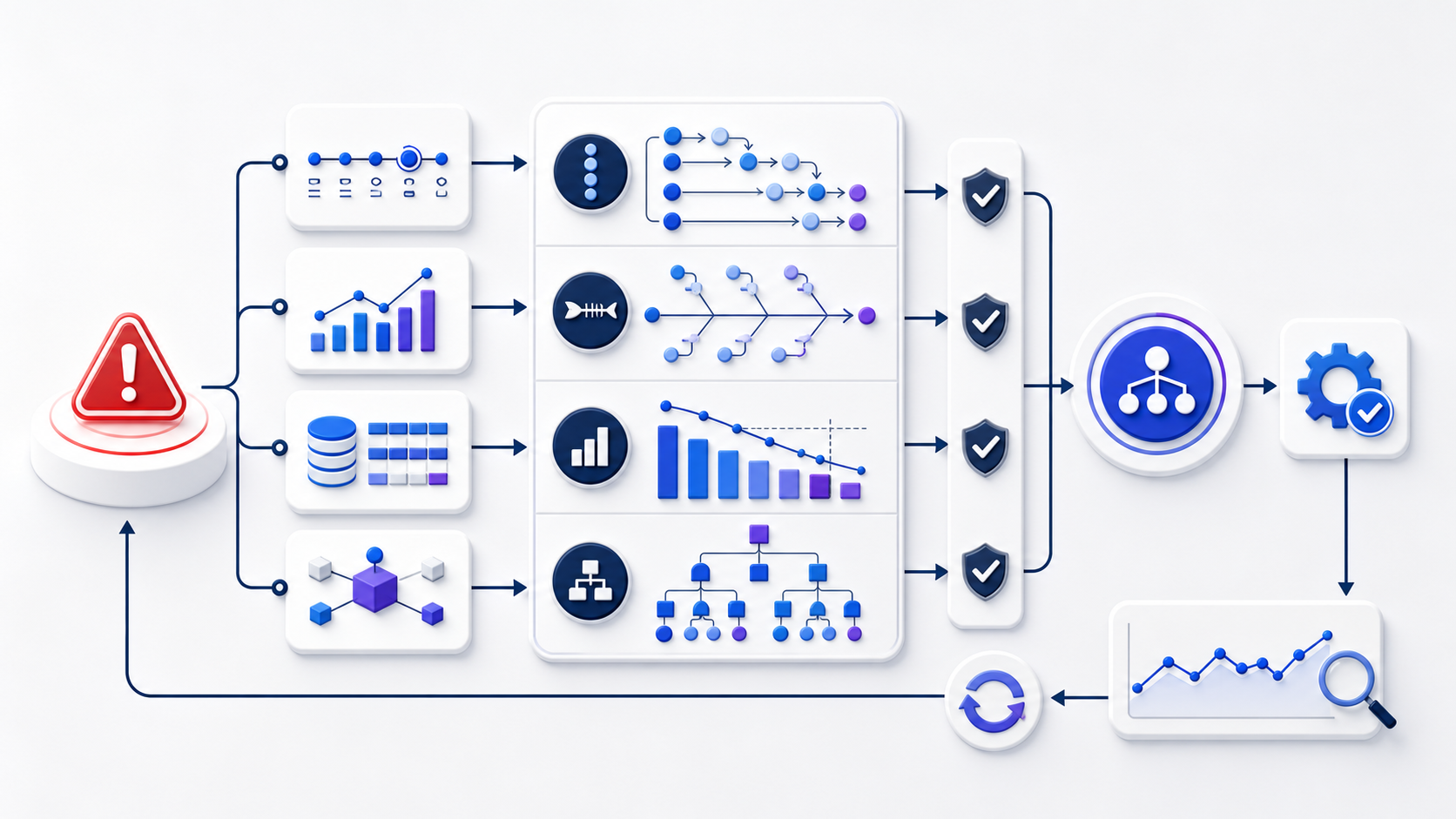
What should root cause analysis tools actually do?根因分析工具究竟应该完成什么?
For the full topic map and the neighboring methods that support this workflow, continue with the anomaly detection and root cause analysis guide. See what product categories detect anomaly signals before you pick a tool.
如需查看完整主题结构以及支撑本流程的相邻方法,请继续阅读异常检测与根因分析指南。
Root cause analysis tools should turn scattered incident information into a reviewable chain from evidence to decision, action, and measured outcome. A useful toolchain captures source material, separates observations from hypotheses, records why a cause was accepted or rejected, assigns corrective actions, and shows whether risk declined after the change. Diagramming methods are one component; the operating record around them is what makes an investigation reusable and auditable.
根因分析工具应当把分散的事件信息转化为一条可复核的链路:从证据到决策,再到行动和可衡量的结果。实用的工具链需要保存原始材料,区分观察与假设,记录某个原因为何被接受或排除,分派纠正措施,并显示变更后风险是否下降。分析图只是其中一环,围绕分析图建立的工作记录,才让调查结果能够复用和审计。
Choose the method in root cause analysis methods techniques. This page addresses a different decision from a method catalog. It is for teams deciding what to assemble, configure, or buy: a lightweight stack for occasional reviews, a controlled case system for regulated work, or a connected analysis environment for operational data. The objective is not to maximize features. It is to create the smallest dependable system that preserves context from the first alert through the effectiveness review.
方法选择见根因分析方法与技术。本页解决的是团队应当组合、配置或采购什么:用于偶发复盘的轻量工具组合、适合受监管工作的受控案件系统,或能连接运营数据的分析环境。目标是建立一套足够精简、同时值得信赖的系统,从第一条告警一直保留上下文到效果复核。
Define the investigation job before evaluating products评估产品之前,先定义调查任务
Begin with the decisions the investigation must support. A maintenance team may need to connect work orders, sensor readings, and replacement history. A data team may need query lineage, deployment events, logs, and ownership. A quality group may require approvals, electronic signatures, retention controls, and evidence exports. Calling all three requirements “RCA software” hides the differences that determine whether a product will work.
先明确调查需要支持哪些决策。维护团队可能需要关联工单、传感器读数与零件更换历史;数据团队需要查询血缘、部署事件、日志和负责人;质量团队则可能需要审批、电子签名、保留策略和证据导出。把这三类需求都简称为“RCA 软件”,会掩盖真正决定产品是否适用的差异。
Estimate monthly volume, severity range, average investigation duration, contributor count, confidentiality, and expected retention. Include both routine cases and rare high-consequence events.
估算每月案件量、严重程度范围、平均调查周期、参与人数、保密级别与保存期限,同时纳入常规案件和低频高后果事件。
List who decides scope, containment, cause acceptance, action approval, closure, and reopening. Each decision should have an accountable role and the evidence needed to make it.
列出谁决定范围、临时控制、原因接受、行动审批、结案与重新开启。每项决策都应有明确责任角色和所需证据。
Identify which records stay in source systems, which are linked, which are copied, and which become the official investigation record. This boundary controls integration and governance effort.
明确哪些记录保留在源系统、哪些只建立链接、哪些需要复制,以及哪些构成正式调查档案。这个边界决定集成与治理工作量。
Build the toolchain in six functional layers用六个功能层构建工具链
Most teams already own fragments of an RCA stack. The gap is usually not another canvas; it is the connection between intake, analysis, decision, and follow-up. Map current products to the six layers below before replacing anything. One product may cover several layers, while a controlled workflow may intentionally use separate specialist systems.
多数团队已经拥有 RCA 工具链的若干部件,缺口往往不是再买一个画布,而是打通受理、分析、决策和跟进。更换产品前,先把现有工具映射到下面六个层级。一个产品可以覆盖多层,受控流程也可能有意使用多个专业系统。
| Layer层级 | Core job核心任务 | Minimum artifact最低产物 | Failure signal失效信号 |
|---|---|---|---|
| Intake受理 | Create a case from an alert, complaint, defect, or review request从告警、投诉、缺陷或复核请求创建案件 | Timestamped problem record带时间戳的问题记录 | Cases begin in chat with no owner案件从聊天开始且无人负责 |
| Evidence证据 | Reference sources without losing origin, time, unit, or version引用来源且保留出处、时间、单位和版本 | Evidence register证据登记表 | Screenshots cannot be traced back截图无法追溯原始来源 |
| Reasoning推理 | Structure hypotheses, relationships, tests, and contradictions组织假设、关系、检验与矛盾信息 | Cause-and-test log原因与检验记录 | Brainstormed ideas appear as facts头脑风暴想法被当作事实 |
| Decision决策 | Record findings, dissent, review, approval, and closure rationale记录结论、异议、复核、审批和结案理由 | Signed decision record已确认的决策记录 | Final slides differ from the case最终汇报与案件记录不一致 |
| Action行动 | Assign controls with owners, dates, dependencies, and status为控制措施设置负责人、日期、依赖和状态 | Corrective-action register纠正措施登记表 | Closure means tasks were merely created创建任务就被视为结案 |
| Learning学习 | Verify outcomes and aggregate patterns across cases验证结果并跨案件汇总模式 | Effectiveness review有效性复核 | The same event returns under a new label同类事件换个名称再次发生 |
Design the case record before the interface先设计案件记录,再讨论界面
A polished interface cannot rescue an ambiguous data model. Define the objects and relationships that must survive export, handoff, and audit. At minimum, keep observations, evidence items, hypotheses, tests, findings, contributing conditions, actions, and verification results as distinct record types. A hypothesis can be plausible without being confirmed; an action can be complete without being effective. Combining those states creates misleading dashboards.
精美界面无法挽救含糊的数据模型。先定义在导出、交接和审计后仍必须保留的对象与关系。至少应把观察、证据项、假设、检验、结论、促成条件、行动和验证结果作为不同记录类型。假设可以合理但尚未确认,行动可以完成但尚未有效;把这些状态混在一起会产生误导性的仪表盘。
- Identity: stable case, evidence, action, and decision IDs that do not change when titles are edited.标识:案件、证据、行动与决策应有稳定 ID,修改标题时不能改变。
- Provenance: source system, collector, collection time, original timezone, units, transformation, and attachment checksum where appropriate.来源:记录源系统、采集人、采集时间、原始时区、单位、转换过程,并在适当时保存附件校验值。
- Reasoning status: proposed, being tested, supported, contradicted, accepted, or rejected—with an explanation and reviewer.推理状态:建议、检验中、获支持、有矛盾、已接受或已排除,并附说明和复核人。
- Change history: who changed a consequential field, when, what changed, and why. Comments are not a substitute for version history.变更历史:记录谁在何时修改了关键字段、修改内容与原因;评论不能替代版本历史。
Turn workflow risks into testable requirements把流程风险转化为可测试需求
Avoid requirements such as “easy to use,” “AI powered,” or “supports collaboration.” They cannot distinguish a strong demonstration from dependable daily operation. Write each requirement as a user, action, condition, expected result, and proof. For example: “When an investigator cites a chart value, a reviewer can open the source record, see the applied filters and units, and reproduce the value without administrator access.”
不要只写“易用”“AI 驱动”或“支持协作”等无法验证的要求,它们无法区分精彩演示与可靠日常运行。每条需求都应写清用户、动作、条件、预期结果和证明方式。例如:“调查人员引用图表数值后,复核人无需管理员权限即可打开源记录,查看所用筛选条件与单位,并复现该数值。”
Test a late-arriving log, a corrected attachment, two events with similar names, a departed action owner, a reopened case, restricted evidence, and an export requested months later. These edge cases reveal more than a scripted feature tour.
测试迟到日志、更正后的附件、名称相近的两起事件、已经离职的行动负责人、重新开启的案件、受限证据,以及数月后的导出请求。这些边界情况比标准功能演示更能揭示产品能力。
Separate requirements into capability, control, and service expectations. Capability describes the task a user must complete; control describes how access, approval, history, or validation constrains it; service expectations cover availability, recovery, support, and change notice. Give each item an owner, priority, acceptance test, and permitted workaround. This structure prevents a useful feature from masking an unacceptable control gap, and it makes tradeoffs visible when no candidate satisfies every preference. Record deferred requirements as explicit risks with review dates rather than letting them disappear after selection.
把需求分为能力、控制和服务三类:能力说明用户要完成的任务,控制说明权限、审批、历史或验证如何约束任务,服务则覆盖可用性、恢复、支持和变更通知。每项都要有负责人、优先级、验收测试和允许的替代方案。未满足的需求应作为带复核日期的明确风险保留,不能在选型后悄然消失。
Connect sources without creating a second system of truth连接数据源,但不要制造第二套事实系统
Integration should reduce transcription while preserving authority. Decide whether each connection needs a live query, a versioned snapshot, a deep link, an event subscription, or a one-time import. Live data is useful for current conditions but may change after the investigation; a snapshot preserves what reviewers saw but can become detached from corrections. Consequential investigations often need both: a frozen evidentiary view plus a link to the current source.
集成应减少重复录入,同时保留权威来源。逐一决定连接方式:实时查询、版本快照、深层链接、事件订阅或一次性导入。实时数据适合查看当前状态,却可能在调查后发生变化;快照能保留复核人当时看到的内容,却可能与后续更正脱节。重要调查通常两者都要:冻结的证据视图,加上指向当前源记录的链接。
Prioritize identity and time before advanced analytics. Consistent asset IDs, service names, customer identifiers, locations, and timezones make correlation possible. Document refresh frequency, late-data behavior, deletion handling, retry policy, field ownership, and what happens when a connector fails. A silent partial import is more dangerous than an explicit outage because it can make an incomplete timeline look complete.
高级分析之前,先解决标识与时间问题。统一的资产 ID、服务名、客户标识、位置和时区,才能支持可靠关联。还要记录刷新频率、迟到数据处理、删除处理、重试策略、字段责任方,以及连接器失败时的行为。静默的部分导入比明确中断更危险,因为它会让不完整时间线看起来完整。
Match governance controls to consequence让治理控制与调查后果相匹配
Not every retrospective needs formal case management, and not every investigation belongs in a shared whiteboard. Classify work by consequence, sensitivity, and external obligation. Low-risk learning reviews may favor speed and broad participation. Safety, privacy, financial, employment, or regulated cases may require restricted evidence, legal holds, segregation of duties, approval gates, and controlled exports. Apply stronger controls where the decision justifies them instead of making every case equally heavy.
并非每次复盘都需要正式案件管理,也并非所有调查都适合放在共享白板。应按后果、敏感度与外部义务进行分类。低风险学习型复盘可以强调速度和广泛参与;涉及安全、隐私、财务、雇佣或监管的案件,可能需要证据限制、诉讼保全、职责分离、审批门槛和受控导出。根据决策后果加强控制,而不是让所有案件都同样沉重。
Use case-level roles, restricted attachments, time-bound guest access, and periodic access review. Verify what search, notifications, exports, and backups expose—not only the case screen.
使用案件级角色、受限附件、限时访客访问和定期权限复核。除了案件页面,还要验证搜索、通知、导出和备份会暴露什么。
Define retention by case class, pause deletion when required, and test whether linked source evidence remains available for the full period.
按案件类别设置保存期限,需要时暂停删除,并测试所链接的源证据在整个期限内是否持续可用。
Version templates, fields, scoring rules, automations, and integrations. A workflow change should not silently reinterpret historical performance.
对模板、字段、评分规则、自动化与集成进行版本管理,流程变化不应悄然改变历史绩效的含义。
Score root cause analysis tools with evidence, not impressions用证据而不是印象为根因分析工具评分
Use a weighted scorecard only after setting pass-or-fail gates. Security, residency, accessibility, exportability, or required approvals may be non-negotiable. Among products that pass, weight criteria according to the actual case profile. Ask evaluators to record the test performed, result, limitation, and supporting screenshot or export. A score without evidence turns procurement into a memory contest.
先设置通过或淘汰条件,再使用加权评分表。安全、数据驻留、无障碍、可导出性或必要审批可能是不可妥协项。对通过门槛的产品,再按实际案件画像赋权。要求评估者记录测试内容、结果、限制,以及支持结论的截图或导出文件。没有证据的分数,只会让采购变成记忆力比赛。
| Criterion指标 | Example weight示例权重 | Evidence to collect应收集证据 |
|---|---|---|
| Evidence traceability证据可追溯性 | 20% | Reproduce a cited value and inspect revision history复现引用数值并检查修订历史 |
| Workflow fit流程适配 | 20% | Complete a real case with intended roles由预定角色完成一个真实案件 |
| Governance治理 | 15% | Test restricted evidence, approvals, audit, and export测试受限证据、审批、审计与导出 |
| Integration resilience集成韧性 | 15% | Interrupt a connector and reconcile late records中断连接器并核对迟到记录 |
| Adoption effort采用成本 | 15% | Measure task time, errors, and help requests测量任务耗时、错误与求助次数 |
| Lifecycle cost全周期成本 | 15% | Model licenses, configuration, support, storage, and exit估算许可、配置、支持、存储与退出成本 |
Run a pilot that includes the difficult parts让试点覆盖真正困难的环节
A credible pilot uses several completed or carefully de-identified cases, not a clean fictional scenario. Select cases with different evidence types, severity, team boundaries, and outcomes. Recreate the work from intake to effectiveness review. Include a case that reached no single root cause, a case with conflicting evidence, and a case that was reopened. The product must support uncertainty without forcing a neat but false answer.
可信试点应使用多个已完成或经过谨慎去标识的案件,而不是过于整洁的虚构场景。选择具有不同证据类型、严重程度、团队边界和结果的案例,从受理一直重建到有效性复核。至少包含一个没有单一根因的案件、一个证据冲突的案件,以及一个重新开启的案件。产品必须允许不确定性存在,而不是强迫团队给出整齐但错误的答案。
A hospital toolchain has to cover healthcare root cause capabilities: one timeline, the clinical record, and CAPA follow-through before the case closes.
医院工具链必须覆盖医疗根因能力:结案前要有一条时间线、临床记录,以及 CAPA 的后续跟踪。
- Baseline the current process.建立当前流程基线。 Measure elapsed time, investigator effort, missing fields, handoffs, overdue actions, and time spent preparing reports. 测量总周期、调查投入、缺失字段、交接、逾期行动和报告准备时间。
- Configure only what the pilot needs.只配置试点真正需要的内容。 Excess customization can disguise weak defaults and inflate future maintenance. 过度定制会掩盖默认能力不足,并抬高后续维护成本。
- Observe real users.观察真实用户。 Record workarounds, duplicate entry, misunderstood states, abandoned fields, and places where users return to spreadsheets or chat. 记录变通做法、重复录入、被误解的状态、被放弃的字段,以及用户返回表格或聊天工具的环节。
- Review outcomes after the novelty fades.新鲜感消退后再复核结果。 Check record quality, action follow-through, reviewer confidence, support load, and whether the pilot changed decisions—not just presentation. 检查记录质量、行动落实、复核信心、支持负担,以及试点是否改变了决策,而不只是改变展示形式。
Evaluate AI as an assistant inside the evidence boundary在证据边界内评估 AI 助手
AI can reduce search and synthesis work by clustering similar cases, extracting events, proposing questions, summarizing interviews, or identifying records that changed near an incident. Evaluate each function separately. Measure retrieval coverage, citation accuracy, time saved, false omissions, and the rate at which reviewers accept, edit, or reject suggestions. A fluent narrative is not a cause finding.
AI 可以通过聚类相似案件、提取事件、建议问题、总结访谈或识别事故附近发生变化的记录,减少搜索与整理工作。每项能力都应单独评估,测量检索覆盖率、引用准确率、节省时间、错误遗漏,以及复核人接受、修改或拒绝建议的比例。语言流畅的叙述并不等于原因结论。
Require source-level citations, visible confidence or uncertainty where meaningful, permission-aware retrieval, prompt and model change controls, and a way to reproduce material outputs. Keep humans accountable for scope, evidence interpretation, cause acceptance, and corrective action. Test for sensitive-data leakage, unsupported claims, automation bias, and performance drift using a representative case set before enabling broader use.
应要求输出提供源级引用,在有意义时显示置信度或不确定性,按权限检索,并对提示词与模型变更进行控制,同时能够复现重要输出。范围设定、证据解释、原因接受和纠正措施仍应由人员负责。扩大使用前,要用具有代表性的案件集测试敏感数据泄露、无依据断言、自动化偏见和性能漂移。
Treat rollout as an operating-model change把推广视为运行模式的改变
Software will not create investigative discipline on its own. Assign a product owner for configuration and integrations, a process owner for investigation policy, data owners for connected sources, and reviewers for consequential cases. Publish a short case-classification rule, a minimum evidence standard, clear closure criteria, and an escalation path when the team cannot obtain required evidence.
软件不会自动带来调查纪律。应分别明确配置与集成的产品负责人、调查政策的流程负责人、连接数据源的数据负责人,以及重要案件的复核人。发布简短的案件分类规则、最低证据标准、明确结案条件,并在团队无法取得必要证据时提供升级路径。
Train with decisions rather than menus. Let participants classify a case, challenge a hypothesis, request missing evidence, approve an action, and reopen an ineffective closure. Provide role-specific checklists and office hours during the first cycles. Review templates monthly at first, then less often once the workflow stabilizes. Remove fields that never inform a decision; add controls only when observed risk warrants them.
培训应围绕决策,而不是菜单。让参与者练习案件分类、质疑假设、请求缺失证据、批准行动,以及重新开启无效结案。最初几个周期提供按角色编写的检查表和答疑时段。开始时每月复核模板,流程稳定后降低频率。删除从不影响决策的字段,只在观察到的风险确有需要时增加控制。
Measure investigation quality, not case throughput alone衡量调查质量,而不只看案件处理量
More closed cases can mean better flow, premature closure, or a change in classification. Pair speed metrics with quality and outcome measures. Track time to containment, time waiting for evidence, proportion of findings with linked tests, overdue high-risk actions, action effectiveness, reopen rate, recurrence by failure pattern, reviewer disagreement, and evidence completeness. Segment results by case type and consequence so easy reviews do not hide difficult ones.
结案数量增加,可能代表流程改善,也可能是过早结案或分类发生变化。速度指标必须与质量和结果指标配对。可以跟踪控制问题所需时间、等待证据时间、附有检验依据的结论比例、高风险行动逾期率、行动有效性、重新开启率、按失效模式统计的复发率、复核意见分歧和证据完整度。结果应按案件类型与后果分组,避免简单复盘掩盖困难调查。
Logins, active users, and completed templates show whether the system is used. They do not show whether decisions improved. Link adoption metrics to record quality, control strength, recurrence, loss avoided, or another outcome that the organization can define consistently.
登录数、活跃用户和已完成模板只能说明系统是否被使用,不能说明决策是否改善。应把采用指标与记录质量、控制强度、复发、避免损失或其他可稳定定义的结果联系起来。
Establish metric definitions before launch and keep a change log when definitions evolve. Decide which clock stops during evidence waits, how linked incidents are counted, what qualifies as recurrence, and when an action becomes effective. Review a sample of records behind every dashboard; otherwise improved completeness may reflect a newly required field rather than better investigation. Use trends for learning and resource decisions, not investigator league tables. Individual rankings encourage teams to choose easy cases, close work early, or avoid recording uncertainty—the opposite of what a trustworthy RCA program needs.
上线前先固定指标定义,定义变化时保留变更日志。明确等待证据时是否暂停计时、关联事件如何计数、什么算复发、行动何时才算有效。每个仪表盘都应抽查底层案件,否则完整度提升可能只是新增必填字段。趋势应用于学习和资源决策,不要用来给调查人员排名,以免诱发挑选简单案件、过早结案或隐藏不确定性。
Plan migration and exit before signing签约之前就规划迁移与退出
Root cause analysis records may remain valuable longer than the software contract. Request a representative export during evaluation and inspect relationships, attachments, timestamps, comments, permissions, history, and stable identifiers. Determine whether exports are readable without the vendor, whether APIs cover the same objects as the interface, and how bulk extraction is priced and rate-limited. Document the process for legal hold, account termination, region change, and vendor outage.
根因分析记录的价值可能超过软件合同期限。评估期间就应索取具有代表性的导出文件,并检查关系、附件、时间戳、评论、权限、历史和稳定标识。确认无需供应商即可阅读导出内容,API 是否覆盖界面中的同类对象,以及批量提取如何计费和限速。同时记录诉讼保全、账户终止、区域变更与供应商中断时的处理流程。
Calculate lifecycle cost beyond licenses: configuration, identity management, connector maintenance, data storage, training, support, audit preparation, template governance, upgrades, and eventual migration. A lower subscription price can be expensive if investigators rebuild context manually or administrators spend each release repairing custom workflows.
全生命周期成本不能只看许可证,还要包含配置、身份管理、连接器维护、数据存储、培训、支持、审计准备、模板治理、升级与最终迁移。如果调查人员必须手工重建上下文,或管理员每次版本发布都要修复定制流程,那么较低订阅价格也可能更加昂贵。
Frequently asked questions about root cause analysis tools根因分析工具常见问题
Do we need dedicated RCA software?我们是否需要专用 RCA 软件?
Not always. Low-volume, low-risk reviews may work with a controlled template, shared evidence folder, action tracker, and clear ownership. Dedicated software becomes more valuable when cases are frequent, cross-functional, sensitive, regulated, evidence-heavy, or difficult to follow through after the meeting.
不一定。低频、低风险复盘可以使用受控模板、共享证据目录、行动跟踪器和明确责任。案件频繁、跨团队、敏感、受监管、证据量大,或会议后难以持续跟进时,专用软件的价值更高。
Should one product cover the entire RCA process?是否应由一个产品覆盖整个 RCA 流程?
Only if it performs each required layer well and preserves traceability between them. Many teams use source systems for evidence, a case system for decisions, and work management for actions. The important requirement is a stable cross-system record, clear ownership, and a way to reconstruct the investigation.
只有当一个产品能良好完成每个必要层级,并保留层级间可追溯关系时才适合。很多团队让源系统保存证据、案件系统记录决策、工作管理工具跟踪行动。关键是跨系统记录稳定、责任清晰,并能重建调查过程。
What is the most important RCA software capability?RCA 软件最重要的能力是什么?
For most teams, it is traceability: a reviewer can move from a finding to the test, evidence, source, decision, corrective action, and effectiveness result. The exact interface matters less than preserving that chain accurately through revisions, exports, and handoffs.
对多数团队而言,最重要的是可追溯性:复核人可以从结论追到检验、证据、来源、决策、纠正措施和有效性结果。具体界面不如在修订、导出与交接后仍准确保留这条链路重要。
How long should an RCA tool pilot run?RCA 工具试点应持续多久?
Run long enough to complete several representative cases through effectiveness review, not merely cause selection. Calendar length depends on case frequency and action lead time. Set exit criteria in advance, including record quality, user effort, governance tests, integration reliability, support load, and measurable decision improvement.
试点要持续到多个代表性案件完成有效性复核,而不只是选出原因。日历时间取决于案件频率和行动周期。应提前设置退出条件,包括记录质量、用户投入、治理测试、集成可靠性、支持负担和可衡量的决策改善。
Can AI replace an RCA facilitator or reviewer?AI 能否替代 RCA 主持人或复核人?
AI can help retrieve, organize, and summarize information, but it should not own consequential judgments about scope, causation, acceptable risk, or closure. Keep source inspection, competing explanations, permission controls, human approval, and post-action verification in the workflow.
AI 可以帮助检索、组织和总结信息,但不应负责范围、因果、可接受风险或结案等重要判断。流程中仍需保留源材料检查、替代解释、权限控制、人工批准和行动后验证。
Official sources and verification notes官方来源与验证说明
- AHRQ Patient Safety Network primer on root cause analysis
- NIST Privacy Framework for managing privacy risk
- CISA secure software development attestation resources
These sources support the systems-oriented RCA framing and the governance questions used in this guide. The six-layer architecture, scorecard weights, pilot design, and lifecycle recommendations are editorial synthesis and should be adapted to organizational policy, applicable law, risk, and current vendor documentation. Product capabilities and external requirements can change; verify them before a consequential purchase or investigation.
这些来源支持本指南所采用的系统导向 RCA 思路与治理问题。六层架构、评分权重、试点设计和生命周期建议属于编辑性整理,应结合组织政策、适用法律、风险和当前供应商文档进行调整。产品能力与外部要求可能变化,重要采购或调查前应再次核验。