Data Analysis Glossary in 2026: 40 Terms Explained
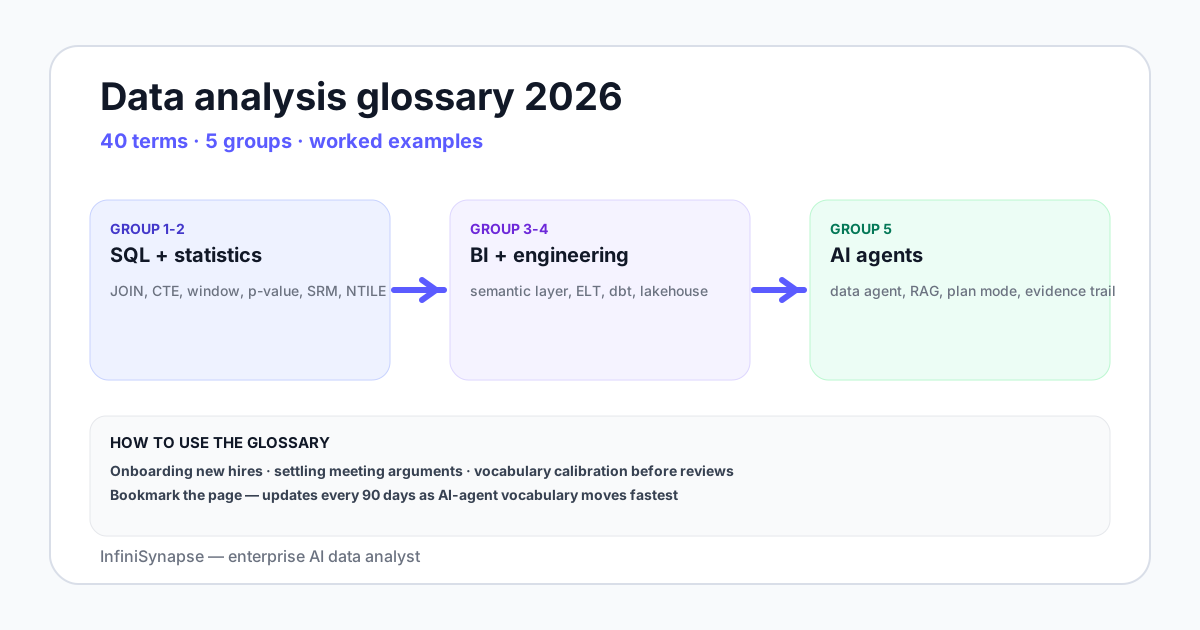
- A working glossary of 40 data analysis terms, grouped into SQL, statistics, BI and reporting, data engineering, and AI agents.
- Each term has a one-sentence definition, a one-sentence worked example, and where relevant, a link to a deeper guide.
- The list is opinionated — terms a working data analyst meets weekly in 2026, not an exhaustive encyclopedia.
- Use it to onboard a new hire, settle a meeting argument, or sanity-check vocabulary before a stakeholder review.
- Bookmark the page; the glossary updates every 90 days as terms migrate (e.g., "data lakehouse" replacing parts of "data warehouse").
SQL terms — the eight that come up daily
| Term | Definition | Example |
|---|---|---|
| GROUP BY | Collapse rows into one row per group, with aggregates over the rest | SELECT region, COUNT(*) FROM orders GROUP BY region |
| HAVING | Filter groups after aggregation; WHERE filters rows before | HAVING SUM(amount) > 1000 |
| INNER JOIN | Return only rows matched on both sides of the join key | orders o JOIN customers c ON c.id = o.customer_id |
| LEFT JOIN | Keep all rows from the left table; NULLs where right has no match | "customers who have not ordered" → LEFT JOIN with WHERE orders.id IS NULL |
| CTE | Named result set used in a later SELECT — readable multi-step logic | WITH monthly AS (...) SELECT * FROM monthly |
| Window function | Compute over a window of rows without collapsing — ranks, running totals | RANK() OVER (PARTITION BY region ORDER BY revenue DESC) |
| UPSERT / MERGE | Insert if new, update if existing, in one statement | MERGE INTO dim_customer USING src ON ... WHEN MATCHED THEN UPDATE |
| NULLIF | Guard divisions against zero by returning NULL when input matches | revenue / NULLIF(customers, 0) |
The deeper walkthrough is in SQL for data analysis. The software question is answered on best SQL analytics software for data analysis.
Statistics terms — the eight an analyst needs in a stand-up
| Term | Definition | Example |
|---|---|---|
| p-value | Probability of seeing data this extreme if the null hypothesis is true | "p < 0.05" is the conventional but flawed cutoff for significance |
| Confidence interval | Range that contains the parameter with stated confidence | 95% CI for conversion rate: [3.2%, 3.7%] |
| Sample size / power | Number of observations needed to detect an effect of a given size | "We need 50,000 users per arm to detect a 1% lift at 80% power" |
| SRM | Sample Ratio Mismatch — assignment split deviates from intended | 49.2% vs 50.8% might signal broken randomization |
| NTILE / quantile | Bucket rows into N equal-sized groups | Income quintiles via NTILE(5) |
| Cohort retention | Share of an entry cohort still active at time N | "% of signup cohort still active 90 days later" |
| Cohort vs segment | Cohort = same entry time; segment = same attribute | "March signups" vs "iOS users" |
| Standard error | Estimated standard deviation of a sample statistic | SE of mean = SD / sqrt(n) |
BI and reporting terms — the eight that anchor dashboards
| Term | Definition | Example |
|---|---|---|
| Semantic layer | Shared business definitions of metrics across BI consumers | "Active customer = ordered in last 90 days" |
| Dimension / measure | Dimension = how you split; measure = what you sum or count | Dimension: region. Measure: revenue. |
| Drill-down | Move from aggregated view to constituent rows | Click a region's revenue → see orders by city |
| Slowly changing dimension | How dimension attributes change over time — Type 1 overwrite, Type 2 history | Customer plan history tracked Type 2 for cohort analysis |
| Fact / dim table | Fact = events with measures; Dim = descriptive attributes | orders (fact) joined to customers (dim) |
| Star schema | One fact table joined to multiple dimension tables | orders fact + customer / product / time dims |
| YoY / WoW | Year-over-year, week-over-week period comparison | "Revenue up 14% YoY" |
| OLAP cube | Pre-aggregated structure across dimensions | Modern equivalent: materialized aggregate tables |
Data engineering terms — the eight pipeline regulars
| Term | Definition | Example |
|---|---|---|
| ELT / ETL | Extract-Load-Transform vs Extract-Transform-Load | Modern default for cloud warehouses is ELT |
| dbt | Transformation framework — SQL models, tests, docs | dbt staging / intermediate / mart pattern |
| CDC | Change Data Capture — only the changed rows since last sync | Postgres logical replication feeding the warehouse |
| Reverse-ETL | Push warehouse data into operational tools like CRMs | Hightouch, Census syncing account scores to Salesforce |
| Data contract | Producer-consumer agreement on schema and SLA | "orders.id will not be reused; deletes are soft" |
| Lakehouse | Single platform combining warehouse and lake capabilities | Databricks Delta Lake |
| Schema drift | Source schema changes that break downstream models | New column added upstream; dbt staging absorbs it |
| Materialized view | Stored query result, refreshed on a schedule or trigger | Snowflake materialized view for repeatedly hit aggregates |
Deeper coverage in SaaS data platform, the data integration platform architecture memo, and the warehouse loader scorecard.
AI agent terms — the eight that came into common use in 2025–2026
| Term | Definition | Example |
|---|---|---|
| Data agent | AI agent that reads, queries, and reasons over structured data | Plans, runs SQL, verifies, returns evidence |
| NL2SQL | Natural language to SQL translation | "What was revenue last month?" → SELECT ... FROM orders |
| RAG | Retrieval-augmented generation — model retrieves context before answering | Agent retrieves business glossary before drafting SQL |
| Knowledge base binding | Pair database with curated business definitions an agent reads as tool | The differentiator described in database + KB binding |
| Plan mode | Agent presents a plan for human review before executing | "I will join orders to customers on ... — approve?" |
| Verification step | Independent query that cross-checks the main result | Count rows two ways; surface a gap if they disagree |
| Evidence trail | Plan + code + result + verification + sources, stored together | The audit-grade artifact for regulated workflows |
| Agentic analytics | BI shifted from pre-modeled questions to planner-executor-verifier loops | Detailed in agentic analytics explained |
How to use this glossary
- Onboard a new hire. Send the link; ask them to flag terms they cannot define in one sentence after reading.
- Settle a meeting argument. "When you said cohort, did you mean signup cohort or feature cohort?" — point to the row.
- Sanity-check vocabulary before a review. Skim before a stakeholder meeting; calibrate to the audience.
- Bookmark the changes. The list updates every 90 days; the AI-agent section moves fastest.
See agentic analytics terms in action
Connect a small Postgres or MySQL database read-only. Seed a business glossary. Ask one question and watch which glossary entries show up in the answer trail — plan mode, RAG retrieval, knowledge base binding, verification step, evidence trail, all visible together.
Try InfiniSynapse onlineFAQ
Methodology and review notes
Last updated: 2026-06-28 · Next scheduled review: 2026-09-28
This glossary draws on vendor documentation from PostgreSQL, MySQL, Snowflake, BigQuery, dbt Labs, and the major BI vendors; statistics references including Ron Kohavi experimentation literature and the American Statistical Association statement on p-values; AI agent research from Anthropic and the ReAct paper; and field experience defining these terms in onboarding and review settings across multiple data teams. The selection is opinionated toward terms used weekly in 2026.
Conflict of interest: InfiniSynapse publishes this guide and sells an enterprise AI data analyst. To reduce bias, the page leads with the topic itself, treats InfiniSynapse as one option among many, and links to external sources for every numeric claim.
Update cadence: Reviewed every 90 days for accuracy and link health.
Sources and references
- [Vendor] PostgreSQL. Documentation. postgresql.org/docs.
- [Vendor] Snowflake. Documentation. docs.snowflake.com.
- [Vendor] dbt Labs. Documentation. docs.getdbt.com.
- [Independent] American Statistical Association. Statement on p-values. amstat.org p-value statement.
- [Independent] Yao et al. ReAct: Synergizing Reasoning and Acting in Language Models. arxiv.org/abs/2210.03629.
- [Vendor] Anthropic. Building Effective Agents. anthropic.com/research/building-effective-agents.
- [Standard] NIST. AI Risk Management Framework. nist.gov/itl/ai-risk-management-framework.
- [Independent] BIRD-SQL benchmark. bird-bench.github.io.