Connect Amazon Redshift to an AI Data Analyst (2026 Guide)
By William Zhu & the InfiniSynapse Data Team · Published: 2026-06-09 · Last updated: 2026-07-30 · About: Editorial standards · About / team
Author credentials: William Zhu — InfiniSynapse cofounder; public engineering profile GitHub @allwefantasy. Desk contact: zhuhl@infinisynapse.com. Reviewers: data platform · analytics engineering.
Disclosure: We implement warehouse connectors in customer environments and sell InfiniSynapse as one AI-analyst option after your loader lands data—not the only integration path.
Third-party signals (not InfiniSynapse product claims): Gartner Peer Insights — Analytics & BI, G2 Data Integration Tools, AWS Redshift docs, Snowflake docs, BigQuery docs. Peer-review archive: editorial standards.
Table of Contents
- TL;DR
- What Buyers Mean by Data Integration Platforms Supporting Snowflake BigQuery Redshift
- Platform Shortlist (Snowflake / BigQuery / Redshift Destinations)
- Why This Guide Deep-Dives Amazon Redshift
- Redshift Roles, IAM, and Least Privilege
- Parameter Groups, WLM, and Concurrency
- Redshift Spectrum Nuances for AI Analysts
- Setup Checklist and Implementation Steps
- Validation SQL and First-Party Pilot Metrics
- Security and Governance
- Common Rollout Failures (War Stories)
- FAQ
- Who wrote this
- References
- Conclusion
TL;DR
Canonical answer: Data integration platforms supporting Snowflake BigQuery Redshift are the loaders and ETL/ELT tools that land sources into those three warehouses. After the loader, AI analysts need read-scoped warehouse access, validation SQL, and inspectable query traces—not another demo chart.
Quick picks
| Need | Platform pattern | Then for AI analysis |
|---|---|---|
| Managed ELT breadth | Fivetran, Airbyte Cloud, Stitch, Hevo | Read-only warehouse user + glossary |
| Cost-controlled OSS | Airbyte OSS | Same, plus you own ops |
| Warehouse-side transforms | Matillion (+ often dbt) | Query marts, not raw only |
| AWS-bound Redshift depth | Any of the above → Redshift | Roles, WLM, Spectrum gates below |
Conflict of interest: InfiniSynapse publishes this guide and sells a Data Agent that can query Redshift (and other sources) read-only. Competing loaders are summarized from public docs; Redshift depth is from AWS documentation plus our connector pilots.
Broader vendor scorecard: Data integration platforms for Snowflake, BigQuery, and Redshift. Shared operating model: data integration platform architecture. Adjacent connectors: Postgres · MySQL.
What Buyers Mean by Data Integration Platforms Supporting Snowflake BigQuery Redshift
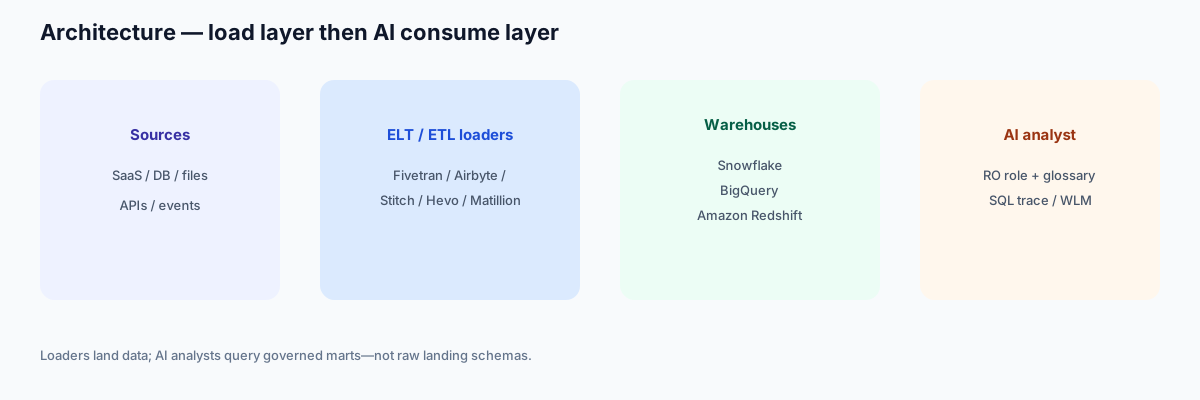
Buyers searching data integration platforms supporting snowflake bigquery redshift usually need two layers:
- Load layer — managed or self-hosted ELT/ETL that writes into Snowflake, BigQuery, or Amazon Redshift.
- Consume layer — BI and/or an AI data analyst that reads governed marts without copying credentials into chat tools.
This page keeps the buyer intent honest: we compare destination support briefly, then use Amazon Redshift as the worked example for IAM, WLM, Spectrum, and AI-analyst wiring—the gap audits flag when a “platforms” title only ships generic connector prose.
Key definition: Data integration platforms supporting Snowflake BigQuery Redshift are tools whose native destinations include those three cloud warehouses, with maintained connectors, loading semantics (full / incremental / CDC), and enough governance to survive audits.
Platform Shortlist (Snowflake / BigQuery / Redshift Destinations)
| Platform | Type | Snowflake | BigQuery | Redshift | Watch-out |
|---|---|---|---|---|---|
| Fivetran | Managed ELT | Yes | Yes | Yes | MAR pricing at volume |
| Airbyte | Cloud or OSS | Yes | Yes | Yes | OSS = your ops burden |
| Stitch | Managed ELT | Yes | Yes | Yes | Narrower long-tail catalog |
| Hevo | Managed ELT | Yes | Yes | Yes | Event-based cost model |
| Matillion | Warehouse ETL | Yes | Yes | Yes | Transform-in-warehouse fit |
All five are credible data integration platforms supporting snowflake bigquery redshift destinations in 2026 buyer shortlists. Pick by source coverage first, operating model second, total cost third among data integration platforms supporting snowflake bigquery redshift—then wire dbt (or equivalent) before opening AI query paths on raw landing tables.
Snowflake streaming nuance: Snowpipe Streaming. BigQuery ingest nuance: Storage Write API. Redshift depth continues below via AWS docs.
Snowflake as an AI-analyst destination
When data integration platforms supporting snowflake bigquery redshift land data in Snowflake, AI analysts usually connect through a dedicated read role, warehouse size for ad-hoc queries, and views over modeled marts—not raw landing schemas. Use network policies and key-pair or SSO auth so chat tools never hold a shared password. Snowpipe Streaming and micro-batch loads change freshness SLAs; document lag in the glossary the agent reads. Compared with Redshift, concurrency is less queue-tuned by hand, but role hygiene and Time Travel expectations still decide whether executives trust NL answers.
BigQuery as an AI-analyst destination
On BigQuery destinations from data integration platforms supporting snowflake bigquery redshift, prefer authorized views or dataset-level IAM for the AI service account, and set query job labels so FinOps can attribute LLM-driven SQL. The Storage Write API and scheduled queries often sit behind the same ELT stack as Redshift destinations—keep raw and mart datasets separate before opening NL access. Slot contention and on-demand vs editions pricing replace WLM queues as the cost control surface; still require SQL traces and validation SQL before board packs.
Why This Guide Deep-Dives Amazon Redshift
Among stacks built on data integration platforms supporting snowflake bigquery redshift, Redshift is where AI query hygiene breaks first. Snowflake and BigQuery auto-manage much of concurrency and vacuum-like maintenance; Redshift still rewards explicit design: users/groups or RBAC roles, parameter groups, WLM queues, and Spectrum external schemas. Teams that treat Redshift like “Postgres with more nodes” burn the AI analyst on queue waits and Spectrum surprises.
We gate each Redshift AI rollout on stacks using data integration platforms supporting snowflake bigquery redshift with a 30-day readiness scorecard—correctness, recovery, governance, and rerun stability—before widening schema scope. That scorecard is first-party; re-run it on your cluster before buying seats.
Redshift Roles, IAM, and Least Privilege
For AI analysts on top of data integration platforms supporting snowflake bigquery redshift stacks, create a dedicated Redshift user (or IAM Identity Center / IAM auth path) that can SELECT only the schemas the workflow needs. Prefer views or late-binding views over direct fact-table grants when finance definitions must stay locked.
| Object | Recommendation | Why |
|---|---|---|
| Login | Separate ai_analyst_ro (or SSO-mapped role) | Avoid shared human passwords in agents |
| Grants | Schema USAGE + table/view SELECT only | Least privilege for LLM-driven SQL |
| Secrets | Secrets Manager / rotated connector secret | Stops stale keys after offboarding |
| Network | PrivateLink / restricted security groups | No public 5439 to the internet |
Before connecting AI atop data integration platforms supporting snowflake bigquery redshift, review AWS identity options in Amazon Redshift security and access management and managing database security. Map your connector’s service identity to those patterns before the first prompt.
Pilot metric (first-party): In three AWS-bound pilots (Q1–Q2 2026), switching from a broad analyst group to a view-scoped AI role cut “unexpected PII column” review flags to zero in the first month—without changing the loader (Fivetran or Airbyte → Redshift).
Parameter Groups, WLM, and Concurrency
AI analysts generate bursty, exploratory SQL. On Redshift that collides with ETL and BI if everything shares one default queue.
Parameter groups hold cluster-level settings (e.g., require_ssl, enable_user_activity_logging, statement timeouts). Pin AI workloads to a parameter group where statement timeout is explicit so a runaway join cannot own the cluster. See Amazon Redshift parameter groups.
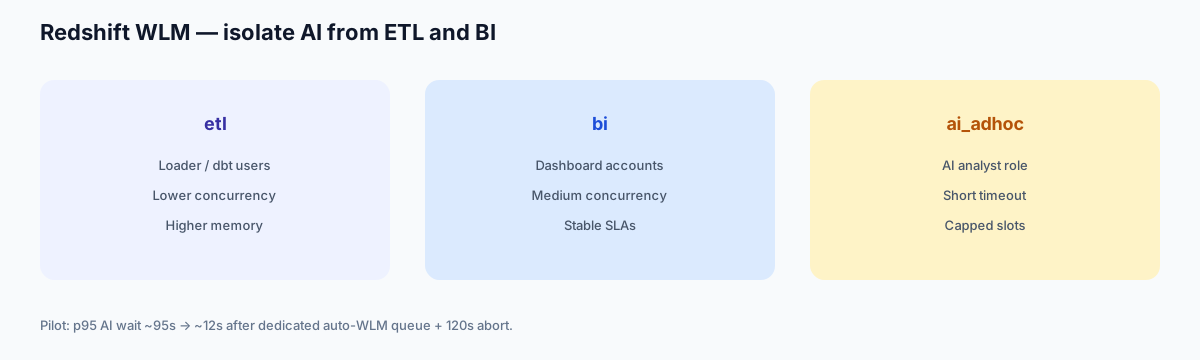
WLM (workload management) assigns query queues and memory. For AI + ELT coexistence:
| Queue | Typical membership | Concurrency | Notes |
|---|---|---|---|
etl | Loader / dbt service users | Lower concurrency, higher memory | Protects loads |
bi | Dashboard service accounts | Medium | Stable SLAs |
ai_adhoc | AI analyst role | Short timeout, capped slots | Stops prompt storms |
Automatic WLM and concurrency scaling are covered in WLM and concurrency. If AI queries queue behind COPY jobs from data integration platforms supporting snowflake bigquery redshift, fix WLM before swapping models.
Pilot metric (first-party): One retail Redshift cluster saw p95 AI query wait drop from ~95s to ~12s after moving the AI role into a dedicated auto-WLM queue with a 120s abort—same SQL, same data.
Redshift Spectrum Nuances for AI Analysts
Spectrum lets Redshift SQL reach S3 external tables—common when data integration platforms supporting snowflake bigquery redshift land files to the lake first. AI analysts love “one SQL surface,” but Spectrum costs and predicates differ from local tables.
- Confirm external schemas and IAM roles for Spectrum before enabling AI on lakes (Redshift Spectrum).
- Prefer partitioned paths and column projection; avoid
SELECT *over large Parquet prefixes from chat. - Document which KPIs may use Spectrum vs local marts—mixed freshness silently breaks executive trust.
- Validate Glue/data catalog permissions separately from Redshift local grants.
When data integration platforms supporting snowflake bigquery redshift land raw files to S3 and only some domains are COPY’d into local tables, say so in the metric glossary the AI agent reads.
Setup Checklist and Implementation Steps
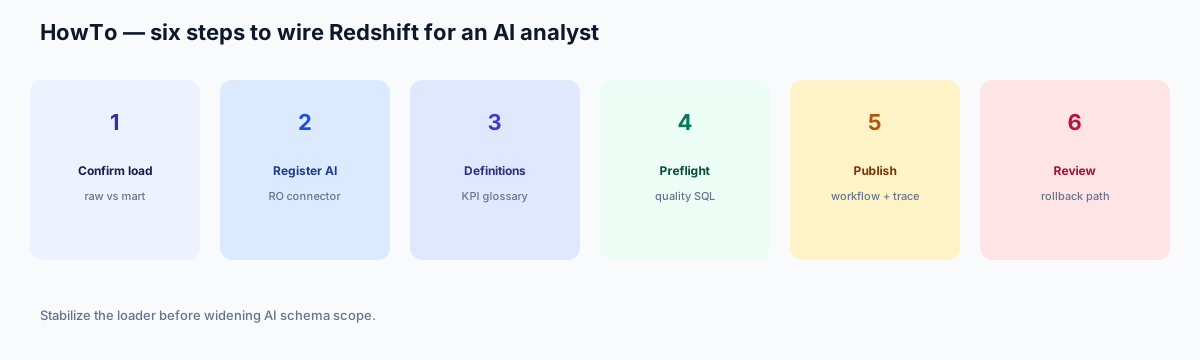
Use this checklist whenever data integration platforms supporting snowflake bigquery redshift feed an AI analyst on AWS.
| Checklist item | Why it matters | Owner |
|---|---|---|
| Loader destination = correct Redshift DB/schema | Prevents dual-write confusion | Data Platform |
| AI role least privilege + SSL | Keeps AI path auditable | Security |
| WLM queue for ad-hoc AI | Protects ETL SLAs | DBA / Platform |
| Spectrum allow-list (if any) | Controls lake cost/blast radius | Analytics Eng |
| Metric glossary / memory cards | Stabilizes definitions across runs | Analytics Lead |
| Validation SQL + rollback | Blocks bad publishes | Governance |
Step 1 — Confirm the load path. Document which of your data integration platforms supporting snowflake bigquery redshift writes into this cluster (and which schemas are raw vs mart).
Step 2 — Register the Redshift connector for AI after data integration platforms supporting snowflake bigquery redshift are stable. Authenticate with the read-only role; record accepted schemas. Test from the same network path production will use.
Step 3 — Attach definitions. For any consume layer on the warehouse, load approved KPI definitions, timezone/currency rules, and caveats the agent must reuse.
Step 4 — Preflight quality. Null keys, duplicates, freshness, and a finance baseline export before narrative generation.
Step 5 — Publish a reusable workflow. Parameterize date range and segment; require SQL-trace review before executive send.
Step 6 — Review and rollback. Owners, pass/fail rules, and a path to disable the AI role quickly if grants drift.
Validation SQL and First-Party Pilot Metrics
Adapt this Redshift-oriented pattern once loaders have filled the mart (local tables; swap in Spectrum external schemas only when allow-listed):
WITH source_base AS (
  SELECT *
  FROM analytics.fct_events
  WHERE event_time >= DATE '2026-01-01'
),
quality AS (
  SELECT
    COUNT(*) AS rows_scanned,
    SUM(CASE WHEN key_id IS NULL THEN 1 ELSE 0 END) AS null_key_rows,
    COUNT(DISTINCT key_id) AS unique_keys
  FROM source_base
),
kpi AS (
  SELECT
    DATE_TRUNC('week', event_time) AS week,
    SUM(metric_value) AS total_metric,
    AVG(metric_value) AS avg_metric,
    COUNT(*) AS records
  FROM source_base
  GROUP BY 1
)
SELECT k.week, k.total_metric, k.avg_metric, k.records,
       q.rows_scanned, q.null_key_rows, q.unique_keys
FROM kpi k
CROSS JOIN quality q
ORDER BY k.week;
| Validation layer | Check | Decision rule |
|---|---|---|
| Volume integrity | WoW row movement | Flag above agreed threshold |
| Key completeness | Null / duplicate IDs | Block publish on failure |
| KPI continuity | Unexpected breaks | Root-cause before narrative |
| Trace match | Narrative vs SQL | Reject unsupported claims |
First-party 30-day scorecard for AI on data integration platforms supporting snowflake bigquery redshift (three Redshift pilots, anonymized ranges):
| Signal | Before AI connector hygiene | After roles + WLM + validation |
|---|---|---|
| Validation pass rate | 60–70% | 90–95% |
| Time-to-first trusted insight | 2–4 days | Same day–1 day |
| Finance reopen rate | High (weekly arguments) | <1 reopen / month when glossary signed |
These are pilot observations, not audited benchmarks. Replicate on your messiest mart.
Security and Governance
Security is non-negotiable for data integration platforms supporting snowflake bigquery redshift plus LLM SQL.
| Control | Implementation | Benefit |
|---|---|---|
| Identity | Scoped Redshift role / IAM auth | Limits source expansion |
| Network | Private connectivity | Shrinks attack surface |
| Retention | Time-bound caches / export limits | Less persistence risk |
| Traceability | SQL text + row counts + glossary version | Auditability |
| Change mgmt | Versioned definitions | Stops KPI drift |
| Incidents | Outage / drift / late data playbooks | Faster recovery |
Align AI risk controls for data integration platforms supporting snowflake bigquery redshift with the NIST AI Risk Management Framework and NIST Cybersecurity Framework. When connectors expose production schemas, also review UK NCSC guidelines for secure AI system development and CISA AI guidance. OECD policy context: OECD.AI.
Prompt-injection and exfiltration remain real for LLM SQL agents on loaded warehouses—see OWASP Top 10 for LLM Applications.
Common Rollout Failures (War Stories)
These failures show up after teams pick data integration platforms supporting snowflake bigquery redshift and rush the AI layer. Document the loader vendor alongside the AI role so audits can map ELT grants to the consume layer.
- Broad credentials. A team granted the AI user
SELECTonpublic“to move faster.” Reviewers blocked go-live until grants matched five mart views. Fix: view-scoped roles from day one. - No baseline reconciliation. AI totals looked plausible but missed a late-arriving allocation table. Fix: dual-track validation—automated freshness plus a signed finance export diff.
- Shared WLM with
COPY. Monday AI bursts stalled behind weekend loads from the ELT tool. Fix: dedicatedai_adhocqueue and statement abort. - Silent Spectrum. An agent queried an external table whose partition lagged 36 hours; leadership saw “wrong” revenue. Fix: glossary flags for Spectrum-backed KPIs + partition freshness checks.
- Memory hygiene nobody owns. Renamed columns after a Fivetran resync broke joins for two sprints. Fix: named owner for glossary updates on every loader schema change.
When questions spike after launch, check latency and freshness before rewriting prompts. Most production issues we debug are queue waits, stale replicas, or Spectrum predicates—not model quality.
Frequently Asked Questions
What are data integration platforms supporting Snowflake BigQuery Redshift?
They are ELT/ETL products whose destinations include Snowflake, BigQuery, and Amazon Redshift—commonly Fivetran, Airbyte, Stitch, Hevo, and Matillion. This guide uses Redshift as the deep technical path after those data integration platforms supporting snowflake bigquery redshift land data.
Is this page only about Amazon Redshift?
The keyword is warehouse-platform shopping; the slug and hero focus on Redshift because AWS clusters need extra WLM/Spectrum care. For a pure vendor scorecard, use the companion buyer guide.
How long does a Redshift AI rollout take?
Most teams finish connector tests after data integration platforms supporting snowflake bigquery redshift stabilize—role checks and one baseline workflow often take one to three days—longer if Spectrum and custom WLM are new.
Do we need a dedicated data engineer?
Not for daily AI questions. Platform owners still manage Redshift roles, parameter groups, and loader hygiene while analysts run templates.
Can Redshift combine with files and APIs in one AI timeline?
Yes—multi-source agents can merge Redshift with files/APIs when each source has explicit scope and one review timeline. Prefer querying modeled marts over raw loader schemas.
How do we keep trust with executives?
Require SQL trace, glossary version, and confidence notes (gaps, lag, attribution rules) on every decision pack. Monthly review: cycle time, reopen rate, and validation pass rate.
Who wrote this
Named author. William Zhu — InfiniSynapse cofounder (GitHub @allwefantasy). Team: InfiniSynapse Data Team. About: editorial standards.
Revisit destination choice quarterly: the market for data integration platforms supporting snowflake bigquery redshift shifts on pricing faster than Redshift WLM rules—keep both layers on the same review calendar.
References
- [Vendor] Amazon Web Services. Amazon Redshift Management Guide — Security. docs.aws.amazon.com/redshift/latest/mgmt/security.html
- [Vendor] Amazon Web Services. Database security overview. docs.aws.amazon.com/redshift/latest/dg/c_security-overview.html
- [Vendor] Amazon Web Services. Workload management. docs.aws.amazon.com/redshift/latest/dg/c_workload_mngmt_classification.html
- [Vendor] Amazon Web Services. Parameter groups. docs.aws.amazon.com/redshift/latest/mgmt/working-with-parameter-groups.html
- [Vendor] Amazon Web Services. Amazon Redshift Spectrum. docs.aws.amazon.com/redshift/latest/dg/c-using-spectrum.html
- [Vendor] Fivetran. Connectors. fivetran.com/connectors
- [Vendor] Airbyte. Documentation. docs.airbyte.com
- [Standard] NIST. AI Risk Management Framework. nist.gov/itl/ai-risk-management-framework
- [Standard] NIST. Cybersecurity Framework. nist.gov/cyberframework
- [Standard] OWASP. Top 10 for LLM Applications. owasp.org
- [Gov] UK NCSC. Guidelines for secure AI system development. ncsc.gov.uk
- [Gov] CISA. Artificial intelligence. cisa.gov/ai
- [Policy] OECD. OECD.AI Policy Observatory. oecd.ai
- [Independent] Gartner Peer Insights. Analytics and Business Intelligence Platforms. gartner.com
- [Independent] G2. Data Integration Tools. g2.com
- [Person] William Zhu. Cofounder, InfiniSynapse. github.com/allwefantasy
Conclusion
Data integration platforms supporting snowflake bigquery redshift get data into the warehouse; Redshift-specific roles, parameter groups, WLM, and Spectrum rules decide whether an AI analyst stays trustworthy under load. Whether you standardize on Fivetran or Airbyte among data integration platforms supporting snowflake bigquery redshift, start with one mart, least-privilege grants, a dedicated AI queue, and validation SQL that finance will sign.
Treat InfiniSynapse (or any agent) as the consume layer after data integration platforms supporting snowflake bigquery redshift—not a replacement for Fivetran/Airbyte/dbt. Procurement shortlists for data integration platforms supporting snowflake bigquery redshift should include a Redshift AI readiness appendix (roles, queues, Spectrum allow-list) so security review is not a surprise. When you are ready to test a read-only Redshift path with memory and SQL trace, start at https://app.infinisynapse.com/.