 InfiniSynapse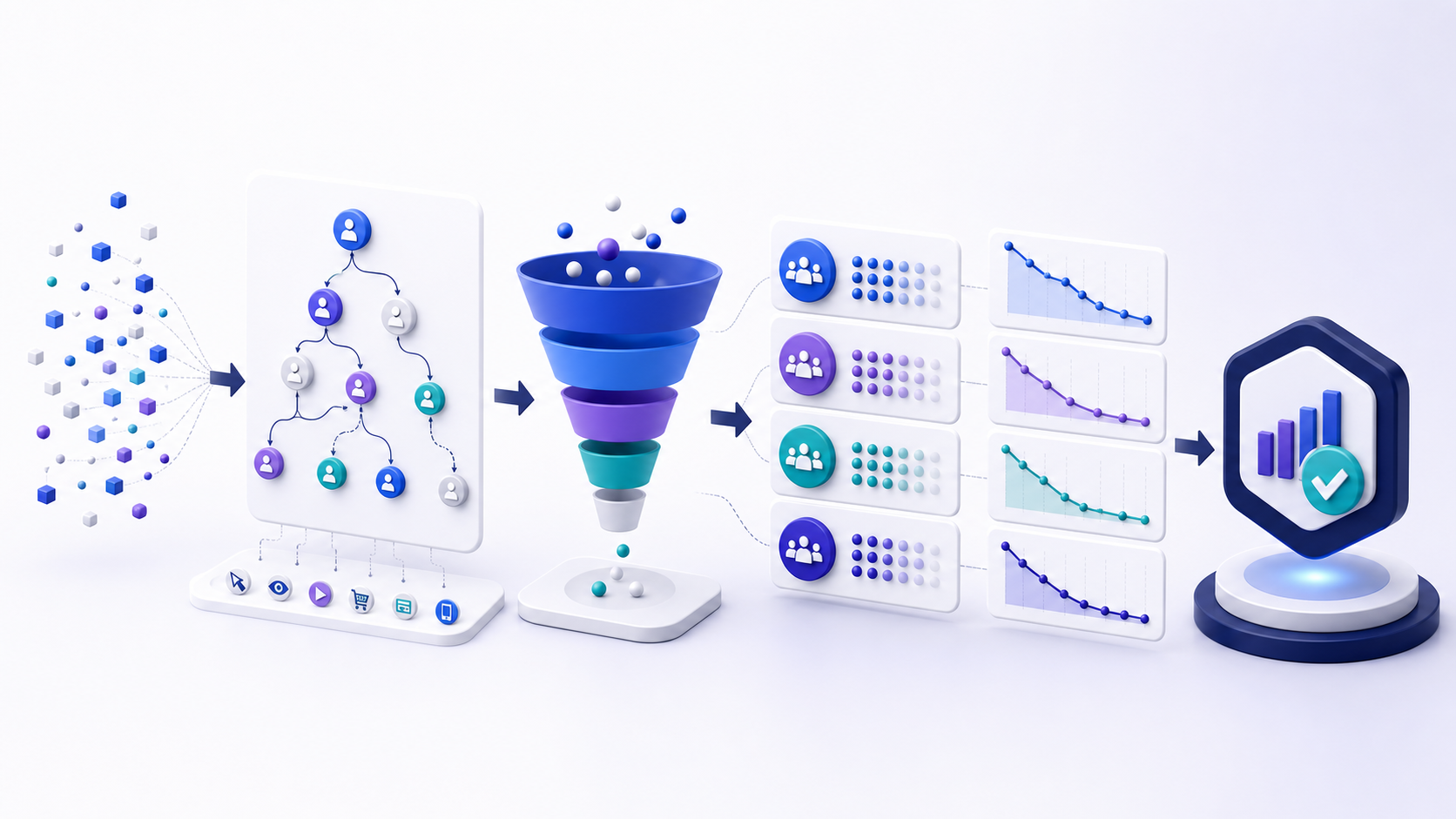
What is behavioral analytics?什么是行为分析?
Behavioral analytics is the systematic analysis of timestamped actions and their context to understand how people use a digital product, where journeys differ or stop, and which patterns deserve a product decision or further test. It usually organizes event data by user, account, session, sequence, and cohort rather than stopping at aggregate page views.
行为分析是对带时间戳的动作及其上下文进行系统分析,用来理解人们如何使用数字产品、旅程在哪些位置分化或停止,以及哪些模式值得采取产品决策或继续检验。它通常按用户、账户、会话、序列和同期群组织事件数据,而不是停留在汇总页面浏览量。
The useful output is not merely a dashboard. It is a traceable statement such as: “New accounts that complete the setup checklist within their first session return more often in week one.” That statement must still be checked for instrumentation errors, selection effects, release differences, and other competing explanations before a team treats it as evidence for a change.
有用的输出不只是仪表板,而应是可追踪的陈述,例如:“首次会话完成设置清单的新账户在第一周更常返回。”在团队把它作为改版依据前,仍要检查埋点错误、选择效应、版本差异和其他竞争解释。
When behavioral analytics is useful—and when it is not enough行为分析何时有用,何时还不够
Diagnosing funnel drop-off, comparing paths, measuring onboarding and feature adoption, building behavioral segments, tracking retention, and finding groups for qualitative follow-up.
诊断漏斗流失、比较路径、衡量引导与功能采用、建立行为分群、跟踪留存,以及寻找需要定性访谈的用户群。
Explaining motivation, proving causality, evaluating experiences that were never instrumented, or making individual-level decisions where privacy, fairness, or legal safeguards require more evidence.
解释动机、证明因果、评估从未埋点的体验,或在隐私、公平与法律要求更高时对个人作出决定。
Behavioral analytics is useful when totals such as monthly active users no longer explain what changed. Growth teams need to know which sequences precede activation. Analysts need a reproducible way to join events, users, accounts, experiments, releases, and outcomes. Behavioral analytics supports those tasks because it keeps order and context. Surveys, interviews, usability tests, and support conversations add the “why” that event logs cannot observe.
当月活等总量指标无法解释变化时,行为分析可以补充动作顺序与上下文;增长团队可以识别激活前的关键序列,分析师也能以可复现方式连接事件、用户、账户、实验、版本和结果。调查、访谈、可用性测试和客服对话则补充事件日志无法观察的“为什么”。
Scope boundary: this guide covers product and customer behavior in websites, apps, and connected digital services. Cybersecurity user and entity behavior analytics (UEBA) uses related sequence and anomaly methods to detect risk, but it has a different purpose, governance model, and decision threshold.
范围边界:本指南讨论网站、应用和互联数字服务中的产品与客户行为。网络安全中的用户与实体行为分析(UEBA)也会使用序列和异常方法,但目的、治理模型与决策阈值不同。
Behavioral data model and preparation checklist行为数据模型与准备清单
A workable event record needs an event name, timestamp, pseudonymous actor or account identifier, source, and only the properties required to interpret the action. A purchase might include order value and currency; a search event might include result count but not raw sensitive text. User and account tables add stable attributes. Release, experiment, consent, and device context should be joined only when the analytical question requires them.
可用事件记录需要事件名称、时间戳、化名化的用户或账户标识、来源,以及解释动作所必需的属性。购买事件可以包含订单金额和币种;搜索事件可以包含结果数量,但不应默认保留敏感原始文本。用户与账户表提供稳定属性;版本、实验、同意状态和设备上下文只在问题需要时连接。
- Define the decision first: write what could change, who owns it, the outcome, and the time window.先定义决策:写明可能改变什么、负责人、结果指标和时间窗口。
- Use a versioned tracking plan: give events stable names, ownership, trigger rules, property types, and sample payloads.使用版本化跟踪计划:为事件定义稳定名称、负责人、触发规则、属性类型和示例载荷。
- Resolve identity deliberately: document anonymous-to-authenticated linking, account membership, bot removal, timezone, and late-arriving events.有意识地处理身份:记录匿名到登录身份的关联、账户成员关系、机器人过滤、时区和迟到事件。
- Validate collection: compare client and server counts, inspect duplicates, impossible order, null IDs, schema drift, and release-specific gaps.验证采集:比较客户端与服务端计数,检查重复、顺序不可能、空 ID、Schema 漂移和特定版本缺口。
- Minimize data: collect only what has a defined purpose, retention period, access policy, and lawful basis.最小化数据:只采集具有明确目的、保留期限、访问策略和合法依据的数据。
Google’s official Analytics documentation distinguishes events from event parameters: events capture an interaction, while parameters add context used by dimensions and metrics. That distinction is a useful general modeling principle even when data is stored in another event platform or warehouse.
Google Analytics 官方文档区分事件与事件参数:事件捕获一次交互,参数提供维度和指标所需的上下文。即使数据存储在其他事件平台或数据仓库中,这仍是通用且实用的建模原则。
A repeatable behavioral analytics workflow可重复执行的行为分析流程
- Frame a falsifiable question. Replace “explore engagement” with “Did first-week activation fall after release 4.2, for which acquisition cohorts, and at which required step?” Define population, window, comparison, outcome, and acceptable uncertainty.提出可证伪问题。把“探索参与度”改成“4.2 版本后首周激活是否下降、影响哪些获客同期群、发生在哪个必需步骤?”定义总体、窗口、比较、结果和可接受不确定性。
- Audit the denominator and event quality. Decide whether the unit is people, accounts, devices, sessions, or opportunities. Inspect missing and duplicate events, timestamp order, identity merges, bot traffic, and exposure eligibility before calculating a rate.审计分母与事件质量。确定单位是用户、账户、设备、会话还是机会。计算比率前检查缺失与重复事件、时间顺序、身份合并、机器人流量和曝光资格。
- Build a baseline view. Plot the outcome over time and segment by release, platform, acquisition source, geography where appropriate, plan, and account age. Mark deployments and tracking changes so a data discontinuity is not mistaken for behavior.建立基线视图。绘制结果随时间变化,并按版本、平台、适用时的获客来源与地区、方案和账户年龄分层。标记部署与埋点变更,避免把数据断点误认为行为变化。
- Choose the method that matches the question. Use paths for sequence discovery, funnels for defined ordered steps, cohorts for comparable start conditions, retention for repeated value, and behavioral segments for meaningful action patterns.选择与问题匹配的方法。用路径分析发现序列,用漏斗分析既定有序步骤,用同期群建立可比起点,用留存分析重复价值,用行为分群描述有意义的动作模式。
- Compare and stress-test. Change the time window, identity rule, attribution rule, and segment threshold. Look for Simpson’s paradox, small samples, seasonality, novelty, survivorship, and changes in who was eligible to perform the behavior.比较并进行稳健性检验。改变时间窗口、身份规则、归因规则和分群阈值;检查辛普森悖论、小样本、季节性、新奇效应、幸存者偏差和有资格执行动作的人群变化。
- Turn the pattern into a testable decision. State the observation, inference, alternatives, decision, expected effect, guardrail metrics, and follow-up date separately. Use an experiment or staged rollout when causal confidence matters.把模式转成可检验决策。分别记录观察、推断、替代解释、决策、预期影响、护栏指标和复核日期。需要因果置信度时,采用实验或分阶段发布。
Behavioral analytics methods: paths, funnels, cohorts, and retention行为分析方法:路径、漏斗、同期群与留存
| Method方法 | Best question最适合的问题 | Required choices必须明确的选择 | Common failure常见失败 |
|---|---|---|---|
| Path analysis路径分析 | What sequences occur before or after a key action?关键动作前后出现哪些序列? | Start/end point, sessionization, repeated events, path depth起终点、会话划分、重复事件、路径深度 | A noisy “spaghetti” diagram with no decision boundary没有决策边界的杂乱路径图 |
| Funnel analysis漏斗分析 | Where does a defined process lose eligible users?既定流程在哪一步流失合格用户? | Step order, conversion window, exclusion, re-entry步骤顺序、转化窗口、排除、重新进入 | Treating optional or out-of-order journeys as failure把可选或非线性旅程当成失败 |
| Cohort analysis同期群分析 | Do groups with a shared start or behavior differ later?共享起点或行为的群体后来是否不同? | Cohort event, calendar granularity, maturity, comparison分群事件、日历粒度、成熟期、比较基准 | Comparing incomplete recent cohorts with mature cohorts把尚未成熟的新同期群与成熟群比较 |
| Retention analysis留存分析 | Do users return to receive value, and at what cadence?用户是否按适当节奏回来获得价值? | Return event, interval, N-day vs unbounded, denominator回访事件、间隔、N 日或无界定义、分母 | Counting any activity instead of meaningful value把任意活动当成有意义价值 |
| Behavioral segmentation行为分群 | Which action patterns define useful groups?哪些动作模式构成有用群体? | Rule, window, recency, minimum evidence, stability规则、窗口、近因、最小证据、稳定性 | Creating descriptive labels that do not change a decision创建无法改变决策的描述性标签 |
These methods are complementary. A path view can reveal an unexpected loop; a funnel can quantify loss at the relevant steps; cohorts can show whether the pattern is concentrated in one release; retention can test whether the behavior is associated with repeated value. Keep each intermediate population count so another analyst can reproduce the denominator. The tool comparison for mobile replay, funnels, attribution, and crashes is the mobile app experience analytics tools comparison.
这些方法可以组合。路径视图发现意外循环,漏斗量化相关步骤的流失,同期群判断问题是否集中于某个版本,留存分析检验该行为是否与重复价值相关。应保留每个中间人群计数,让其他分析师能够复现分母。
Behavioral analytics example: onboarding activation行为分析示例:新用户引导激活
Hypothetical example: a collaborative planning product defines activation as creating a workspace, inviting one teammate, and completing a shared plan within seven days. The team observes that only 31% of eligible new accounts activate after a release, compared with 38% in the previous four mature weekly cohorts. These figures are illustrative, not InfiniSynapse customer data or a benchmark.
假设示例:某协作规划产品把激活定义为七天内创建工作区、邀请一位队友并完成一份共享计划。团队观察到版本发布后只有 31% 的合格新账户激活,而此前四个已成熟周同期群为 38%。这些数字仅用于示例,不是 InfiniSynapse 客户数据或行业基准。
The audit finds no change in account creation, but the `invite_sent` event is missing on one mobile release. Server-side invitation records confirm that invitations still occurred, so the apparent drop at that step is partly measurement loss. After reconstructing the event from verified server records, activation is 35%. A remaining decline is concentrated among accounts that encounter a permission error before creating the shared plan.
审计发现账户创建没有变化,但某个移动端版本缺少 `invite_sent` 事件。服务端邀请记录确认邀请仍在发生,因此该步骤的表面下降部分来自测量缺失。用已验证的服务端记录重建事件后,激活率为 35%;剩余下降集中在创建共享计划前遇到权限错误的账户。
The team records three separate statements. Observation: the permission-error segment has lower seven-day activation. Inference: the error may block completion. Decision: fix the permission path, restore the client event, and run a staged release with activation, error rate, support contacts, and invitation delivery as guardrails. The analysis did not prove user motivation and did not claim the repaired event alone would improve activation.
团队分别记录三类陈述。观察:权限错误分群的七日激活更低。推断:错误可能阻止完成任务。决策:修复权限路径、恢复客户端事件,并分阶段发布,同时监控激活、错误率、客服联系和邀请送达等护栏指标。分析没有证明用户动机,也没有声称仅修复埋点就会改善激活。
How to avoid misleading behavioral insights如何避免误导性的行为洞察
- Correlation is not a mechanism. Successful users may adopt a feature because they were already more motivated, experienced, or better supported.相关性不是机制。成功用户采用某功能,可能因为他们原本就更有动机、更熟练或获得了更多支持。
- The product shapes the data. Navigation, defaults, availability, permissions, and tracking determine which behavior is possible and observable.产品塑造数据。导航、默认值、可用性、权限和埋点共同决定哪些行为可能发生且可被观察。
- Identity errors change sequences. Shared devices can merge people; cleared cookies can split one person; account analysis can hide differences between members.身份错误会改变序列。共享设备可能合并多人,清除 Cookie 可能拆分同一用户,账户级分析可能掩盖成员差异。
- Segments can become unstable. A threshold chosen after viewing the outcome may overfit. Test whether the segment remains useful in later cohorts.分群可能不稳定。查看结果后才选择的阈值可能过拟合,应检验该分群在后续同期群中是否仍然有用。
- Privacy is a design constraint. Pseudonymous data can still be sensitive. Limit purpose, collection, retention, joins, exports, and access; obtain appropriate legal and privacy review for the markets and data involved.隐私是设计约束。化名数据仍可能敏感。应限制目的、采集、保留、连接、导出和访问,并针对具体市场与数据获得适当的法律和隐私审查。
Do not use behavioral data as a substitute for consent or as an unrestricted profile of an individual. Aggregation, minimum cohort sizes, role-based access, audit logs, deletion processes, and documented retention can reduce—but not eliminate—risk. Requirements vary by jurisdiction and implementation, so this page is not legal advice.
不要把行为数据当作同意的替代品,也不要建立不受限制的个人画像。汇总、最小同期群规模、基于角色的访问、审计日志、删除流程和明确保留期可以降低但不能消除风险。具体要求因司法辖区和实现方式而异,本页不构成法律建议。
Behavioral analytics validation checklist行为分析结果验证清单
| Layer层级 | Validation question验证问题 | Evidence to retain应保留的证据 |
|---|---|---|
| Collection采集 | Did the event fire once, with the expected schema and timestamp?事件是否按预期 Schema 和时间戳只触发一次? | Tracking-plan version, sample payload, QA record跟踪计划版本、示例载荷、QA 记录 |
| Population总体 | Who was eligible, included, excluded, and mature?谁有资格、被纳入、被排除并已成熟? | Query, counts at each filter, cohort window查询、每次筛选计数、同期群窗口 |
| Robustness稳健性 | Does the pattern survive reasonable definitions and windows?模式能否经受合理定义与窗口变化? | Sensitivity table, uncertainty, alternative specifications敏感性表、不确定性、替代设定 |
| Interpretation解释 | What was observed, inferred, assumed, and not measured?哪些是观察、推断、假设和未测量内容? | Decision note and competing explanations决策记录与竞争解释 |
| Outcome结果 | Did the change affect the target without harming guardrails?改动是否改善目标且未损害护栏指标? | Experiment or rollout design, effect, follow-up date实验或发布设计、效果、复核日期 |
Re-run the analysis from a saved query or notebook, reconcile headline counts to a source system, and ask a second reviewer to challenge the population and identity rules. If the result changes materially under a defensible alternative definition, report the range rather than selecting the most persuasive number.
应从保存的查询或 Notebook 重新运行分析,把核心计数与源系统对账,并请第二位审核者挑战总体和身份规则。如果在合理替代定义下结果发生实质变化,应报告范围,而不是挑选最有说服力的数字。
Analyze behavioral event data with InfiniSynapse使用 InfiniSynapse 分析行为事件数据
Prepare a database or warehouse connection, documented event and identity fields, a clear population, outcome, and time window. InfiniSynapse is an AI-powered data analysis tool that can work across connected databases and files; use it to explore event data and produce analysis with tables, charts, and explanations. Review generated queries, source coverage, denominators, and assumptions before acting. It is not a tracking SDK, consent manager, experimentation platform, or automatic proof of causality.
请先准备数据库或数据仓库连接、已记录的事件与身份字段、明确的分析总体、结果和时间窗口。InfiniSynapse 是 AI 辅助数据分析工具,可连接数据库和文件;你可以用它探索事件数据并生成表格、图表和解释。采取行动前,应复核生成的查询、来源覆盖、分母和假设。它不是埋点 SDK、同意管理器、实验平台,也不会自动证明因果。
Open the InfiniSynapse online data analyst打开 InfiniSynapse 在线数据分析工具Best practices and next steps最佳实践与下一步
- Maintain a small governed event vocabulary before adding more properties or derived metrics.在增加更多属性或派生指标前,先维护精简且受治理的事件词表。
- Pair every behavioral metric with a definition, owner, query, expected cadence, and failure mode.为每个行为指标配套定义、负责人、查询、预期频率和失败模式。
- Use qualitative research to explain surprising paths and experiments to test causal product changes.用定性研究解释意外路径,用实验检验具有因果要求的产品改动。
- When an agency readout needs ordered event evidence, start from clickstream evidence for an agency readout.机构读出需要有序事件证据时,从机构读出所用的点击流证据写起。
- Review the related InfiniSynapse guide for AI-assisted data analysis for product managers and the guide to data quality management.继续阅读 InfiniSynapse 的产品经理 AI 辅助数据分析指南与数据质量管理指南。
The practical next step is to choose one decision, one population, and one outcome, then audit the event chain required to answer it. A smaller trustworthy analysis is more useful than a large behavioral dashboard whose identities, denominators, and collection gaps remain unknown.
实际下一步是选择一个决策、一个总体和一个结果,然后审计回答该问题所需的事件链。一个规模较小但可信的分析,通常比身份、分母和采集缺口都不明确的大型行为仪表板更有价值。
Frequently asked questions about behavioral analytics行为分析常见问题
What is behavioral analytics?什么是行为分析?
Behavioral analytics is the systematic analysis of timestamped actions and their context to understand how people use a digital product, where journeys differ or stop, and which patterns merit a product decision or further test.
行为分析是对带时间戳的动作及其上下文进行系统分析,用来理解人们如何使用数字产品、旅程在哪里分化或停止,以及哪些模式值得产品决策或继续检验。
What data do you need for behavioral analytics?行为分析需要哪些数据?
Start with stable event names, timestamps, pseudonymous user or account identifiers, relevant event and user properties, and a documented definition of the outcome. Consent status, identity rules, release versions, and data-quality checks are also important.
从稳定事件名称、时间戳、化名化用户或账户标识、相关事件与用户属性,以及已记录的结果定义开始。同意状态、身份规则、版本和数据质量检查同样重要。
How is behavioral analytics different from web analytics?行为分析与 Web Analytics 有何不同?
Web analytics often summarizes traffic, channels, and page performance. Behavioral analytics follows actions and sequences at user, account, or cohort level across a product, while still requiring appropriate privacy controls.
Web Analytics 通常汇总流量、渠道和页面表现;行为分析则跨产品在用户、账户或同期群层面跟踪动作与序列,同时仍需适当的隐私控制。
Does behavioral analytics prove why users act?行为分析能证明用户为什么行动吗?
No. Event data records what happened, and observational patterns can support hypotheses, but they do not reveal motivation or prove causality by themselves. Combine them with qualitative research and controlled experiments when the decision requires a causal claim.
不能。事件数据记录发生了什么,观察模式可以支持假设,但不能单独揭示动机或证明因果。决策需要因果结论时,应结合定性研究与受控实验。
Is behavioral analytics the same as UEBA in cybersecurity?行为分析与网络安全 UEBA 相同吗?
No. Product behavioral analytics studies customer or user interaction to improve journeys and outcomes. User and entity behavior analytics in cybersecurity models activity to detect risk or anomalies. They may share event and sequence methods, but their purpose, controls, and decisions differ.
不同。产品行为分析研究客户或用户交互,以改进旅程和结果;网络安全中的用户与实体行为分析对活动建模,以发现风险或异常。两者可能共享事件与序列方法,但目的、控制和决策不同。
Authoritative sources and evidence notes权威来源与证据说明
The event and event-parameter model was checked against the Google Analytics definition of an event and Google Analytics guidance on event parameters. Privacy cautions were checked against the UK Information Commissioner’s Office guidance on cookies and similar technologies. These sources support collection and privacy principles; the workflow, comparison table, and hypothetical example are editorial synthesis.
事件与事件参数模型核对了 Google Analytics 对事件的定义和 Google Analytics 事件参数指南;隐私注意事项核对了英国信息专员办公室关于 Cookie 与类似技术的指南。这些来源支持采集和隐私原则;工作流、比较表和假设示例属于编辑整理与推演。